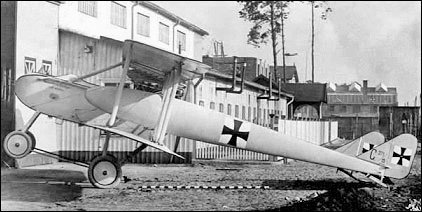
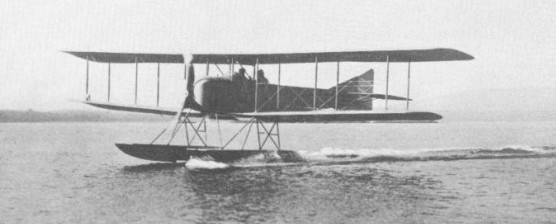
Airco DH 3         

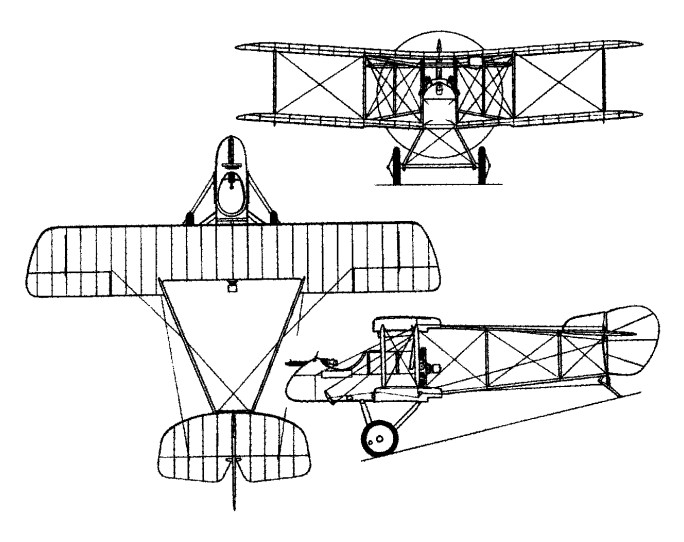
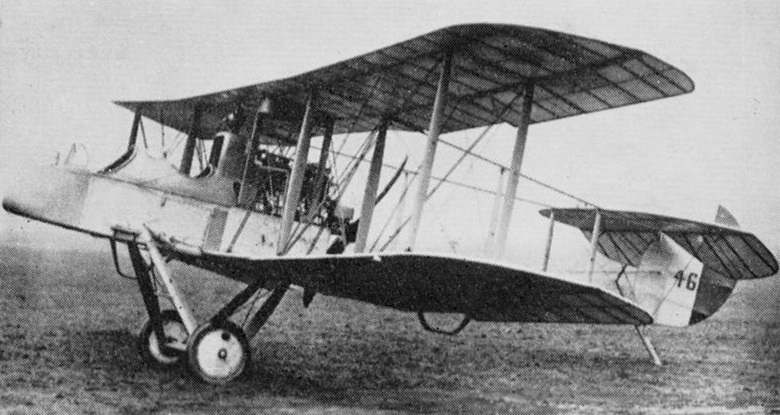
Under the designation Airco D.H.3, Geoffrey de Havilland designed a large two-bay biplane that was intended to fulfil a bombing role. With folding wings in order to save hangar space, and a conventional tailskid landing gear complemented by two wheels beneath the fuselage nose, extending well forward of the main wheels, to prevent it from bumping on the ground. Two Beardmore engines were mounted between the wings, directly above the main landing gear, and each drove a pusher propeller mounted on an extension shaft to clear the trailing edge of the wing. Accommodation was provided for a crew of three, the pilot in an open cockpit just forward of the wings, and the two gunners in individual cockpits, one in the nose forward of the pilot, and the other just aft of the wings.

A second prototype was built with more powerful Beardmore engines, each of 119 kW (160 hp), and with cutouts in the wing trailing edges in the area of the propellers so that the extended drive-shafts could be eliminated. This was designated D.H.3A, and almost immediately the War Office ordered 50. The order was later cancelled.

Neither of these aircraft was to enter production and both were reportedly scrapped within 12 months without seeing service use.

The DH 3 was also built under licence by Häfeli; some being operated as a single passernger airliner circa 1919.

Engine: 2 x Beardmore inline piston, 89-kW /120-hp
Maximum speed at sea level: 153 km/h / 95 mph
Climb to 1980m / 6,500ft: 23 minutes 30 seconds
Endurance: 8 hours
Cruise: 75 mph
Empty weight: 1805 kg / 3,980 lb
Maximum take-off weight: 2635 kg / 5,810 lb
Wing span: 18.54m / 60ft l0in
Length: 11.23m / 36ft l0in
Height: 4.42m / l4ft 6in
Wing area: 73.67m / 793 sq.ft
Armament: 2 x flexible 7.7-mm (0.303-in) Lewis guns, plus bomb load

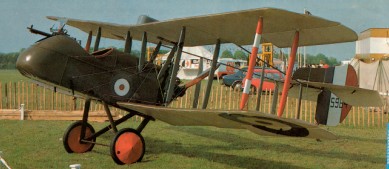
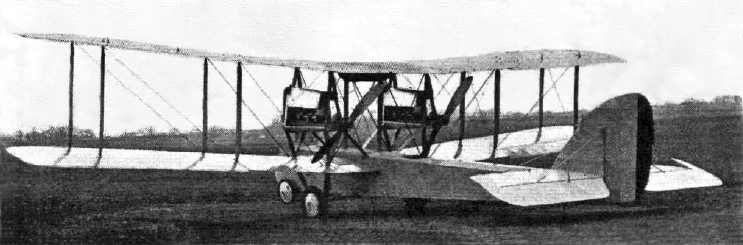
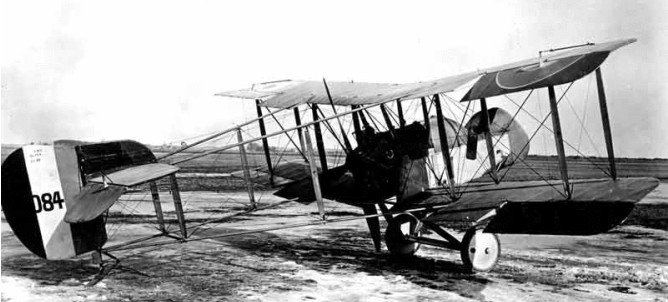
Airco DH 2

A conventional two ¬bay biplane of pusher configuration, the fuselage was curved along the front and top surfaces with slab sides and a flat underside – and held the armament, pilot, controls, fuel and engine. The pilot sat in an open-air cockpit “tub”. A single machine gun was fitted to the front of the fuselage. Fuel was held directly aft of the pilot in one tank, and ahead of the engine, the latter mounted to the extreme end of the fuselage rear with a two-blade wooden propeller. Wings were in a two-bay with parallel struts additionally held by cabling. Both upper and lower wings sported slight dihedral. The empennage tapered off to become a single vertical tail fin with a high-mounted horizontal plane affixed. The undercarriage was fixed in place and featured two large main landing gear wheels attached to the fuselage underside. The rear of the aircraft was supported by a simple tail skid.

Armament consisted of a single semi-trainable .303 Lewis type machine gun fed by a 47-round drum magazine. The machine gun could be mounted within three pre-set positions, allowing the pilot to fix the weapon at advantageous angles of fire. This proved highly impractical once in action. These three pre-set positions became largely ignored as most pilots soon learned to fix the machine gun in place and aim the entire aircraft at the intended target instead. Major Lance Hawker produced a fixed clip and even revised the gunsight for improved accuracy by allowing for leading of the target. Once enacted, the new clip and gunsight – along with the fixed machine gun – lessened the pilot’s workload substantially.

The prototype first flying in 1915, it began powered by a 100 hp Gnome Monosoupape engine. After trials in Britain, the prototype was issued to No 5 squadron RFC in France for further testing by July of 1915, but was destroyed following enemy action on August 9, 1915.

The D.H.2 was considered worthy of series production and initial deliveries began in late 1915 to No 24 Squadron, which was sent to France in February 1916 with 12 D.H.2s as the first ever British squadron to be equipped with single seat fighters.

With its small speed range and sensitive controls the D.H.2 caused some handling problems for pilots initially, but it was accepted as a highly manoeuvrable little fighter.

Modifications were made to the nose of the nacelle; the ammunition was carried in drums on external racks on each side of the cockpit; and the revised fuel system comprised a gravity tank fitted either under or on top of the upper mainplane on the port side. Production models retained the Gnome engine, as comparative trials with a 110 hp Le Rhone 9J powerplant revealed that this gave an inferior performance.

At least one DH.2 fell to German guns, but within time, she formed the ranks of No. 24 Squadron who first netted an aerial victory with a DH.2 on April 2nd, 1916. The DH.2 essentially became the Royal Flying Corps (RFC) first “true” dedicated fighter platform.

The first Imperial German Monoplane was downed by a DH.2 on April 25th, 1916. In June alone, DH.2 pilots racked up a further 17 enemy aircraft. A further 15 were counted in August and another 15 were netted in September. Ten more enemy aircraft were tallied in November.

Along the Western Front, the DH.2 had met her match by the new breed of German and Austro-Hungarian fighter by December 1916. On December 20th, 1916, five out of six DH.2s were lost in one aerial fight against just five Albatros D.III series fighters. Phasing out of the D.H.2 began in France in March 1917, though D.H.2s serving in Palestine with No 11 Squadron, and with No 47 Squadron and a joint RFC/RNAS squadron in Macedonia, had a slightly longer service life. Two were evaluated at Home Defence stations in Britain in 1917 but were unable to cope with the Zeppelin raiders.

No fewer than 100 DH.2s were retained on the British mainland to help train a new generation of fighter pilot, where they served until 1918. By the fall of 1918, the DH.2 was officially retired from any active service with the RFC.

The RFC remained the sole operator of the DH.2. She served within squadrons No.5, No.11, No.17, No.18, No.24, No.29, No.32, No.41, No.47 and No.111.

In total 453 D.H.2 were built.

Replica:
Mason DH 2

Airco DH.2
Engine: 1 x Gnome Monosoupape, 100hp
Wing span: 8.61 m / 28 ft 3 in
Length: 7.68m / 25 ft 2½ in
Height: 2.91 m / 9 ft 6½ in
Wing area: 23.13 sq.m / 249 sq.ft
Empty weight: 423 kg / 943 1b
Loaded weight: 654 kg / 1,441 lb
Fuel capacity: 26.3 gallon
Maximum level speed at sea level: 150 km/h / 93 mph / 81 kt
Maximum Range: 249 miles / 400km
Endurance: 2 hours 45 minutes
Rate-of-Climb: 545ft/min / 166m/min
Climb to 1830m /6,000ft: 11 minutes
Service Ceiling: 14,000 ft / 4270 m
Armament: 1 x 7.62mm forward-firing Lewis machine gun on flexible mount.
Crew: 1
Airco DH.2
Engine: 1 x Le Rhone 9J, 110 hp
Wing span: 8.61 m / 28 ft 3 in
Length: 7.68m / 25 ft 2½ in
Height: 2.91 m / 9 ft 6½ in
Wing area: 23.13 sq.m / 249 sq.ft
Empty weight: 455 kg / 1004 1b
Loaded weight: 702 kg / 1547 lb
Maximum level speed at sea level: 143 km/h / 92 mph
Maximum Range: 249 miles / 400km
Endurance: 2 hours 45 minutes
Rate-of-Climb: 545ft/min / 166m/min
Climb to 1830m /6,000ft: 11 minutes
Service Ceiling: 14,000 ft / 4270 m
Armament: 1 x 7.62mm forward-firing Lewis machine gun on flexible mount.
Crew: 1
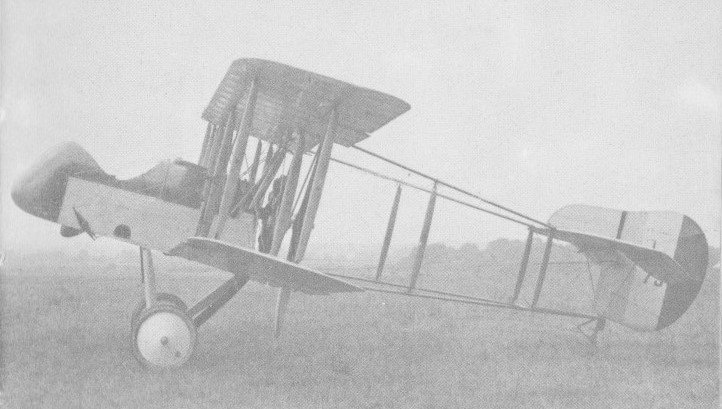
Airco DH.2
Engine: 1 x Clerget 9Z, 110 hp
Wing span: 8.61 m / 28 ft 3 in
Length: 7.68m / 25 ft 2½ in
Height: 2.91 m / 9 ft 6½ in
Wing area: 23.13 sq.m / 249 sq.ft
Empty weight: 428 kg / 943 1b
Maximum take-off weight: 654 kg / 1,441lb
Maximum level speed at sea level: 150 km/h / 93 mph / 81 kt
Maximum Range: 249 miles / 400km
Endurance: 2 hours 45 minutes
Rate-of-Climb: 545ft/min / 166m/min
Climb to 1830m /6,000ft: 11 minutes
Service Ceiling: 14,000 ft / 4270 m
Armament: 1 x 7.62mm forward-firing Lewis machine gun on flexible mount.
Crew: 1

Airco DH 1

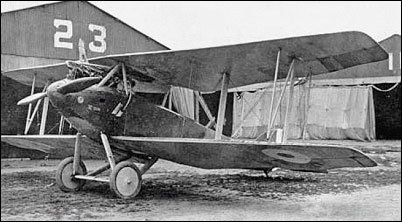
Geoffrey de Havilland was hired by the Airco firm in June of 1914 as lead designer and began developing the Airco “DH.1”. The DH.1 was a two-seat reconnaissance scout biplane fitted with a water-cooled inline engine in a “pusher” arrangement.

Geoffrey de Havilland piloted the prototype DH 1 fighter and reconnaissance aircraft on its first flight in early 1915. A two seat pusher biplane with the observer in the front cockpit, which also housed a forward firing machine gun, the DH 1 was powered by a 70 hp Renault engine, instead of the originally specified 120 hp Beardmore powerplant and the War Office ordered 49 examples. Appearing at the beginning of 1915, it was tested by Geoffrey de Havilland. Airco was fully committed to building Farman aircraft and employed a sub-contractor, Savages Ltd of Kings Lynn, but because of their inexperience, production of the DH.1 was delayed. An order for 100 was placed with Savages of Kings Lynn and production models differed from the prototype in having dual controls, a modified nacelle, reinforced brac¬ing wires and a simplified undercarriage.

Beardmore engines eventually became more plentiful and with this engine the type was designated DH.1A. With an all up weight increase of nearly 136 kg (300 lb), including a 10% additional fuel load, it was 13 km/h (8 mph) faster than the DH 1 and had a more rapid rate of climb.

At the end of 1915, the first five DH.1s off the production line had been alloated to training units. The remainder of the first batch were fitted with the 120 hp Beardmore and re-designated DH.1a.

Six DH.1a from the first batch saw service in the Middle East, and a further 44 were assigned to Home Defence units. No 14 Squadron had six DH1As which were operational in Palestine from the summer of 1916 on escort duty. The second batch of 49 was again built by Savages Ltd, but only 73 of the total number saw service with RFC units. Some survived in Britain until 1918, but all had been withdrawn from service before the Armis¬tice.

DH 1
Engine: Renault, 70hp
Span: 12.50 m / 41 ft 0 in
Length: 8.82 m / 28 ft 11.25 in
Height: 3.4 m / 11 ft 2 in
Empty weight: 615 kg / 1354 lb
Loaded weight: 927 kg / 2044 lb
Maximum speed: 132 km/h / 80 mph
Ceiling: 4114 m / 13,500 ft
Endurance: 4 hr

DH 1A
Engine: Beardmore, 120hp
Span: 12.50 m / 41 ft 0 in
Length: 8.82 m / 28 ft 11.25 in
Height: 3.4 m / 11 ft 2 in
Empty weight: 1610 lb / 730 kg
Loaded weight: 2340 lb / 1061 kg
Maximum speed: 144 km/h / 90 mph
Ceiling: 4114 m / 13,500 ft
Endurance: 4 hr

DH 1A
Engine: Austro-Daimler, 120hp
Span: 12.50 m / 41 ft 0 in
Length: 8.82 m / 28 ft 11.25 in
Height: 3.4 m / 11 ft 2 in
Empty weight: 1610 lb / 730 kg
Loaded weight: 2340 lb / 1061 kg
Maximum speed: 144 km/h / 90 mph
Ceiling: 4114 m / 13,500 ft
Endurance: 4 hr

Aircraft Manufacturing Company Ltd / Airco

In the summer of 1911 British businessman George Holt Thomas acqured the manufacturing rights from the Maurice and Henry Farman Aircraft Company to build their aircraft. At the same time he negotiated the rights to build the French Le Rhone and Gnome engines. Within nine months he had created the Aircraft Manufacturing Co Ltd, based at Hendon, London, and combined it with his two other companies, the Aeroplane Supply Company and Airships Ltd, with a capital of £14,700.

In the summer of 1912 a ‘Military Trials’ was held and the Aircraft Manufacturing Co submitted the Maurice Farman 70 hp biplane. The aircraft performed reasonably well but did not get a contract to build for the RFC. The company was awarded a £100 consolation prize.

For the next two years Holt Thomas acted just as an agent for the Farmans, and the company became “Airco”. Holt Thomas was approached by Geoffrey de Havilland with the suggestion that they build their own aircraft. Holt Thomas offered him a job as a designer and to establish the firm’s own design department at a salary of £600 plus commission on every aircraft sold.

Based at Hendon, London, the company made several types of military aircraft, generally known as D.H. rather than Airco. These were the D.H.1 and 1A two-seat pushers; D.H.3 and 3A twin-engined pushers; D.H.4 two-seat tractor (representing, as a fast day-bomber, one of the greatest aeronautical advances of the First World War); D.H.5 single-seat tractor with backward stagger; D.H.6 tractor trainer; D.H.9, an extensively developed D.H.4; D.H.9A, an even greater advance; D.H.10 and 10A, built in pusher and tractor forms (notably tractor); D.H.11 twin-engined bomber; and D.H.14 and 15 single-engined bombers.

Early civil transport types were the D.H.16 and D.H.18. Other companies controlled by Airco built flying-boats, air engines and airships. After the war Holt Thomas founded Air Transport and Travel Ltd.

The Aircraft Manufacturing Co. was sold in 1919 to the B.S.A.-Daimler group who, disappointed at the failure of air transport in 1919-20, shut the firm down. Almost immediately de Havilland and C.C.Walker, financed largely by Holt Thomas, out of money which he got by selling B.S.A. shares which he received in payment for the A.M.C. Ltd, started de Havilland Aircraft Co. Ltd. Airco name was temporarily revived January 1958 for production of D.H.121 jet transport.

On 1 January 1929 George Holt Thomas, founder of Aircraft Manufacturing Company Ltd, died.

Aichi Tokei Denki Kabushiki Kaisha

The Aichi Watch and Electric Machinery Co, Nagoya, Japan.
Aichi Tokei Denki Kabushiki Kaisha was established in 1899 as a manufacturer of electrical equipment and watches, but first built airplanes in 1920 and aero engines in 1927.
From 1920s essentially a supplier to the Japanese Navy, but built civil types also, including a mail plane for the Japan Air Transport Company. Aichi established a working relationship with Ernst Heinkel Flugzeugwerke in Germany. Wishing to contend in early 1931 for an Imperial Japanese navy requirement for a two-seat carrier-based dive-bomber, Aichi requested Heinkel to design and build an aircraft to meet the navy’s specification. Required for operation with float or wheel landing gear, the resulting Heinkel He 50 prototype flew in the summer of 1931 with twin floats. A second version, with wheel landing gear, was supplied to Aichi under the export designation He 66.
The aircraft DIA type of 1934 sank US gunboat Panay in 1937. Later D3A monoplane was perhaps the most famous of the company’s types, duplicating German interest in dive-bombers. Code-named “Val” by the Allies, this type attacked Pearl Harbor December 7,1941, and was also successful against British warships in the Indian Ocean. H9A1 twin-engined flying-boat was built in numbers; also notably E16A reconnaissance floatplane; B7A attack bomber; and the M6A catapultlaunched submarine-borne bomber, intended to attack such targets as the lock gates of the Panama Canal.

Costruzioni Aeronautiche Giovanni Agusta SpA.

The company was founded by Count Giovanni Agusta in 1923, who flew his first airplane in 1907 and several more were built before the First World War. The firm was revived in 1923, specialising in light aircraft. The MV Agusta motorcycle manufacturer began as an offshoot of the Agusta aviation company at the end of the Second World War as a means to save the jobs of employees of the Agusta firm.

In 1952 Agusta was granted a license to build Bell Model 47 helicopters, the first Agusta-built example flying in May 1954, and over 1,200 were built before production ended in mid-1970s. The company also produced Bell Iroquois models as Agusta-Bell 204B and 205, 212 and 206 JetRanger helicopters. In 1967, under Sikorsky license, production of SH-3D helicopters began, and in 1974 production of HH-3F (S-61R); production of final HH-3F Combat SAR version lasted into mid-1990s. Together with Elicotteri Meridionali, SIAI-Marchetti, and other Italian companies, Agusta became involved in production of the Boeing Vertol CH-47C Chinook. Other license-built helicopters include AB-412EP/Griffon/Maritime Patrol versions of the Bell 412EP and Griffon, AMD-500E version of the McDonnell Douglas MD 500E, and Agusta-Boeing 520N NOTAR helicopter.

The company also had ambitions to design and build its own helicopters. The Agusta A.101 and the Agusta A.106 can be considered the best of its earlier attempts. Others included the AB.102, A.103, A.104, and A.115. Agusta-designed helicopters include the twin-turboshaft A109 civil/military multipurpose type (flown August 1971), A 119 Koala single-turboshaft wide-body helicopter (first flown February 1995), and A129 Mangusta tandem two-seat attack helicopter (first flown September 1983) and its more-powerful International variant with five-blade main rotor as standard (first flown January 1995).

It also produced a small line of aero engines such as the GA.70 and GA.140.

Developed in the 1970s, the Agusta A109 has undoubtedly been the company’s biggest success. The A109 is a commercial and military twin turbine helicopter, of which the latest variants are still in production, hundreds having already been sold.

Agusta acquired 30% of SIAI-Marchetti in 1970, increased its stake to about 60% by 1973 and reached complete ownership in 1983.

In 1983 the Agusta A129 Mangusta anti-tank helicopter partook in its first official flight engagement. It was the first attack helicopter to be designed and produced in Western Europe. However, this helicopter has been a limited commercial success so far, seeing service with the Italian Army, and only now has a modernized variant being developed for the Turkish Army.

The 1980s saw the start of several collaborative projects for Agusta. In 1981 Agusta and Westland of Britain started the EH101 medium-lift naval helicopter project in order to satisfy the requirements of the Royal Navy and the Italian Navy. In 1985 the company started a collaborative programme with the aeronautic industries of Eurocopter Deutschland; Eurocopter, and Fokker in order to develop and produce the NHI NH90, a 9-ton twin engine multi-role medium helicopter in order to satisfy the requirements of their respective countries’ armed forces.

1990s projects include the Agusta A109 Power, an improved version of the A109 (1994) and the Agusta A119 Koala (1997), a single-engine design based on the A109.

Agusta became involved in a notorious Belgian bribery scandal when it was revealed that the company had paid the two Belgian socialist parties who were then (1988/1989) in the government to assist the company in getting the contract for attack helicopters for the Belgian army.

1995: 520 Via Giovanni Agusta, Cascina Costa di Samarate, Varese I-21017, Italy.

In 1998 Agusta formed a joint venture with Bell Helicopter Textron called the Bell/Agusta Aerospace Company. Its aim was to develop the Bell/Agusta AB139 helicopter and the Bell/Agusta BA609 tiltrotor aircraft. Bell later withdrew from the AB139 project, which is now known as the AgustaWestland AW139.

In July 2000 Finmeccanica and GKN plc agreed to merge their respective helicopter subsidiaries (Agusta and GKN-Westland Helicopters), forming AgustaWestland.

Ago C.IV

The C.IV was a two-seat reconnaissance aircraft, with a conventional cross-axle landing gear and tapered biplane wings. Powered by a 220hp Benz Bz.IV engine driving a two-blade propeller fitted with a spinner, armament was a forward-firing Spandau and a rear-mounted Parabellum machine-gun. About 70 production aircraft became operational from early 1917, although large orders had been placed with three manufacturers.

Ago C.I / C.II      

C.II

Designed by Swiss engineer A. Haefeli (earlier with Farman) the C.I and C.II series of twin-boom reconnaissance biplanes were each armed with one machine-gun in the nose. C.I and C.II land-planes had a four-wheel landing gear under the central two crew nacelle and a tailskid under each boom. Power was provided by a 160hp Mercedes D.III and 150hp Benz III or 220hp Benz Bz.IV pusher engine respectively.

C.Is and C.IIs became operational over the Western Front in the latter half of 1915. Serving just a short span, the C.II performed from 1915 on, replaced by more conventional and modernised types before the end of the war.

The similarly powered C.I-W (one built) and C.II-W (two built) twin-float seaplane versions were operated by the German Navy in a coastal reconnaissance and defence role.

Aerowerke Gustav Otto AGO C.II
Engine: 1 x Benz IV 6-cylinder liquid-cooled inline, 220hp.
Length: 32.28ft (9.84m)
Wingspan: 47.57ft (14.50m)
Height: 10.40ft (3.17m)
Empty Weight: 2,998lbs (1,360kg)
Maximum Take-Off Weight: 4,290lbs (1,946kg)
Maximum Speed: 80mph (128kmh; 69kts)
Maximum Range: 360miles (580km)
Service Ceiling: 14,764ft (4,500m)
Armament: 1 x 7.92 Parabellum machine gun
Accommodation: 2