Vickers FB.7

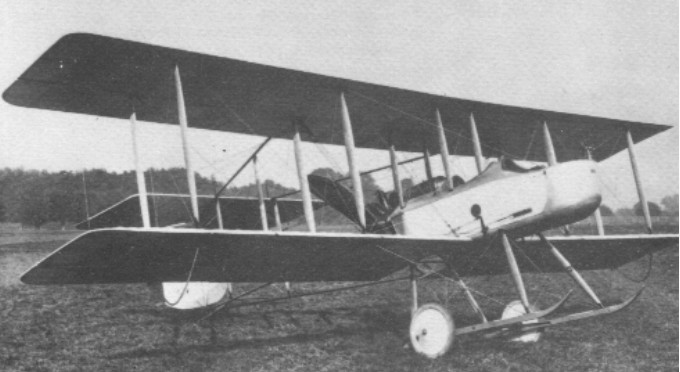
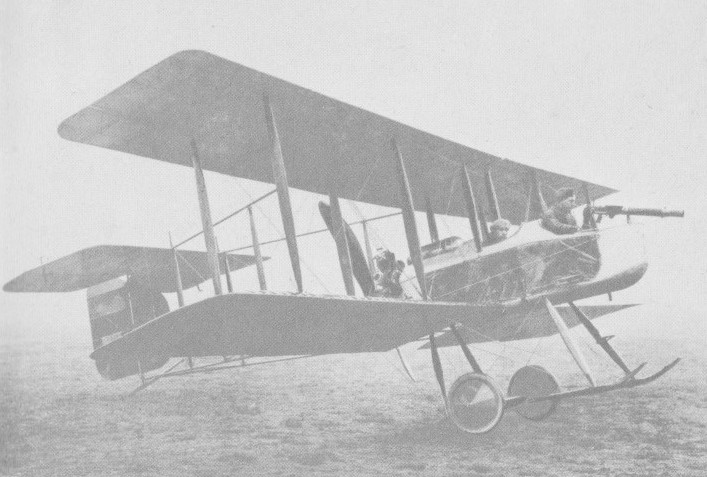
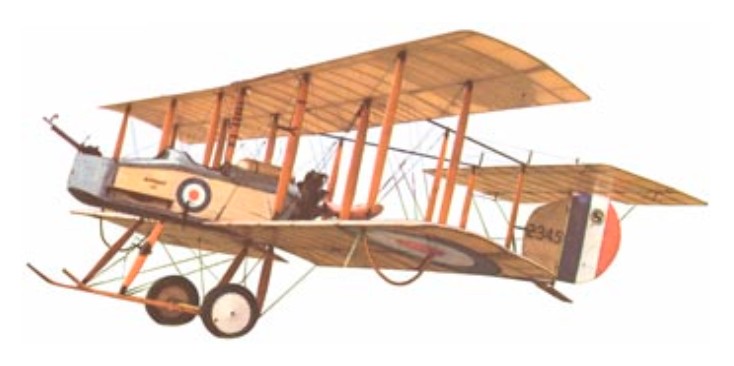
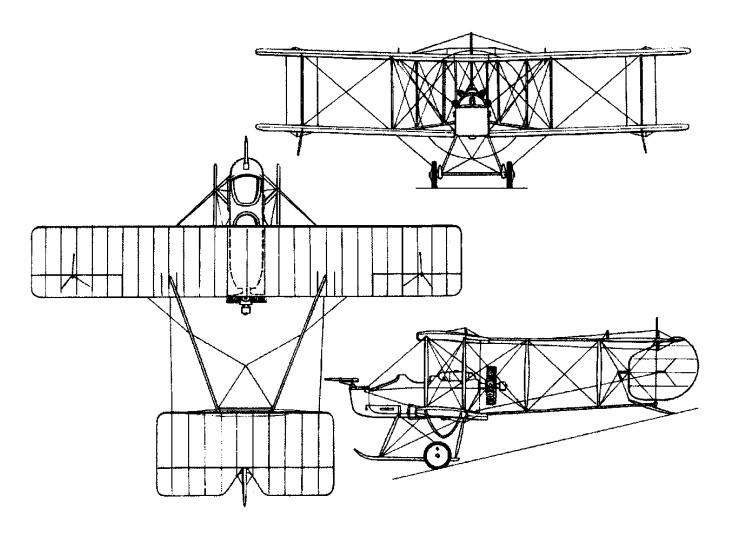
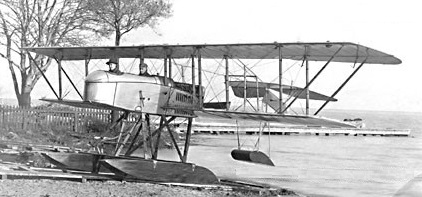
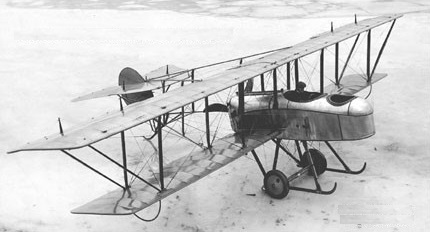
On the outbreak of World War I, Vickers engaged R L Howard-Flanders to design a twin-engined fighting aeroplane capable of carrying a Vickers one-pounder quick-firing gun with armour protection for the gunner. Powered by two 100hp Gnome Monosoupape nine-cylinder rotaries mounted overhung between the main-planes and suspended on simple steel-tube open framework, the prototype was designated E.F.B.7 and was flown for the first time in August 1915. An ungainly unequal-span biplane with two bays of struts, the E.F.B.7 accommodated the pilot aft of the mainplanes, several feet from the gunner in the extreme nose. The substantial gun mount was bolted to the centre of the forward cockpit floor, the gunner’s seat being attached to the mount with which it traversed – sufficient room was provided in the cockpit to permit gun and gunner to turn through a full 360 degrees.

The E.F.B.7 was one of the first twin-engined military aircraft to fly successfully, and an order for 12 production F.B.7s was placed on 20 August 1915, immediately after the initial flight tests of the E.F.B.7, but, in the event, the series model was to differ in a number of major respects. The distance separating the two-man crew was found unacceptable and the pilot was brought forward of the wings in sensible proximity to the gunner, the structure of the upper wing was completely redesigned and the fuselage was revised in cross section, becoming rectangular throughout rather than having an inverted triangular cross section aft. Owing to a shortage of Gnome rotaries, the first production aircraft was fitted with 80hp Renault eight-cylinder air-cooled engines as the F.B.7A, the engine change resulting in a major loss of performance. As the F.B.7A possessed no operational usefulness, Vickers persuaded the War Office to cancel the contract for the remaining aircraft (which were being built by A Darracq & Company at Fulham under subcontract).

Max take-off weight: 1450 kg / 3197 lb
Empty weight: 969 kg / 2136 lb
Wingspan: 18.17 m / 60 ft 7 in
Length: 10.97 m / 36 ft 0 in
Wing area: 59.46 sq.m / 640.02 sq ft
Max. speed: 121 km/h / 75 mph
Ceiling: 2745 m / 9000 ft

Vickers F.B.7

Vickers E.F.B.6

Progressive changes introduced by successive E.F.B.3s led to the E.F.B.5 – the E.F.B.4 being a project with a more streamlined nacelle centred between the wings and only two tailbooms – which was flown from Joyce Green to Brooklands on 17 July 1914. In parallel, Vickers developed the E.F.B.6, which, basically similar to the E.F.B.5, had longer-span upper wings. It lacked top decking between the two crew seats and had ailerons in the upper wings only. At Brooklands on 14 July 1914, the E.F.B.6 was taken on strength by the Royal Flying Corps when World War I began, but was not developed.

Vickers EFB-5 / FB.5 Gunbus / Vintage Aircraft & Flying Assoc. FB.5 Gunbus

Progressive changes introduced by successive E.F.B.3s led to the E.F.B.5 – the E.F.B.4 being a project with a more streamlined nacelle centred between the wings and only two tailbooms – which was flown from Joyce Green to Brooklands on 17 July 1914. In parallel, Vickers developed the E.F.B.6, which, basically similar to the E.F.B.5, had longer-span upper wings. It lacked top decking between the two crew seats and had ailerons in the upper wings only. At Brooklands on 14 July 1914, the E.F.B.6 was taken on strength by the Royal Flying Corps when World War I began, but was not developed.

No orders were received but Vickers felt certain that war was imminent and began building 50 F,B.5s. These were eventually taken over by the RFC, which put a total of 241 in service. The E.F.B.5 was ordered into production for both the RFC and the RNAS on 14 August 1914, the first series aircraft being completed in the following October. At this time, the aircraft became simply F.B. (Fighting Biplane) 5 and was dubbed Gunbus. The E.F.B.5 had retained the semi-circular tail-plane of the E.F.B.2 and early E.F.B.3, but the series F.B.5 had an enlarged tailplane of rectangular planform and a larger rudder. A Lewis gun on a more practical mount supplanted the similar-calibre Vickers in the nose and the standard power plant was the 100hp Gnome Monosoupape nine-cylinder rotary.

The true fighter squadron was born on the 14 February 1915 when No.11 Squadron was formed at Netheravon. Completely equipped with Vickers FB5 aircraft this was the first unit established purely with the intention of destroying other aircraft.

The first F.B.5 reached the Western Front early February 1915, and, on the following 25 July, the first squadron of any air service formed specifically for fighting duties and equipped throughout with a single aircraft type arrived in France, this being the RFC’s No 11 Sqn with F.B.5s.

The RNAS made little use of the F.B.5, and, after the delivery of four to that service, the large majority of subsequent deliveries went to the RFC, although the RNAS did receive two further F.B.5s which, ordered in May 1915, were fitted with the 150hp Smith Static radial engine, its large diameter propeller necessitating the raising of the fuselage nacelle several inches above the lower wing. Two hundred and forty-one F.B.5s were delivered to the RFC, of which 109 were sent to the British Expeditionary Force in France (60 in 1915 and 49 in 1916). Licence production of the F.B.5 was undertaken in France by the Societe Anonym Darracq (which built a total of 99 of these and the later F.B.9) between May 1915 and June 1916. Twelve were also built under licence in Denmark in 1917-18 by the Tojhusvasrksted. At least four F.B.5As were built with armour-plated fuselage nacelles and these were powered by 110hp Clerget 9Z nine-cylinder rotary engines and had oleo undercarriages. Suffering an unreliable engine and a marginal performance throughout its operational career, the F.B.5 was finally withdrawn from the Western Front in the autumn of 1916, being subsequently confined to RFC instructional units.

Built by members of the Vintage Aircraft Flying Association for eventual display at the RAF Museum, a Gunbus reproduction was powered by a Gnome 100 hp Mono rotary with original prop.

Vintage Aircraft Flying Association Gunbus reproduction

The Vintage Aircraft & Flying Assoc. FB.5 Gunbus was built in 1966 at Weybridge. Registered G-ATVP c/n VAFA.01, it first flew at Wisley on 14 June 1966. It was stored for a short while at Henlow but then went on display in the RAF Museum at Hendon.

Vintage Aircraft & Flying Assoc. FB.5 Gunbus at RAF Museum

Gallery

Engine One 100 hp Gnome Monosoupape
Length 27 ft 2 in (8.25m)
Wing span 36 ft 6 in (11.1m)
Height: 3.38 m / 11 ft 1 in
Wing area: 35.49 sq.m / 382.01 sq ft
Weight empty 1,220 lb (553 kg)
Max take-off weight: 930 kg / 2050 lb
Max speed: 70 mph (113 kph) at 5000 ft
Range: 402 km / 250 miles
Service ceiling: 9,000 ft (2,700 m) fully loaded
Endurance 4.5 hours
Seats: 2
Armament: One Lewis machine gun, plus small bombs

FB.5
Engine: Gnome Monosoupape, 100 hp
Wingspan: 36 ft 6 in
Wing area: 362 sq.ft
Length: 27 ft 2 in
Height: 11 ft 0 in
Empty weight: 1220 lb
Loaded weight: 2050 lb
Wing loading: 5.4 lb/sq.ft
Max speed: 60 mph at 5000 ft
Service ceiling: 9000 ft
Endurance: 4 hr
Rate of climb: 19 min to 6500 ft
Armament: 1 x Vickers mg
Crew: 2

Vickers F.B.5 Gunbus

Vickers (Aviation) Ltd / Vickers-Armstrong

Vickers was formed in Sheffield as a steel foundry by the miller Edward Vickers and his father-in-law George Naylor in 1828. Naylor was a partner in the foundry Naylor & Sanderson and Vickers’ brother William owned a steel rolling operation. Edward’s investments in the railway industry allowed him to gain control of the company, based at Millsands and known as Naylor Vickers and Company. It began life making steel castings and quickly became famous for casting church bells. In 1854 Vickers’ sons Thomas (a militia officer known familiarly as ‘Colonel Tom’) and Albert joined the business and their talents – Tom Vickers as a metallurgist and Albert as a team-builder and salesman – were key to its subsequent rapid development. “Its great architects,” the historian Clive Trebilcock writes, “Colonel T.E. (1833-1915) and Albert (1838-1919) Vickers… provided both inspired technical leadership… and equally astute commercial direction. Both men were autocrats by temperament, but neither shunned advice or avoided delegation; each, but particularly Albert, had a marked gift for the selection of talented subordinates.”

Vickers (Aviation) Ltd / Vickers-Armstrong Article

In 1863 the company moved to a new site in Sheffield on the River Don in Brightside.

The company went public in 1867 as Vickers, Sons & Company and gradually acquired more businesses, branching out into various sectors. In 1868 Vickers began to manufacture marine shafts, in 1872 they began casting marine propellers and in 1882 they set up a forging press. Vickers produced their first armour plate in 1888 and their first artillery piece in 1890.

Vickers bought out the Barrow-in-Furness shipbuilder The Barrow Shipbuilding Company in 1897, acquiring its subsidiary the Maxim Nordenfelt Guns and Ammunition Company. at the same time, to become Vickers, Sons & Maxim.

Ordnance and ammunition made during this period, including World War I, was stamped V.S.M.

The yard at Barrow became the “Naval Construction Yard”. With these acquisitions, Vickers could now produce a complete selection of products, from ships and marine fittings to armour plate and a whole suite of ordnance. In 1901 the Royal Navy’s first submarine, Holland 1, was launched at the Naval Construction Yard. In 1902 Vickers took a half share in the famous Clyde shipyard John Brown and Company.

Further diversification occurred in 1901 with the acquisition of a proposed business which was incorporated as The Wolseley Tool and Motor Car Company and in 1905 the goodwill and patent rights of the Siddeley car. In 1911 a controlling interest was acquired in Whitehead and Company, the torpedo manufacturers.

Vickers Airships Article

In 1911 the company name was changed to Vickers Ltd and expanded its operations into aircraft manufacture by the formation of Vickers Ltd (Aviation Department) on March 28, 1911, under Capt. H. F. Wood, and a Vickers School of Flying was opened at Brooklands, Surrey on 20 January 1912. Production rights for Esnault-Pelterie REP tractor monoplane obtained in 1911; several variants built before First World War.

In 1912 Vickers produced Type 18 Destroyer for Admiralty; pusher-engined gun-carrying fighter from which evolved, via successive E.F.B. (Experimental Fighting Biplane) prototypes, the F.B.5 and F.B.9 “Gunbus” fighters of First World War. Later front-gunned tractor-engined F.19 was less successful. During war also built RAF B.E.2 series, B.E.8, F.E.8, and S.E.5a and Sopwith 1 1/2-Strutters under license. Vickers Vimy of 1917 remained standard RAF bomber throughout 1920s: one used by Alcock and Brown for first non-stop Atlantic crossing by airplane on June 14/15 1919. Vimy Commercial was 11 -passenger airliner with enlarged fuselage; Vernon troop transport developed from this.

In 1919, the British Westinghouse electrical company was taken over as the Metropolitan Vickers Electrical Company; Metrovick. At the same time they came into Metropolitan’s railway interests.

Vimy and Vernon succeeded respectively by Virginia and Victoria in mid-1920s, followed by Pegasus engined development, the Valentia.

By the end of 1924 Armstrong’s was virtually bankrupt. The bank of England discreetly moved in, and eventually brought pressure to force a merger with Vickers, using the Sun Insurance Company as their front to guarantee the new company, now called Vickers Armstrong. It was a condition of the rescue that the new company would restrict themselves to ship building, heavy engineering, and predominantly armaments.

A reorganisation during 1926 led to the retention of the rolling stock group: Metropolitan Carriage wagon and Finance Company and The Metropolitan -Vickers Company and the disposal of: Vickers-Petters Limited, British Lighting and Ignition Company, the Plywood department at Crayford Creek, Canadian Vickers, William Beardmore and Co, and Wolseley Motors.

In 1927, Vickers merged with the Tyneside based engineering company Armstrong Whitworth, founded by W. G. Armstrong, to become Vickers-Armstrongs, Ltd. Armstrong Whitworth had developed along similar lines to Vickers, expanding into various military sectors and was notable for their artillery manufacture at Elswick and shipbuilding at a yard at High Walker on the River Tyne. Armstrongs shipbuilding interests became the “Naval Yard”, those of Vickers on the west coast the “Naval Construction Yard”. Armstrong Whitworth Aircraft was not absorbed by the new company.

In 1928 the Aviation Department became Vickers (Aviation) Ltd and four months later acquired Supermarine, which became the “Supermarine Aviation Works (Vickers) Ltd”. In 1938, both companies were re-organised as Vickers-Armstrongs (Aircraft) Ltd, although the former Supermarine and Vickers works continued to brand their products under their former names. Supermarine became Vicker-Supermarine in 1929. 1929 saw the merger of the acquired railway business with those of Cammell Laird to form Metropolitan Cammell Carriage and Wagon (MCCW); Metro Cammell.

Vickers’ own products continued in early 1930s with Vildebeest torpedo- bomber and Vincent general-purpose biplane. June 1935 saw first flight of Pegasus engined long-range Wellesley bomber, first RAF aircraft to use system of geodetic construction devised by Dr. B. N. (later Sir Barnes) Wallis, who remained head of research until early 1970s. Subcontract production included Armstrong Whitworth Siskin IIIAs (1929-1930), Hawker Harts (1932-1934) and Hart Trainers (1936). In March 1936 the prototype was flown of R. J. Mitchell’s supreme design, the Supermarine Spitfire; and in June 1936 prototype of Vickers Wellington twin-engined bomber.

Vickers’ main concern up to and during Second World War was production of Wellington bomber and Avro Lancaster; Wellington replaced at end of war and early postwar by its non-geodetic successor, the Warwick. In August 1946 came first flight of VC1 Viking, first postwar British transport to enter airline service. Subsequent products included four-jet Valiant (first British V-bomber); world’s first turboprop airliner to enter production/service, the Viscount; and in 1959 the four-turboprop Vanguard airliner.

In 1960 the aircraft interests were merged with those of the Bristol, English Electric Company and Hunting Aircraft to form the British Aircraft Corporation. This was owned by Vickers, English Electric and Bristol (holding 40%, 40% and 20% respectively). BAC in turn owned 70% of Hunting. The Supermarine operation was closed in 1963 and the Vickers name for aircraft was dropped in 1965. Under the terms of the Aircraft and Shipbuilding Industries Act BAC was officially nationalised in 1977 to become part of the British Aerospace group, which exists today in the guise of BAE Systems.

The Aircraft and Shipbuilding Industries Act also led to the nationalisation of Vickers’ shipbuilding division as part of British Shipbuilders. These had been renamed Vickers Armstrong Shipbuilders in 1955, changing again to Vickers Limited Shipbuilding Group in 1968. This division was privatised as Vickers Shipbuilding and Engineering Ltd (VSEL) in 1986, later part of GEC’s Marconi Marine. It remains in operation to this day as BAE Systems Submarine Solutions.

With their steelworking operations also nationalised into British Steel the remnants of Vickers became Vickers plc. In 1986, Vickers acquired the armaments manufacturer Royal Ordnance Factory, Leeds, which became Vickers Defence Systems. Other acquisitions included automotive engineers Cosworth in 1990, waterjet manufacturer Kamewa in 1986 and Norwegian marine propulsion and engineering company Ulstein in 1998. 1998 also saw the sale of Rolls-Royce Motors and Cosworth to Volkswagen Group for £430 million, beating out BMW’s offer of £340 million.

Vickers remained independent until 1999 when the then Vickers plc was acquired by Rolls-Royce plc who sold the defence arm to Alvis plc, which became Alvis Vickers. Vickers plc and the subsidiaries retained by Rolls-Royce were renamed Vinters in March 2003. This Vickers name lived on in Alvis Vickers, until the latter was acquired by BAE Systems in 2004 to form BAE Systems Land Systems.

BAE Systems announced on 31 May 2012 that the ex Vickers Defence Systems factory on Scotswood Road, Newcastle would close at the end of 2013.
UFAG C.I / 161 / Neuschloss-Lichtig NL Sportplane

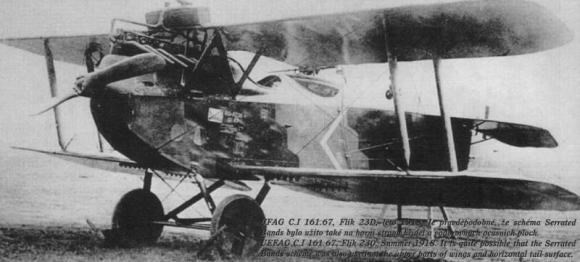
The UFAG C.I was a military reconnaissance aircraft produced in the Austro-Hungarian Empire during World War I, by the Ungarische Flugzeugfabrik Abteil Gesellschaft (UFAG). It was introduced in April 1918, and was widely used on the Italian Front in the final months of World War I.

The UFAG C.I incorporated the best features of the Brandenburg C.II(U) with single-bay wings and ‘I’ strut inter-plane bracing, which was replaced wing conventional steel-tube interplane struts in production aircraft. More manoeuvrable than the Phönix C.I, the C.I had good performance, but suffered from a few odd handling characteristics.

Ufag C.Is in service

Production of the C.I continued after the Armistice by MARE and was also built by the Neuschloss-Lichtig factory as the NL Sportplane.

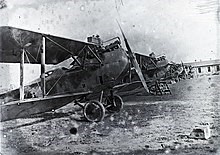
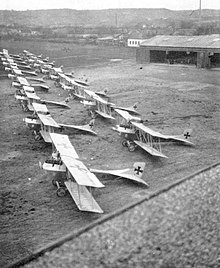
UFAG Brandenburg C.I aircraft in Albertfalva (Budapest) in 1916

The C.I was widely used by the KuKLFT on the Italian front by at least 30 Fliks. The C.I was also used post WWI by the Hungarian Red Airborne Corps as well as the clandestine Hungarian Legügyi Hivatal. Ex-military C.Is were also converted for civil use and as mailplanes.

Twenty UFAG C.I were captured from the Hungarian Soviet Republic in 1919 and used by the Romanian Air Corps.

Variants:

Ufag 161.01
First prototype 8.92 m (29.3 ft) span, 200 hp (150 kW) Hiero 6, ‘I’ type inter-plane struts.

Ufag 161.02
Second prototype, 230 hp (170 kW) Hiero 6, ‘I’ type inter-plane struts.

Ufag C.I
(series 161.03 to 161.22) Production by Ufag, 9.12 m (29.9 ft) span, 230 hp (170 kW) Hiero 6, twin inter-plane struts.

Ufag C.I
(series 161.31 to 161.250) Production by Ufag, 9.5 m (31 ft) span, 230 hp (170 kW) Hiero 6, twin inter-plane struts.

Ufag C.I(Ph)
(series 123.01 to 123.40) Production by Phönix, 9.12 m (29.9 ft) span, 230 hp (170 kW) Hiero 6, twin inter-plane struts.

UFAG 60.01
an improved C.I which would evolve into the UFAG 60.03 / C.II.

Specifications:

C.I second series 161.23 – 161.250
Powerplant: 1 × Hiero 6, 170 kW (230 hp)
Propeller: 2-bladed wooden fixed-pitch
Upper wingspan: 9.5 m (31 ft 2 in)
Lower wingspan: 9.4 m (30 ft 10 in)
Wing area: 26.3 m2 (283 sq ft)
Length: 7.41 m (24 ft 4 in)
Height: 2.7 m (8 ft 10 in)
Empty weight: 750 kg (1,653 lb)
Gross weight: 1,150 kg (2,535 lb)
Maximum speed: 190 km/h (120 mph, 100 kn)
Range: 350 km (220 mi, 190 nmi)
Endurance: 3 hours
Service ceiling: 4,900 m (16,100 ft)
Guns: 1 x 8 mm (0.315 in) Schwarzlose machine-gun forward-firing fixed machine guns; 1 x 8 mm (0.315 in) Schwarzlose machine-gun in trainable rear cockpit mounting
Bombs: 12 x 12 kg (26 lb) bombs (161.131 onwards)
Crew: 2

UFAG / Ungarische Flugzeugfabrik A.G. / MARE / Magyar Repülőgépgyár Rt.

UFAG badge from 1912

It was not until 1912 that the first Hungarian aircraft factory was born in Budapest, at the corner of Hungária körút and Váci út, with the cooperation of Ganz-Danubius, the Weiss Manfréd factory, the Hitelbank and the financial wizard Camilio Castiglioni, who had also helped BMW to prosper. The company was given the creative name of First Hungarian Airship and Aircraft Factory and, lacking its own types, started to produce biplane Lohner aircraft.

The company’s first manager was the twenty-four-year-old Viktor Wittmann, who in 1910, with a degree in mechanical engineering, set off for Reims, France, to study European aircraft manufacturing. The following year, he was already testing aircraft for the Monarchy’s air force at Aspern airbase in Austria. In May 1915, during a demonstration flight of one of the factory’s military aircraft, he lost control of the plane and crashed from an altitude of 30 to 40 metres.

However, the first and earliest site of the factory did not have an airport, so most of the aircraft parts had to be transported to Rákosmező, where the airplanes were assembled and tested.

In the light of this, and the increasing demand for aircraft, the company grew rapidly, outgrowing its available space. They found a new site in Albertfalva, on the outer section of Fehérvári út, where there was enough space not only for halls but also for an airport (which was actually just a flat field, as the runways were not paved at the time).

Hansa-Brandenburgische Flugzeug Werke then joined the company’s ownership, and from then the company began to produce aircraft under the names MARE (Magyar Repülőgépgyár Rt.) and UFAG (Ungarische Flugzeugfabrik Aktien Gesellschaft), including an increasing number of German-designed Hansa-Brandenburg C.I. aircraft, which accounted for a quarter of the Austro-Hungarian Empire’s First World War fleet, 1,258 of them.

These were still canvas-covered, wood-frame and plywood machines and were powered by 160, 200 and 230 hp Hiero engines manufactured by UFAG. They were armed with one or two Schwarzlose machine guns, redesigned for aircraft, with greatly increased rate of fire.