Produced Super Interceptor two-seat turboprop lightplane, expected to be followed by six-seat Lightning Model 400 with turboprop driving tail-mounted propeller, but instead followed by XP-99 Prop-Jet as conventionally-configured, pressurized six-seater with nose turboprop (first flown 1982).
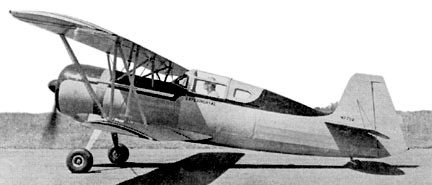
The 1950 Smith-Cirigliano Baby Hawk was a major modification of 1928 Cirigliano SC-1 with lengthened fuselage and new tail, canopied cockpit, Cessna spring gear, cowling.
Only one conversion was made, N775W, by Everett M Smith.
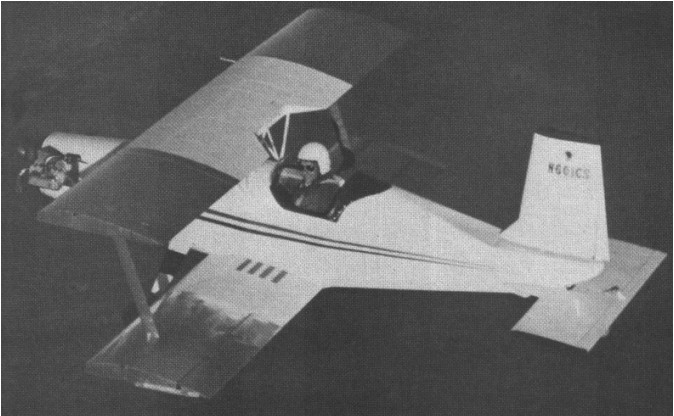
Der Kricket, an original bipe design by Cyril Smith, was built in 857 man hours, and finds that it flies fine from mile-high airports. The philosophy of design simplicity for Der Kricket began with selection of basic materials, and the construction concept developed requires only two sizes of 2024-13 aluminum angle. The spar for the horizontal stabilator is 2-inch square 6063 tubing, requiring a minimum of work. A 2-inch diameter 6063-15 tube spar for the rudder becomes self-hinging with two nylon, teflon or phenolic bushings. All ribs are constructed with a unique self-jigging tab to insure ac¬curate alignment dpring attachment to the various spars. Fuselage is semi-monocoque construction, built upside down on a flat surface, and tricks bor¬rowed from model-airplane building days are employed in assembling the fuselage. A 2 x 11-foot “pin board” on sawhorse supports is used for the fuselage layout. Longerons are tacked to the layout, then four bulkheads added to assure simple, accurate alignment. The “poor man’s deco,” (1/8th-inch soft aluminum pop rivets) are used when necessary for positioning, then are drilled out and replaced with monel or stainless steel pop rivets during final assembly. Full-flying tail surfaces, both vertical and horizontal, are easily constructed and attached, and provide effective control at low airspeeds, with ample rudder movement for takeoff and land¬ing rolls. A good-sized antiservo tab was chosen to provide ample control feel and reasonable sensitivity at cruise speeds. Smith elected to utilize as many pre¬fabricated items as possible in building Der Kricket – landing gear legs from the VP-1 Volksplane; aircraft-style Go Kart wheels and brakes; low-pressure aircraft tires for the mains; and a modified 5-inch caster for a tailwheel. The wing is a NACA 4412.
First flying on 19 September 1978, the prototype N501CS, flew for 25 years before Smith donated it to the Mid-America Air Museum.
Built by A.J.F. Smith in the UK, the Santos Dumont non-rigid airship was registered G-BAWL c/n 1. Powered by a Wankel engine if first flew, from Cardington, on 7 May 1974.
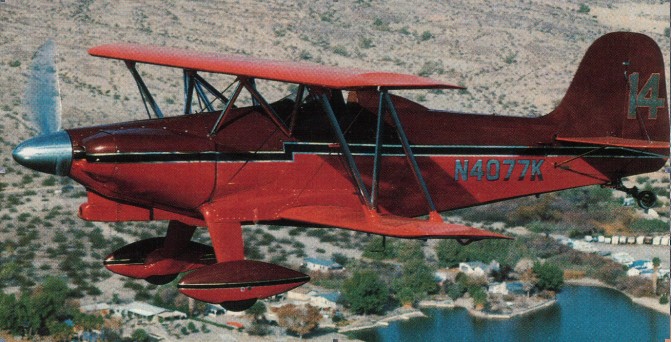
The primary appeal of the Smith Miniplane is its small-size construction simplicity and open-cockpit. The fuselage framework is a conventional truss structure of welded steel tubing, faired to shape with wood stringers. As on most similar designs, the vertical stabilizer is welded up as part of the rear fuselage structure. The wings are made from spruce spars and ribs. Several engines can provide the power, the Continental from 65 to 85 hp or the Lycoming from 100 to 125 hp.
The 1956 DSA-1 Miniplane model designation was for “Damn Small Aeroplane”. The prototype first flew on 29 October 1956.
Smith Miniplane N90P
There have been hundreds of the original Smith Miniplane Biplanes built and flying today. In 1996 plans cost US$140.
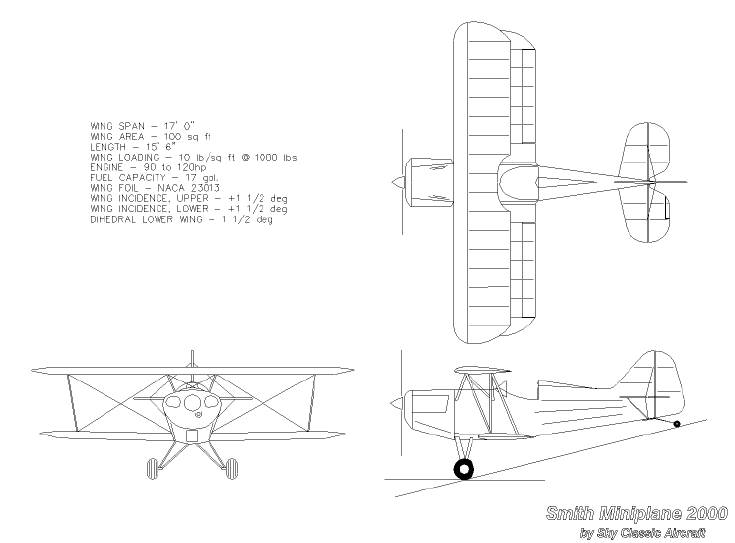
Sky Classic Aircraft introduced the 2000 version of the Smith Miniplane Biplane. Many of the parts and pieces on the aircraft were simplified to make it easier to build.
Changes include: 1) New wing fittings to simplify building. 2) Stretched the length of the fuselage by 5 inches to accommodate a larger person. 3) Stretched the width of the fuselage by 2 inches to accommodate a larger person. 4) Added a trim tab to the elevator. 5) Reshaped the rudder assembly to look more racy. 6) Added struts to the horizontal stabilizer to stop any cracking like the Pitts did. 7) Changed the wing foil to a NASA 23013. Good for aerobatics yet very stable with less drag. 8) Changed the wing angles of attack to fix an old problem on the old aircraft. 9) Reduced the rudder control speed to make it just a little easier to fly. 10) Aircraft plans on computer CAD so that they are easy to read. 11) Adding springs to the original type landing gear.


 All Aero