Preduzece SOKO SOKO Vazduhoplovna Industrija, Ro Vazduhoplovstvo Soko Air Ltd
Bosnia-Herzegovina Founded as Preduzece SOKO in October 1950, and produced license-built Westland Whirlwind helicopters. Designed the G-2A Galeb two-seat armed jet basic trainer (first flown 1961), produced for the Yugoslav Air Force and for export. Designed the J-1/RJ-1 Jastreb attack and reconnaissance versions of Galeb, and the P-2 Kraguj piston-engined counterinsurgency aircraft (first flown 1966); the G-4 Super Galeb jet trainer (first flown July 1978). Built the Aerospatiale/Westland Gazelle helicopter under license in several versions, including Partizan, GAMA antiarmor model and HERA reconnaissance model; and joined lAv Craiova of Romania in development/ production of J-22 Orao/IAR-93 attack aircraft (first flown 1974 but out of production before all deliveries made, due to regional conflict).
Privatized 1991, at which time extensive subcontract work included components/ assemblies for Airbus, ATR, Dassault, de Havilland, EMBRAER, Eurocopter, McDonnell Douglas and Tupolev commercial aircraft. Did not go out of business during regional conflict that followed, but had short periods of inactivity during the worst of the troubles.
Following 1998 restructure of Soko company and its division into several smaller concerns under Soko Holding Co, Soko Air Ltd. was created at the Mostar-Rodoc factory to undertake its aviation programs. They include the Soko 2 two-seat very light monoplane (first flown November 1996) and LH1 two/three-seat light helicopter, which was at an advanced stage of design at time of writing. Other work includes civil aircraft component production for international customers, and design of four- and six-seat lightplanes.
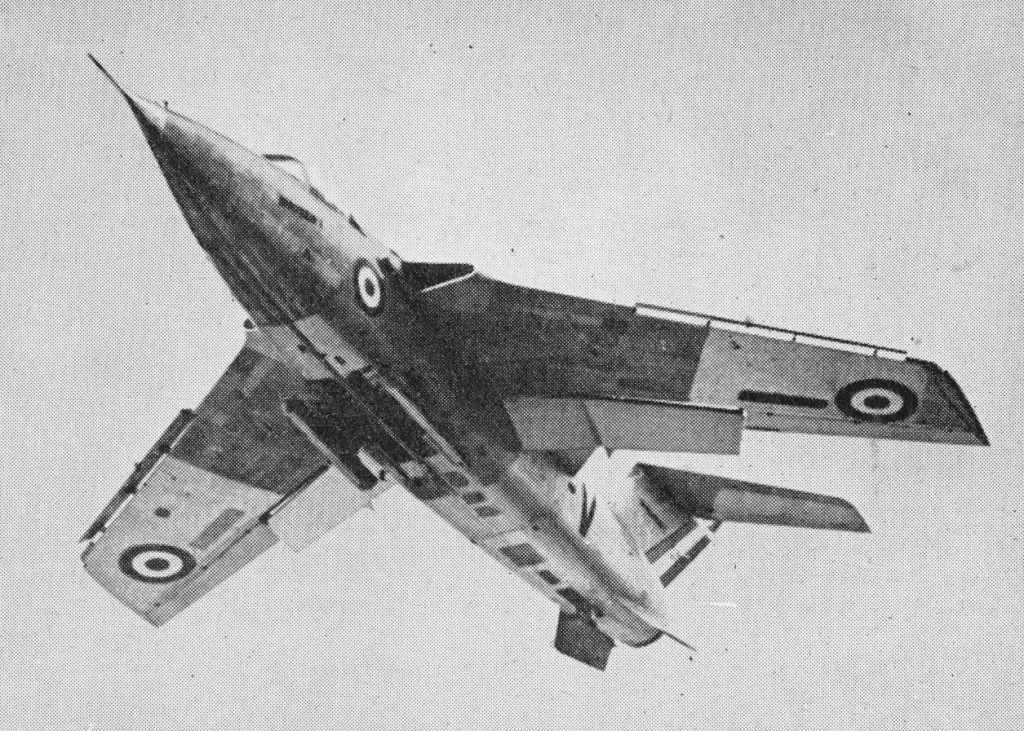
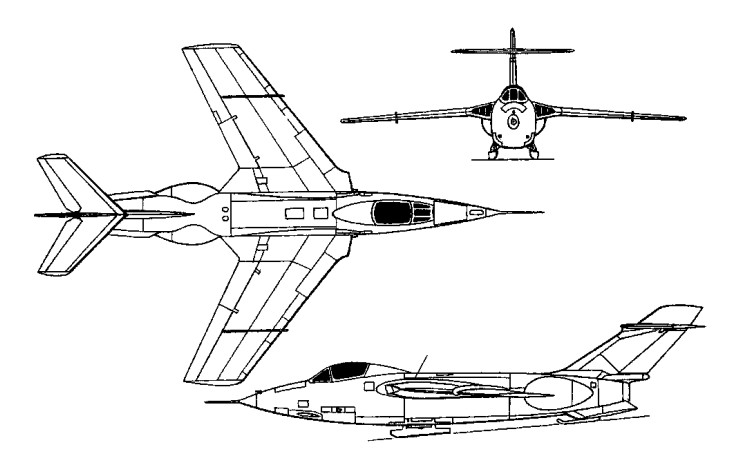
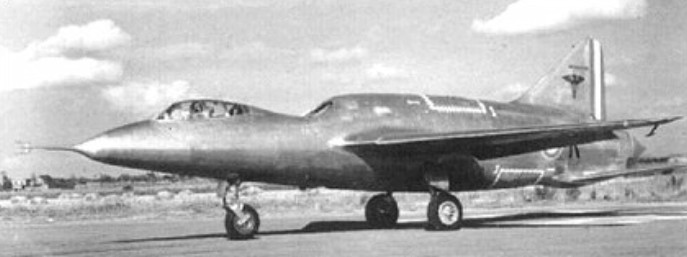
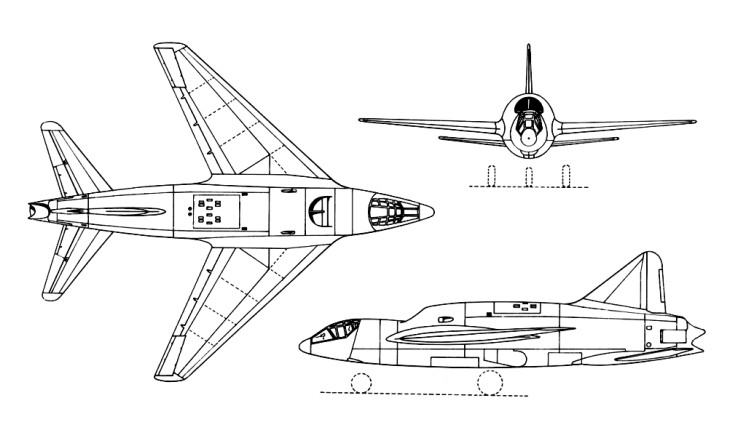
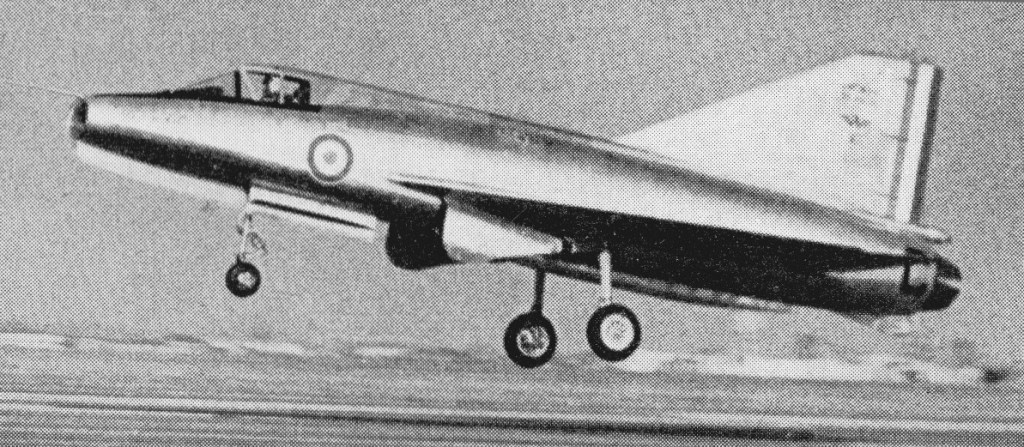
A private-venture single-seat tactical support fighter, the SE 5000 Baroudeur – a name derived from the Arabic word baroud for battle, and, in French Foreign Legion parlance, describing a pugnacious fighter – was designed by Wsiewolod J Jakimiuk. Of all-metal construction with a wing sweptback 36 degrees at quarter-chord, the Baroudeur represented an attempt to achieve a measure of independence from permanent runways. In place of a conventional undercarriage, it was provided with a combination of jettisonable take-off trolley and landing skids like the Me 163B Komet.
The first prototype was powered by a 2,395kg SNECMA Atar 101B turbojet and flew on 12 May 1954.
Proposed armament comprised two 30mm or 37mm cannon. The Baroudeur was progressively re-engined with the Atar 101C and 101D-1, this last, rated at 2,600kg, powering a second prototype, which flew on 12 May 1954 and featured a three degree increase in wing anhedral.
Two months earlier, an official contract covered both SE 5000 prototypes as well as three SE 5003 pre-series aircraft. The first SE 5003 was flown in September 1955 with an 3,700kg Atar 101E-4, the second and third aircraft having a 2,850kg Atar 101D-3 and a 3,500kg Atar 101E-3 respectively. The Baroudeur eventually demonstrated the ability to take-off without recourse to the jettisonable trolley and the first SE 5003 was flown with flush-fitting auxiliary fuel tanks on the aft fuselage sides. The NATO nations elected to adopt a more conventional aircraft to meet the lightweight tactical fighter requirement and development of the Baroudeur was discontinued.
SE 5003 Engine: 1 x SNECMA “Atar” 101C, 27.5kN Loaded weight: 7150 kg / 15763 lb Empty weight: 4520 kg / 9965 lb Wingspan: 10.0 m / 33 ft 10 in Length: 13.66 m / 45 ft 10 in Height: 3.25 m / 11 ft 8 in Wing area: 25.30 sq.m / 272.33 sq ft Max. speed: 1033 km/h / 642 mph Crew: 1
A second prototype, the SE.2415 Grognard II, flew in February 1945. A two-seater with wings swept at 32 degrees, it was damaged in a belly landing. Both designs suffered from flutter-induced problems. The definitive production version would have been the SE.2418, which was to have been powered by Rolls-Royce Tay turbojets, but the SO Vautour was selected to meet the Armee de l’Air’s ground-attack requirement instead.
SE.2415-08 Engine: 1 x 2400kg Rolls-Royce Nene 102 turbojet Max take-off weight: 18000 kg / 39683 lb Empty weight: 11312 kg / 24939 lb Wingspan: 13.58 m / 45 ft 7 in Length: 16.84 m / 55 ft 3 in Height: 5.20 m / 17 ft 1 in Wing area: 44.23 sq.m / 476.09 sq ft Max. speed: 960 km/h / 597 mph Cruise speed: 880 km/h / 547 mph
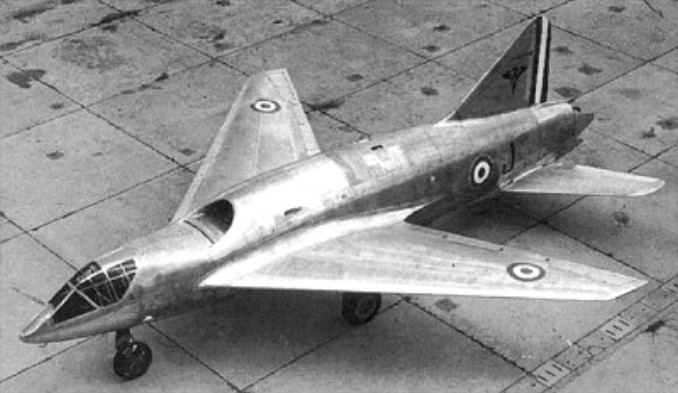
Designed as a single-seat ground-attack aircraft, the Sud-Est SE.2410 Grognard (Grumbler – a nickname for a soldier of Napoleon’s Old Guard) prototype flew for the first time on 30 April 1950. Powered by two 2197kg thrust Hispano-Suiza Nene 101 turbojets mounted one above the other in the fuselage and aspirated via a dorsal inlet, the Grognard I flew as a single¬-seater with wings swept at 47 degrees.
A second prototype, the SE.2415 Grognard II, flew in February 1945. Both designs suffered from flutter-induced problems. The definitive production version would have been the SE.2418, which was to have been powered by Rolls-Royce Tay turbojets, but the SO Vautour was selected to meet the Armee de l’Air’s ground-attack requirement instead.
SE.2410 Grognard Engine: 2 x 2197kg Hispano-Suiza Nene 101 turbojets Wingspan: 13.57 m / 44 ft 6 in Wing area: 495 sq.ft Length: 15.40 m / 50 ft 6 in Height: 17 ft Empty weight: 24,508 lb Loaded weight: 31,967 lb Max. speed: 1038 km/h / 645 mph at 4920 ft Ceiling: 11590 m / 38050 ft ROC: 5315 fpm Range: 853 km / 530 miles Armament: 2 x 30mm cannon, bombs and rockets Crew: 1
In 1946 in France, plans were drawn for three new aircraft including the Sud-Est 2010, for 150 passengers, with delivery at the end of 1948. Fifteen SE 2010s had been ordered for delivery at the end of 1948. However, it was 2 April 1949 before the aircraft, christened the Armagnac, made its maiden flight. Powered by four 3,500-hp Pratt & Whitney Wasp Majors, this was designed to carry 64 passengers (with bunks) on the South and North Atlantic routes, or 107 on shorter runs. Air France, however, refused the aircraft on the grounds that bunks were no longer required, and there was therefore excessive space in the fuselage. Four were bought by Transports Aériens Intercontinentaux for freighting, but after only eight months this company decided that they were not economical. In 1954 they were overhauled and used to transport troops and supplies from Toulouse to fight the war in Indo-China. A further five were also used for this purpose.
Engines: 4 x Pratt & Whitney R-4360 Wasp Major, 3500 hp Pax cap: 150
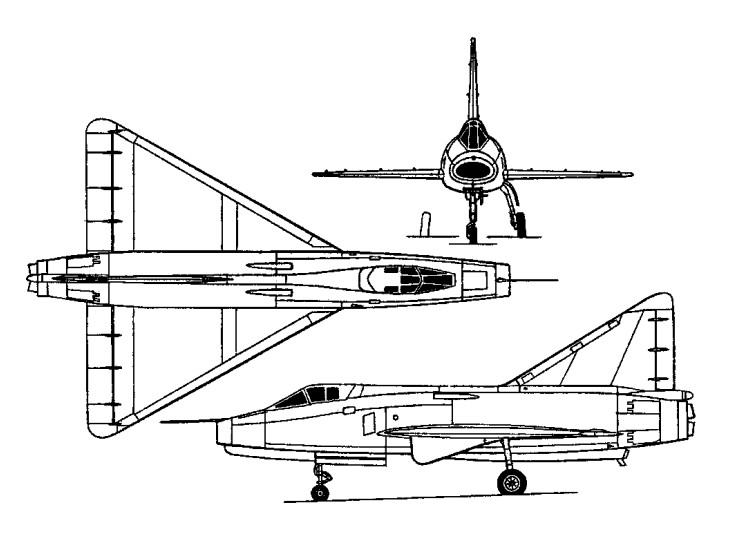
From the end of 1951, the bureau d’etudes headed by Pierre Satre at the SNCA du Sud-Est undertook a series of studies of potential lightweight mixed-power interceptor fighters under what was effectively the generic designation SE 212. These studies crystallized in the shape of a small, 60-degree delta powered by a SNECMA Atar 101F with an afterburning thrust of 3800kg and a 750kg SEPR 75 rocket motor. The primary armament was intended to consist of a single AA 20 or R 052 missile carried externally on the fuselage centreline, alternative armament being two 30mm DEFA cannon or 24 SNEB rockets of 68mm calibre. An official contract was placed for two prototypes, the first of which was flown on 20 April 1956 without the rocket motor fitted. The Atar 101F turbojet was subsequently replaced by an Atar 101G with an afterburning thrust of 4400kg, and the first flight during which the rocket motor was lit took place on 19 December 1956. The second prototype SE 212 was flown on 30 March 1957. During flight testing a speed of 1444km/h, or Mach=1.36, was attained at 12,300m without the rocket motor and 1667km/h, or Mach=1.57, was reached at 11,800m with the rocket motor lit. These speeds were achieved without armament fitted, and the test programme terminated in 1958.
Loaded weight: 6700 kg / 14771 lb Empty weight: 4575 kg / 10086 lb Wingspan: 7.44 m / 24 ft 5 in Length: 12.07 m / 40 ft 7 in Wing area: 29.60 sq.m / 318.61 sq ft Max. speed: 1667 km/h / 1036 mph
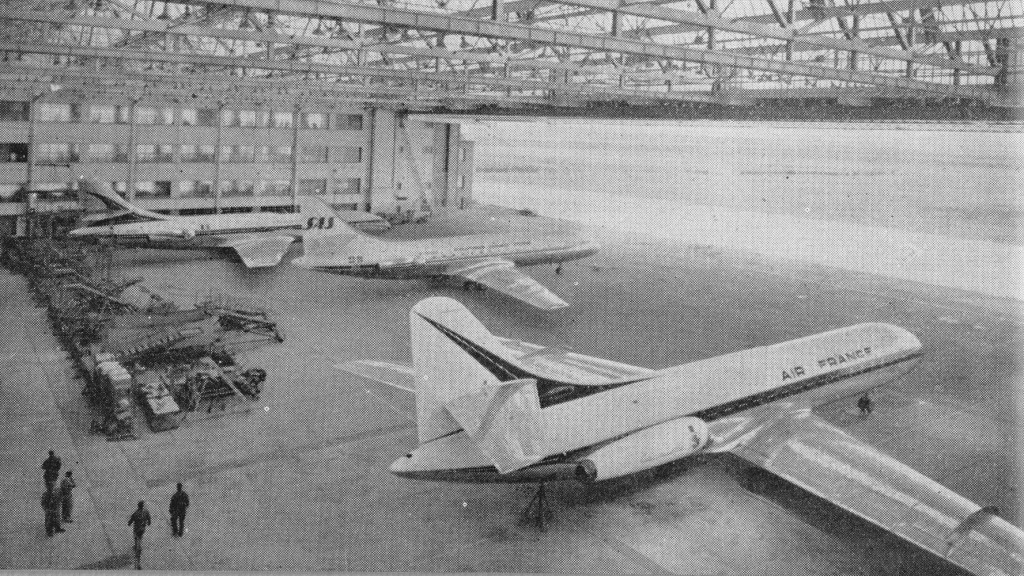
The Caravelle was the outcome of a specification issued in November 1951 by the French Secretariat General of Commercial and Civil Aviation for a 1600 to 2000km range airliner with a 6000 to 7000kg payload requirement at a speed of 620km/h. Six major French aircraft constructors submitted design proposals. The S.N.C.A. du Sud-Est responded with two projects: one a triple Atar-design with three rear mounted SNECMA Atar turbojets, designated the X120 and the other based on the use of two as yet undeveloped by-pass engines, designated the X210. This design then matured to feature two rear mounted Rolls-Royce Avon R.A.26 engines. In January 1953 the French government ordered two flying and two static prototypes of the twinjet.
In Toulouse, Sud Aviation was building the SE 210, destined to be known as the Caravelle, and the most successful of European civil aircraft of its generation. The prototype, F-WHHH, made its maiden flight on 27 May 1955, followed by the second prototype, F-WHHI, on 16 May 1956 and four more were ordered in July 1953. To speed construction the first Caravelles used DH Comet nose sections purchased from de Havilland. The Caravelle was the first jet to be built in France, and its design, with rear-mounted engines, was revolutionary. Originally it was intended to have three French-made SNECMA turbojets, but it was soon decided that two Rolls-Royce Avons would be more economical. On 3 February 1956, after extensive trials, Air France placed an order for 12, with an option for 12 more.
First production and two prototypes – 1958
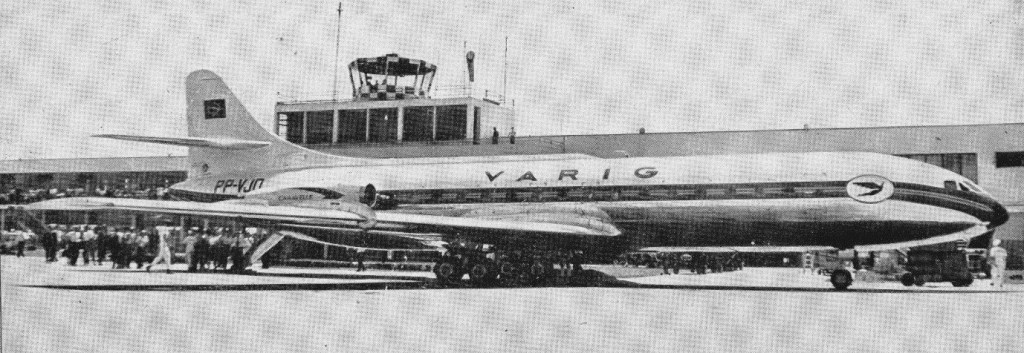
The first production machine, the Sud-Aviation SE-210 Caravelle I F-WHRA, was flown on 18 May 1958, and the initial production series, the Caravelle I and IA with Rolls-Royce Avon 522 and 526 engines respectively, entered service with Air France and S.A.S. in mid-1959. The first series, Caravelle I, was delivered to Air France from 18 May1958, and after one year’s proving they inaugurated the company’s regular service Paris-Rome-Istanbul. Other airlines – SAS, VARIG, Air Algérie – soon followed Air France’s lead. These Caravelle I and IA have been converted to Caravelle III standards with the Rolls-Royce Avon RA.29 mk527’s, and a maiden flight on 11 February 1960.
The Caravelle proved a great success, despite the competition from American manufacturers, and the aircraft then went through a series of modified types. The first production Caravelle III, being the 24th Caravelle whose maiden flight took place on 30 December 1959, was provided with more powerful engines, Avon 527s, and had a greater capacity. The first operational aircraft went into service with Alitalia on 23 May 1960. This model offers standard accommodation for 64-80 passengers, and was supplanted in production by the Caravelle VI-N and VI-R with the Avon 531s and Avon 533Rs respectively. The first Caravelle VI-N flew on September 10, 1960, followed by the VI-R on February 6, 1961. The VIN had a heavier payload and longer range; the VIR, of which 20 were ordered by the American United Air Lines for the New York-Chicago service, had numerous other modifications.
Orders for the Caravelle totalled nearly 100 by the autumn of 1960.
On 4 September 1963 a Swissair Caravelle had brakes overheat from extensive taxiing ad parts of a tire and melted wheel rim were found on the runway. When retracted, the overheated landing gear ruptured hydraulic and fuel lines starting a hot fire in the wing. Losing control, it crashed shortly after take-off from Zurich, Switzerland, killing 80 persons on board.
The Caravelle 10B introduced more fuel efficient Pratt & Whitney JT8D turbofans, while the 11R was a convertible passenger/freighter based on the 10. The Caravelle IIR, which first flew in 1967, had a three foot fuselage extension, forward of the wing, incorporating a large cargo door in the left side of the fuselage, for mixed passenger freight, and Pratt and Whitney turbofan engines.
Caravelle IIR
Then, in 1964, came the Super Caravelle12, a slightly stretched version powered by Pratt & Whitney JT8D-1 turbojets, which was flown in service for the first time by Finnair on 16 August 1964. It was stretched 3.21 m over the Caravelle 10 and could seat up to 128 single class passengers.
When production ended in 1973, a total of 282 SE-210 Caravelles were built, including 20 Caravelle I; 12 Caravelle 1A; 78 Caravelle 3 (including 31 upgraded from 1/1A); 53 Caravelle 6N; 56 Caravelle 6R; 20 Caravelle 10B1R; 22 Caravelle 10B3; 1 Caravelle 10R; 6 Caravelle 11R and 12 Caravelle 12.
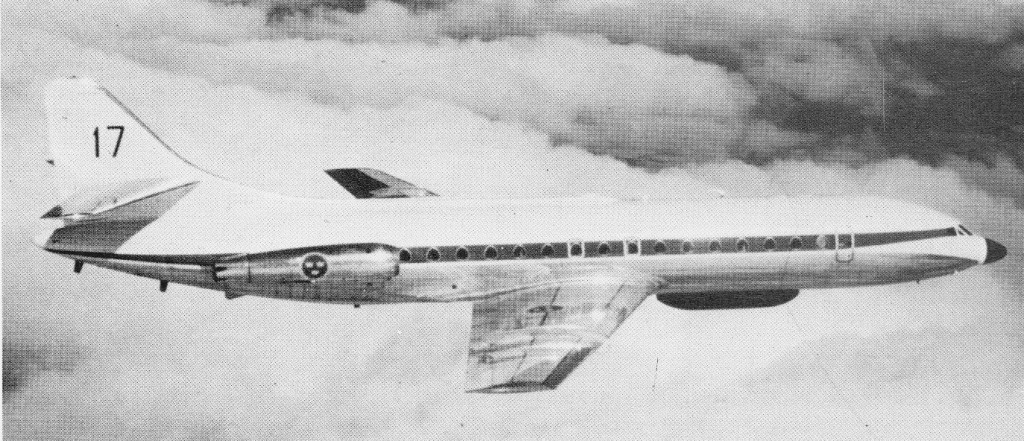
Two Caravelles were purchased by the Swedish Air Force from SAS airline in 1971 (formerly SE-DAG and SE-DAI) and equipped with a long black ventral pod and the insignia of the Flygvapnet. The Caravelles actually served as flying spies for National Defence Research Institute with batteries of multi-track recorders installed in the cabin.
Swedish electronic reconnaissance Caravelle
Air France flew its last Caravelle service on 28 March 1981, from Amsterdam to Paris. The event came just short of 22 years after the Caravelle went into service, on 5 May 1959, and in all Air France purchased 46 Caravelles of various types, out of total production of 280. The fleet world-wide had logged about 7 million flight hours by the end of 1980, and according to Aerospatiale 174 examples are still in service.
Caravelle I Engines: 2 x 12,600 lb. (5,725 kg.) thrust Rolls Royce Avon turbojet Length 105 ft. (32.01 m) Wing span 112.5 ft. (34.30 m.) Weight empty 57,935 lb. (26,280 kg.) Max. accommodation: 99 Max cruise 525 m.p.h. (845 km.p.h.) Range 1,430 miles (2,300 km.) with max. payload
Caravelle IIR Engines: 2 x Pratt & Whitney JT8D-7B
Caravelle III Engines: 2 x RR Avon 527, 11,400 lb Wing span: 112 ft 6 in (34.3 m) Length: 105 ft 0 in (32.01 m) Height: 28 ft 7 in (8.72 m) Max TO wt: 101,413 lb (46,000 kg) Max level speed: 500 mph ( 805 kph)
Caravelle VIN Engines: 2 x RR Avon 531
Caravelle VIR
Super Caravelle Engines: 2 x Pratt & Whitney JT8D-1 turbojet
Caravelle 12 Engines: 2 x Pratt & Whitney JT8D-9, 64.5kN Max take-off weight: 58000 kg / 127869 lb Empty weight: 29500 kg / 65037 lb Wingspan: 34.29 m / 113 ft 6 in Length: 36.23 m / 119 ft 10 in Height: 9.02 m / 30 ft 7 in Wing area: 146.70 sq.m / 1579.06 sq ft Cruise speed: 825 km/h / 513 mph Ceiling: 7620 m / 25000 ft Range w/max.fuel: 11240 km / 6984 miles Range w/max.payload: 3465 km / 2153 miles Crew: 2 Passengers: 128-140
Produced, like a number of French contemporaries, designs by Yves Gardan. In late 1960s these included the GY90,100 and, 110. GY100 was four-seat tourer or aerobatic two-seater, production of which began September 1968.
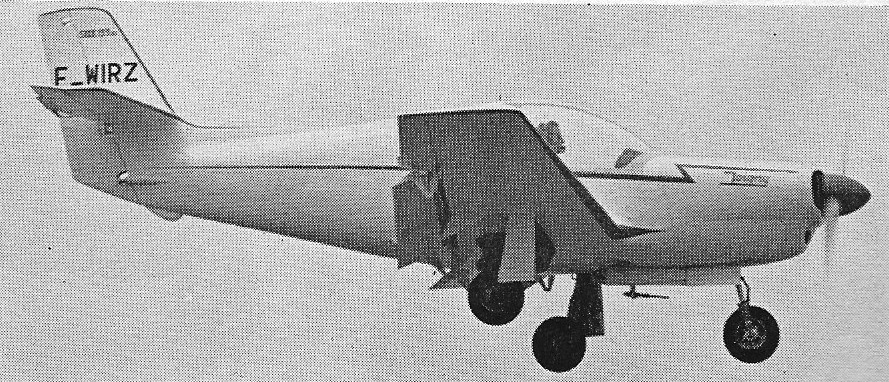
After failing to obtain a license to build the CAB Supercab, Societe De Recherches Et De Constructions Mecaniques designed a new lightplane known as the SRCM-153 Joigny, which first flew in March 1960. This was a three/four-seat monoplane with retractable landing gear, powered by a 150 hp Lycoming O-320A engine.









 All Aero