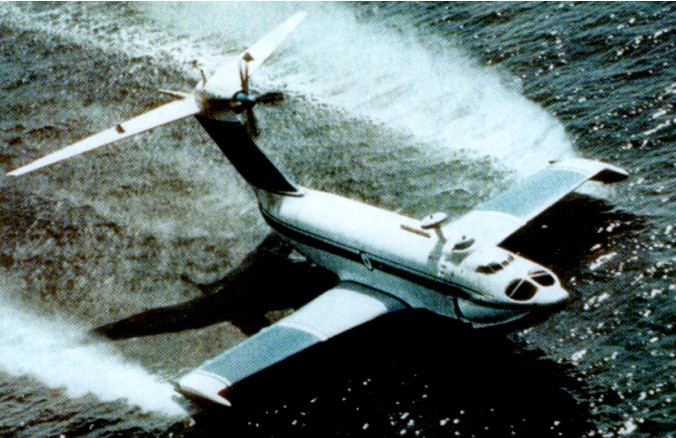
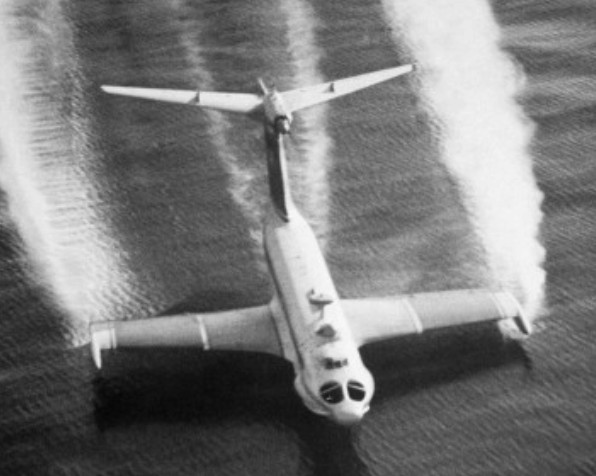
A 125-tonne, 200-knot troop transport and assault wing in surface effect craft for the Soviet forces. The development of ekranoplans was supported by Dmitri Ustinov, Minister of Defence of USSR. About 120 ekranoplans (A-90 Orlyonok class) were initially planned to enter military service in the Soviet Navy.
In 1972, the first really working military “Orlyonok” was built, intended for the transfer of amphibious assault forces to a range of up to 1,500 km.
The figure was later reduced to less than thirty vehicles, planned to be deployed mainly for the Black and the Baltic Soviet navies. Marshal Ustinov died in 1985, and the new Minister of Defence Marshal Sokolov effectively ceased the funding for the program. The only three operational A-90 Orlyonok ekranoplans built (with renewed hull design) and one Lun-class ekranoplan remained at a naval base near Kaspiysk.
A-90 “Orlyonok” in the Museum of the Navy in Tushino, Moscow
The Central Design Bureau for Hydrofoil named after R.Ye. Alekseev (Central Design Bureau for SEC) was developing a project for an ekranoplan ocean zone with a take-off weight of about 500 tons. About this on Tuesday at the forum “Marine Industry of Russia” said the director and chief designer of the concern “Morinformsystem-Agat” Georgy Antsev.
The International Forum “Marine Industry of Russia” takes place from May 19 to 21, 2015 in Moscow, in the Gostiny Dvor exhibition complex. The forum presented a project of a coastal zone WIG with a take-off weight of 60 tons.
“We need WIG ocean zone with a take-off weight of 500 tons. Such developments are conducted in the CDB Alekseev. Today there is a reboot of the Soviet period, a search is underway for the customer, certain research and development, modeling, and prototyping, ”said Antsev. – It has a very good direction – it is necessary both for passenger transportation, and for northern tasks, and for tasks of protecting state borders. He can use the airfield infrastructure and be at some point, in essence, an airplane. “
The ekranoplan, or a ship on a dynamic air cushion is a high-speed vehicle flying at a height of up to several meters from the surface of water, land, snow or ice. This is a kind of hybrid between an airplane and a watercraft, with equal mass and speed, the winged surface of an ekranoplan is much smaller than that of an airplane, and according to the international classification it belongs to sea vessels. Ekranoplans capable of tearing themselves off the surface for a long time and moving into “airplane” flight mode are called echo flight.
The very first developments, as well as actually operating samples, were obtained by designers of the USSR. The direction was developed by two independent teams. One, under the leadership of Rostislav Alekseev, who, as early as October 1, 1941, defended his thesis “Hydrofoil Glider”. After that, he devoted his life to the development and creation of ekranoplanes. The CDB for SEC was founded in the early 50s.
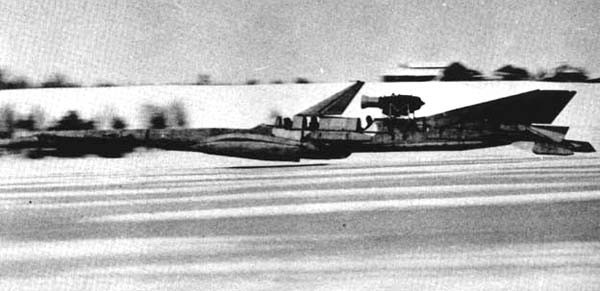
СМ-1
In the early 60s, a test base for these devices was built on the Gorky Reservoir. In 1961, the first flight of the SM-1 / CM-1 screening vehicle took place, and the following year, the SM-2 / CM-2.
СМ-2
Developed by the Soviets from the 1960s onwards, particularly by Dr Rostislav Alexeyev’s Central Hydrofoil Design Bureau, the leading exponents in the design and operation of Wing in Surface Effect types are now located in the Russian Federation. Far ahead of the West in terms of construction and flying experience, the Soviets planned a fleet of 120 surface skimming WISE military transports in the 1980s and four prototypes were built. However, with the end of the Cold War the funds and the cause for the manufacture of the planned balance-of-power-altering transport fleet ceased.
Southern Sailplanes proprietor Ralph Jones was the agents in Britain for Schempp-Hirth KG.
Southern Sailplanes were converting a 17.6m span Cirrus to have a wing of 24m, with a centre-section of 5m span having spars constructed with carbon-fibre reinforced plastic. The estimated competition date was 1971.
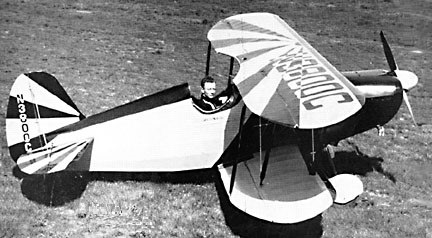
The 1950 Southern Commercial Airmotive Corp aerobatic biplane was built from salvage of a Being P-12 for Charles Short and sometimes seen credited to his name.
The one built was registered N3800C and also seen also as re-registered (Del) Denly Special in the 1950s.
First flown on 14 Feb 1950, the Southern Airmotive Special (possibly N3900) was a single seat open cockpit biplane. It was operated as the aerobatic ‘Roberts Special”, piloted by Charles Roberts.
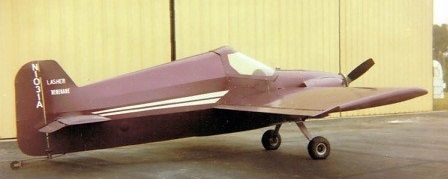
This Formula-V sport racer features a straight-line midwing design. The design was largely based on the Cassutt Special III, but was made suitable to accept VW or VW-based engines. Its designer, Charles Lasher, has chosen steel-tube construction for the fuselage and tail because of its ability to withstand the shock of a crash better than other materials
The wings are a wood-frame structure with fabric covering. The ship is made to handle any Volkswagen from 35 to 65 hp.
The first aircraft was built by M. Ricketts and after eighteen months of construction it was first flown in 1974, registered N73RL (c/n B15). Of conventional construction with all-wood wings and fabric-covered fuselage, the single-seat aircraft was powered by one 55 hp Volkswagen VW1600 motor car engine.
N73RL took second and third places in the Formula V competition at the 1978 and 1979 Cleveland National Air Races respectively, and was used for aerobatic displays.
Plans for amateur construction were marketed via Southern Aero Corporation of Miami Lakes, Florida, after 1983 via Charles Lasher.
Lasher Renegade I (N1031A c/n B96)
At least four Renegade I aircraft were completed in the USA: N73RL, N1031A, N35DE, and N64JM (designated Michalak R-1).
Biplane Racer Andrew Buehler has set up an LLC and negotiated to acquire the design and manufacturing rights for the Renegade from Creighton King in 2014. Initial planning was for Ed Fisher of Raceair Designs to help with the development and construction of a new Renegade airframe, to use in the promotion of the design. Several minor improvements, and a new wing design were in the works.
Engine: VW 40-hp Wingspan 16 ft Length 14 ft Gross Wt. 652 lb Empty Wt. 400 lb Fuel capacity 7.5 USG Top speed 130 mph Cruise 120 mph Stall 49 mph Climb rate 1000 fpm Takeoff run 560 ft Landing roll 400 ft Range 375 sm
Span: 17 ft 0 in (5.18 m) Wing chord, constant: 5 ft 0 in (1.52 m) Length: 15 ft 0 in (4.57 m) Height: 4 ft 3 in (1.30 m) Empty weight: 451 lb (205 kg) Max takeoff weight: 670 lb (304 kg) Max speed: over 170 mph (273 kmh) Max cruise speed: 145 mph (233 kmh) Landing speed: 50 mph (81 kmh) Max climb at sea level: 850 ft (259 m)/min Service ceiling: 12,000 ft (3,660 m) Range: 225 mls (362 km)
Built specially to compete for the Kremer prize of £5,000 for man-powered flight, design started in July 1960 and actual construction in January 1961. It was finished in September 1961.
First flown on 9 November 1961 at Lasham, the first flight was about 50 yds at a height of about six feet over level ground and in still air. A single seat, fixed wing monoplane with the propellor driven by pedalling.
By 1962 SUMPAC was flying up to 650 yds and executing turns.
In 1964 it was modified in various details and given a different belt drive mechanism. In flight test it was damaged after a stall at about 30 ft.
The machine was donated to the Shuttleworth Trust where it was displayed at Old Warden. It was allocated BAPC.7.






 All Aero