Squirecraft SA102.5 Cavalier / K & S SA102.5 Cavalier

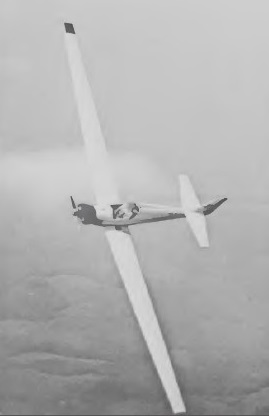
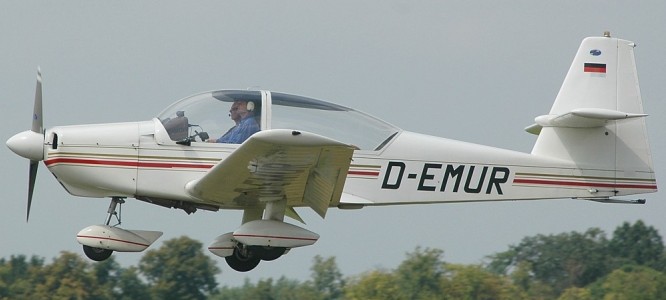
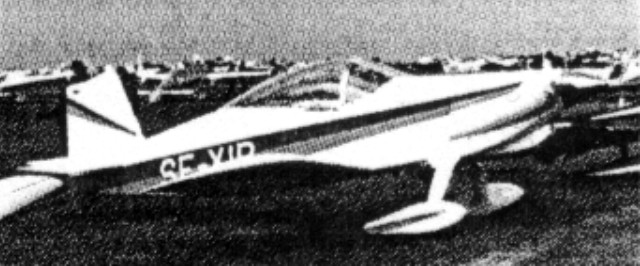
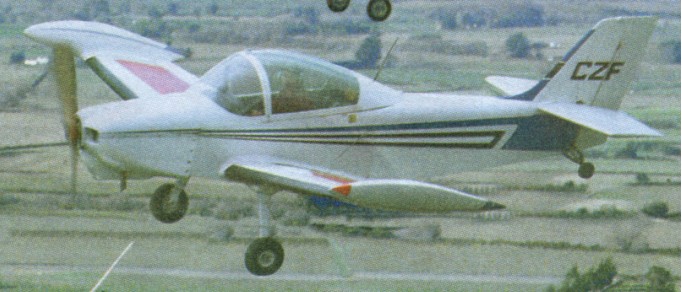
The original plans built, all wood, two place Cavalier SA.102 was designed in 1964 by Stan McLeod of Calgary, Alberta, and was based on the French Minicab. Retaining much of the basic airframe of the GY-20 but features a redesigned cockpit with a third, child, seat. The tail surfaces were redesigned and the aircraft sits on a tricycle undercarriage.

The initial version, the SA.102, encountered stability problems but these were solvrf by the addition of angled tip-tanks. This version first flew in February 1971, designated SA.102.5.

Subsequent revisions by McLeod led to the 100 to 125 hp SA.102.5 and SA.102.88.

The SA 102-5 Cavalier is a side-by-side two-seater of all wood and fabric construction, that can use any four-cylinder Continental, Lycoming or Franklin engine and rated in the 85 to 150-hp range. The prototype flew in 1969. The wing section is a NACA23015 at the root and NACA23012 at the tip. The wing structure consists of a single wooden box spar plywood leading edge, an auxiliary rear spar for the flaps and ailerons and a diagonal drag spar. The entire centre section is plywood covered, the remainder of the wing being fabric covered. The fuselage is a wooden truss type structure of spruce and ply construction. The cockpit doors and canopy are of moulded fibreglass. The rear decking is fabric covered. The empennage is of all wood construction with fabric covered control surfaces. The standard aircraft has a fixed tricycle under-carriage, but a tailwheel version is available. Fuel is carried in wing tip tanks of 13 or 1 6 Imp gallon capacity.

Gross Wt. up to 1800 lb
Empty Wt. 900 lb
Fuel capacity 40 USG
Wingspan 26’l0”
Length 18’4”
Wing area: 118 sq.ft
Top speed 200 mph
Cruise speed 165 mph
Stall 50 mph
Climb rate 1500 fpm
Range 850 sm
Landing roll 800 ft
Seats: 2

Engine: Lycoming O-290, 125 h.p
Span: 27’4”
Length: 22’0”
Wing Area: 118 sq. ft
Empty Weight: 9001b
Loaded Weight: 1,500 lb
Max. Speed: 150mph
Cruise Speed: 130mph
Stall Speed: 50mph
Initial Climb: 1,000 fpm
Range: 715 miles

Engine: 135 hp
Cruise: 150 mph
ROC: 2000 fpm
Range: 700 sm

SA.102.5-88
Engoine: 125 hp
Empty weight: 950 lb
MTOW; 1800 lb
Tip tank cap: 38 USG
Max level speed: 170 mph
Vne: 200 mph
Cruise: 150 mph
Rate of Climb: 1200 fpm
Loading: +3g
Take off dist: 500 ft
Landing dist: 600-800 ft
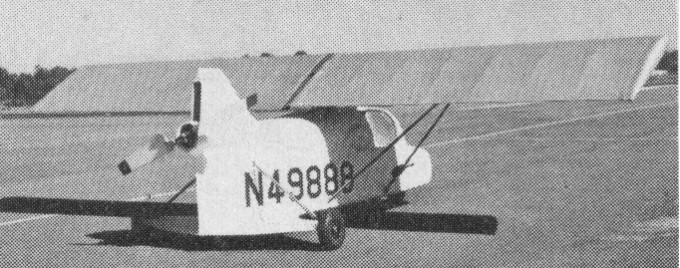
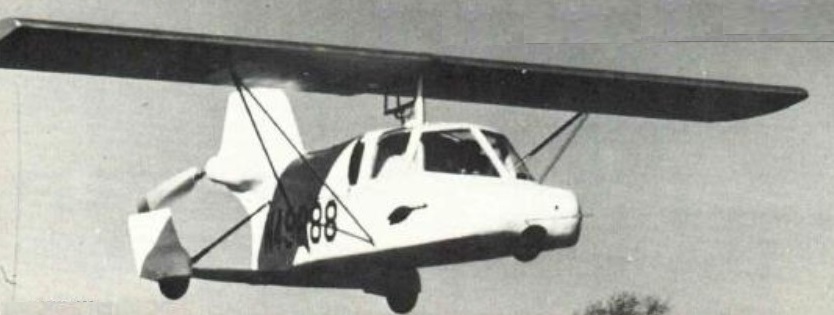
Spratt Control wing

Dr G A Spratt’s first powered airplane with pivoting wings was a single-place, open cockpit biplane, built in 1912, and powered by a 40hp Curtiss V-8 air-cooled engine.

The second controlwing was a single-place open cockpit high-wing monoplane built in 1934, powered by a 25hp Jacobs outboard motor modified to air cooling (now in EAA Museum), and registered N14763. With an empty weight of 180 lb, it was the first controlwing airplane to do any real flying.

The 1939 Controlwing further development of Spratt’s controllable-wing theory was a two place, open cockpit, mid-wing flying boat. A 65hp Lycoming pusher engine was mounted in the bow, driving a prop by a long shaft. The wing is mounted over a twin-tailed, boat-shaped fuselage.

The 1947 version, N3915A, had a 65hp Continental mounted aft of the cockpit. Spratt’s project continued well into the 1970s with several successful flying boats. Plans marketed to home-builders; 80 sets sold by 1982.

The 1973 Controlwing 105 N49888 was a two-place cabin, high-wing monoplane landplane with a 60ci Mercury marine engine. The span was 22’0″ and length 12’6″. Spratt’s continuance of design numbers from his days at Convair sometimes lead to confusion of this plane with Convair-Stinson 106 Skycoach.

The 1964 Controlwing 106 N910Z was a two-place, open cockpit high-wing monoplane flying boat.

Circa 1975 the Controlwing 107 was a two-place, open cockpit high-wing monoplane flying boat, powered by a modified 80hp Mercury marine engine. The span was 24’0″, length 17’0″, and useful load: 500 lb.

Seats: 2

Sportline Aviacija / Lak / Lithuanian Aviation Constructions / Experimentalnii Zavod Sportivnoi Aviatsii / Experimental Sports Aviation Factory

The Lithuanian Aviation Plant (now JSC “Sportinė Aviacija ir Ko”) Company was founded in 1969 and designed and manufactured highest quality gliders. In the course of its history the Company designed, tested and produced 20 different types and modifications of gliders and motor-gliders.

The first composite high performance glider BK.-7 “Lietuva” took-off in 1972. Since then, many other aviation projects were developed and manufactured best known of which are the 1978 Open class glider LAK-12; 15-18m class glider LAK-17a, Standard class gliders Genesis 2 and LAK-19; self- sustaining gliders LAK-17AT and LAK-19T; primary training glider LAK-16, open class ships LAK-20T and LAK-20M. The most popular member of the glider family is the Open Class glider LAK-12. Within 25 years, 253 units have been built and operated in 20 different countries. The LAK-12 was designed according to technical requirements and standards of the former Soviet Union, so called Norms of Flight Safety. In some cases, these Norms were stricter than the current European standards (CS-22).

Since 1996, Sportline Aviacija have worked on the American design standard class glider Genesis. Being the developer of the engineering part of the design, we completed the strength tests and calculations in accordance with JAR-22 standards. All works on obtaining type certificate in accordance with JAR-22 have been carried out and 26 units have been manufactured.

More than a thousand L-13 “BLANIK” gliders from all over the former Soviet Union and Bulgaria were overhauled in the plant.

Over the past 15 years after the company became private, LAK-17 type glider was developed and modified, and about 200 units of 15m and 18m class gliders were manufactured and delivered to the customers all over the world.

In 1999, the LAK factory was completely privatized, and a joint-stock company, Sportinë Aviacija, AB, was formed.

2002 launched a new open class glider, LAK-20 (two-seater version), and at the same time a turbo moto version of this glider as well. Few prototypes of the open class two-seater gliders LAK-20 and LAK-20M have been assembled, but the further development of the project has been frozen.

New modification of LAK-17 is the LAK-17B, which further evolved into a the most revolutionary and progressive product- the LAK-17B-FES (Front Electric Sustainer). The LAK-17B FES has been certified by EASA.

A Certificate issued by the Lithuanian Civil Aviation Authority, which grants the right to perform production of sailplanes, self-launching sailplanes as well as related products and parts.

LAK gliders are worldwide type certified, not only in Lithuania, but have type certificates for gliders in EASA, CAR, and other countries.

Apart from building gliders, the factory has capacities to develop a large variety of aviation or non-aviation composite structures and constructions. The testing facility can be employed for comprehensive analysis of projects and has its own strength test laboratory.

Sportavia SFS 31 Milan / Scheibe SFS 31 Milan

Designed by Rene Fournier and Egon Scheibe, Sportavia built the SFS 31 Milan, a single seat development of the Fournier RF4D with a sailplane wing of the Scheibe SF-27M motorglider and a feathering prop. The Milan’s designation is formed by adding together the manufacturers’ initial letters and the numbers in the designations of these two aircraft.

Like all of Rene Fournier’s designs, it had a big bubble canopy. It has spoilers for approach control and outrigger wheels and a steerable tailwheel to aid in taxiing. The cantilever wings are low-set instead of in the shoulder position of the SF-27M and Zugvogel V, with 4° dihedral from the roots, and are wooden structures with a pine box spar and plywood ribs covered with birch plywood and fabric; Schempp-Hirth glassfibre/metal air brakes are fitted in the upper surfaces. The SF-27M’s wings were made stronger than those of the unpowered SF-27 Zugvogel V, and it is powered by a 26hp Hirth Solo vertically-opposed four-cylinder engine. The Milan’s powerplant is a 39hp Rectimo (converted Volkswagen) 4 AR 1200 ‘flat four’ engine in a conventional tractor installation, driving a Hoffman two-blade fixed-pitch or fully-feathering wooden propeller, of 4ft 4in of 4ft 5.5in diameter respectively. The single fuel tank in the fuselage has a capacity of 7.7 Imp gallons. The landing gear is similar to the RF4D’s, but with spring-assisted retraction of the main wheel.

The Milan prototype, D-KORO, made its first flight on 31 August 1969. The SFS 31 was produced jointly by Sportavia and Scheibe.

Milan SFS-31
Engine: 29kW / 39 bhp Rectimo 4AR 1200
Wing span: 15 m / 49 ft 2.5 in
Wing area: 12 sq.m / 129 sq.ft
Aspect ratio: 18.6
Airfoil: Wortmann
Length: 19 ft 10.25 in
Height: 5 ft 1.75 in
Empty Weight: 310 kg / 682 lb
Payload: 130 kg / 286 lb
Gross Weight: 440 kg / 968 lb
Wing Load: 36.67 kg/sq.m / 7.5 lb/sq.ft
Max cruising speed: 112 mph at sea level
L/DMax: 29 95 kph / 51 kt / 59 mph
MinSink: 0.82 m/s / 2.7 fps / 1.60
Take-off run: 690ft
Range with max fuel: 415 miles
Structure: wood
Seats: 1
No. Built: 24

Sportavia / Sportavia-Putzer GmbH

Alfons Pützer and Comte Antoine d’Assche, director of the French company Alpavia SA, formed a new company in 1966, Sportavia-Pützer, to produce the Fournier series of light aircraft.

Formed to take over from Alpavia SA manufacture of Avion-Planeur series designed by Rene Fournier, by spring 1969 had delivered 150 RF4D single-seaters. Two-seat RF5 flew 1968, followed by RF6 and RS180 Sportsman four-seat lightplane.

Sportavia Pützer went bankrupt in 1977 not long after the first prototype RF-9 had made its maiden flight.

Became entirely owned by Rhein-Flugzeugbau GmbH 1977 and lost name 1981.

Sport Aircraft S-18

Modelled after the Thorp T-18 and incorporating folding wings.

Engine: Lycoming, 150 hp
HP range: 150-180
Speed max: 183 mph
Cruise: 165 mph
Range: 530 sm
Stall: 63 mph
ROC: 1200 fpm
Take-off dist: 900 ft
Landing dist: 1200 ft
Service ceiling: 18,000 ft
Fuel cap: 29 USG
Weight empty: 923 lbs
Gross: 1600 lbs
Height: 5.1 ft
Length: 19.33 ft
Wing span: 20.8 ft
Wing area: 86 sq.ft
Seats: 2
Landing gear: tail wheel

Spitfire Taurus

Earlier, in August 1978, P.Z.L. Swidnik concluded an agreement with the Spitfire Helicopter Company of Media, Pennsylvania, US allowing them to market a modified version of the Kania (itself an Mil Mi-2 verion) in Western countries under the name Spitfire Taurus. This differed primarily from the standard Polish version by introducing uprated Allison 250-C28 turboshaft engines, each with a take-off rating of 373kW fed by a large common intake; revised nose contours and sporting a ventral fin. However, the company has since gone out of business, and it is not known if any conversions were completed.

Taurus
Engine: 2 x Isotov 350P, 400 shp
TBO: 3500 hr
Main rotor: 48.3 ft
Seats: 9
Length: 39.2 ft
Height: 12.3 ft
Max ramp weight: 7400 lb
Max takeoff weight: 7400 lb
Standard empty weight: 5166 lb
Max useful load: 2234 lb
Max landing weight: 7400 lb
Max sling load: 1763 lb
Disc loading: 4 lbs/sq.ft
Power loading: 9.3 lbs/hp
Max usable fuel: 1472 lb
Max rate of climb: 900 fpm
Service ceiling: 13,300 ft
Hover in ground effect: 6,900 ft
Hover out of ground effect: 7900 ft
Max speed: 147 kt
Normal cruise @ 3000 ft: 128 kt
Fuel flow @ normal cruise: 435 pph
Endurance @ normal cruise: 2.8 hr

Spitfire Mark 1 / II / IV

Spitfire Mk.II

The Spitfire Mark I was a utility helicopter built in the United States in the late 1970s and intended for series production. In essence, the Mark I was an Enstrom F-28 that was modified to use an Allison 250 turboshaft engine and geared transmission in place of the original piston engine and system of vee belts. The resulting powerplant installation was lighter and more compact, which allowed for additional cargo or fuel.

Spitfire Helicopters’ parent company, Fetsko Aviation Sales and Transportation began work on the prototype in January 1976, and on a number of pre-production aircraft in February 1977. Fetsko displayed a mockup of the concept at the National Maintenance and Operations Meeting at Reading, Pennsylvania in June 1976.

The prototype (registered N4890) first flew in December 1978. By May 1979, Spitfire had supplemental approval for the turbine conversion and by July, the company reported that it had sold 42 examples of the Mark I and Mark II and expected to build 60 aircraft during 1980. The engine installation on production models was to be slightly further forward than on the prototype.

The Spitfire II derivative of the Enstrom uses a new four seat front fuselage and the Allison engine with Enstrom rotor and rear fuselage.

Other projects included Spitfire Mark IV with auxiliary propulsion engines at tips of stub wings.

However, Spitfire remained dependent on Enstrom to supply airframes for remanufacture, and Enstrom distanced itself from the project somewhat. Competing plans by Enstrom and Spitfire to market Polish-built Mil Mi-2 helicopters in the United States might have contributed to the friction. In Spitfire’s version of the deal, Polish manufacturer PZL-Świdnik would also contribute to the Spitfire manufacturing efforts. By November 1979, Enstrom refused to supply airframes to Spitfire.

The situation improved somewhat in the 1980s, and Spitfire president Jack Fetsko reported in May 1983 that relations with Enstrom had improved to the point where the two companies could “talk programs”. By that time, costs had increased from $US 165,000 expected in 1979 to $US 285,000 but Spitfire had taken deposits for 50 Mark Is, and had a firm sale for the first production aircraft. Together with companies Sodian and Soprea, Spitfire formed a new venture, Spitfire Helicopters International, to manufacture the Mark I and Mark II in Málaga, Spain.

Nothing came of the joint venture, and Spitfire’s attempts to market F-28 derivatives came to an end. In the 1990s, Enstrom marketed its own turbine-powered version of the F-28 as the Enstrom 480.

Mark 1
Engine: Allison 250-C20B, 420 shp
TBO: 3500 hr
Main rotor: 32 ft
Seats: 3
Length: 29.4 ft
Height: 9.2 ft
Max ramp weight: 2350 lb
Max takeoff weight: 2350 lb
Standard empty weight: 1292 lb
Max useful load: 1058 lb
Max landing weight: 2350 lb
Disc loading: 2.9 lbs/sq.ft
Power loading: 5.6 lbs/hp
Max usable fuel: 469 lb
Max rate of climb: 1550 fpm
Service ceiling: 15,000 ft
Hover in ground effect: 13,400 ft
Hover out of ground effect: 8000 ft
Max speed: 112 kt
Normal cruise @ 3000 ft: 96 kt
Fuel flow @ normal cruise: 180 pph
Endurance @ normal cruise: 2.4 hr
Range: 308 mi

Mark II Tigershark
Engine: 420hp Allison 250-C20B
Rotor: 31’11”
Useful load: 1175 lb
Max speed: 135 mph
Cruise: 120 mph
Seats: 4

Mark IV
Engine: 420hp Allison 250-C20B
Rotor dia: 33’4″
Length: 30’0″
Useful load: 2100 lb
Max speed: 215 mph
Cruise: 201 mph
Range: 482 mi
Seats: 4-5