An Austrian hang glider manufacturer during 1975-87.
Post WW2
Steen Steenship
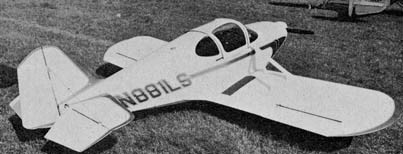
LaMar Steen’s first airplane was a two-place, low-wing design named the Steenship. The Steenship has wooden wings, a tube-and-fabric fuselage, and originally sported a many-coat nitrate dope covering job. The modified O-290-G engine produced 140hp and gave the plane a very respectable cruise speed of 165 mph. In addition, it was stressed for aerobatics (+/- 9 G). Construction took 3-1/2 years and cost $3,800.
It first flew in July 1966 as N881LS. No plans were ever made available for the Steenship, and no original blueprints or construction drawings exist today.
The May 1989 issue of Sport Aviation had an article about Bob Leonard’s restoration of the plane in Healdsburg, CA. In mid-2002, Burt Nichols in Arkansas purchased it (still retaining the original registration number N881LS) and flew it regularly. After 200 hours in the first 9 months he decided to upgrade the original Lycoming O-290 to a Lycoming O-320. As of July 2003, it was very close to first flight with the new engine.
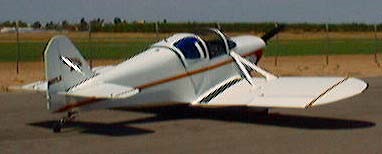
In late Jan. 2005, it was in the process of a rebuild.
Engine: 140hp Lycoming O-290G
Cruise: 145 mph
Stall: 60 mph
Load factor: 9G±
Seats: 2
Stearman
Stearman Aircraft Company
Stearman Aircraft Division of the Boeing Aircraft Company
The Travel Air Manufacturing Company was in es¬sence Walter Beech, Lloyd Stearman and Clyde Cessna, all backed by Walter P. Innes. In 1926, Stearman quit to go it alone. Originally Stearman Aircraft Company, formed at Venice, California, by Lloyd Stearman in 1927. Stearman was already known in connection with Laird, Swallow, and Travel Air; the new company was formed by consolidating Lyle-Hoyt Aircraft Corporation (formerly West Coast distributor of Travel Air) and technical ability of Stearman.
Factory soon moved to Wichita, Kansas, building private and commercial aircraft and becoming part of United Aircraft and Transport Corporation. Types built included three-seaters, trainers and mailplanes.
In 1929 Lloyd Stearman sold his company to the ‘United Aircraft and Transport Corporation’. In September 1934 the group was split up and Boeing Air Transport, pulled out of this group and took the Stearman Aircraft Company with it as wholly owned subsidiary as the Wichita Division of Boeing.
Nevertheless, biplane trainers built throughout Second World War were persistently called Stearman. Basic type was Model 75, dating from 1936 and having numerous service designations; production totaled about 10,000. Name Kaydet (originally Canadian) not favored in U.S.A., where Army models had PT and Navy models NS designations. Some versions had enclosed cockpits. After Second World War some 4,000 of Model 75 converted for cropdusting.
1929: Absorbed Hamilton Metalplane Co.
1931: L C Stearman resigned to join Lockheed Corp, Burbank CA.
1931: Northrop Aircraft, Burbank, and Stearman Aircraft Corp, Wichita.
1936: Stearman-(Dean B) Hammond, Oakland CA.
1941: Stearman Aircraft Div, Boeing Airplane Co, Wichita.
July 1968: Reformed as Stearman Aircraft Corp, Washington DC.
St.Croix Aerial
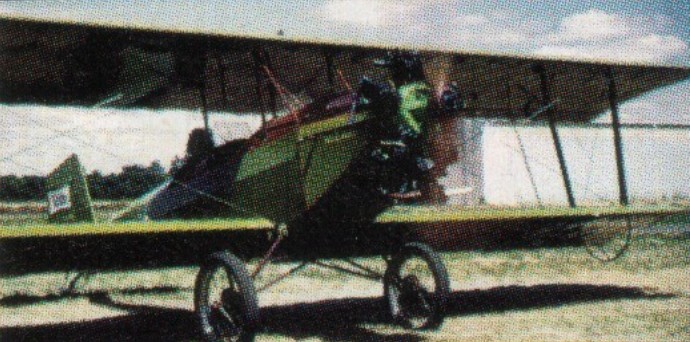
Chad and Charles Wille constructed in 1947 of a Pietenpol Aircamper which Charles redesigned it in 1977 as a biplane called Aerial.
Engine: Continental O-300, 145 hp
HP range: 85-200
Height: 7 ft
Length: 19.5 ft
Wing span: 29.5 ft
Wing area: 250 sq.ft
Empty weight: 900 lb
Gross weight: 1400 lb
Fuel capacity: 15 USG
Top speed: 105 mph
Cruise: 85 mph
Stall: 36 mph
Range: 150 sm
Rate of climb: 1000 fpm
Takeoff dist: 250 ft
Landing dist: 200 ft
Seats: 2
Landing gear: tailwheel
St.Cyrien Pup
In 1958 Mr K.C.Desmond St.Cyrien started construction of a Sopwith Pup replica at his home in Horley. He secured the registration G-APUP for it. Much later it was allocated the PFA number 1582.
After having started this replica St.Cyrien ‘acquired’ bit by bit, Pup serial N5182 from a store of a French aviation collection. Parts of the replica were disposed of to G.Neale of Canada and others went to the USA.
The original Pup was then put under an intensive period of restoration at Luton and then at Horley. It was completed at Fairoaks with an original Le Rhone engine. It first flew on 11 August 1973, from Fairoaks, as N5182 ‘Shiels’, for ultimate donation to the RAF Museum.
Statler Little Mike
Bill Statler was a former Lockheed engineer who designed an all-metal midwing racer, Little Mike, in the Goodyear 190-ci. Class.
Statler Firefly
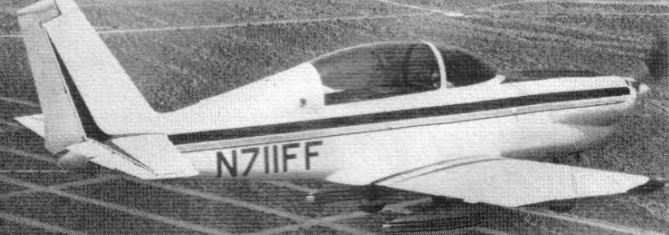
Firefly was designed by Bill Statler, former Lockheed engineer who earlier designed an all-metal midwing racer, Little Mike, in the Goodyear 190-ci. class, Firefly was designed to resemble a two-place For¬mula One racer, carries 80 sq.ft of wing instead of 66. Both cockpit places have complete controls; Firefly is soloed from front seat. Con¬struction is basically metal, with fiberglass cowl, wingtips, fairings, wheel pants. Flaps are electrically operated.
Offered with plans and construction manuals for home-builders, the Statler Firefly N711FF first flew on 8 October 1976, piloted by Al Foss.
Engine Continental C-85-12F
Wingspan 19’2”
Length 18’11”
Gross Wt. 1300 lb
Empty Wt. 835 lb
Fuel capacity 18 USG
Top speed 240 mph
Cruise 143 mph
Stall 63 mph clean, 56 mph flaps down
Climb rate 800 fpm
Ceiling 16,000 ft
Takeoff roll 600 ft
Landing roll 800 ft
Range 400 mi
Endurance 3 hrs. plus res
Seat 2
Statler, William H
Bill Statler was a former Lockheed engineer who designed an all-metal midwing racer, Little Mike, in the Goodyear 190-ci. Class.
William H Statler, of Northridge CA., built the Dos Equis Challenger unlimited racer and Statler Firefly in 1982 and 1976 respectively.
Start + Flug H-121 Globetrotter / Schulmeister
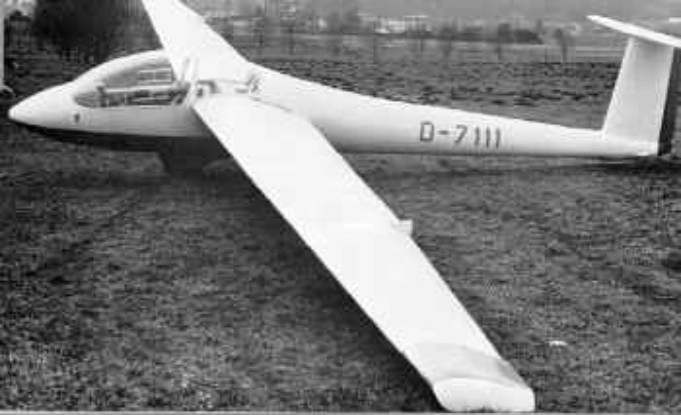
Designed by Walter Stender and Ursula Hanle and originally known as the Schulmeister, this side-by-side two-seater training sailplane first flew in prototype form on 28 July 1977, and production began in March 1978. The Globetrotter is a cantilever mid-wing monoplane of 17m span with a T-tail, and mainly of glassfibre reinforced plastic construction. The wings have an Eppler E 603 aerofoil section and are swept forward 2° 30′; air brakes are fitted in the upper surfaces, and there is provision for water ballast. Landing gear consists of a non-retractable monowheel and tailwheel, and the two pilots sit under a one-piece canopy that slides forward to open over the tip of the nose.
Only one was built.
Wing span: 17 m
Wing area: 15.8 sq.m
Aspect ratio: 18.29
Airfoil: Eppler 603
Empty Weight: 400 kg
Gross Weight: 600 kg
Wing Load: 38 kg/sq.m
L/DMax: 36 100 kph
Min Sink: 0.65 m/s 80 kph
Seats: 2
Span: 55 ft 9.25 in
Length: 25 ft 1.5 in
Height: 3ft 5.25 in
Wing area: 170.1 sqft
Aspect ratio: 18.3
Empty weight: 639 lb
Max weight: 1,102 lb
Max speed: 155 mph
Min sinking speed: 2.13 ft/sec at 50 mph
Best glide ratio: 36:1 at 62 mph
Start + Flug H-111 Hippie
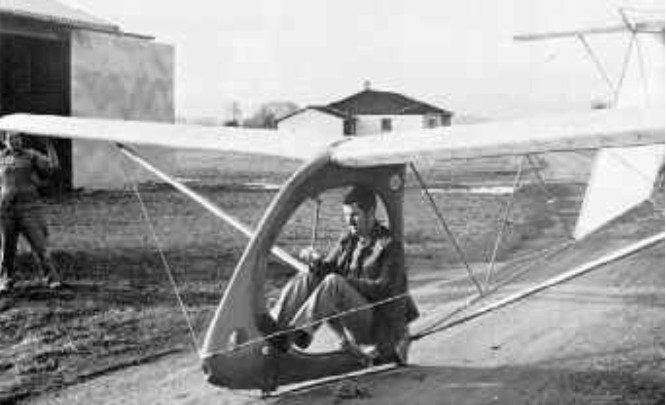
Designed by Ursula Hanle, this simple ultra-light single-seat glider weighs only 106lb without the pilot and is designed to achieve take-off by a variety of methods: by foot-launch, auto-tow, winch launching or any other suitable form of assisted launch.
It has strut-braced dihedral wings of constant chord with small endplate-type fairings and Wortmann aerofoil sections. The basic structure is of glassfibre with carbon-fibre reinforcement; the wings are plastic-covered and the tail surfaces fabric-covered, the tail being carried on an open girder-type framework, and the braced tailplane being mounted on the large fin. The landing gear is formed by the glassfibre seat fairing which has a small keel surface underneath it, and there is a metal hoop at the base of the rudder to form a tailskid. The pilot sits behind a windscreen extending from the leading edge to the front of the seat fairing.
For a foot-launch the product of the hill’s angle in degrees and the wind speed in metres per second should be a figure of 80 or above. After foot-launching, the pilot draws up his legs into the hoop-like glassfibre seat fairing at the front of the aircraft, which also serves as the landing skid.
The Hippie flew for the first time on 15 August 1974 and examples were flying in five countries outside Germany.
The airframe can be dismantled and packed into a carrying case measuring 5m (16ft 4.75in) by 1.10m (3ft 7.25in) by 0.60m (1ft 11.75in).
A new version of the Hippie was available, with wings of honeycomb construction, a longer tail structure of aluminium tubing, an enlarged rudder, quick-connect fittings and an enlarged seating area for the pilot.
35 were built.
Wing span: 10 m / 32 ft 9.75 in
Wing area: 9 sq.m / 96. 9sq ft
Length: 18 ft 8.5 in
Height: 4 ft 7 in
Empty Weight: 48 kg / 110 lb
Gross Weight: 133 kg / 298 lb
Wing Load: 14.8 kg/sq.m
Max speed: 37 mph
Aspect ratio: 11.11
Airfoil: FX S 02
L/DMax: 12 at 45 kph
Min Sink: 1.3 m/s 40 kph
 All Aero