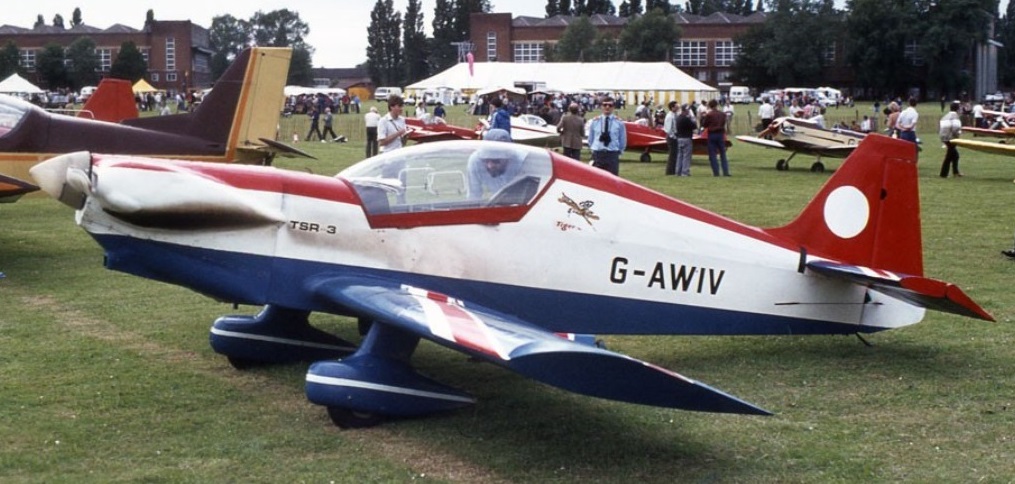
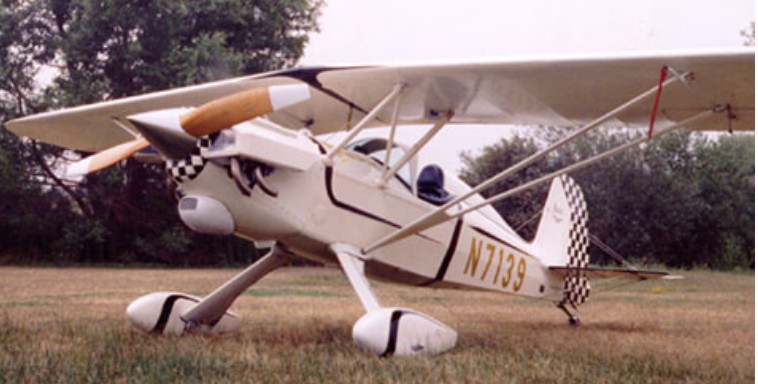
Designed in 1968 by Tom Story as a single-seat racer. It was built at Redhill, UK, and first flew there on 25 July 1968. Registered G-AWIV PFA.1325, it was later stored at the builders’ home awaiting rebuild.
Engine: Continental C90 Wingspan: 18.06 ft Length: 17.10 ft
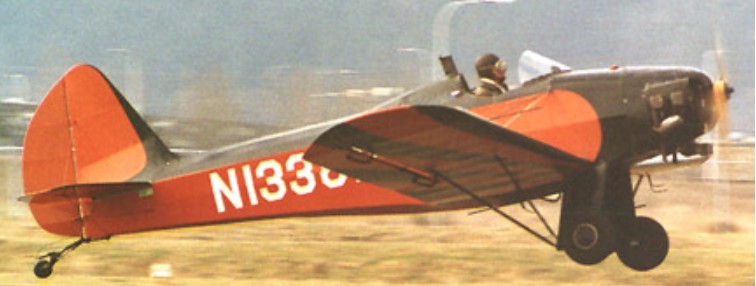
George Bogardus modified the Story Wimpy, calling it Little Gee Bee. He successfully flew across the country several times, and his efforts helped lead to the introduction of the Experimental/Amateur-Built category. About the time of Bogardus’ flights, a friend of Tom Story’s named George Andrus decided he wanted a similar plane. Story wanted one again, himself, so he struck a deal:. Andrus would supply the materials, and Story would do the welding.
The airplanes were built on the cheap…the severe cheap. Two A-65s were bought from the junkyard and given a rag overhaul. Andrus also bought the tubing for the metal fuselages from the junkyard. He didn’t have a pickup truck or a trailer, so he’d buy a crashed J-3, cut the tubing in lengths long enough to fit in the trunk of his car, then take it home for Story to weld.
The planes turned out well. They were almost identical to Little Gee Bee, except they were open-cockpit. Story kept S/N 1 for himself, and Andrus took S/N 2.
S/N 1 eventually got a canopy added…the plane still exists today, and is the spitting image of Little Gee Bee.
Andrus kept S/N 2 for several years, then decided to sell it in 1954. He advertised it for $600.
Cecil Hendricks, a young garage mechanic in Seattle, saw the ad. The plane was just perfect for him…but in the mid ’50s, $600 was a lot of money. He decided to look for three partners.
Unfortunately, he found only two. One of the potential partners liked the airplane a lot, though, and decided to buy two of the shares so they could buy the airplane.
The partner’s name? Peter M. Bowers.
Pete flew the Story for a number of years. When EAA announced their design contest, he started thinking. The Story was a fun airplane, but one of the factors in the contest was ease of building. The Story had some fairly complex weldments in it. It just wasn’t suited for the design contest requirements.
But Les Long has already proven the low-wing design was the most efficient. Pete decided to design a new airplane, of similar configuration as the Story, but all-wood in construction.
The result, of course, was the Fly Baby. The Fly Baby isn’t just a Story Special in wood…you can’t just replace a steel tube with a wooden longeron without a major design effort, and the Fly Baby landing gear is much simpler than the Story’s.
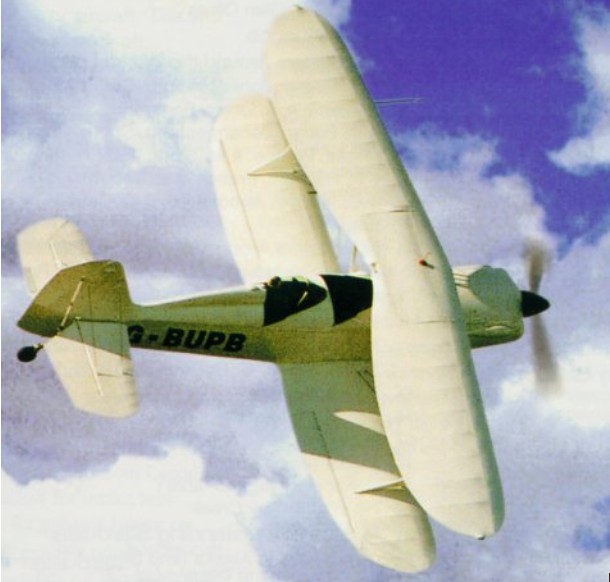
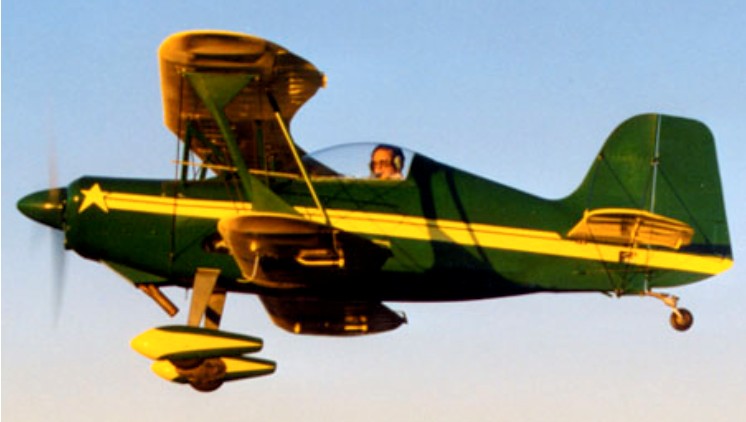
Designed by Jim Osborne & Morgan Schrack the Acroduster Too, originally called the Schrack-Stolp Super Star-duster Too, is a scaled-down 9/10 scale version of the Starduster Too and first flown in 1984. The Acroduster Too SA750 is a fully aerobatic, two-place machine stressed to plus & minus 9 G’s. It has modified symmetrical wings and is meant for minimum of 180 and up to 360 horsepower. It possible to remove the front windscreen, cover the front cockpit with a hatch cover, and add a sliding bubble canopy over the rear hole. The fuselage was also metalized back to the rear of the cockpit.
The optimum engine is the fuel-injected 200 HP Lycoming, with constant speed propeller. The prototype cruises about 160 mph, climbs 2300 fpm, and stalls at 55 mph. Although it has a comparatively sharp stall and sensitive control response, wings can be maintained in the level attitude with rudder alone or with aileron. This with stick full back by reducing power to idle and zero climb until stall is obtained.
Construction follows traditional biplane practices with steel tube structure and spruce wing spars. Ribs are plywood with cap strips.
All materials were available from Stolp Starduster Corporation, either in kit form or as raw materials.
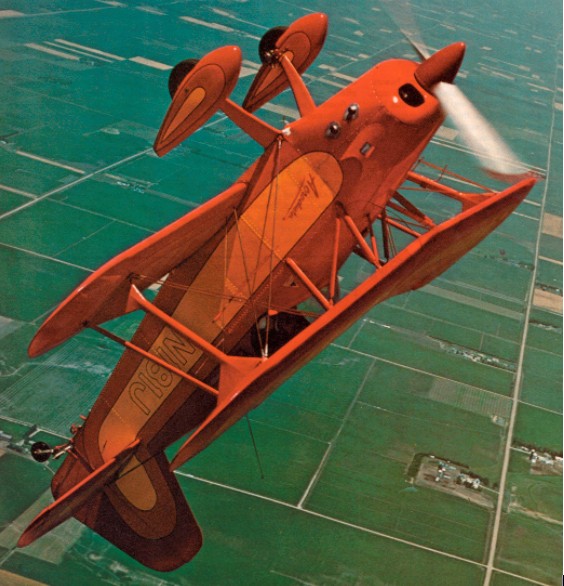
First introduced in 1973, the SA-700 Acroduster is a single-seat, fully aerobatic biplane suitable for engines in the 125-200 hp range. Its fuselage is an all-metal structure constructed from light alloy, and its wings are conventional two-spar structures with spruce spars, plywood ribs and fabric covering. A unique feature of the Acroduster 1 is that when the stick is pulled back, all four ailerons are raised slightly to help maintain aileron control when the airplane is stalled in a normal attitude. The opposite happens when the stick is pushed forward to aid control when the airplane is in an inverted stall.
The Acroduster uses com¬pletely separate wing panels pinned in the center with a pivot type joint and tied to the fuselage with an open stance ca¬bane that has four mounting points on the wings.
They are always building from a kit because Osborne won’t sell a set of plans without the com¬plete materials kit to keep them compa¬ny. The kit is literally a complete, but disassembled, airplane that needs only the engine and propeller. Even the motor mount and gas tank are completely fin¬ished and ready to nail in place.
Engine: Lycoming, 200 hp Height: 6.25 ft Length: 15.75 ft Wing span: 19 ft Wing area: 105 sq.ft Weight empty: 740 lb Gross: 1190 lb Aerobatic Weight 1050 lb Fuel cap: 25 USG Wing Loading 10 lb/sq ft Power Loading 5.25 lb/hp Speed max: 180 mph Cruise: 165 mph Stall: 70 mph ROC: 3000 fpm Service ceiling: 12,000 ft Seats: 1 Landing gear: tail wheel
Aerovant Aircraft Corp Acroduster I Engine: Lycoming, 200 hp Height: 6.3 ft Length: 15.8 ft Wing span: 19 ft Wing area: 105 sq.ft Fuel capacity: 25 USG Empty weight: 740 lb Gross weight: 1190 lb Top speed: 180 mph Cruise: 165 mph Rate of climb: 3000 fpm Service ceiling: 12,000 ft Seats: 1 Landing gear: tailwheel
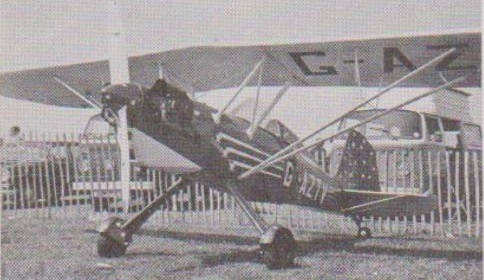
First flown in 1968, the Starlet is a single-place parasol-winged monoplane. This ship was originally designed by Lou Stolp to handle a Volkswagen engine but now has been modified to house small air¬craft engines. Engines most commonly used are the VW 1500 or the 108-hp Lycoming.
Construction follows standard Stolp Starduster practice. All basic structure except the wing is made of 4130 steel tubing. The wing uses spruce spars and plywood ribs with cap strips. The airfoil is a Clark Y, High-Lift. Optimum engine is the 108 HP Lycoming; however, engines of 85 HP to 125 HP may be used. The Starlet will fly well with Rotax, Subaru, Suzuki, or Continental engines.
The drawings are quite complete and easy to follow, with ribs printed to full size. The drawings are printed on an offset press so they will not fade and shrinking is held to a minimum.
All material kits are available from Stolp Starduster Corporation at reasonable prices. In addition, we can furnish fabricated wings ready to cover, complete welded assembly, turtlebacks, nose cowls, wheel pants, windshields, aluminum fuel tanks, etc.
Sid Miles G-AZTV, Sywell, UK. The first to fly in UK
The Starlet SA500 is easy and economical to build and fun to fly. It is stable and relatively fast. The parasol wing makes it especially suitable for operating out of rough field. Although a small airplane, the Starlet has a roomy cockpit suitable for a large adult.
Kits and plans were marketed for home-builders for $35.00.
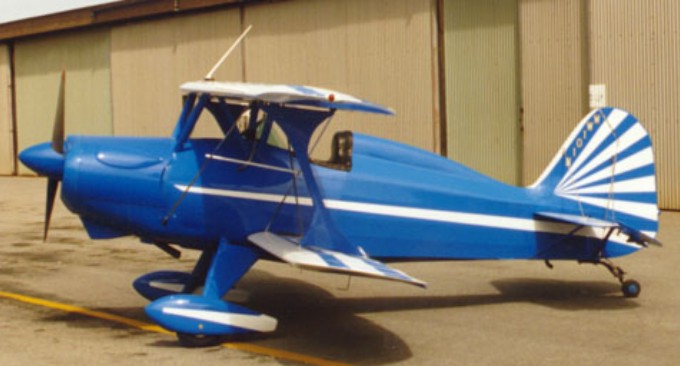
Designed by Lou Stolp and first flown in 1971, the Starduster Too was built to fill a need for a reasonably sized, two-place, open sport biplane. It was built to fly just for fun and is not intended to be an aerobatic airplane. It is quite strong, however, and many owners use the aircraft for aerobatic flight, but this is beyond the original concept of the machine. The aircraft is rated +/- 6G. Stability is good and the light wing loading makes slow landing speed and short-field operation outstanding.
The main structure of the airplane is built of 4130 steel tubing, wood faired and fabric covered, and sheet stock and has no machined fittings or other complicated bends, which is an advantage for the average homebuilder with limited machine equipment to use. The wings have spruce spars and the ribs are made of 1/4″ plywood using a modified M-6 airfoil and fabric cover. All four wings carry ailerons. Construction of the plane has been kept as simple as possible.
Starduster Too
The prints are quite complete with ribs and most fittings full size, which saves considerable time on construction of these parts.
The O-360 Lycoming is the best optimum size engine either in the 180 HP or the 200 HP version. Quite a few Starduster Too aircraft have been constructed with the Lycoming IO-540, with as much as 375 HP. There are Ranger powered, Ford V-8 and V-6 powered, Continental powered, Jacobs, and even some R-985 powered examples. The airframe is a proven unit and allows for many different types and kinds of engines. On the low end of the power curve there are some 125 HP aircraft in service. Stolp recommends the 180-hp Lycoming with a constant-speed prop as the Optimum powerplant. There are several aircraft with over 2,500 flying hours, and one with more than 5,000 hours.
All raw materials as well as certain prefabricated parts (such as fiberglass turtlebacks, nose cowls, wheel pants, cockpit cowlings, welded aluminum fuel tanks, plexiglass windshields, canopies, and so forth) are available at reasonable prices.
Variation: Neubert Nostalgia
Engine: Lycoming, 180 hp HP range: 159-300 Height: 7.5 ft Wing span: 24 ft Fuel cap: 44 USG Weight empty: 1000 lb Gross: 1985 lb Speed max: 148 mph Cruise: 130 mph Range: 600 sm Stall: 50 mph ROC: 1800 fpm Take-off dist: 700 ft Landing dist: 1000 ft Service ceiling: 16,000 ft Seats: 2 Landing gear: tail wheel
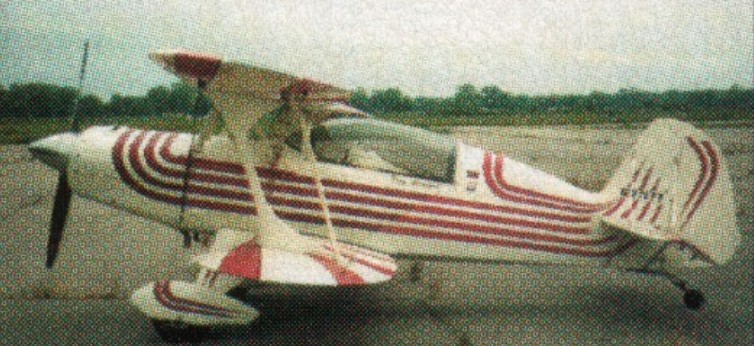
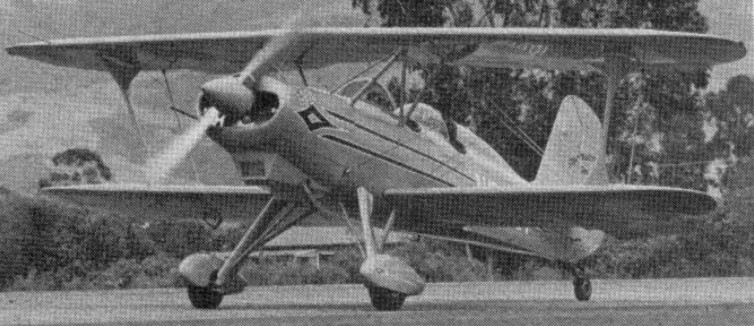
Designed by Lou Stolp, this single-place member of the Stolp family is the younger brother to the two-place Starduster Too. The Starduster is intended for the Lycoming 125-hp engine, but it has been built with engines ranging from 85 to 170 hp with a constant-speed prop. The 125 to 160 hp range is optimal.
The Starduster One SA100 was built to fill a need for a single-place, open sport biplane. It was built to fly just for fun and is not intended to be an aerobatic airplane. It is quite strong, however, and many owners use the aircraft for aerobatic flight, but this is beyond the original concept of the machine.
The main structure of the airplane is built of 4130 steel tubing and sheet stock and has no machined fittings or other complicated bends, which is an advantage for the average homebuilder with limited machine equipment to use. The wings have spruce spars and the ribs are made of 1/4″ plywood using a modified M-6 airfoil. Construction of the plane has been kept as simple as possible and it goes pretty well.
The prints are quite complete with ribs and most fittings full size, which saves considerable time on construction of these parts.
Markets plans and kits to build a range of very well-known aircraft, as the SA-101 Starduster single-seat biplane, SA-300 Starduster Too tandem two-seat biplane (first flown 1957), SA-500 Starlet single-seat high-wing monoplane (first flown 1969), SA-750 Acroduster Too tandem two-seat aerobatic biplane (first flown 1973), and aerobatic SA-900 V-Star (single-seat biplane development of Starlet).
The Seabee inspired a number of follow-on designs, including the “Twin Bee”, a twin-engine conversion implemented by Joseph Gigante and his United Consultants (later STOL Aircraft) firm at Norwood Airport near Boston and sold by Seaplane Services, Meredith.
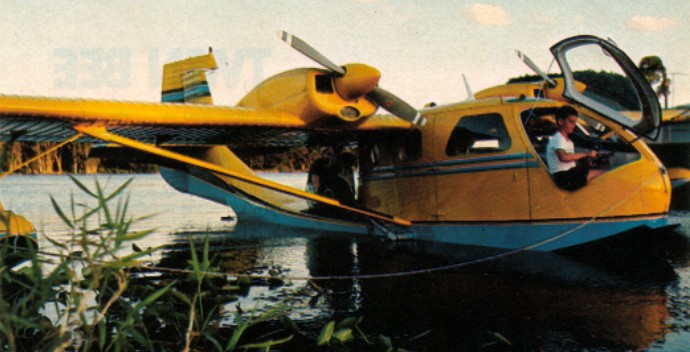
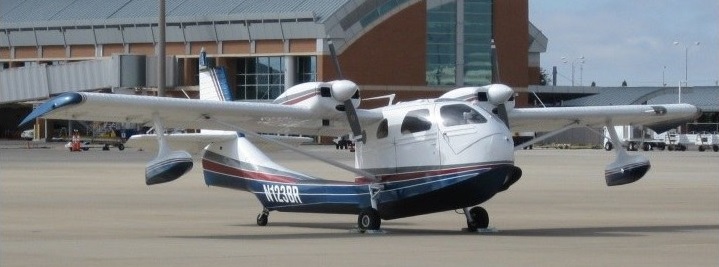
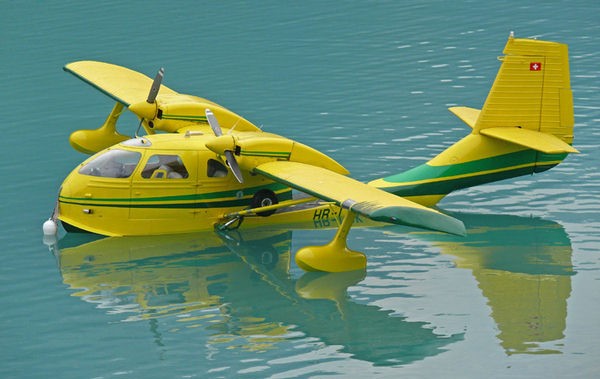
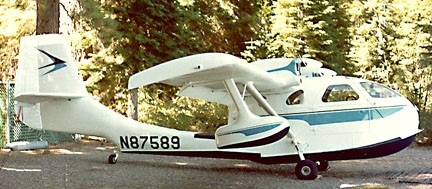
Designed by Joseph W Gigante, United Consultants added three foot wing root extensions on each side, plus a three foot center fuselage plug. The airframe is zero-¬timed, and all of the hydraulics, cables, instruments and furnish¬ings are new. Capping the makeover are two Lycoming IO-360-B1D 135 kW / 180 hp fuel injected engines driving two-bladed Hartzell variable propellers in tractor configuration on each wing. Two 180hp Lycoming O-360-A1A tractors originally in the 1960 built prototype N87588, IO-360-B1D for production (A6EA).
United Twin Bee N123BR
The result had center of gravity problems, which were solved by increasing the size of the fuel tank and installing a new fuel tank in the tailboom, which increased range at the expense of some fiddling with fuel management during a flight.
The Twin Bee is fuelled at the left rear of the cabin wall, direct¬ly above the 85 USG main tank in one of the keel compart¬ments. There’s a 16 USG auxiliary tank in the tail, just below the elevator. While an access panel leads to the auxiliary tank’s fuel cap, you customarily fill it by transferring fuel from the main. A single switch on the panel operates a valve and pump that move fuel in either direction between the two tanks.
The two seats in the second row can be replaced by a bench seat for three, the rearmost solo seat between the two portholes provides a little less space; it’s a nice place for a child to sit.
The doors hinged on the rear instead of the front. Changing the door hinge from front to rear was motivated by the need to keep the occupants from stepping out into the prop arc. The doors were implemented with additional latching and warning lights to indicate if they weren’t locked.
The first conversion was performed in 1960 built in the old hangars of Helio Aircraft at Norwood Airport, MA, In her original configuration, the prototype had two 180 hp Lycoming O-360-A1A engines, and made her first flight in 1960 with a Helio test pilot at controls. Later most test flights were made by test pilot Peter Annis. During development, engine model was changes to injection type, the cowlings were redesigned and the tail control surface areas were increased.
After extensive flight tests for five years, the UC-1 Twin Bee was awarded the US FAR Aircraft Type Certificate No: A6EA on 25 June 1965. The first production aircraft was delivered one year later.
Conversion is accomplished by replacing the Seabee’s original 215 hp Franklin engine by two 180 hp Lycoming IO-360-B1D engines, driving 2-blade CS/feathering tractor propellors. The original wing span is increased by 6 ft, to 43.33 ft, by adding a 3-foot wing-root extension on each side. The hull is stretched 3 ft by inserting a “plug” just aft of cabin, to counter-act shift of CG. Further the rudder/trim-tab area is increased according to the increased power. The fuel capacity is increased from 75 US gal to 101 US gal by the addition of a new 85 US gal main fuel tank above step and 16 US gal fuel tank in the tail boom. The instrument panel, and the seat tracks, are moved forward to allow a fifth seat in the original cargo area.
23 updates sold from 1965 to 1987, the last one in 1987.
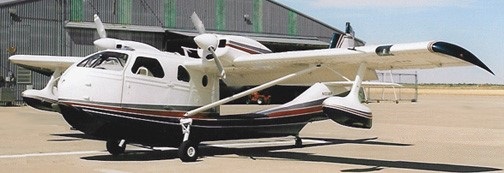
United Twin Bee N87589
UC-1 Twin Bee Engines: two Lycoming IO-360-B1D 135 kW / 180 hp Wingspan: 43’3″ Length: 31’4″ Useful load: 1300 lb Max speed: 147 mph Cruise speed: 131 mph Stall: 38 mph Range: 900 mi Ceiling: 19,000 ft Seats: 5





 All Aero