Sud-Est SE.3101

SE.3101

The first all-French helicopter to be designed and built after World War 2, SNCA du Sud-Est’s single-seat SE.3101 was powered by an 85hp Mathis engine and flew for the first time on 1 June 1948.

This experimental helicopter was to study the placing of auxiliary rotors intended simultaneously to provide torque correction and longitudinal control. Two rotors, with compressed wood blades 1.6m in diameter, were placed symmetrically at 45°, one on each side of a V-shaped beam at the end of the fuselage, which was made of soldered tubes without a skin covering. These variable-pitch airscrews enabled the aircraft to be steered by varying their pitch differentially.

There then followed the 2-seat SE.3110 (F-WFUE), which had a 200hp Salmson 9 NH piston engine.

SE.3101

Sud-Est SE.3101
Engine: 1 x Mathis 4GB 20, 82kW
Main rotor diameter: 7.50m
Length: 6.90m
Max take-off weight: 520kg
Empty weight: 400kg
Max speed: 120km/h
Cruising speed: 95km/h
Service ceiling: 3000m
Range: 100km

Sud-Est SE-2300 / SE-2310 / SE-2311

Sud-Est SE-2310

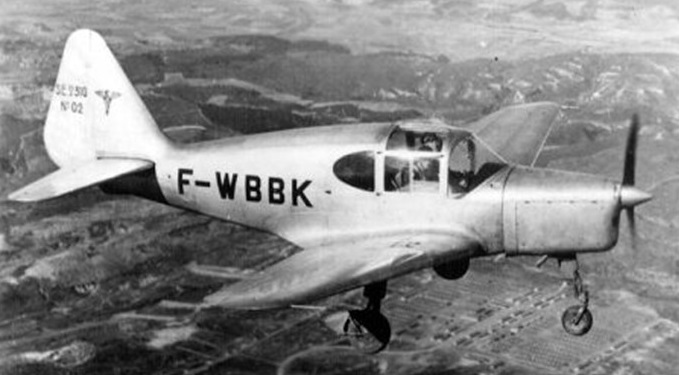
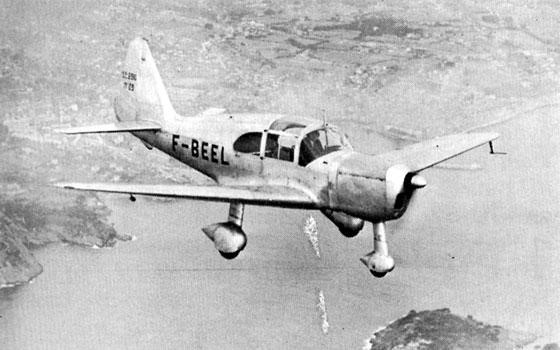
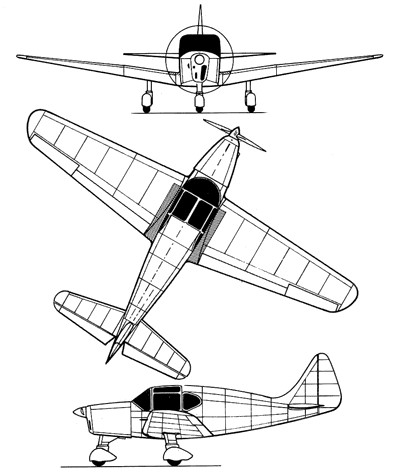
Pierre Satre began the SE-2300 design during World War II as a conventionally laid out, all metal, two seat, single engine cantilever monoplane, with tapered low wings having 4° of dihedral built around inverted U-section main and auxiliary spars. The wings had a centre section integral with the fuselage and two outer panels, all covered with electrically welded skin. There were plain flaps, with a maximum deflection of 40°.

The fuselage of the SE-2300 was constructed from four pre-formed panels welded together. A 140 hp (104 kW) Renault Bengali 4 four cylinder, inverted, air-cooled inline engine, fed from a fuselage tank, drove a two blade propeller. The over-wing cabin seated two side-by-side with dual controls. Behind these seats was space for a third (optional in the SE-2300 and standard in the SE-2310 variant) and baggage. There were access doors and rear view transparencies on both sides. At the rear, the tailplane was mounted at mid-fuselage and the fin and deep rudder were straight tapered except near the keel and almost triangular above the fuselage.

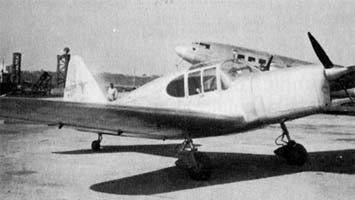
The first and only SE-2300 first flew on 26 October 1945 and had a fixed conventional undercarriage with oleo-pneumatic springing, faired main legs and wheels and a swivelling tailwheel. The two SE-2310s had tricycle undercarriages, the first unfaired but the second with faired legs and spats.

SE.2310

With a four seat version, the SE-2311 under development but unbuilt, the three seat SE-3010 was entered into a 1946 French Transport Ministry contest for a four seat tourist aircraft in February 1946. It was not successful, the award going to the Nord 1200 Norécrin and development of the SE-2300 series was abandoned. The last example remained in use until at least 1956 as a company hack.

SE-2300

Gallery

SE-2300
Original version
Engine: 140 kW (190 hp) Renault 4 Pei
Propeller: 2-blade, 1.90 m (6 ft 3 in) diameter wooden
Wingspan: 10.13 m (33 ft 3 in)
Wing area: 15.0 m2 (161 sq ft)
Length: 7.40 m (24 ft 3 in)
Height: 2.11 m (6 ft 11 in)
Empty weight: 685 kg (1,510 lb) equipped
Gross weight: 1,015 kg (2,238 lb)
Maximum speed: 235 km/h (146 mph; 127 kn)
Cruising speed: 212 km/h (132 mph; 114 kn)
Range: 900 km (559 mi; 486 nmi)
Service ceiling: 4,650 m (15,256 ft)
Wing loading: 67 kg/m2 (14 lb/sq ft)
Power/mass: 0.10 kW/kg (0.063 hp/lb)
Landing speed: 75 km/h (47 mph; 40 kn)
Landing distance: 300 m (985 ft) from 8 m (26 ft) with flaps down
Seats: two or three
conventional undercarriage.

SE-2310/11
Engine: 170 hp Regnier 4 L-00 LO-2
Three seats

SE-2310/111
Engine: 135 hp Regnier 4
faired undercarriage legs and wheels.
Three seat

Sud-Est SE-2100

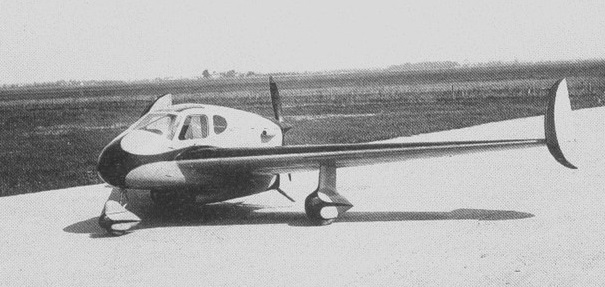
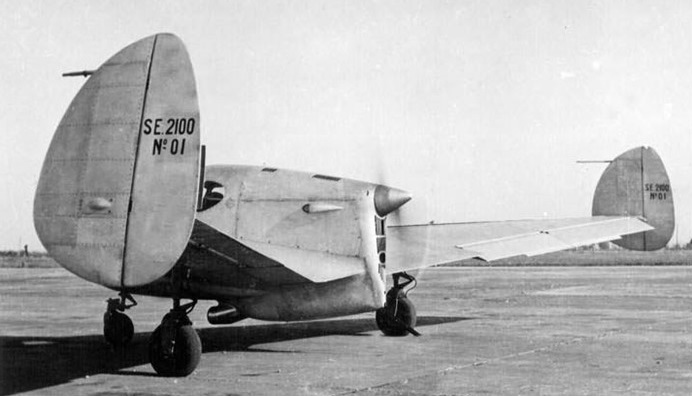
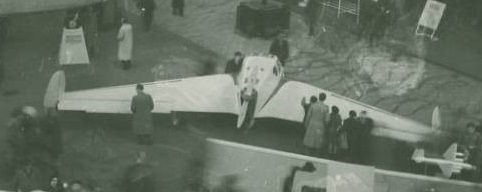
The Sud-Est or SNCASE SE-2100, sometimes known as the Satre SE-2100 after its designer, Pierre Satre, later the chief designer of the Concorde, at the end of World War II. An all-metal tailless, pusher configuration aircraft, it had a low, cantilever, straight tapered wing with 55° of sweep on the leading edge and 10.43° of dihedral. There were fixed leading edge slots and trailing edge ailerons but no conventional flaps. The wing tips carried large, rounded fins with rudder-like rear portions which only moved outwards; they were used differentially for yaw control and jointly as flaps.

The SE-2010 had a short, blunt nosed nacelle-type fuselage with a cabin which could be configured to seat one centrally or two in side-by-side, dual control configuration. The seats were just aft of the leading edge, with a baggage compartment behind them. Access was via deep, wide, forward hinged doors on both sides; to make this possible, a piece of the wing root leading edge was an integral part of each door. A 140 hp (104 kW) Renault Bengali 4 four cylinder, inverted, inline engine was mounted in pusher configuration behind the cabin and aircooled via a ventral scoop; it drove a two blade propeller positioned just behind the trailing edge. The SE-2100’s fixed, tricycle undercarriage had pneumatic shock absorbers and mainwheel brakes; the nosewheel was free-swivelling. At different times the undercarriage legs and wheels were unfaired or faired.

The only SE-2010 built flew for the first time on 4 October 1945 at Toulouse. The test pilot was Mr. Pierre Nadot (test pilot of the S.N.C.A.S.E.-Société Nationale de Constructions Aéronautiques du Sud-Est).

The aircraft was still existed in 1952.

Gallery

Engine: 1 × Renault Bengali 4Pei, 140 kW (190 hp) at 500 m (1,640 ft) and 2,400 rpm
Propeller: 2-bladed, 1.90 m (6 ft 3 in) diameter wooden
Length: 4.92 m (16 ft 1 in)
Wingspan: 9.89 m (32 ft 5 in)
Height: 1.89 m (6 ft 2 in)
Wing area: 15.11 m2 (162.6 sq ft)
Airfoil: S.T. Ae.230 (Abrial-3) at root, NACA 009 at tips
Empty weight: 518 kg (1,142 lb)
Gross weight: 800 kg (1,764 lb)
Fuel capacity: 144 L (31.7 Imp gal; 38.0 US gal)
Maximum speed: 226 km/h (140 mph; 122 kn)
Cruising speed: 198 km/h (123 mph; 107 kn)
Range: 500 km (311 mi; 270 nmi)
Service ceiling: 5,000 m (16,404 ft)
Wing loading: 52.83 kg/m2 (10.82 lb/sq ft)
Landing speed: 90 km/h (56 mph; 49 kn)
Crew: Two

Sud-Est S.E.1010

Ordered by the French Ministère de l’Air (Ministry of Aviation) the S.E.1010 high-altitude photographic survey aircraft was designed and constructed by the SNCASE (Société Nationale de Constructions Aéronautiques du Sud–Est) at Marignane.

Powered by four 1,590 hp SNECMA (previously Gnome–Rhône) 14R-28/29 radials and registered F-WEEE, the aircraft was first flown from Marignane by a crew led by test pilot Jacques Lecarme on 24 November 1948.

Intended for high-altitude photography, The SE 1010 was based on the 1944 SE 1000 trans-Atlantic postal aircraft project. Intended foe the Institut Geographique National, the aircraft was complete with darkroom.
It carried seven cameras of which four could be used simultaneously from two vertical and two oblique stations.

The SE 1010 was intended to operate from short fields under primitive conditions and provision was made for the carriage of tools, engine and prop parts, and even spare main an tail wheels.

The crew of 4-6 were in pressurised accommodation, and the aircraft was entirely metal.

The aicraft used Mercier wing tip ailerons with hinge lines at approximately 45 deg to the fuselage centre line, these permitting the installation of flaps along almost the entire trailing edge of the wing.

Four aircraft were ordered and construction of a small production batch was started in 1949. The first, F-WEEE, was flown for the first time on 24 November 1948.

During a test flight on 1 October 1949, the aircraft entered a flat spin, from which it did not recover, the six crew were killed, including test pilot Henri Vanderpol. Subsequently the Ministère de l’Air revised its opinion of piston engines on future aircraft and the project was abandoned.

Engines: 4 x Gnome-Rhone 14R 28/29, 1590 hp
Wingspan: 101 ft 8.5 in / 31 m
Wing area: 1251.84 sq.ft / 116.2 sq.m
Length: 71 ft 6.5 in / 21.81 m
Height: 17 ft 0.75 in / 5.2 m
Empty weight: 39,022 lb / 17,700 kg
Normal loaded weight: 60,186 lb / 27,300 kg
Max speed: 323 mph / 520 kph at 26,250 ft / 8000 m
Eco cruise: 249 mph / 400 kph at 26,250 ft / 8000 m
Max range: 3915 mi / 6300 km

Sud-Est

Societe Nationale de Constructions Aeronautiques du Sud-Est
SNCASE

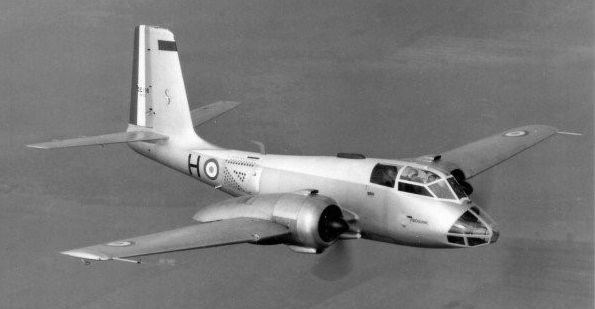
In France, the Socialist Government of the so called Popular Front brought all the companies building military aircraft, aero engines and ar¬mament under its control in 1936. The im¬mediate result was the socialized oblivion of such established companies as Marcel Bloch, Bleriot, Nieuport, Potex, Dewoitine, Hanriot and Farman within half a dozen nationalized groups or Societies Nationales, named ac¬cording to their geographical location (Nord, Ouest, Centre, Midi and so on). Liore-et-Olivier, Potez, Romano, and SPCA formed SNCASE in 1936. Sud-Est was a nationalised company that had taken over manufacture from Bloch.

Company thus became responsible for development and production of LeO.45 twin-engined bomber, first flown January 1937, outstanding in many points of design and much used and adapted during and after Second World War. Built also Romano trainers and LeO.43 catapult floatplane, of type first flown December 1934.

In 1941 the company absorbed SNCAM. Early post-Second World War products included Languedoc four-engined airliner, developed from Bloch 161 of 1939, which entered service between Paris and Algiers in 1946, and was ordered additionally for military use.

Dewoitine joined SNCASE in 1942.

After World War II, although four of the nationalized groups continued operating un¬der state control, private companies were al¬lowed to resume the design and manufacture of both civil and military aircraft. Some of the pioneering names of French aviation, such as Breguet and Morane Saulnier, returned to prominence, and by 1950 a new one had been added Avions Marcel Dassault.

Military types in development included Grognard twin-jet attack aircraft of 1950; the unique trolley-launched skid-landing Baroudeur strike aircraft of 1953; and Mistral and Aquilon developments of the British de Havilland Vampire and Sea Venom. Especially notable original developments were the Alouette helicopter series first flown in 1951, and the rear-engined twin-jet Caravelle in 1955.

Until 1 September 1956 known as Societe Nationale de Constructions Aeronautiques du Sud-Est (SNCASE). On the 1st September 1956 the S.N.C.A. du Sud-Est was merged with the S.N.C.A. du Sud-Oest into Sud-Aviation.
Sud-Aviation SA-610 Ludion

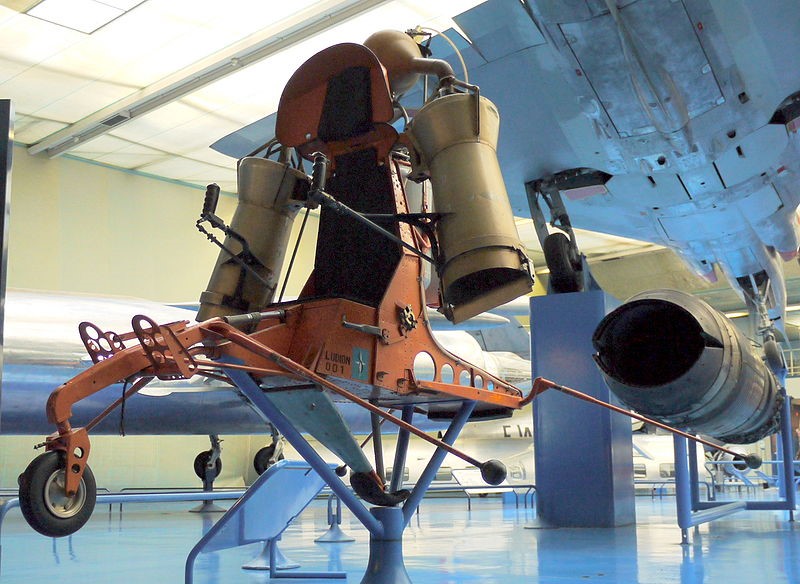
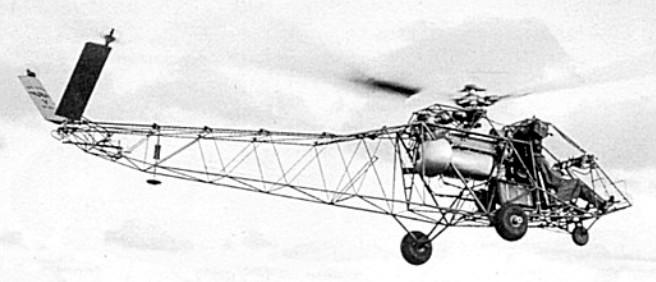
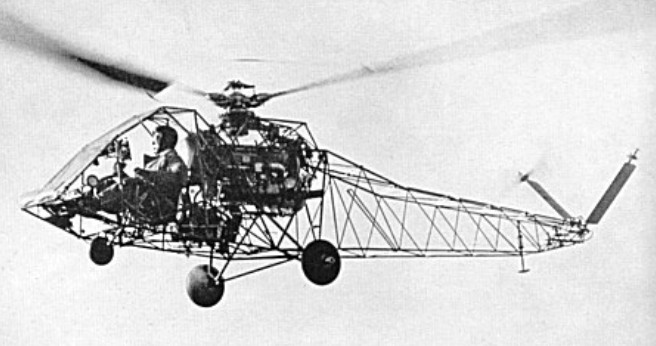
The Sud Aviation/Aérospatiale SA-610 Ludion (Ludion – Cadet) was a tiny, unorthodox VTOL aircraft demonstrated at the 1967 Paris Air Show. It consisted of little more than a chair, behind which were mounted two downward-pointing augmented rocket engines with control provided by thrust vectoring. The Ludion was intended to carry its pilot and 30 kg (66 lb) of equipment up to 700 m (2,300 ft) at an altitude of up to 200 m (600 ft).

The unusual powerplant consisted of a monofuel de-composition chamber fed with pressurised isopropyl nitrate (AVPIN), ignited by a catalyst. The high pressure gasses produced in the de-composition chamber were fed to two augmentor tubes, built by Bertin, either side of the pilots seat, angled slightly outwards. As the gasses entered the augmentor tubes through rocket nozzles, thrust was augmented by inducing airflow through the ducts which acted as aero-thermo-dynamic ducts, due to the heat and kinetic energy added to the flow through the ducts, and the carefully shaped exhaust nozzles.

SA-610 Ludion
Powerplant: 1 × SEPR S178 isopropyl nitrate (AVPIN) decomposition gas generator with augmentor tubes
Length: 1.95 m (6 ft 5 in)
Width: 1.485 m (4 ft 10 in)
Height: 1.6 m (5 ft 3 in)
Empty weight: 90 kg (198 lb)
Gross weight: 170 kg (375 lb) approx
Capacity: payload 30 kg (66 lb)
Crew: 1
Ceiling: 700 m (2,297 ft)

Sud-Aviation SE.3131 Gouverneur

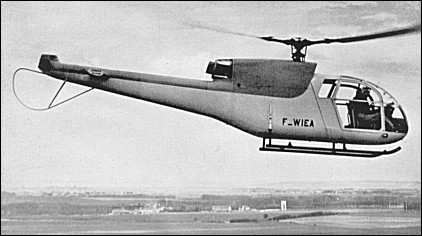
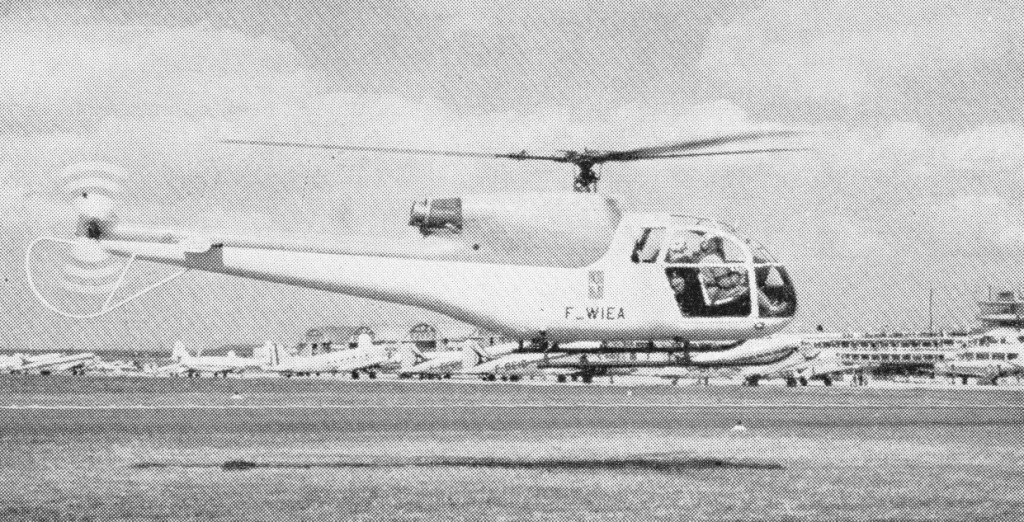
This new helicopter, which was brought out as a product of Sud Aviation, first flew on 10 May 1957 (F-WIEA). It was introduced to the public during the French International Air Show at le Bourget soon afterwards. It basically an Alouette II with an Artouste engine, covered fuselage and executive cabin seating 5 occupants including the pilot, by the well-known expert Loewy.

Streamlining gave the Gouverneur improved cruising speed.

Both the main and the anti-torque rotor are taken from the Alouette, but to protect the latter, a bow-shaped tail skid is provided. Much thought has been given to making the Gouverneur’s cabin as comfortable as possible, particularly by means of sound-proofing.

Engine: 1 x Turbomeca Artouste II
Rotor diameter: 10.2m
Length: 9.7m
Fuselage width: 2.08m
Gross weight: 1500kg
Empty weight: 925kg
Cruising speed: 195km/h
Absolute ceiling: 4600m
Range: 600km
Seats: 5

Sud-Aviation

Formed 1 March 1957 by amalgamation of Ouest-Aviation (SNCASO) and Sud-Est Aviation (SNCASE). Main responsibility was further development and marketing of highly successful S.E.210 Caravelle twin-jet airliner, first flown in 1955, and Alouette series of helicopters. Continued also development of S.E.5000 Baroudeur, S.O.9050 mixed-power interceptor and widely used S.O.4050 Vautour twin-jet multipurpose aircraft. Frelon series of large turbine-powered helicopters developed after first flight in February 1959, and Super Frelon flew December 1962, setting new world records. In 1965, Morane-Saulnier became a subsidiary of Sud-Aviation. Design leadership in A300 European Airbus assumed and diversification into non-aeronautical fields undertaken. Jointly with Nord Aviation made Corvette light rear-engined jet transport.

On January 1st, 1970 became major component of Aerospatiale, with Nord-Aviation and SOCATA, and the missile manufacturing company, SEREB.