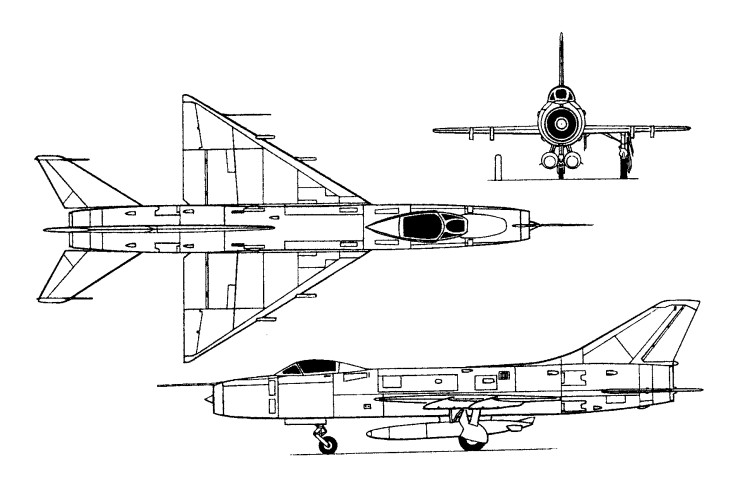
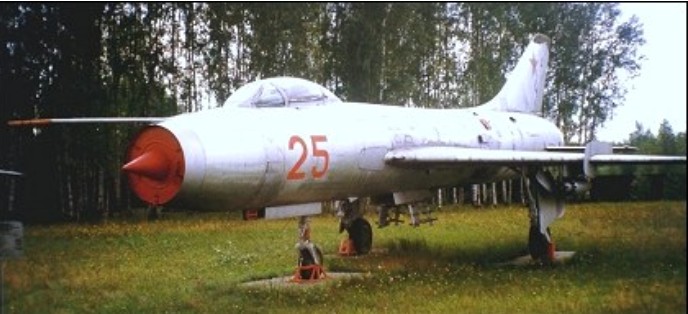
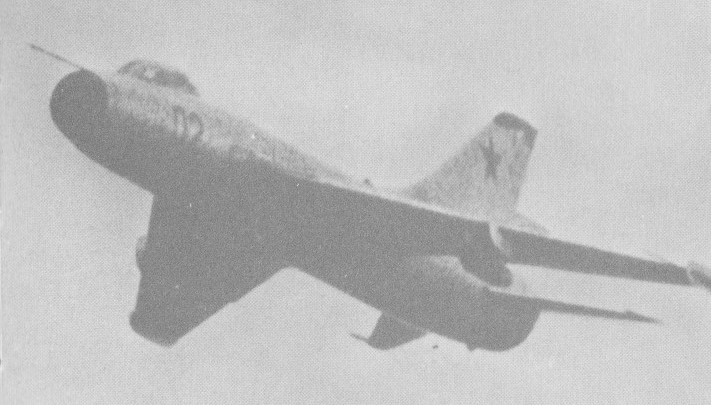
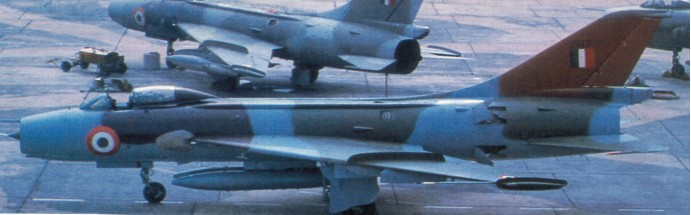
The Su-9 ‘Fishpot-B’ developed in the late 1950s was a successful fighter with just over 1,000 aircraft produced between 1957 and 1962. The limited range of the TsD-30T radar and K-5MS led Sukhoi to develop the Su-11 with new Oryol radar and K-8M missile.
Within a short timescale, the Pavel Sukhoi OKB succeeded in developing a successful limited all-weather single-seat interceptor fighter from the T-3 and its immediate derivatives. Assigned the designation Su-9, this interceptor was available to enter IA-PVO Strany service from 1961. The Su-9 was directly evolved from the T-4 series of prototypes, which, sharing the 57 degree delta wing and Lyulka AL-7F turbojet with the preceding prototypes, differed from one another in detail design, systems and equipment. With a single exception, the T-4 prototypes featured a circular nose intake with a translating centrebody to accommodate the S-band R1L search-and-track radar. The exception, the T-49, had a unique arrangement of box-type intakes flanking a slim, ogival nose radome.
The first T-4 series prototype, apparently designated T-401, entered flight test during 1957, and, in May 1960, an essentially similar aircraft, the T-405, established a new 100km closed-circuit record of 2092km/h. The definitive fighter development, the T-43, was first flown on 10 Sept 1957 as the T-431, and established a zoom climb altitude record of 28,850m on 14 July 1959. Three years later, the T-431 set both a sustained altitude record of 21,170m and a 500km closed-circuit record of 2337km/h.
Revealed at the 1956 Aviation Day at Tushino were large Sukhoi fighters; one with a swept wing (called Fitter by NATO) and the other a tailed delta (called Fishpot). Both were refined into operational types, losing some of their commonality in the process. The delta Su-9 fighter was used in large numbers as a standard Soviet (P-VO Strany) defensive fighter, replaced from 1968 by the Su-11 with long nose, large radar and inlet and new missiles. Code names of tandem trainers are Su-7U Moujik and Su-9U Maiden.
An all weather fighter aircraft. NATO code name ‘Fishpot-B’.
Series production of the T-43 as the Su-9 was launched in 1959, standard armament comprising four beam-riding K-5 AAMs on underwing pylons. Production of the Su-9 is believed to have exceeded 1,000 aircraft, and this type remained in Soviet service until the beginning of the ‘eighties.
Su-9 Type: single seat all weather interceptor Engine: 1 x Lyulka AL-7F single-shaft afterburning turbojet, 22,046 lb (10.000 kg) thrust Wingspan: 8.43 m / 28 ft 8 in Length: 16.70 m / 55 ft 9 in Wing area: 26.25 sq.m / 282.55 sq ft Height: 16 ft (4.88 m) Max take-off weight: 12000 kg / 26456 lb Empty weight: 8750 kg / 19291 lb Max. speed: 1915 km/h / 1190 mph Range with twin drop tanks: 900 miles (1450 km) Armament: four Alkali-air-to-air missiles on wing pylons: no guns
Su-9U Type: dual control trainer Engine: 1 x Lyulka AL-7F single-shaft afterburning turbojet, 22,046 lb (10.000 kg) thrust Range with twin drop tanks: 900 miles (1450 km)
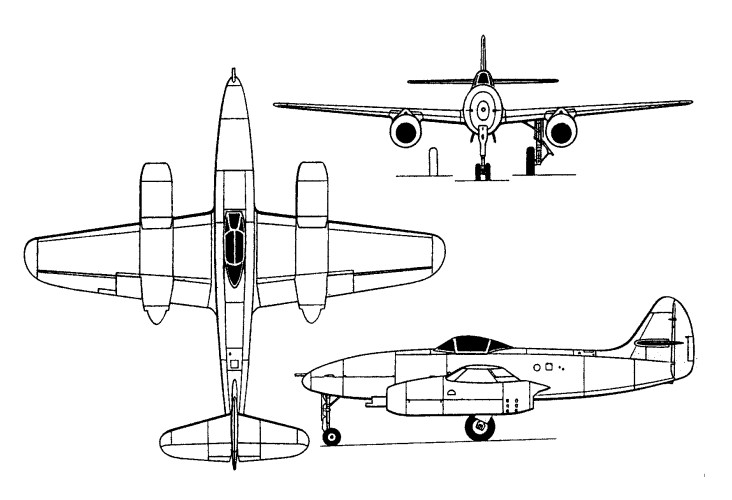
Displaying a close conceptual similarity to the Messerschmitt Me 262, the Su-9 single-seat fighter, also known as Samolet (Aircraft) K, entered flight test in the autumn of 1946. Of all-metal construction with a semi-monocoque, oval-section fuselage and single-spar wings, the Su-9 had an armament of one 37mm and two 23mm cannon, and was powered by 1,984 lb.s.t. (900 kgp) RD 20 turbojets (based on Junkers Jumo 004B turbojets). The Su-9 embodied a number of innovatory features including hydraulically-boosted control surfaces, a cordite-fired ejection seat, a variable-incidence tailplane, provision for assisted take-off rockets and a braking parachute. Racks under the centre fuselage permitted carriage of one 500kg or two 250kg bombs. The Su-9 was shown publicly over Tushino on 3 August 1947. It was subsequently claimed a 559 m.p.h. (900 km h) maximum speed was attained.
With completion of State testing in the following December, series production was recommended. However, although possessing no more than a superficial resemblance to the Me 262, its configurational similarity to the German fighter was a stigma which led Yosif Stalin to reject the Su-9 out of hand.
Su-9 (‘K’)
Engines: 2 x 1,984 lb.s.t. (900 kgp) RD 20 turbojet Max take-off weight: 6380 kg / 14066 lb Empty weight: 4060 kg / 8951 lb Wingspan: 11.21 m / 37 ft 9 in Length: 10.57 m / 35 ft 8 in Height: 3.72 m / 12 ft 2 in Wing area: 20.24 sq.m / 217.86 sq ft Max. speed: 900 km/h / 559 mph Range: 1140 km / 708 miles
The S 1, created by the newly resuscitated design bureau of Sukhoi and to demonstrate M = 2.05 early in its test programme, was the first dedicated interdiction and close air support fighter developed in the Soviet Union since WW2. While a small pre series was being built for service evaluation by the V VS TacAir component, the Frontovaya Aviatsiya (FA), as the Su 7, a second prototype embodying some aerodynamic refinement, the S 2, joined flight test, and it was this, in productionised S 22 (or S 2 2) form, that was to be ordered into large scale production in 1958 as the Su 7B.
With the change in the VVS FA heavy fighter requirement from a primary air-to-air role to that of ground attack, the Sukhoi OKB undertook revision of the basic S-2 “frontal” fighter as the S-22. Embodying some structural changes to cater for the primarily low-level mission, together with equipment and armament changes, the S-22 retained the highly sweptback (60 degrees at quarter chord) wing, circular-section fuselage and Lyulka AL-7F turbojet of the S-2 (Su-7). The first prototype of the ground attack fighter flew in April 1959. Preparations for series production of the S-22 as the Su-7B (the suffix letter signifying Bombardirovshchik) at Novosibirsk had begun prior to the prototype testing, thus allowing this ground attack fighter to enter the VVS FA inventory early in 1960.
The Su-7B possessed a gun armament of twin 30mm cannon, and four external stores stations (two fuselage and two wing) had a theoretical maximum ordnance load of four tonnes. The Su-7B was succeeded in 1961 by the Su-7BM (Modifikatsirovanny) with an AL-7F-1 turbojet, this engine, standardised for all subsequent versions, being rated at 7000kg boosted to 10110kg with afterburning.
The Su-7BM (S-22M) also introduced a revised fuel system with prominent external piping ducts along the upper rear fuselage. To improve rough field capability in a version designated Su-7BKL (S-22KL) the flaps were redesigned, provision made for ATO rockets and twin braking chutes, and a unique wheel-skid (kolyosno-lyzhnyi) undercarriage introduced. The main undercarriage members embodied small, extensible steel skids for use on soft ground and were accommodated, when retracted, in bulged bays.
Su-7BM
The definitive series model introduced in the mid ‘sixties and remaining in production into the early ‘seventies was the Su-7BMK – the suffix letters signifying modifitsirovanny kolyosny – with new mainwheel members (from which the skids had been eliminated) retracting into flush wheel wells. This modification was accompanied by upgrading of the avionics fit, provision of zero-zero ejection seat and standardisation on a further pair of wing stores pylons as introduced by late Su-7BKLs.
Revealed at the 1956 Aviation Day at Tushino were large Sukhoi fighters; one with a swept wing (called Fitter by NATO) and the other a tailed delta (called Fishpot). Both were refined into operational types, losing some of their commonality in the process. The highly swept Su-7B became the standard Soviet bloc attack aircraft, some thousands being supplied to all Warsaw Pact nations and to Egypt, Cuba, India, Syria, Hungary, Iraq and North Vietnam. There are many sub-variants, the -7BM being a STOL roughfield version. Code names of tandem trainers are Su-7U Moujik and Su-9U Maiden.
Su-7B
Though criticized for its poor payload/range capabilities, the Sukhoi Su-7 possessed the saving graces of excellent handling qualities, good low-level gust response and manoeuvrability. Remaining in service with 15 air arms in 1984, although almost replaced within Soviet front-line units, it has seen action on several occasion during wars in the Middle East and Indian sub-continent. First flown in 1955, the aircraft entered service four years later in its Su-7B form, under the NATO reporting name ‘Fitter-A’, and rapidly established itself as the standard fighter-bomber of the Soviet air force and some Warsaw Pact allies. Three progressively improved models followed, but featured insufficient changes to warrant a change of Western designation. In the Su-7BM, underwing stores pylons were doubled to four; the muzzle velocity of the internal cannon was increased; and an uprated engine was fitted, take-off power being further boosted, if required, by two JATO bottles, The aircraft also introduced a radar warning receiver in the tail and two duct fairings running long the spine. Rough-field operation was provided in the Su-7BU, whose large, low-pressure nosewheel tyre is betrayed by a blistered floor to its bay. Further changes of detail were incorporated in the later Su-7BMK, but little could be done to moderate the demands of the thirsty AL-7F engine, which on full afterburner at sea level would consume the entire 2940 litres (647 Imp gal) of internal fuel in a little over eight minutes, Even so, fuel capacity is reduced in the operational trainer versions (Su-7UM and Su7UMK, known to NATO as ‘Moujik’) to make way for a second seat, despite a slight lengthening of the fuselage.
Egyptian air force Su-7BMKstrike aircraft have been refitted with a British nav/attack system.
The Sukhoi bureau opted to consider variable geometry for an evolutionary development of the classic Su-7 ground-attack fighter, whose poor payload/range performance could perhaps be transformed by a limited form of variable geometry. It was clear that provision of full variable-geometry wings would require a structural redesign of the fuselage as well as the wings, and was thus impractical. The bureau therefore selected a partial variable-geometry layout in which only the outer wings were pivoted, and this arrangement was used on the S-221 prototype, which was evaluated as the Su-7IG. The modification radically improved the type’s payload/range equation, and the type entered production as a type known variously as the Su-17, Su-20 and Su-22 according to model and engine.
Finally withdrawn from VVS-FA first-line service in 1986, the Su-7B was supplied to Afghanistan, Algeria, Czechoslovakia, Egypt, Hungary, India, Iraq, North Korea, Poland, Romania, Syria, Vietnam and South Yemen.
Su-7B Type: single-seat close-support and attack Engine: 1 x Lyulka AL-7F single-shaft afterburning turbojet, 22,046 lb (10.000 kg) thrust Wing span: 29 ft 3.5 in (8 93 m) Length (including pitot boom): 57 ft (17.37 m) Height: 15 ft 5 in (4.70 m) Range with twin drop tanks: 900 miles (1450 km) Armament: two 30 mm NR-30 cannon, 70 rounds in wing roots, four wing pylons, inners rated at 1,653 lb (750 kg) and outers at 1,102 lb (500 kg), but when two tanks are carried on fuselage pylons total external weapon load is reduced to 2.205 lb (1000 kg)
Su 7BKL
Su-7BM Type: single-seat close-support and attack Engine: 1 x Lyulka AL-7F single-shaft afterburning turbojet, 22,046 lb (10.000 kg) thrust Wing span: 29 ft 3.5 in (8 93 m) Length (including pitot boom): 57 ft (17.37 m) Height: 15 ft 5 in (4.70 m) Empty wt: 19,000 lb (8620 kg) Max loaded wt: 29,750 lb (13,500 kg) Max speed at alt. clean: 1055 mph (1700 km/h, Mach 1.6) Initial climb: 29,900 ft (9120 m)/min Service ceiling: 49,700 ft (15.150 m) Range with twin drop tanks: 900 miles (1450 km) Armament: two 30 mm NR-30 cannon, 70 rounds in wing roots, four wing pylons, inners rated at 1,653 lb (750 kg) and outers at 1,102 lb (500 kg), but when two tanks are carried on fuselage pylons total external weapon load is reduced to 2.205 lb (1000 kg).
Su-7BMK ‘Fitter-A’ Type: single-seat ground-attack fighter Powerplant: one 10000-kg (22,046-1b) thrust Lyulka AL-7F7-1 afterburning turbojet Wingspan 8,93 m (29 ft 3.5 in) Length, including probe 17,37 m (57 ft 0 in) Height 4.57 m (15 ft 0 in) Wing area 27.60 sq.m (297 sq ft) Empty weight: 8620 kg (19,004 lb) Normal take-off weight: 12,000 kg (26,455 lb) Maximum speed at sea level 850 km/h (528 mph) without afterburning, or 1350 kph (839 mph) with afterburning Initial climb rate 9120 m (29,920 ft) per minute Service ceiling 15150 m (49,705 ft) Range: 430 mi / 690 km Maximum take-off 13500 kg (29,762 lb) Armament: two 30-mm NR-30 cannon (with 70 rpg) in wing roots; six weapon pylons: two under fuselage and two under the inner wings, each carrying up to 500 kg (1,102 lb) of stores, plus two under the outer wings each carrying up to 250 kg (551 lb); weapon load reduced to 1000 kg (2,205 lb) when two 600-litre (132-Imp gal) droptanks are carried on fuselage pylons Seats: 1
Su 7IG
Su-7U Type: dual control trainer Engine: 1 x Lyulka AL-7F single-shaft afterburning turbojet, 22,046 lb (10.000 kg) thrust Wing span: 29 ft 3.5 in (8 93 m) Length (including pitot boom): 57 ft (17.37 m) Height: 15 ft 5 in (4.70 m) Range with twin drop tanks: 900 miles (1450 km) Armament: two 30 mm NR-30 cannon, each with 70 rounds in wing roots, four wing pylons, inners rated at 1,653 lb (750 kg) and outers at 1,102 lb (500 kg), but when two tanks are carried on fuselage pylons total external weapon load is reduced to 2.205 lb (1000 kg)
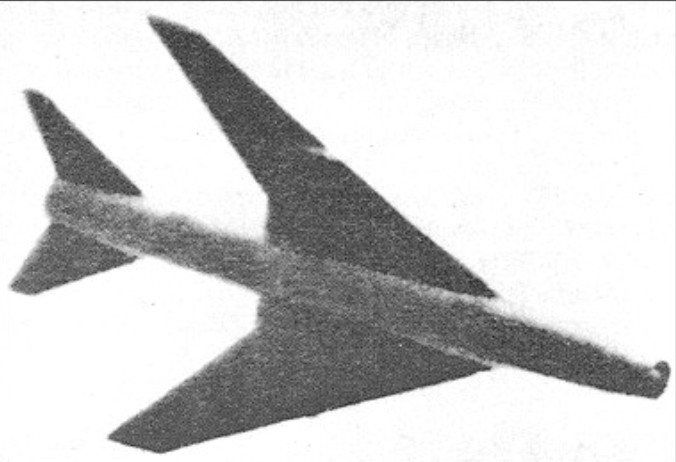
Unofficially dubbed Balalaika thanks to its resemblance in shape to the sound box of that musical instrument, the T-3 initiated the series of missile-armed single-seat tailed-delta interceptor fighters developed by Pavel Sukhoi’s OKB. Evolved in parallel with the S-1 “frontal” fighter and first flown on 26 May 1956 by Vladimir Makhalin, the T-3 possessed 57 degrees of wing leading-edge sweepback, was intended to be armed with two K-8 or K-9 missiles and was to have had an Almaz (Diamond) search-and-track radar. The elements of the Almaz were to have been housed within a broad elliptical radome above, and a circular housing on, the intake splitter plate. Powered initially by an unaugmented Lyulka AL-7 turbojet – which was to give place to an AL-7F rated at 6500kg boosted to 9060kg with afterburning – the T-3 was demonstrated over Tushino on 24 June 1956.
NATO code name ‘Fishpod-A’.
TsAGI wind tunnel testing of the efficiency of air intake/radar housing combinations being inconclusive, two further prototypes, the PT-7 and PT-8, were completed with different arrangements. The former, flown in September 1956, retained the chin intake position and superimposed elliptical radome, but with a variable-angle lower wedge to produce a two-dimensional intake. The PT-8, which joined the test programme two months later, featured a lengthened – by approximately 1.25m – nose with circular air intake and conical translating centrebody. The T-3 and its PT variations provided the basis for the further T-4 series from which the first production Sukhoi tailed-delta fighters were to be derived.
T-3 Engine: AL-7F Wingspan: 8.43 m / 28 ft 8 in Length: 16.75 m / 55 ft 11 in Wing area: 24.20 sq.m / 260.49 sq ft Max. speed: 2100 km/h / 1305 mph Ceiling: 18000 m / 59050 ft Range: 1840 km / 1143 miles
During reorganisation of the Soviet aircraft industry in November 1949, Pavel O Sukhoi’s OKB was disbanded, being resurrected three-and-a-half years later, in May 1953, to pursue development of two fighter projects with either the 58 degree to 62 degree swept wing, or the 57 degree or 58 degree tailed delta configurations evolved by the Central Aerodynamics and Hydrodynamics Institute. These were referred to as the S-1 and T-3 respectively, the prefix letters signifying strelovidnyi (arrowhead) and treugolnyi (triangular) in reference to the wing configuration (ie, sweptback and delta). Both aircraft were designed around the large, new Lyulka AL-7 (TRD-31) turbojet, but enjoyed only limited design commonality.
The S-1 was conceived as a so-called “frontal” fighter – a tactical air superiority warplane intended to operate in the vicinity of the battlefront – and was the first Soviet aircraft to feature a slab-type tail and a translating nose cone. Flown on 8 September 1955, the S-1 was initially fitted with an unaugmented AL-7 rated at 14,330-lb / 6500kg aspirated via a circular nose inlet with a conical inlet centrebody that translated in and out to regulate the supersonic airflow through the inlet. This was replaced by an afterburning AL-7F of 9500kg with which the S-1 established a national speed record of 2170km/h, or Mach=2.04, in April 1956. Featuring 62 degrees of sweepback, the S-1 had an armament of three 30mm cannon and provision for a retractable ventral tray for 32 spin-stabilised 57mm rockets. Demonstrated over Tushino on 24 June 1956, this prototype crashed on 21 November that year.
A second prototype, the S-2, embodying some aerodynamic refinements, had joined the test programme in the meantime and – although this was not to complete State testing until the autumn of 1957 – manufacture of a pre-series went ahead simultaneously. Built in sufficient quantity to equip a regiment for evaluation purposes, these fighters, which possessed a primary air-to-air role and entered service in the Soviet Far East in early 1959, were assigned the designation Su-7. This repeated the appellation of the mixed-power experimental fighter tested in 1944. A requirement change led to the further development of the basic design as a dedicated ground attack fighter under the designation Su-7B (S-22).
While a small pre series was being built for service evaluation by the V VS TacAir component, the Frontovaya Aviatsiya (FA), as the Su 7, a second prototype embodying some aerodynamic refinement, the S 2, joined flight test, and it was this, in productionised S 22 (or S 2 2) form, that was to be ordered into large scale production in 1958 as the Su 7B.
Su-7 (pre-series) Max take-off weight: 9423 kg / 20774 lb Wingspan: 9.15 m / 30 ft 0 in Length: 16.72 m / 55 ft 10 in Max. speed: 1827 km/h / 1135 mph
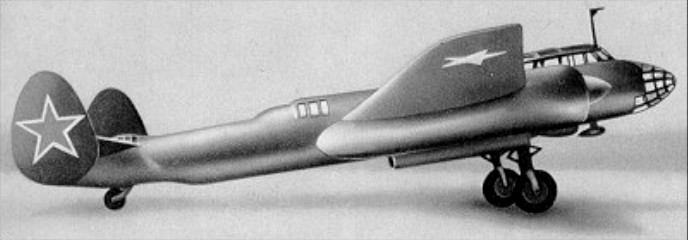
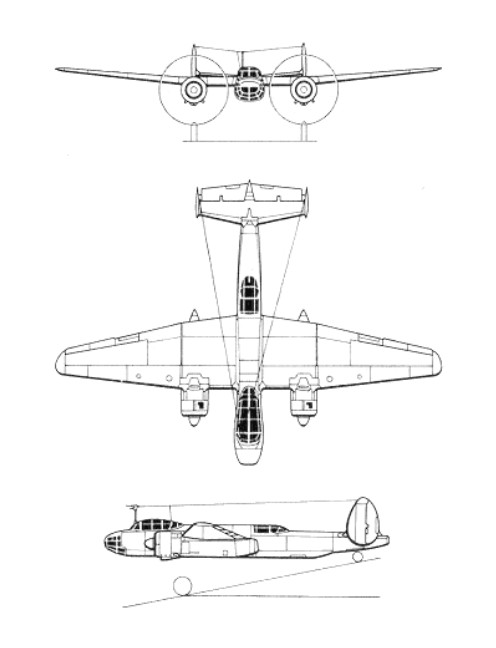
The 1946 UTB-2 was a trainer derivative of the Tu-2. The UTB-2 was structurally similar, but because of the elimination of combat equipment it was much lighter, and this allowed the use of less powerful engines. The front fuselage was widened to make room for a trainee and instructor side-by-side.
Engine: 2 x ASh-21, 515kW Max take-off weight: 6546 kg / 14432 lb Wingspan: 18.9 m / 62 ft 0 in Length: 14.0 m / 46 ft 11 in Height: 4.8 m / 16 ft 9 in Wing area: 48.8 sq.m / 525.28 sq ft Max. speed: 380 km/h / 236 mph Cruise speed: 340 km/h / 211 mph Ceiling: 6000 m / 19700 ft Armament: 1 x 12.7mm machine-guns, bombs Crew: 3
In 1924, Pavel O. Sukhoi joined the Central Aero and Hydrodynamic Institute, or TsAGI, eventually becoming a bureau design leader under Andrei N. Tupolev on ANT-25 long-range record-breaker. During 1939, Sukhoi established his own design bureau, using previous Bureau Osovikh Konstruktsii offices, and began the redesign of the ANT 51 with an M 88B engine, a low wing and an increased offensive load, this emerging as the BB 1, entering series production in 1940, and being redesignated Su 2 in 1941.
In Second World War Sukhoi’s own name was especially associated with Su-2 light bomber and attack aircraft.
After January 1949, the bureau’s next design was the Aircraft R prototype for a planned Su-17 supersonic fighter. But in November 1949 the Sukhoi bureau was closed down by Stalin and the almost complete prototype was cancelled. Sukhoi and most of his team were transferred to the Tupolev bureau and continued work in the development of the aerodynamic and structural features required for supersonic fighters.
In 1953 Stalin died, and Sukhoi’s request for his own design bureau was then granted: this produced a new sequence of numerical designators that leads to considerable confusion in the identification of Sukhoi aircraft. The first result of the bureau’s re-established independence was a series of swept-wing and tailed delta prototypes in the S and T series.
He was responsible for twin jet Su-7 of 1947. The later and unrelated Su-7 of his second jet series became a swept-wing attack aircraft first seen 1956. Su-9, operational from 1959, and Su-11 were single-seat all-weather fighters with delta wings. The operational and large-size Su-15 twin-jet delta-wing allweather interceptor was also tested in prototype Flagon-B STOL form in July 1967. Su-17 first flew August 1966 as very much improved variable-geometry fighter developed from Su-7, and was followed by Su-20 and Su-22 for export. Su-24 is a variable-geometry attack type, seating two crew side-by-side and has been in service since February 1975. A nuclear strike bomber, reconnaissance and electronic warfare aircraft, Su-24 was designed to penetrate enemy defenses for five minutes at 1,400km/h and 200m altitude, as a supersonic replacement for the II-28 and Yak-28. In total, about 1,200 Su-24s were built during 1972-92, finally giving way on the production line to the Su-27IB.
Sukhoi died in September 1975, but subsequent Sukhoi designs continue to honor his name. These include Su-25/Su-28 and Su-39 related subsonic close-air support and tank-busting jets (first Su-25 flew February 1975 and became operational in 1981). The Su-27 Flanker long-range air-supriority fighter (first flown May 1977 and in production since 1982 for home use and export, latter including J-11s assembled in China), the tandem two-seat Su-30 multirole fighter and attack variant of Su-27 that carries further avionics to allow it to command a group of Su-27s (first flown December 1989 and users including India). The side-byside two-seat Su-32FN maritime strike aircraft and Su- 27IB or Su-34 tactical interdictor developed from Su-27, the Su-33, or Su-27K carrierborne fighter Su-27 derivative (first flown August 1987 and first deployed on board Admiral Kuznetsov’m 1995). Su-35 advanced air-superiority fighter (first flown June 1988) and Su-37 variant with thrust-vectoring nozzles, again Su-27 developments.
A fifth-generation tactical fighter, approximately equivalent to the U.S. F-22, is the S-37, first flown in September 1997 and featuring swept-forward wings and eventually to have thrust-vectoring engine nozzles. S-54 and S-55 are newly designed lightweight jets for multirole combat and training uses, T-60S is a projected strike bomber of very stealthy appearance and S-80 is a new transport with patrol and surveillance variants. A program in 1999 was the development of the KR-860, a super-large 860-seat airliner. General-aviation programs include Su-26, Su-29 and Su-31 single- and two-seat aerobatic competition aircraft (first flown 1984, 1991 and 1992 respectively) and Su-49 tandem two-seat primary trainer, while projects are for S-16 twin turboprop transport for 16 passengers or cargo, S-21 10-passenger supersonic business jet (with projected 68-passenger S-51), S-38 single-seat agricultural monoplane, and S- 96 twin-propfan 8-passenger executive transport.
In 2016 Sukhoi, major aircraft holding company, employed more than 26,000 people. 100% of stock of the Sukhoi belonged to the United Aircraft Corporation (JSC). The Company is Russia’s major manufacturer of export aircraft, placed third in the world in terms of the numbers of modern fighters produced.
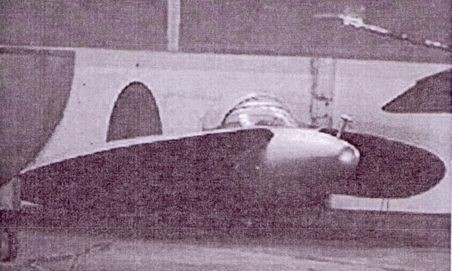
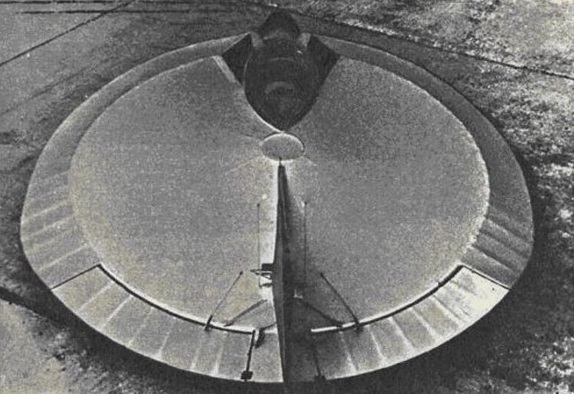
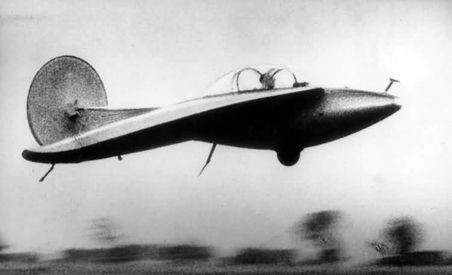
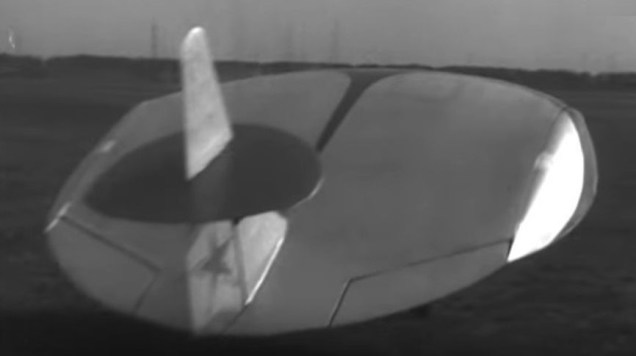
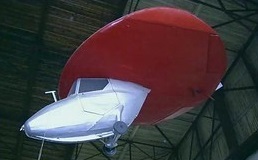
A 1960 version of the Discoplan 2 aircraft’s structure appears to have been based on a wooden or steel truss covered with lacquered canvas — standard lightplane and glider construction. Apparently the disc-shaped vertical “fin” was designed to revolve on a horizontal axis like a bicycle wheel — possibly to provide some sort of gyroscopic stabilization to the aircraft’s control system via a system of cables and struts.
The construction was carried out by Lavochkin. The circular wing has neither ribs or longerons. The light alloy edging around the perimeter of the “wheel” serves only to give a streamlined form to the tip. It is controlled by ailerons and rudder.
Reported in March 1963, the circular wing Discoplan II was successfully tested on an airfield near Moscow in the previous Autumn.
The Discoplan-II was piloted by Vladimir Ivanov, a glider expert.
One of the main features of the machine discovered during tests was the aerodynamic effect of the ‘air cushion’. Owing to the proximity of the wing to the ground, and thanks to its circular form, the influence of the cushion on the landing and take-off characteristics proved most beneficial. At a height of 1.5-2m / 59-79 in Discoplan-II automatically stabilised both in the lateral and transverse directions and could fly without the pilot touching the controls. In gliding down to land the pilot also felt how the Discoplan was “padded” by the air cushion. Thus, the landing was also of an automatic.
Wingspan: 5 m / 16 ft 5 in Wing area: 20 sq.m Empty weight: 240 kg Gross weight: 240 kg / 529 lb Wing loading: 12 kg/m2 Seats: 1
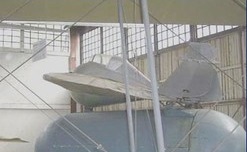
.During 1949-50 Master of Technology M.V.Sukhanov built an experimental single seat glider having a wing and control surfaces circular in planform, which he called Discoplan-I. The wing diameter was 3.5 m / 11 ft 6 in, and the gross weight was 230 kg / 507 lb.
The flight trials of the Diskoplan-I were carried out under the direction of the designer by a team of young engineers from the Voluntary Society for Assisting Army, Air Force and Navy, and covered aerobatics. It proved absolutely spin-proof.
It was flying in 1957.
Sukhanov “Discoplan I” 1957 on the Ground and in the air.
Developed from the SO.7050 and SO.7055 two-seat cabin monoplanes, the SO.7060 Deauville differs primarily in having the 75 hp Mathis 4GO replaced by a 105 hp Walter Minor 4-III.
The first of two Deauville prototypes flew on 22 March 1948. Of all-metal construction, dual controls are provided and a third seat may be fitted aft of the side-by-side front seats.
SO.7050 Engine: 75 hp Mathis 4GO
SO.7055 Engine: 75 hp Mathis 4GO
SO.7060 Deauville Engine: 105 hp Walter Minor 4-III Wing span: 34 ft Wing area: 161.4 sq.ft Length: 21 ft 10 in Height: 7 ft 11 in Empty weight: 1140 lb Loaded weight: 1760 lb Max speed: 127 mph Cruise: 105 mph at 3280 ft Range: 500 mi











 All Aero