Sukhoi T-4 (100) / Stoka

This project was triggered in December 1962 by the need to intercept the B-70, SR-71, Hound Dog and Blue Steel. At an early stage the mission was changed to strategic reconnaissance and strike for use against major surface targets. It was also suggested that the basic air vehicle could form the starting point for the design of an advanced SST. From the outset there were bitter arguments. Initially these centred on whether the requirement should be met by a Mach-2 aluminium aircraft or whether the design speed should be Mach 3, requiring steel and/or titanium. In January 1963 Mach 3 was selected, together with a design range at high altitude on internal fuel of 6,000km. General Constructors Sukhoi, Tupolev and Yakovlev competed, with the T-4, Tu-135 and Yak-33 respectively. The Yak was too small and did not meet the requirements, and the Tupolev was an aluminium aircraft designed for Mach 2.35.

From the start Sukhoi had gone for Mach 3, and its uncompromising design resulted in its being chosen in April 1963. This was despite the opposition not only of Tupolev but also of Sukhoi’s own deputy Yevgenii Ivanov and many of the OKB’s department heads, who all thought this project an unwarranted departure from tactical fighters. Over the next 18 months their opposition thwarted a plan for the former Lavochkin OKB and factory to assist the T-4, and in its place the Boorevestnik OKB and the TMZ factory were appointed as Sukhoi branch offices, the Tushino plant handling all prototype construction. A special VVS commission studied the project from 23rd May to 3rd June 1963, and a further commission studied the refined design in February-May 1964. By this time the T-4 was the biggest tunnel-test project at CAHI (TsAGI) and by far the largest at the Central Institute of Aviation Motors. The design was studied by GKAT (State aircraft technical committee) from June 1964, and approved by it in October of that year. By this time it had outgrown its four Tumanskii R-15BF-300 or Zubets RD-17-15 engines and was based on four Kolesov RD-36-41 engines. In January 1965 it was decided to instal these all close together as in the B-70, instead of in two pairs. Mockup review took place from 17th January to 2nd February 1966, with various detachable weapons and avionics pods being offered. Preliminary design was completed in June 1966, and because its take-off weight was expected to be 100 tonnes the Factory designation 100 was chosen, with nickname Sotka (one hundred). The first flight article was designated 101, and the static-test specimen 100S. The planned programme then included the 102 (with a modified structure with more composites and no brittle alloys) for testing the nav/attack system, the 103 and 104 for live bomb and missile tests and determination of the range, the 105 for avionics integration and the 106 for clearance of the whole strike/reconnaissance system.
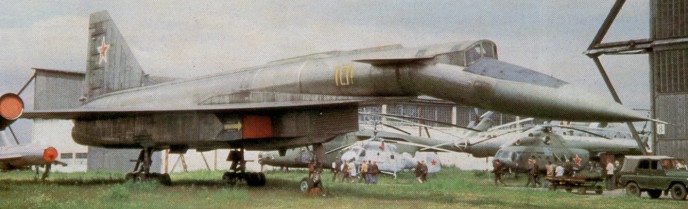
On 30th December 1971 the first article, Black 101, was transferred from Tushino to the LII Zhukovskii test airfield. On 20th April 1972 it was accepted by the flight-test crew, Vladimir Ilyushin and navigator Nikolai Alfyorov, and made its first flight on 22nd August 1972. The gear was left extended on Flights 1 through 5, after which speed was gradually built up to Mach 1.28 on Flight 9 on 8th August 1973. There were no serious problems, though the aft fuselage tank needed a steel heat shield and there were minor difficulties with the hydraulics. The VVS request for 1970-75 included 250 T-4 bombers, for which tooling was being put in place at the world’s largest aircraft factory, at Kazan. After much further argument, during which Minister P V Dement’yev told Marshal Grechko he could have his enormous MiG-23 order only if the T-4 was abandoned, the programme was cancelled. Black 101 flew once more, on 22nd January 1974, to log a total of 10hrs 20min. Most of the second aircraft, article 102, which had been about to fly, went to the Moscow Aviation Institute, and Nos 103-106 were scrapped. Back in 1967 the Sukhoi OKB had begun working on a totally redesigned and significantly more advanced successor, the T-4MS, or 200. Termination of the T-4 resulted in this project also being abandoned. In 1982 Aircraft 101 went to the Monino museum. The Kazan plant instead produced the Tu-22M and Tu-160.

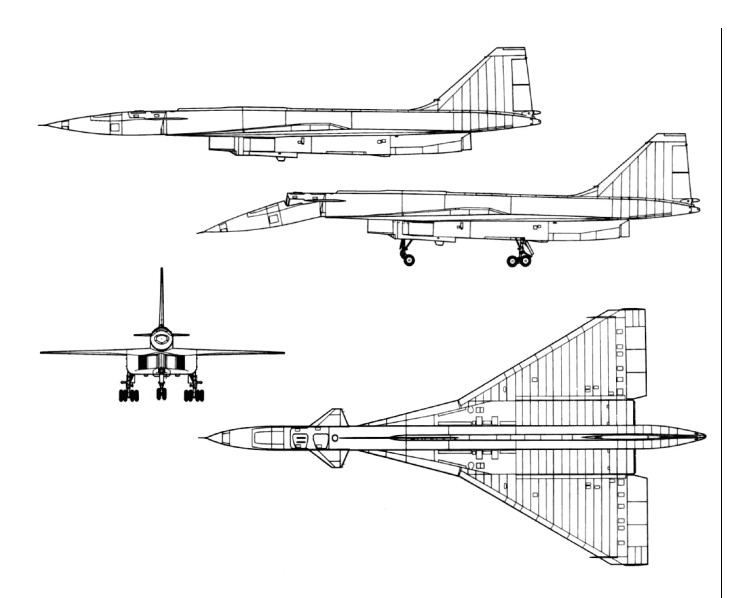
Engine: 4 x Kolesov RD-36-41, 159.3kN
Max take-off weight: 135000 kg / 297626 lb
Empty weight: 55600 kg / 122578 lb
Wingspan: 22.0 m / 72 ft 2 in
Length: 44.5 m / 146 ft 0 in
Height: 11.2 m / 37 ft 9 in
Wing area: 295.7 sq.m / 3182.89 sq ft
Max. speed: 3200 km/h / 1988 mph
Cruise speed: 3000 km/h / 1864 mph
Ceiling: 25000-30000 m / 82000 – 100000 ft
Range w/max.fuel: 7000 km / 4350 miles
Crew: 2
Sukhoi T-4 (100)

Sukhoi P-1

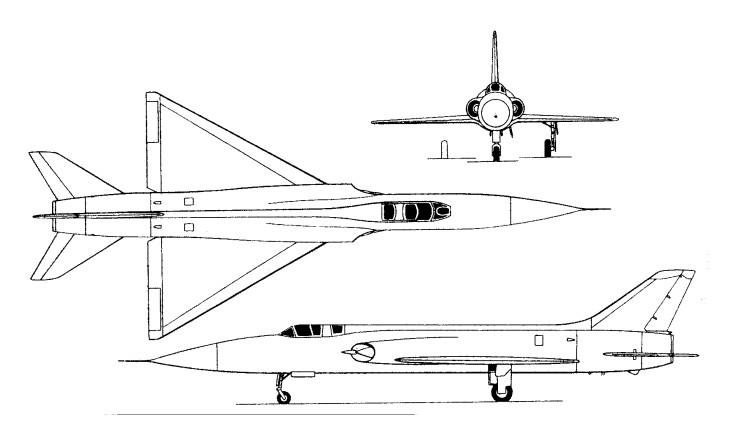
During 1957, the Sukhoi OKB began construction of the prototype of a new tailed-delta interceptor, the two-seat P-1 (the prefix letter indicating Perekhvatchik, or interceptor) intended to meet a requirement for a fighter equipped with collision-course radar and carrying a mixed armament of guided and unguided missiles plus cannon. Flown on 12 July 1957 by Nikolay Korovushkin, the P-1 had a 57 degree delta wing with dog-tooth leading edges and lateral air intakes with translating centrebodies. Power was provided by an unspecified turbojet with a maximum afterburning thrust of 10600kg and armament included a battery of 50 unguided spin-stabilised 57mm rocket missiles, provision being made for a single 37mm cannon and guided missiles on underwing pylons. Poor engine reliability and serious delay in development of the intended X-band radar led to discontinuation of development of the P-1 on 22 September 1958.

P-1 (estimated)
Max take-off weight: 17010 kg / 37501 lb
Wingspan: 9.50 m / 31 ft 2 in
Length: 21.30 m / 70 ft 11 in
Max. speed: 2050 km/h / 1274 mph
Ceiling: 19500 m / 64000 ft
Range: 2000 km / 1243 miles

Sukhoi P-1

Sukhoi T-49

The bureau was also attracted by the possible advantages of lateral inlets, which would leave the nose free for search radar, and developed the T-49 prototype with such a forward fuselage. This confirmed the practicality of the concept, and further evolution produced the P-1 prototype.

Based on the Su-11, the T-49 experimented an alternative radar/intake arrangement. The radar was protruded forward, while the air intakes were placed at each sides of the radome. Maiden flight on 10 January 1960, tests soon stopped following a non-fatal accident.

Sukhoi P Prototype

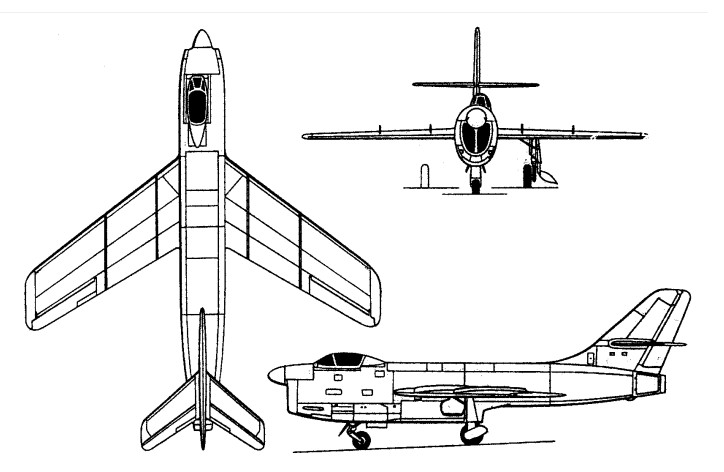
In January 1948 the Soviet air force issued a requirement for an all-weather interceptor, and among the several designs submitted was one from Sukhoi. This was developed as the Aircraft P prototype with 35 degree swept flying surfaces and the same tandem arrangement of engines as used in the competing La-200 and I-320. Sukhoi was the first of the competing bureau to get a prototype into the air, in January 1949. The prototype revealed good performance, but suffered from problems and when the aeroplane was lost as a result of flutter induced structural failure the programme for a possible Su-15 production model was cancelled.

Sukhoi Su-17 – 1949

Making its debut in 1949, the Su 17 was intended to compete with the MiG 17 and, according to Russian sources, was the first Soviet aircraft to exceed Mach unity. An interesting feature of the Su 17 was its detachable nose section which, in an emergency, could be employed as an escape capsule.

Sukhoi T-5

Sukhoi’s T-5 was the result of a study for an alternative propulsion system for the Lyul’ka AL-7 and delayed AL-9 single turbojets. The Su-9 prototype (T-3) was modified with a new rear fuselage with side-by-side arrangement of two Tumanskii R-11F-300 turbojets. First flown on 18 July 1958, tests ended on 1 June 1959. The increased weight of the rear had caused the centre point of gravity to move aft.

First flight of T-5 experimental prototype, by Vladimir Ilyushin, was on 18 July 1958.
T-5 flight tests ended on 1 June 1959.

Sukhoi Su-15 (I)

Rolled out at Novosibirsk on 25 October 1948 and first flown in January 1949, the Su-15, or Samolet P, was a single-seat all-weather interceptor. It was powered by two 2270kg RD-45F turbojets mounted in tandem, the forward engine exhausting beneath the centre fuselage and the aft engine exhausting via an orifice in the extreme tail. The pilot’s pressurised cockpit was offset to port, a tunnel feeding air to the rearmost turbojet passing to starboard. The air intake was surmounted by a radome intended to accommodate Izumrud (Emerald) AI radar, the single-spar wings were sweptback 35 degrees at quarter chord and armament comprised two 37mm cannon. During its 39th flight, on 3 June 1949, the Su-15 developed uncontrollable flutter, its pilot ejecting. At that time a second prototype was still incomplete and the development programme was abandoned. A maximum speed of 693 m.p.h. (1050 kph) was claimed for the Su 15.

Max take-off weight: 10437 kg / 23010 lb
Empty weight: 7409 kg / 16334 lb
Wingspan: 12.87 m / 42 ft 3 in
Length: 15.44 m / 51 ft 8 in
Wing area: 36.00 sq.m / 387.50 sq ft
Max. speed: 1032 km/h / 641 mph
Range: 1600 km / 994 miles

Sukhoi Su-15 (I)

Sukhoi Su-11 (II)

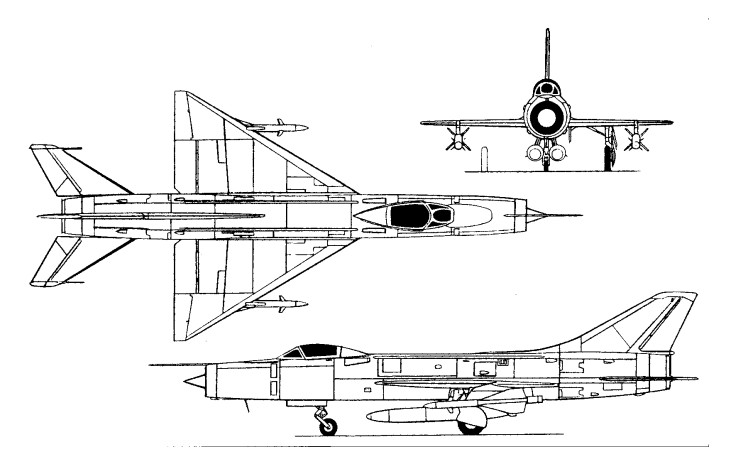
The limited range of the TsD-30T radar and K-5MS led Sukhoi to develop the Su-11 with new Oryol radar and K-8M missile.

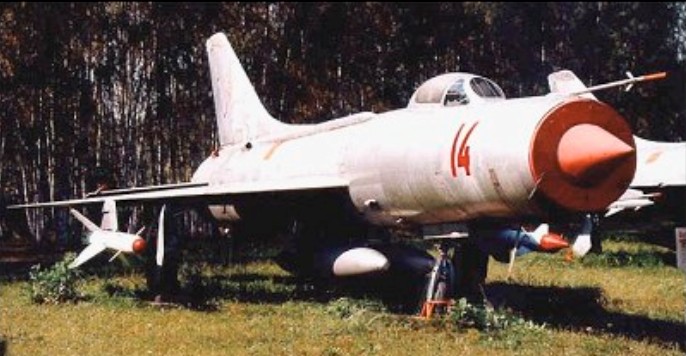
The availability of a more powerful radar, the Uragan (Hurricane) 5B, matched with new medium-range AAMs available in alternative semi-active radar guidance and infra-red homing versions in the mid ‘sixties, led to upgrading of the basic T-43 (Su-9). The larger-diameter dish of the Uragan I-band radar necessitated an intake centrebody of almost twice the cross-section area of that of the series Su-9. This, in turn, required increasing the intake lip diameter to allow for the same airflow, which, the AL-7F engine being retained, remained essentially unchanged. External piping ducts along the upper rear fuselage, similar to those of the Su-7BM, signified a revised fuel system, and armament comprised two medium-range missiles (one radar-guided and the other IR-homing). With the AL-7F-1 turbojet providing an afterburning thrust of 10,110kg, the revised T-43 series limited all-weather interceptor was adopted by the IA-PVO Strany under the (re-used) designation Su-11 as interim equipment pending introduction of the more advanced Su-15 that was being developed in parallel. The Su-9 fighter was used in large numbers as a standard Soviet (P-VO Strany) defensive fighter, replaced from 1968 by the Su-11 with long nose, large radar and inlet and new missiles. The Su-11 supplemented and partly replaced the Su-9 until similarly withdrawn in the early ‘eighties.

The Su-11 ‘Fishpot-C’ first flew on 25 Dec 1958 as the T-47 prototype, and entered series production in 1962 at Novosibirsk. After the series production of 112 aircraft, the Su-11 production was ceased because of its poor performance and flight handling, caused by its heavy nose shifting the centre point of gravity forward disrupting the design’s balance.

An all weather fighter and trainer aircraft. NATO code name ‘Fishpot-C’ and ‘Maiden’’. The Su-11 ‘Fishpot-C’ is an improved version of the Su-9 with a more powerful engine, the Lyulk4 AL-7F turbo¬jet of 22,000 lbs thrust with afterburner. It has a maximum speed of Mach. 1.8 at 36,000 feet and carries two ‘Anab’ air-to-air missiles, one radar-homing and one infra¬red.

Gallery

Su-11
Type: single seat all weather interceptor
Engine: 1 x Lyulka AL-7F single-shaft afterburning turbojet 22,046 lb (10.000 kg) thrust
Wingspan: 8.43 m / 28 ft 8 in
Wing area: 26.2 sq.m / 282.01 sq ft
Length: 17.4 m / 57 ft 1 in
Height: 16 ft (4.88 m)
Max take-off weight: 14000 kg / 30865 lb
Empty weight: 9100 kg / 20062 lb
Initial climb 27.000 ft (8230 m)/min
Max. speed: 1915 km/h / 1190 mph
Ceiling: 17000 m / 55750 ft
Range with twin drop tanks: 900 miles (1450 km)
Armament: two Anab air-to-air missiles, one radar-homing and one infra-red on wing pylons, no guns.

Sukhoi Su-11 (II)

Sukhoi Su-11 (I)

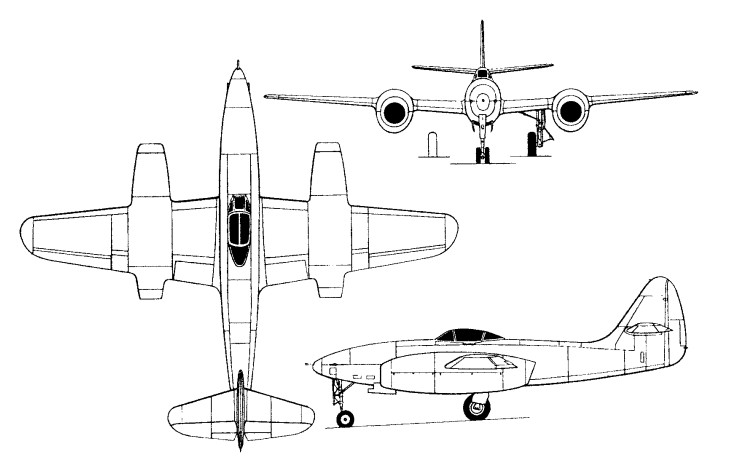
In late May 1947, flight testing commenced of a development of the Su-9, the Su-11 or Samolet LK, which was destined to be the first Soviet jet fighter powered by a turbojet of indigenous design. The fuselage of the Su-11 was fundamentally similar to that of the Su-9, apart from some structural revision, but because of the appreciably larger engines, the wing structure was extensively modified, and a pressurized cockpit.

The Su-11 was powered by two Lyulka TR-1 turbojets each developing 2866-lb (1300-kg), these being mounted ahead of the main-spar. Armament was the same as that of the Su-9.

Flight trials were started in October 1947 and factory trials were completed in April 1948, but the TR-1 turbojet was inadequately developed and, like its predecessor, the Su-11 was handicapped by the suggestion that it copied German technology. Aleksandr Yakovlev telling Yosif Stalin that it was no more than a “warmed over Me 262”.

Further development of the basic design concept followed with the Su-13.

Engines: two Lyulka TR-1 turbojets, 2866-lb (1300-kg)
Max take-off weight: 6350 kg / 13999 lb
Empty weight: 4495 kg / 9910 lb
Wingspan: 11.80 m / 39 ft 9 in
Length: 10.57 m / 35 ft 8 in
Height: 3.72 m / 12 ft 2 in
Wing area: 21.40 sq.m / 230.35 sq ft
Max. speed: 940 km/h / 584 mph
Range: 910 km / 565 miles

Sukhoi Su-11 (I)