Tallmantz P-1 Phoenix

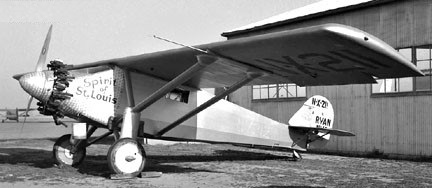
In 1966 Tallmantz Aviation built the Phoenix specially for the motion picture, “Flight of the Phoenix”. Based on a Fairchild C-82A, with North American AT-6 and other parts, power was a 450hp P&W R-985.

Built for filming in “The Flight of the Phoenix” the aircraft was not sufficiently strong nor the engine powerful enough for an actual landing and take-off on the desert floor. Instead, Paul would simulate takeoff and landing with low approaches and climb outs.

On July 6, Paul made his first attempt to film the scenes. Shortly after take-off from Yuma, he returned with an overheating engine. He tried again the next day, and in the relative cool of daybreak he flew the Phoenix to Buttercup Valley in the desert for the first time. Crouching just behind Paul in a makeshift crew position was stuntman Bobby Rose, with three plywood cut-outs of men attached on top of the wings near the fuselage, to depict ‘passengers’.

On that early morning he flew the requested low approaches in front of three widely-spaced motion picture cameras and returned safely to Yuma before the air got too hot and thin. Only later did the second unit director decide the cameras were set up too close to the scene and requested a repeat the next morning.

Before the sun broke above the horizon, Paul and Bobby again clambered up the ungainly Phoenix and strapped themselves in. They took off shortly after 05:00 for the short flight westward. Paul rolled into the shallow valley, sun rising behind him, descending to just feet above the desert floor, gunning the Pratt & Whitney R-985 and, with exaggerated effect for the cameras to depict the struggling Phoenix reaching for the sky, barely cleared a ridge of sand dunes. The director was pleased with what he knew his cameras had captured but called for an “insurance shot” just to make sure what he needed was in the can.

Paul knew the routine. He was heard over the radio vowing to “give them a good one” and brought the Phoenix around one more time. During the second approach it was obvious the descent rate was far too high and whatever Paul was doing to correct it wasn’t enough. The Phoenix hit the desert hard on its makeshift landing gear, right in front of a camera.

Quickly recovering, Paul struggled to pull the Phoenix back into the air. But the jarring impact had neatly snapped the aircraft just aft of the wing where the wooden fuselage joined the centre section. With the fuselage disintegrating and out of balance, the nose dropped and the propeller dug in to the desert causing the engine to shear off. The resulting wreckage tumbled across the desert floor.

Within the billowing cloud of dust and wreckage, Paul was killed instantly. Mantz might have survived the crash, as the cockpit section was relatively undamaged but, instead of a crash helmet, he was requested to wear a soft hat like actor James Stewart wore in the film. Bobby was thrown clear, miraculously surviving the crash, but with serious injuries.

The movie, of course, remained in production, but key scenes planned for the ending remained unshot. The footage from Buttercup Valley was usable, up until the accident anyway, but it amounted to a minute or less of film.

With no aircraft to film, the film crew packed up and moved back to Hollywood while other plans were considered. As the impending release date approached, Twentieth Century Fox finally came up with a makeshift replacement. A stubby North American O-47 belonging to The Air Museum at Ontario, California, was hurriedly modified to fill in as the Phoenix, at least for distant shots. The landing scenes were awkwardly deleted from the script but the end of the film was essentially as planned, with the survival of the eight men from their desert ordeal.

Tallmantz footage depicting the take-off amounted to about 18 seconds in the completed film, with the replacement O-47 sequence occupying about the same time in later scenes. The completed film, released in December 1965, does the best with what it has, but the loss of the flying Phoenix early in the filming is obvious.

Replacement

Tainan F-5 / TN-1

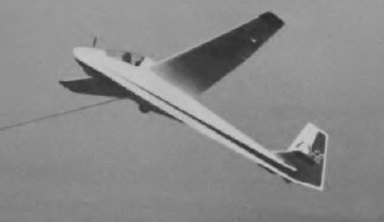
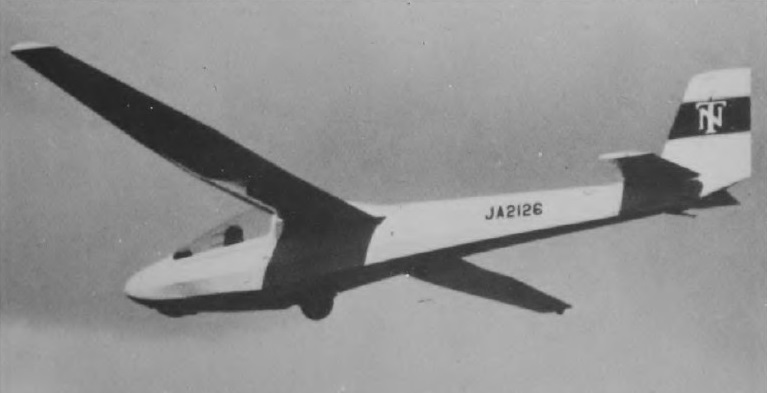
Also known by the manufucturers’ designation F5, the TN-1 single-seater was designed by Yukio Tanaka and construction of the prototype began in August 1974; this made its first flight in December 1976. The Japan Civil Airworthiness Board was conducting certification trials in the spring of 1978 and it was hoped to begin production in the summer of that year.
Of conventional wood and fabric construction very similar to the Mita III, the TN-1 had cantilever single-spar high wings of spruce and plywood, with fabric covering and a forward sweep of 2″ 4′ at the quarter-chord line; the wooden ailerons are ply-covered and there are Schempp-Hirth air brakes. The steel tube fuselage framework has fabric covering over wooden stringers, and the nose is of glassfibre. The wooden tail unit has fabric covered elevators and rudder, and there is a trim tab in the starboard elevator. There is a non-retractable unsprung monowheel mounted at the cg with a band brake, plus a tailskid.

Span: 50 ft 10.5 in
Length: 25 ft 0.75 in
Height: 7 ft 2.75 in
Wing area: 172.0 sqft
Aspect ratio: 15.03
Empty weight: 595 lb
Max weight: 837 1b
Max speed: 81 mph (in smooth air)
Max aero-tow speed: 81 mph
Min sinking speed: 2.59 ft/sec
Best glide ratio: 26:1 at 49 mph

Tainan Mita III / LADCO / Light Aircraft Development Co Mita III

Mita III

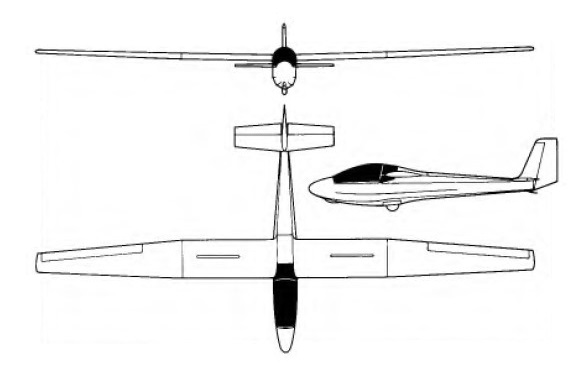
Japanese sailplanes of indigenous design often represent, as does the Mita III tandem two-seater training and sporting glider, an essentially conventional design philosophy. The Mita was built by LADCO – the Light Aircraft Development Co of Tokyo, whose designer was Mr Asahi Miyahara, and its production has been continued under licence by the Tainan Industry Co Ltd (Tainan Kogyo KK) after the latter took over the manufacture of sailplanes from LADCO; by 1 January 1979 a total of 37 Mita IIIs had been built.

Of conventional wood and fabric construction, the Mita has cantilever shoulder wings of constant chord centre section with tapered outer panels, of all-wood single box spar construction with plywood covering. The ailerons are fabric-covered and there are Schempp-Hirth air brakes in the wing upper surfaces. The fuselage is a steel tube framework with wooden stringers and fabric covering; the nose and forward section are of glassfibre, and there is an aero-tow release in the nose as well as a winch release at the cg. The wooden tail unit has a fabric covered rudder and elevators, and the landing gear consists of a rubber-sprung non-retractable monowheel with brake, plus a tailskid. The pilots sit under a flush-fitting two-piece blown canopy that hinges sideways to starboard for entry and exit.

Mita 3
Span: 16.0 m / 52 ft 5 in
Length: 7.96 m / 26 ft 1.5 in
Height: 1.28 m / 4 ft 2.5 in
Wing area: 15.87 sq.m / 170.82 sq.ft
Aspect ratio: 16.13
Wing section: NACA 633/618
Empty weight: 300 kg / 661 lb
Max weight: 450 kg / 992 lb
Water ballast: None
Max wing loading: 28.4 kg/sq.m / 5.81 lb/sq.ft
Max speed: 118 mph / 103 kt / 190 km/h (in smooth air)
Max aero-tow speed: 81 mph
Stalling speed: 33.5 kt / 62 km/h
Min sinking speed: 0.72 m/sec / 2.36 ft/sec at 47 mph / 40.5 kt / 75 km/h
Best glide ratio: 30:1 at 51 mph / 44 kt / 82 km/h

Mita III

Tachikawa R-HM

The Tachikawa R-HM is a refined two-seat cabin version of the Mignet pre-war Flying Flea, powered by a 90 hp Continental C90-12F engine. It is generally similar to the H.M.310 Estafette produced by Avioes Mignet do Brasil.

The R-HM is a tandem monoplane or heavily-staggered biplane, lift being divided between the two surfaces which give a slot effect.

The registration was JA3094.

Engine: 90 hp Continental C90-12F
Wingspan: 26 ft 3 in
Wing area: 201.5 sq.ft
Length: 16 ft 8 in
Height: 6 ft 6 in
Empty weight: 910 lb
Loaded weight: 1422 lb
Max speed: 99 mph
Cruise: 74.5 mph
Range: 298 mi

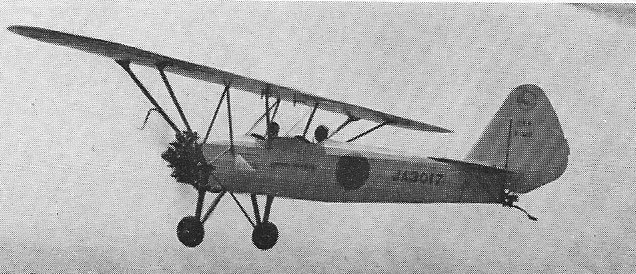
Tachikawa R-52

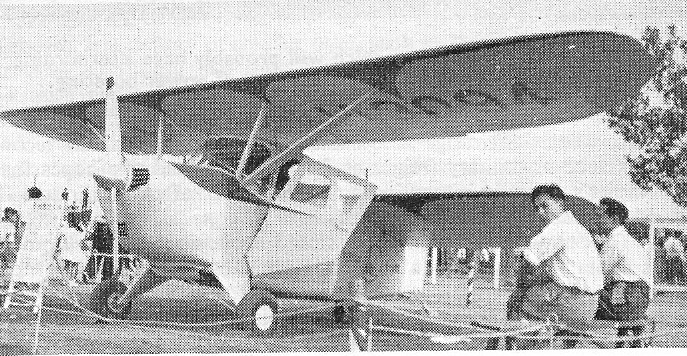
The Tachikawa R-52 was completed in September 1952 and was the first aircraft built entirely from Japanese materials and powered by a Japanese engine (a 130 hp Shinphu 2 radial) to be completed after World War 2.

Derived from the pre-war R-38, the R-52 tandem two-seat parasol-wing trainer was the first product of the Shin Tachikawa Kasushiki Kaisha, and the prototype was presented by the Yomiuri Press for student instruction. The R-52 is of mixed construction with fabric covering.

Engine: 130 hp Shinphu 2
Wingspan: 35 ft
Length: 24 ft 3 in
Height: 9 ft 2 in
Empty weight: 1500 lb
Loaded weight: 2105 lb
Max speed: 124 mph
Cruise: 93 mph
ROC: 722 fpm
Range: 310 mi