Taylor, Molt

Born in 1912 in Portland, Oregon, Moulton B. (Molt) Taylor developed the Aerocar, the flying automobile that is easily converted back to a car with trailerable wing and tail components. Taylor started out in 1948 with $50,000 capital put up by businessmen in his home town of Longview, Washington. But his innovative ideas have found their way into many other unusual aircraft including the US Navy XLRQ-1 Amphibious Assault Glider, the Coot Amphibious aircraft, the IMP (also known as the Ascent 1 Tribute) and the Mini-IMP and Micro-IMP.

He wrote regularly for Sport Aviation, and other aviation magazines on everything from engine selection to static testing of aircraft parts.

1961: Aerocar International, Longview.
c.1970: Aerocar Inc.
Moulton B “Molt” Taylor, Chehalis and Longview WA. USA
1980: MB. (Molt) Taylor, P.O. Box 1171, Longview, WA 98632, USA.
Mini-IMP Aircraft Co, Saginaw TX. USA
2001: Aerocar International.

Molt was officially inducted into the EAA Hall of Fame by Paul Poberezny on November 10th, 1995. Only 6 days later, on November 16th, he left this world and us behind.

Aerocar International is a new firm formed by Roy Hyde (Hyde Investment Co) of Ft Worth TX with Molt Taylor as vice president-engineering and Herman Zimmer, vice president-marketing. Taylor, who first flew his Aerocar in 1950 and has logged more than 1,000 flight hours and 100,000 road miles on the vehicle, was a naval aviator and project engineer at the Naval Aircraft Factory where he was in charge of pilotless aircraft and missile development prior to setting up Aerocar Inc in Longview.
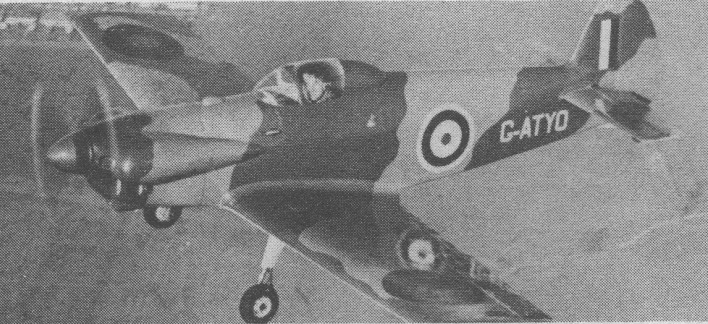
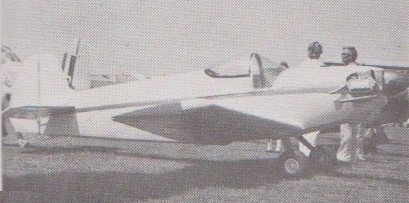
Taylor Tater Bug

In 1963 Merton Taylor built a single place low-wing cabin monoplane Tater Bug registered N1052Z. Using an NACA 4309 – NACA 4309 wing, the first flight was in Febuaray 1963.

Engine: Continental C-85-12, 85hp
Wing span: 18’0″
Length: 17’5″
Useful load: 330 lb
Max speed: 170 mph
Cruise speed: 150 mph
Stall: 80 mph
Range: 550 mi
Seats: 1

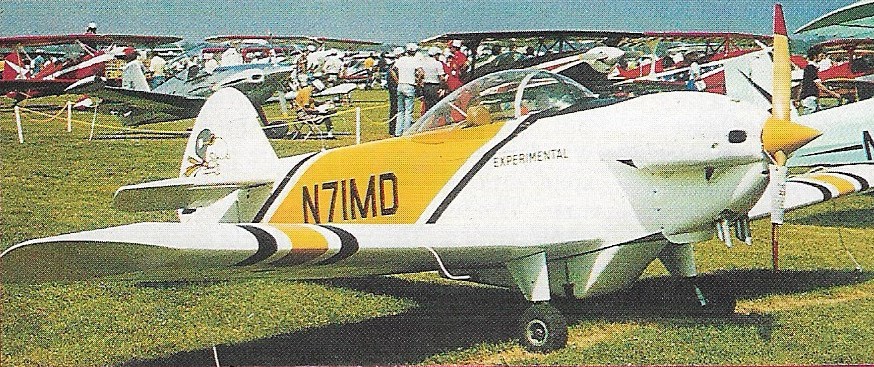
Taylor JT-2 Titch

The Taylor JT.2 Titch was designed in 1964 to meet Rollason’s Midget Racer competition, placed second overall. A prototype built by John Taylor was first flown at Rochford on 22 January 1967 with a Continental C85-12F engine. It crashed in May 1987, killing Taylor. The plans then being sold by his widow.

Titch G-BCSY at Sywell 1975

The Taylor Titch has a reputation as a pleasant-to-fly aerobatic plane. Its stall occurs at a very high angle of attack and is straightforward, with no wing drop and a height loss of only 50 feet. This single-place monoplane features all-wood wings with plywood and fabric covering. Its fuselage is also an all-wood structure that includes double-curvature plywood covering and aluminum cockpit side panels. When the low-powered Taylor Monoplane became known in the United States, requests were made for permission to fit larger engines than the design permitted. This led to the introduction of the Titch. The Titch is stressed for any engine from 40 to 90 hp, the only provision being a reposition of the engine bulkhead for engines of 65 hp or more. This allows for the use of VW, Lycoming or Continental powerplants.

Engine: Continental, 85 hp
HP range: 60-100
Speed max: 200 mph
Cruise: 160 mph
Range: 380 sm
Stall: 48 mph
ROC: 1600 fpm
Take-off dist: 350 ft
Landing dist: 900 ft
Service ceiling: 18,000 ft
Fuel cap: 10 USG
Weight empty: 500 lbs
Gross: 760 lbs
Height: 4.8 ft
Length: 16.7 ft
Wing span: 18.9 ft
Wing area: 68 sq.ft
Seats: 1
Landing gear: tail wheel

Engine: VW 2100
Cruise: 115 mph
ROC: 800 fpm
Range: 250 sm
Span: 18 ft 9 in
Length: 16 ft 1.5 in
Empty wt: 455 lbs
Max wt: 710 lbs

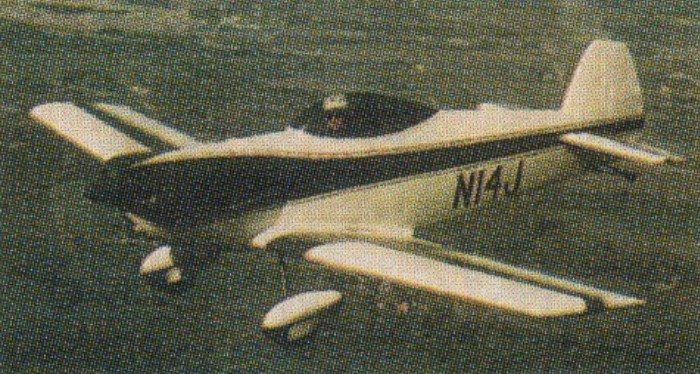
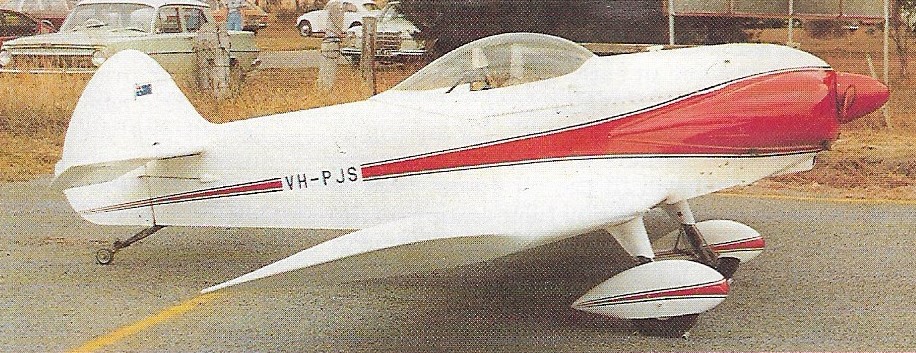
Taylor JT-1 Monoplane

Designed by John Taylor, the Monoplane is a single seat, cantilever, low wing. acrobatic aircraft built with the object of producing an airframe for not more than £100 Sterling. The wing is a constant chord structure with an RAF 48 aerofoil section, and consists of a centre section and outer panels. Each panel has two spruce and plywood spars, wooden ribs and a plywood covered leading edge D nose, the remainder of the wing being fabric covered. Split trailing edge flaps are fitted. The fuselage is a conventional wooden structure hav¬ing spruce longerons and frames and plywood covering. The wing centre section is built integral with the fuselage. The fin and tailplane are plywood covered wooden structures, while the rudder and elevators are fabric covered wooden structures. The main undercarriage consists of cantilever legs fitted with coil springs for shock absorption. The wheels have Avro Anson tailwheel tyres. A leaf spring tail skid with a steerable skid pad is fitted. A 6 Imp. gallon fuel tank is installed behind the firewall. The prototype flew with a 37 h.p. JAP engine, but converted Volkswagen engines are also suitable. Since the first prototype flew in June 1960, no modifications of any kind have been incorporated.

Variation: Ladd Taylor Chihuahua

Gallery

Engine: VW 1500cc
HP range: 40-60
Speed max: 115 mph
Cruise: 100 mph
Range: 290 sm
Stall: 35 mph
ROC: 950 fpm
Take-off dist: 350 ft
Landing dist: 750 ft
Service ceiling: 13,500 ft
Fuel cap: 7.5 USG
Weight empty: 430 lbs
Gross: 660 lbs
Height: 4.1 ft
Length: 15 ft
Wing span: 21 ft
Wing area: 76 sq.ft
Seats: 1
Landing gear: tail wheel

Engine: VW 1600cc
Cruise: 90 mph
Climb: 500 fpm
Range: 250 sm

Engine: JAP, 38 hp
Wing span: 21 ft 0 in (6.4m)
Wing Area: 72 sq. ft
Length: 15 ft 0 in (4.57 m)
Height: 4 ft 10 in (1.47 m)
Empty Weight: 400 lb
Max TO wt: 610 lb (276 kg)
Wing Loading: 8.5 lb/sq.ft
Max level speed: 105 mph (169 kph)
Cruise Speed: 92 mph
Stall Speed: 34 mph
Climb: 650 fpm
Range: 230 miles

Taylor, John F.

John F.Taylor designed JT.1 Monoplane single-seat monoplane and JT.2 Titch single-seat racing monoplane, first flown 1959 and 1967 respectively. Plans for both aircraft remain available from Mrs T. Taylor.
1980: Mrs John F. Taylor, 25 Chesterfield Cres, Leigh-on-Sea, Essex, England.
1995: 79 Springwater Rd, Leigh-on-Sea, Essex SS9 5BW, England.