Ted Smith sold his interest in Aero Commander to Rockwell and by 1966 had completed the first mockup of the Aerostar and production commenced, with finance from American Cement, at Van Nuys. Ted Smith then sold out to the American Cement Company, which, Smith says, simply didn’t know how to run an aircraft business and consequently ran Aerostar into the ground before finally selling out to Butler Aviation, another firm with no experience in manufacture. Butler did nothing with the Aerostar, and eventually, Smith was able to buy back the company and a large inventory of parts at a much lower price than that at which he had sold out in the first place. This sequence of events is crucial; it amounted to a huge gift to Smith, who found himself able to sell a comparatively exotic airplane of excellent performance at unnaturally low prices, because he obtained his parts – enough of them to make hundreds of airplanes in some cases at a huge discount. Thus, after only a short time in business, Smith could boast of a 10 percent annual return (before taxes), one of the highest in the industry.
Designed by Ted Smith during late 1964 as a dual controlled high performance twin engined executive / light transport aircraft, the prototype N540TS first flew in November 1966 and had 160 horsepower Lycoming IO-320 engines, but the airframe was designed to take various powerplants up to turbines without major changes. Accommodating six passengers, the cabin measures 12 ft 6 in long, 46 in wide, and 48 in high and a 30 cu.ft baggage compartment aft has an external access through a 24in high and 22in wide door.
Entry through the left hand clamshell door allows everyone to board before the pilot, get settled in, and then he just slides in and buttons up. Also situated on the port side is the door to the 30 cu ft 240 lbs baggage locker. The two 24 volt batteries are situated in the rear fuselage area along with the 35,000 BTU heater. Large fowIer flaps are fitted and, like the undercarriage, are hydraulically operated. The main undercarriage wheels retract inwards while the nose wheel retracts forwards. The undercarriage is held in the up position by hydraulic pressure alone, there is no lock.
Aerostar 600
The Aerostar 600 received FAA certification (TC A17WE) during March 1968 for the Ted Smith Aircraft Co. The production type flying for the first time during October 1967. The 290 hp Lycoming IO 540, used on the first production airplane delivered in 1968, was available on Aerostars in a normally aspirated or a turbocharged version. The FAA approved the type on 12 April 1978 for Piper.
Aerostar 600A
The prototype first flew in 1966 and had 180 horsepower engines, but the airframe was designed to take various powerplants up to turbines without major changes. The 290hp Lycoming IO 540, used on the first production airplane delivered in 1968, was available on Aerostars in a normally aspirated or a turbocharged version.
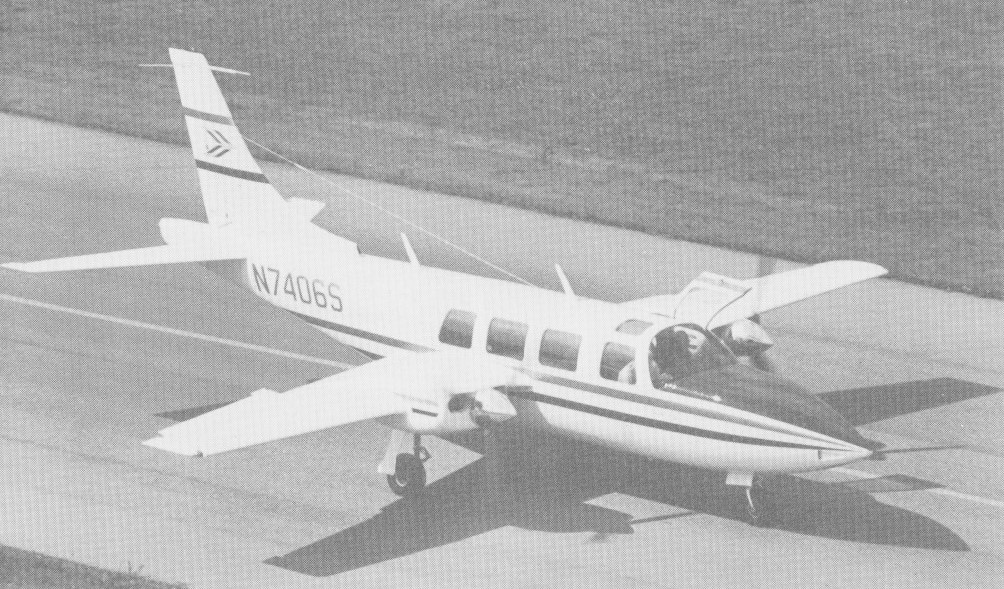
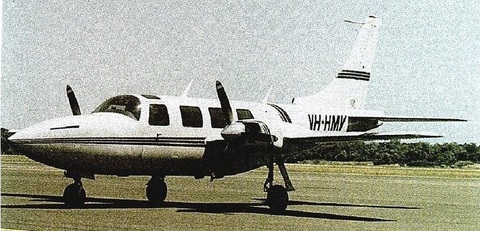
The three Piper Aerostars the non turbocharged 600, turbocharged 601 B and pressurized 601P are virtually identical in appearance. Heavy, butt joined and flush riveted skins give the airplane an extremely smooth surface, and the thicker than usual gauge metal serves two purposes. Its extra strength reduces the amount of internal structure needed, and it deforms less during flight to more accurately retain its aerodynamic shape.
Aerostars all have power steering. The nosewheel is turned by pressing the left or right side of a spring loaded rocker switch on the center console. The switch actuates a solenoid that directs hy¬draulic system pressure to a combination shimmy damp¬er/steering cylinder on the nosewheel. The controls are connected by push pull rods. The right engine on the Aerostar has the only hydraulic pump, which supplies pressure for the gear, flaps and power steering. To retract the gear after a right engine failure, the propeller must be allowed to windmill for eight seconds to provide sufficient hydraulic pressure. An extended gear subtracts 300 fpm from the rate of climb. A single engine go around with the right engine dead would be extremely difficult. The optional electric hydraulic backup pump would seem a desirable investment.
There are no up-locks on the gear. It is held in the retracted position by hydraulic pressure and by a pressure accumulator should the pump fail.
Smith designed the fuel system to be as simple as possible. There is a 42 USgallon fuselage tank behind the cabin and a wet wing cell on each side extending from the engine nacelle to the wingtip. Because of the thin, laminar flow wing, these tanks are long and shallow. They each hold 66.25 USgallons usable, for a total usable capacity of 174.5 USG. The fuel gauge displays the total capacity of the three tanks; by moving a spring loaded toggle switch, you can read the capacity of either wing tank. To obtain the quantity of the center tank, you must subtract the amount in each wing tank from the total readout.
The electrically operated fuel valves (one for each engine) have three positions – on, off and crossfeed. With the selectors “on,” each engine draws from both the center tank and its own wing tank. The system is arranged so that the wing tanks will run out first, leaving the center tank to feed the remaining fuel to both engines. The intent was that for normal operations the pilot would select ‘on,’ and forget about fuel management.
The Aerostar has standard leather upholstery covering bucket seats. Most used 600s and 601s have a brake mod which apparently remedied a pad deficiency in the original system. The fuselage: four longerons, widely spaced frames, heavy skins, butt joints, all rivets machine-countersunk and shaved, wide open spaces of unsupported panel. In a departure from classical design practice, Smith designed his structures with skins one or two gauges thicker than are commonly used, and with fewer than the usual number of frames and longerons. Stringers—stiffeners riveted across wide sheet panels to prevent buckling—are omitted entirely. Smith’s rationale was that some of the added skin weight would be made up by eliminating many detail parts; and that thick skins could be depended on to provide strength in compression, while thin ones could not. Thick skins would make the wing stiff enough to be free of flutter at jet speeds, despite a laminar airfoil thin enough to have a fairly high critical mach number. The tail feathers are interchangeable. All the control surfaces are moved by push-pull tubes; there is no aileron trim— fuel is crossfed to correct wing heaviness—and yaw and pitch trim are electric, with gearhead motors providing part of the control surface balance. Mammoth fittings and pins in quadruple shear connect the wing box to the fuselage at four points. The wing box passes through the fuselage just behind the last pair of seats; above it is a large hat shelf, and behind it a fuel tank. Still farther aft in the fuselage is the luggage compartment, situated at shoulder level. The entire cabin is ahead of the wing spar. The wing loading is high—32.4 lb/sq ft at gross in the normally aspirated Model 600, whose gross weight is 5500 pounds. The fuel system is controlled by motor-driven electric valves which take their cues from three-position rotary switches on the panel: Off, On, Crossfeed. Normally, each engine feeds from,its wing and the fuselage tank; on crossfeed, it would feed from the opposite wing tank only. Fuel is taken in through three fillers, one in the fuselage and two at the wing tips (the entire wing outboard of the engine nacelles is wet), and all three sumps are drained at a convenient point on the underside of the tail cone. All hydraulic pressure, in the standard version of the system, is provided by a pump on the right engine. A small accumulator in the tail cone provides standby power in emergencies. Hydraulic power is used for the gear, flaps, and nosewheel steering. The nosewheel steering system consists of a rocker switch on a center subpanel (which also has the trim switches) which directs a restricted flow of hydraulic fluid to either side of the shimmy dampener, depending which way you want to turn. Holding the rocker switch down feeds fluid to the appropriate side, turning the nosewheel in proportion to the time the switch is held de¬pressed. Since it is the nature of a shimmy dampener to permit controlled leakage from one side of the piston to the other, the nosewheel tends to center itself gradually once deflected. A steering failure is there¬fore not critical; the airplane can be steered with brakes.
The 601A became the B model in 1977 with the addition of 15 inches to each wingtip for increased stability at high altitudes, automatic rather than manual wastegate controls and a 300 pound gross weight increase. The 1978 model has an improved wastegate that is more durable and efficient, resulting in an increase of critical altitude from 16,000 to 23,000 feet.
The first 601P rolled off the production line in May 1974, as a 1975 model. The first 601P had “short” wings, with a span of just over 34 feet. The factory extended the wings early in the production run and virtually all of the airplanes built with less span were redone by the factory to the new 36.67 foot wingspan. Maximum cruise on the first 601P was shown in the pilot’s operating hand book as 256 knots at 25,000 feet.
By 1970 the plant was too small, and through lack of capital, the Aerostar type certificate was sold to Bulter Aviation. Production was carried out for them by Mooney as ” Mooney Aerostars”. On 7 December 1972, Ted Smith & Associates was formed with Butler Aviation to continue Aerostar production, which by 1975 it was in full product¬ion in California in three versions, the normal 600 series, the turbo-charged 601 and the pressurised 601P, and remained until the death of Ted Smith and subsequent sale of all rights to Piper, on 27 March 1978.
The Aerostar 601P, Lycoming IO 540 SIA5, 290 hp each, was priced at $220,900 (1977). The 1978 optional blower in the ventilation system helps to keep the cabin bearable on the ground.
Piper Aircraft adopted the name Sequoya for a production version of what was the Smith Aerostar. The specification of the PA 60 Sequoya 602P is almost identical with that of the Aerostar 601P, but a change of engine variant achieves a greater range at a reduced cruising speed, a better rate of climb on one or two engines, a better service ceiling and improved take off performance.
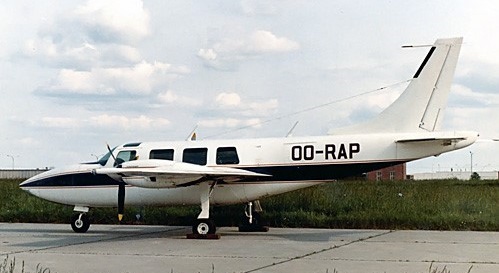
Piper Aerostar PA60-600 OO-RAP (c/n 61-0273-105)
In 1981, Piper introduced the 602P. This airplane is virtually identical to the 601P except for the engines, and they are quite different, even though the horsepower remains the same at 290 a side. The 602P has an engine turbocharger package that was designed as one unit and offers greater usable horsepower. This can be seen directly in single engine ceiling: 12,900 feet compared with 9,300 feet for the 601P. Maximum cruise was scaled back a bit from the 601P’s original number, to 245 knots. Some of this l l knot loss can be attributed to a higher maximum takeoff weight, 6,000 pounds as compared with 5,700 pounds for the original, and the rest would go to the drag of the extended wingspan.
To get more from the airplane, Piper installed more horsepower for the 700P. The basic Lycoming 540-cubic-inch-displacement engines run at higher turbo boost, developing the additional 60 hp per side. Lycoming has retained the same 1,800-hour recommended TBO. Each engine uses two turbochargers. The 700P engines counterrotate, rotate opposite the direction of other twins’; on the 700P, the prop tips rotate away from the top of the fuselage. This came from a retest of the Aerostar design that mandated an improvement in directional control when flying at low airspeeds. The directional control problem was addressed on other models by adding vortex generators, or a supplemental ventral rudder under the tailcone. The 700P also became the first Aerostar produced with cowl flaps and with intercoolers.
The 700Ps cruise number is 261 knots at 81 percent power and 25,000 feet, so, even with the extra pow¬er, not a lot of speed is gained over the 601P. Because the 700P uses fuel at 307 pph at 81 percent pow¬er, an optional additional 40 USG fuel tank was made available, and most were equipped with it, increasing maximum fuel load to 1,233 pounds, enough for a five-hour flight at relatively high power. With the extra tank, this gave a total of 1,233 pounds (205.5USG). Only 25 or these were built.
The 700 Superstar was the prototype of a stretched fuselage variant. With additional fuel capacity and increased take-off weight, registered N72TS, it first flew on 22 November 1972.
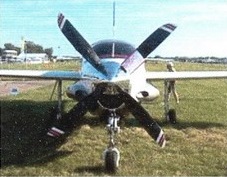
The Speedstar 850 was a modification to fit one nose mounted turboprop engine, instead of the two wing mounted engines. 25 were produced between 1983 and 1985.
Speedstar 850
The Aerostar was produced between 1967 and 1984, of the 1010 produced, 519 were built by Piper.
Aerostar 600 Engines: 2 x Lycoming IO-540, 290 hp Wing Span: 34 ft 2.5 in / 10.43 m Length: 34 ft 9.75 in / 10.61 m Height: 12 ft 1.5 in Wing Area: 170 sq ft Wing Loading: 32.3 lb/sq ft Power Loading: 9.5 lb/sq ft Baggage Capacity: 30 Cu ft, 200 lb MTOW: 5,500 lb / 2495 kg Max Zero-Fuel Weight: 4,450 lb Empty Weight: 3425 lb / 1553 kg Standard Useful: 1,700 lb Minimum Control Speed: 97 mph Best Rate of Climb Speed: 145 mph Best Rate of Climb Single Engine: 135 mph Best Angle of Climb Speed: 125 mph Best Angle of Climb Single Engine 125 mph Never Exceed Speed: 278 mph Maneuvering Speed: 187 mph Max Flap Extension Speed: 20 degrees – 180 mph, Full flaps: 148 mph Max Gear Extension Speed: 180 mph Max Gear Retraction Speed: 150 mph Max Speed at Sea Level: 260 mph Cruising Speed 70% at 10,000 ft / 3050m: 250 mph / 217 kt / 402 kph Cruising Speed 65% at 10,000 ft: 209 kts Cruising Speed 55% at 10,000 ft: 223 mph Stalling Speed: (dirty, power off) 77 mph Rate of Climb at Sea Level: 1,850 fpm / 564 m/min Rate of Climb Single Engine: 450 fpm Service Ceiling: 22,000 ft Single Engine ceiling: 6,300 ft Takeoff Distance: 1,095 ft Takeoff Distance Over 50ft: 2,120 ft Landing Distance: 932 ft Landing Distance Over 50 ft: 2,032 ft Fuel Capacity (usable): 170 USG Range (max fuel, 45 min res) max cruise, 250 mph: 1,063 sm Range (max fuel, 30 min res) 65% 10,000ft/3050m, 250 mph: 1,400 sm / 1216 nm / 2250 km Max range, 204 mph: 1,650 sm Wheel track: 10.2 ft Baggage cap: 240 lbs / 109 kg / 30 cu.ft / 0.85 cu.m Seats: 6 Vmc: 92 mph T/O dist: 1000 ft T/O dist 50 ft: 1400 ft Ldg dist: 895 ft Ldg dist 50 ft: 2420 ft Cabin length: 12 ft 6 in / 3.81 m Cabin width: 3 ft 10 in / 1.17 m Cabin height: 4 ft 0 in / 1.22 m
Aerostar 600A
similar to the 600 but with minor detail changes. Engines: 2 x Lycoming IO-540-K1J5, 290 hp TBO: 2000 hrs Props: Hartzell 3-blade CS full feathering 6 ft 6 in Wingspan: 34 ft 2 in Wing area: 170 sq.ft Wing aspect ratio: 6.9 Length: 34 ft 9.75 in Height: 12 ft 1.25 in Max ramp wt: 5525 lb Max take off wt: 5500 lb Standard empty wt: 3560 lb Max useful load: 1763 lb Max landing wt: 5500 lb Wing loading: 32.4 lbs/sq.ft Power loading: 9.5 lbs/hp Max useable fuel: 993 lb / 177 USG Baggage capacity: 240 lb Climb rate: 1800 fpm @ 122 kt Climb gradient: 885 ft/nm Rate of climb @ 8000 ft: 1150 fpm Service ceiling; 21,200 ft SE rate of climb: 360 fpm @ 113 kt SE climb gradient: 239 f/nm SE ceiling: 6300 ft Max speed SL: 260 mph / 226 kt Cruise @ 65% power @ 8,000ft: 207 kt Fuel flow @ 65% power @ 8,000ft: 185 pph Endurance @ 65% power @ 8,000ft: 5.1 hr Cruise speed 10,000ft: 250 mph Stalling speed clean: 76 kt Stall speed gear/flaps down: 74 kt Turbulent air penetration speed: 163 kt Retractable undercarriage T/O dist (50 ft): 1400 ft Ldg dist (50ft): 1950 ft Range 9000ft: 1408 mi Seats: 6
Aerostar 600AE Designation for types sold in Europe
Aerostar 601 / PA-61 Later designated PA-61 FAA approved during November 1968 for the Ted Smith Aircraft Co and on 12 April 1978 for Piper. Engines: 2 x Lycoming IO-540-S1A5, 29 hp Ceiling: 20,000 ft Max speed: 240 kts Fuel cap: 177 USG Range (no res): 1436 sm Stall, clean: 77 kts Vmc: 80 kt 117 produced.
Aerostar 601B / PA-61 Later designated PA-61 Increased wingspan, same as 601P Engines: 2 x Lycoming IO 540 P1A5 or S1A5, 290 hp TBO: 1,800 hrs Props: Hartzell constant speed, full feathering Wingspan: 36 ft 8 in Length: 34 ft 9.75 in Height: 12 ft 1.25 in Wing area: 178.2 sq.ft Baggage capacity: 240 lb Empty weight: 4031 lb Useful load: 1,969 lb Payload with full fuel: 922 lb Gross weight: 6,000 lb Maximum landing weight: 6,000 lb Usable fuel capacity: 174.5 USG/1,047 lb Wing loading: 33.6 lb/sq.ft Power loading: 9.13 lb/hp Max speed 25,000ft: 302 mph / 259 kt Max cruise, 75% power at 25,000 ft: 236 kt Econ cruise, 55% power at 25,000 ft: 212 kt Duration at max cruise: 4.8 hr Duration at econ cruise: 6.4 hr Stalling speed, clean: 79 kt Stalling speed, full flaps: 71 kt Maximum rate of climb: 1,530 fpm Single engine rate of climb: 254 fpm Single engine climb gradient 109 knots (Vyse): 141 ft/nm Certificated ceiling: 30,000 ft Single engine service ceiling: 9,250 ft Takeoff 50 ft: 2310 ft Landing from 50 ft: 2175 ft Range 25,000ft: 1435 mi Seats: 6 44 produced
Aerostar 600BE Designation for types sold in Europe
Aerostar 600P / PA-61P Later PA-61P. Produced from 1972, pressurised, increased weights and turbocharged engines. 492 produced
Aerostar 600PE Designation for types sold in Europe
Aerostar 601P Engine: 2 x Lycoming IO-540-S1A5, 290 hp Seats: 6 Wing loading: 33.7 lb/sq.ft Pwr loading: 10.2 lb/hp Gross wt: 6000 lb Empty wt: 4000 lb Equipped useful load: 1970 lb Baggage capacity: 240 lb Payload max fuel: 923 lb Range max fuel/75%: 1125nm/4.5hr Range max fuel /55%: 1304nm/6.2hr Service ceiling: 26,350 ft Max speed 25,000ft: 290 mph 75% cruise @ 25,000 ft: 247 kt Cruise: 230 kts @ 65% pwr @ 20,000ft 55% Cruise: 212 kt Vmc: 80 kt Stall: 69-77 kt 1.3 Vso: 90 kt ROC: 1530 fpm SE ROC: 285 fpm @ 117 kt SE ceiling: 9100 ft Min field length: 2047 ft T/O dist (50 ft): 2310 ft Ldg dist (50ft): 2100 ft Fuel cap: 1047 lb / 177 USG Cabin pressure: 4.25 psi
PA-60 Aerostar 602 Engines: 2 x 290 hp Lycoming Seats: 6 Empty Wt: 4125 lbs Gross wt: 6000 lbs Useful load: 1875 lbs Max Cruise: 283 mph Max range: 1260 sm
PA-60 Aerostar 602P Piper-developed version of the 601P with the 290 hp Lycoming TIO-540-AA1A5 engines First built: 1974 Engine: 2 x Lycoming IO-540-AA1A5, 290 hp TBO: 1800 hr Prop: Hartzell 3 blade, constant speed 78 in Seats: 6 Length: 34.8 ft Height: 12.1 ft Wingspan: 36.7 ft Wing area: 178 sq.ft Wing aspect ratio: 7.6 Max ramp wt: 6029 lb Max take off wt: 6000 lb Standard empty wt: 4075 lb Max useful load: 1954 lb Max landing wt: 6000 lb Wing loading: 33.7 lbs/sq.ft Power loading: 10.3 lbs/hp Max useable fuel: 993 lb Climb rate: 1460 fpm @ 117 kt Climb gradient: 749 ft/nm Rate of climb @ 8000 ft: 1320 fpm Certificated ceiling; 25,000 ft 8,000 ft cabin altitude: 20,600 ft SE rate of climb: 240 fpm @ 109 kt SE climb gradient: 131 f/nm SE ceiling: 8800 ft Max speed: 257 kts Cruise @ 65% power @ 8,000ft: 203 kts Cruise @ 65% pwr @ 18,000 ft: 220 kts Fuel flow @ 65% power @ 18,000ft: 182 pph Endurance @ 65% power @ 8,000ft: 5.2 hr Stalling speed clean: 79 kts Stall speed gear/flaps down: 77 kts Turbulent air penetration speed: 167 kts Retractable undercarriage 124 built
1981 Piper Aerostar 602P Engines: 2 x Lycoming IO 540 AA1A5, 290 hp Recommended TBO: 1,800 hrs Props: Hartzell, 3 blade, 78 in dia Length: 34.83 ft Height: 12.17 ft Wingspan: 36.67 ft Wing area: 178 sq ft Max ramp weight: 6,029 lbs Max takeoff weight: 6000 lb Empty weight: 4,406 lb Useful load: 1,623 lb Zero fuel weight: 5,900 lb Maximum landing weight: 6,000 lb Wing loading: 33.7 lbs/sq ft Power loading: 10.3 lbs/hp Max usable fuel: 165.5 USG/993 lb Certified ceiling: 25,000 ft Max pressurization differential: 4.25 psi 8000 ft cabin altitude at: 20,600 ft Max rate of climb: 1,755 fpm Max single engine rate of climb: 302 fpm Single engine climb gradient: 154 ft/nm Single engine service ceiling: 12,900 ft Maximum cruise speed, FL 250: 245 kt Cruise, 65% power at 15,000 ft: 210 kt Cruise, 65% power at FL 250: 226 kt Fuel flow at 65%: 32.4 gph, 199.4 pph Endurance at 65%, no res: 6.2 hr Stalling speed, clean: 86 kts Stalling speed, flaps down: 77 kt Turbulent air penetration speed: 167 kt
620 A pressurised Aerostar with 310 hp TIO-540 engines, one built.
Ted Smith sold his interest in Aero Commander to Rockwell and by 1966 had completed the first mockup of the Aerostar and production commenced in 1967, with finance from American Cement, at Van Nuys. Occupied a new factory at Van Nuys, California, in 1968. Airframe concerned claimed to have only about 50 percent of components used in comparable types, with loads carried by unstiffened sections of metal skin. Some vertical and horizontal surfaces interchangeable.
Ted Smith then sold out to the Ameri¬can Cement Company, which, Smith says, simply didn’t know how to run an aircraft business and consequently ran Aerostar into the ground before finally selling out to Butler Aviation, another firm with no experience in manufacture. Butler did nothing with the Ae¬rostar, and eventually, Smith was able to buy back the company and a large inventory of parts at a much lower price than that at which he had sold out in the first place. This sequence of events is crucial; it amounted to a huge gift to Smith, who found himself able to sell a comparatively exotic airplane of ex¬cellent performance at unnaturally low prices, because he obtained his parts¬ – enough of them to make hundreds of air¬planes in some cases at a huge discount. Thus, after only a short time in business, Smith could boast of a 10 percent annual re¬turn (before taxes), one of the highest in the industry.
In 1972 became Ted R. Smith and Associates Inc, further developing Aerostar range. During 1976 the company was renamed the Ted Smith Aerostar Corp and later that year Ted Smith died.
During March 1978 Piper acquired the Aerostar.
In 1991 the Aerostar Type Certificate and manufacturing documentation were purchased by J.Christy & S.Spencer, former employees of Ted Smith Aerostar Corp. They began to operate a maintenance, support and parts service in the name of Aerostar Aircraft Corp.
From 1976 this company held manufacturing and tooling rights for the Thurston Teal, which was previously owned by Schweizer Aircraft Corporation. Plans to restore the Teal to production in 1978, as the TSC-1A3 Marlin, did not take materialize.
When during the 1950s the Chinese People’s Republic decided to revive the country’s sporting gliding movement it was to Poland that they turned for help, and with the aid of instructors, technicians and designers from the Polish SZD organisation a central Gliding School was organized at An-Yan and large gliding establishments were set up at Tchan-Tia-Kou. It was here that a Chinese glider design office was formed towards the end of 1956 under the direction of Dipl Ing Niespal of the Polish SZD, and a Glider Manufacturing Centre was organized for the licence production of Polish types such as the ABC, Salamandra, the SZD-8 Jasolka, the SZD-12 Mucha 100 and the SZD-9 Bocian, examples of which had already been purchased from Poland; production of these types began during 1955-56.
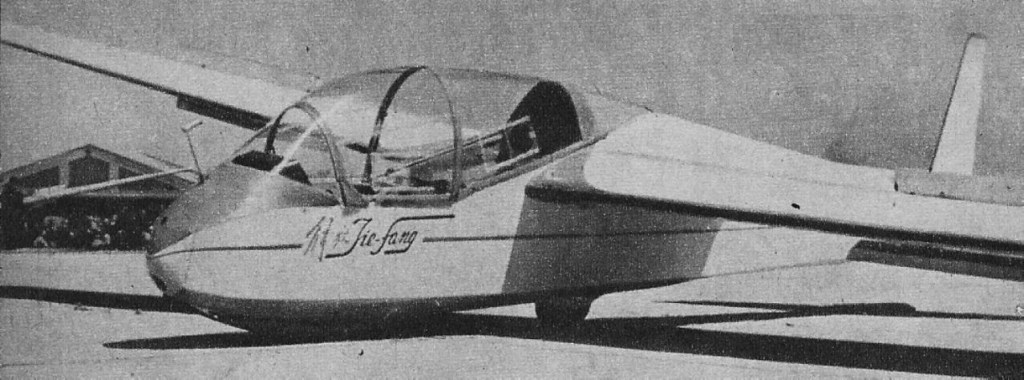
It was at Tchan-Tia-Kou that the first Chinese glider of original design, the Lie-Fang (or Liberation) two seater intermediate trainer, was created. The design of the Lie-Fang, one of the first gliders to originate in China, was led by the Polish J. Niespal. He was assisted by two Chinese engineers, Tchen-Kuei-Wen and Li-Ti-Tuin.
Niespal used the 1953 SZD-12 Mucha 100 as a starting point. There were many differences between the Mucha and the Lie-Fang, partly because the latter was a two-seat aircraft and therefore longer, with a much modified nose and more strongly forward-swept wings; the Lie-Fang’s fuselage was a simpler, flat sided structure compared with the Mucha’s oval section monocoque and the empennage was more angular.
The Lie-Fang 1 (English: Liberation 1), some sources Jeifang 1, is wood framed, with some use of the local “poton” wood and with a mixture of plywood and fabric covering. It has a high mid mounted single spar wing with a plywood covered torsion box leading edge, Behind the spar the wing is fabric covered. In plan it is straight tapered with unswept leading edges, resulting in forward sweep of 2° at one quarter chord. There is 4° of dihedral and 2° of washout. Its ailerons are slotted and fabric covered and spoilers, mounted behind the spar at about one third span, open above and below the wing.
The wooden slotted ailerons are also fabric covered and there are spoilers on both top and bottom wing surfaces. The fuselage is a plywood monocoque with a light alloy nose-cap, and the cantilever tail unit is of wood with fabric covering.
The fuselage is a flat sided monocoque which tapers gently to the rear, with the straight tapered tailplane mounted on top of it and forward of the fin. The rear surfaces are fabric covered. The straight edged rudder extends to the keel and moves in a cut-out between the elevators, one of which has a trim tab. The cockpit, mostly ahead of the wing leading edge, seats pupil and instructor in tandem with a single set of instruments that they can both see. The fixed, two part forward canopy reaches almost to the nose; a rear transparent section opens sideways for access to both seats. The Lie-Fang lands on a fixed monowheel undercarriage under the wing, fitted with brakes and aided by a short, rubber sprung nose skid and a tail bumper.
The landing gear consists of a non-retractable monowheel with brake, and a rubber-mounted skid under the forward fuselage. The two pilots are seated in tandem under a large sideways-opening Perspex canopy.
The prototype made its first flight on 10 May 1958. It was cleared for cloud flying and classed as semi-aerobatic. It went into production at the Tchan-Tia-Kou manufacturing centre, Shenyang, and was intended that pupils should graduate from the Lie-Fang to the single-seat SZD Mucha, which it resembles in appearance, for their first solo flights and the Lie-Fang went into small-scale production for the Chinese gliding centres.
Wingspan: 15.00 m (49 ft 3 in) Length: 8.00 m (26 ft 3 in) Wing area: 18.5 m2 (199 sq ft) Aspect ratio: 12.4 Airfoil: Göttingen 549 over most of the span, NACA 4412 at tip Height: 1.35 m (4 ft 5 in) Empty weight equipped: 242 kg (534 lb) Max takeoff weight: 420 kg (926 lb) Stall speed: 55 km/h (34 mph, 30 kn) Never exceed speed: 165 km/h (103 mph, 89 kn) Rough air speed max: 138 km/h (85.7 mph; 74.5 kn) Aerotow speed: 140 km/h (87.0 mph; 75.6 kn) Winch launch speed: 100 km/h (62.1 mph; 54.0 kn) Terminal velocity: with full airbrakes 165 km/h (103 mph; 89 kn) g limits: +4.5 Max l/d: 22 at 53 mph / 86 km/h / 46.4 kn Min sinking speed: 0.8 m/s / 160 ft/min / 2.62 ft/sec at 38.5 mph / 62 km/h / 33.5 kn Min sink: 2.6 ft/sec at 38.5 mph Crew: Two
Shen Yang, near Mukden Quantity production of Polish designed ABC, Bocian, Jaskolka and Mucha sailplanes began at Shen Yang in 1955-56. At about the same time, a design team was formed under the leadership of Dipl./Ing. J.Niespal of the Polish SZD (experimental glider establishment). The first product of this team, which included Dipl.Ing Tchen-Kuei-Wen and Li-Ti-Tiun, was the Lie-Fang No.1.
With origins in the Taylorcraft Model B of the early 1940s, the F-19 and F-20 are revived and improved versions of the Models 19 and 20. Three models of the F-19 Sportsman were offered as Standard, Custom, and Deluxe. There was a modernisation after Continental suspended production of the O-200 engine.
A higher-powered version, the F-21 two-seat sporting trainer, was designed with aluminium ‘T’-beam wing spars and a new fuel system. This in turn has given way to the F-22.
The F-21B has been certificated in Australia, and the manufacturer hoped that this would generate sufficient interest for the production line to start up again. The price for a standard, equipped aircraft had risen to $33,000, which Taylorcraft says reflected higher engine costs, which are “going out of sight”.
The 1979 T Craft was the F model. With 100 horsepower, it weighs 900 pounds and it can lift another 600 pounds. The T Craft tops out at 110 knots, it stalls at 37, and it departs or returns to Earth fully loaded over a 50 foot obstacle in 375 feet. It will cruise 350 miles while sipping six gallons an hour.
The F-19 was built until 1980.
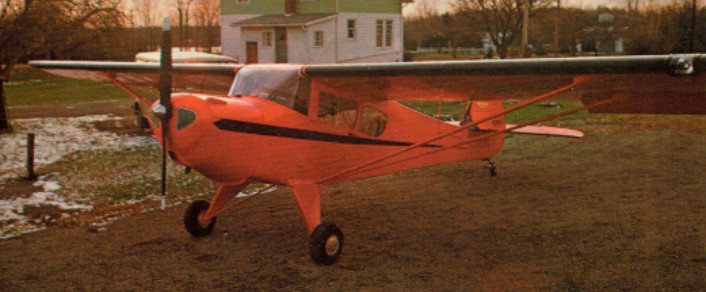
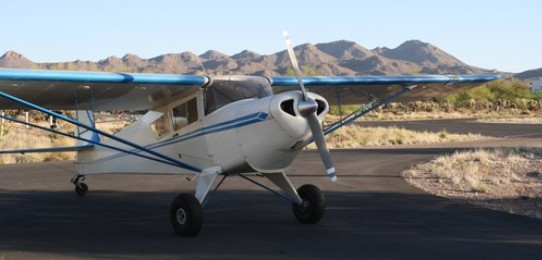
1975 model Taylorcraft F-19
Built in 1979 at the plant in Alliance, Ohio, wrapped in Dacron and painted, each T Craft is towed a couple of miles out to Barber Field for final assembly.
The F-21 was first built in 1980.
1980 Taylorcraft F-21
Taylorcraft production includes 100 prewar Model As, 1800 military L-2s, more than 2800 post-war BC-12Ds, and more than 120 F-19 Sportsmans.
19 Sportsman Engine: 1 × Continental C-85, 85 hp (63 kW) Prop: 2-bladed metal Wingspan: 36’0″ Length: 22’0″ Empty weight: 860 lb (390 kg) Gross weight: 1,500 lb (680 kg) Fuel capacity: 18 U.S. gallons (68 L; 15 imp gal) Maximum speed: 120 mph (193 km/h; 104 kn) Cruise speed: 110 mph (96 kn; 177 km/h) Stall speed: 38 mph (33 kn; 61 km/h) Range: 300 mi (261 nmi; 483 km) Service ceiling: 17,000 ft (5,182 m) Rate of climb: 700 ft/min (3.6 m/s) Crew: one Capacity: one passenger
F-19 Engine: 1 x Continental O-200-A, 100 hp Seats: 2 Wing loading: 8.17 lb/sq.ft Pwr loading: 15 lb/hp Gross wt: 1500 lb Empty wt: 870 lb Equipped useful load: 585 lb Payload max fuel: 441 lb Range max fuel/75% pwr: 401nm/3.9hr Service ceiling: 18,000 ft 75% cruise: 100 kt 55% cruise: 78 kt Stall: 37 kt 1.3 Vso: 49 kt ROC: 775 fpm Min field length: 400 ft Fuel cap: 144 lb
Developed from the Taylorcraft Model A, the side-by-side two-place, single-engine, Model B was constructed in large numbers during the late 1930s and early 1940s and was available for delivery from the factory as a land plane and a floatplane. Like many light aircraft of its day, the fuselage is constructed of welded steel tubing and covered with doped aircraft fabric. The wings are braced using steel-tube struts.
The Model B was mainly bought by private pilot owners. Large numbers were flown in the United States, and many were sold to owners in Canada and several overseas countries, including those in Europe.
The BF (ATC 699) of 1938 sold for $1,549 and had an optional fully-cowled 65hp Franklin 4AC giving a slight increase in performance. The BF-12-65 added an elevator trim tab.
The Model B production was restored post-WW2 as the BC-12. Almost 4500 were built before replaced by the Model 19.
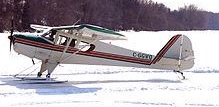
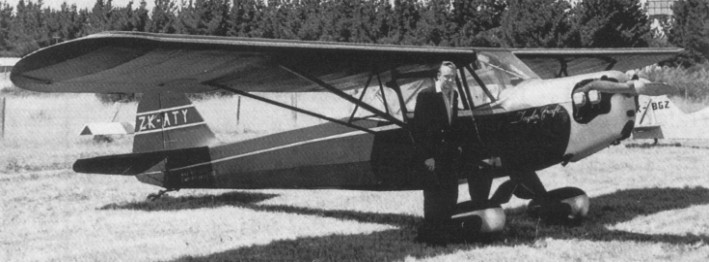
Taylorcraft BF-12-65
Many were still active in 2015.
The wing’s airfoil, rather than being the flat bottom Clark “Y” or USA 35 everyone else was using, was a semi-symmetrical 23000 series known for low drag and less gentle stall characteristics. For a wing that long to be that fast, it had to have a low-drag airfoil.
The pre-war airplanes used 1025 steel tube or a combination of 1025 and 4130. Postwar airplanes are all 4130. The wings use pressed-aluminium ribs over wooden spars. Most Taylorcrafts use Shinn brakes which are mechanical shoe types with the lining on the drums, not the shoes.
In 1939 and 1940, Taylorcraft built the BL-50 (with optional 65hp A-65), BC-65 and the BF-60. All three models were the same airframe with a Continental, Lycoming, or Franklin engine. The number in the model designation indicated the engine horsepower. The 1938 BL was ATC 700 and sold for $1,549-1,595.
The BC (ATC 696) sold for $1,495-1,565. Seating was side-by-side. A total of 2,401 of the B models were produced of which a large number went to Army and the USAAF as L-2, O-57, and TG-6 glider. One went to Great Britain for evaluation of production. 132 were built under license by Taylorcraft Aeroplanes Ltd in 1939-41 as C (with O-145) and Plus-D (90hp Cirrus Minor). The first military use of a personal lightplane was 18 civil models impressed into RAF as C/2.
A total of 4314 of the 1941 BL-12 Deluxe model with the 65hp Lycoming O-145 engine were sold, including export deliveries. The BLS-50 was powered with a 60hp 4AC-17 engine.
In England, from 1953 to 1968, Taylorcraft Ltd produced 798 B models as civil Auster Autocrat and military Auster VI, plus 1,150 other models, until the end of production in 1968.
Postwar versions were reintroduced in 1946 as BC-12-D Standard and Deluxe Traveller (ATC 696) with 65-85hp Continentals. Last production version, as F-22 by Taylorcraft-Ruckle of Lock Haven PA, had a list price of $34,110 in 1991.
As World War II broke out, all production of civilian airplanes ceased at the Taylorcraft Corporation. Taylorcraft submitted a tandem seat design for the U.S. Army Air Corps evaluation and the airplane was accepted and designated the L-2 liaison aircraft. Some 1800 were produced throughout the war.
L2A
The BC-12D retained the popular Continental A-65-8A engine. It had side-by-side seating and an enclosed engine cowling.
Taylorcraft production includes 100 prewar Model As, 1800 military L-2s, more than 2800 post-war BC-12Ds, and more than 120 F-19 Sportsmans.
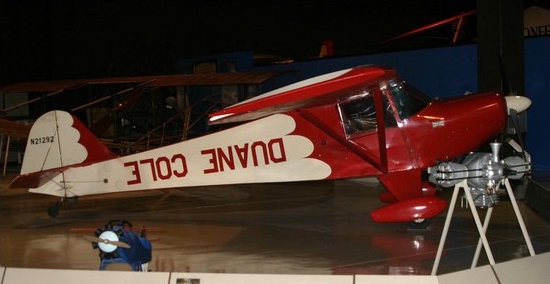
Duane Cole’s Taylorcraft, a BF-50, was built in 1938, the same year Cole earned his Private Pilot license. In 1950, it was acquired by John Vasey, a well-known aerobatic pilot and air show performer. Vasey shortened (“clipped”) the wingspan from 36 feet to 28 feet, 10 inches, and strengthened the wings. That gave the airplane more speed and a faster roll rate. Vasey also moved the pilot’s seat and control seat to the center of the cabin, making the two-seat BF-50 into a single-seat airplane, and shifting the airplane’s center of gravity. Finally, he replaced the original Franklin 50-horsepower engine with an 85 hp fuel-injected engine. His modifications turned the docile BF-50 into a powerful and agile aerobatic performer.
Taylorcraft BF, N21292
Duane Cole bought N21292 from Vasey in 1952. Thus began one of the longest running aerobatic “partnerships” in history. Duane Cole and his signature red and cream Taylorcraft entertained millions of air show spectators in 47 states and five foreign countries. Cole installed a new 150-horsepower engine on the plane, but otherwise left the basic structure and Vasey’s modifications unchanged. He had little use for radios or instrument flying, and flew all over the US using pilotage and dead reckoning skills.
In 1962 and 1964, Cole flew the Taylorcraft to win the US National Aerobatic Championship and was named in 1962 to the US aerobatic team to compete for the international title in Budapest, Hungary.
BC / BC-50 1938 – Based on the Model A with a 50 hp Continental A-50-1 engine and modified wing construction, also known as the BC-50 Wingspan: 36’0″ Length: 22’0″ Useful load: 468 lb Max speed: 97 mph Cruise speed: 88 mph Stall: 35 mph Range: 275 mi Seats: 2
BCS 1939 – Seaplane variant of the BC
BC-65 1939 – Model BC with a 65 hp Continental A-65-1 engine Wingspan: 36’0″ Length: 22’0″ Useful load: 510 Max speed: 105 mph Cruise speed: 95 mph Stall: 38 mph Range: 250 mi Seats: 2
BCS-65 1939 – Seaplane variant of the BC-65.
BC-12-65 / L-2H 1941 – As BC-65 except for minor structural changes and added elevator trim tab and a Continental A-65-7 engine.
BC-12D Twosome 1945 – Postwar production version of the BC-12-65 with a Continental A-65-8 engine with alternate tail surface, alternate one piece window and other minor changes.
BCS-12D 1946 – Seaplane variant of the BC-12D
BC-12D1 1946 – As the BC-12-D with left hand door, parking brake and right-hand wing tank removed
BCS-12-D1 1946 – Seaplane variant of the BC-12D1
BC-12D-85 Sportsman 1948 – A BC-12D fitted with a 85 hp Continental C85-8F engine and increased power and gross weight.
BCS-12D-85 1948 – Seaplane variant of the BC-12D1.
BC-12D-4-85 1949 – A BC-12D-85 fitted with an extra rear side window and a Continental C85-12F engine.
BCS-12D-4-85 1949 – Seaplane variant of the BC-12D-4-85.




 All Aero