Howard L Terril
Torrance CA.
USA
Circa 1957-66 built aircraft
Howard L Terril
Torrance CA.
USA
Circa 1957-66 built aircraft
First flown on 10 February 1957 (N7939A), the Termite open cockpit, high wing monoplane was marketed as plans for home-builders.
The original motor was a 36hp Aeronca E-113C.
Reportedly 20 were under construction by 1961.
Engine: Continental, 40hp
Wingspan: 23’6″
Length: 15’1″
Useful load: 225 lb
Max speed: 95 mph
Cruise speed: 85 mph
Stall: 38 mph
Range: 150 mi
Seats: 1
fdr: Wilbur L Smith
Bloomington IL.
USA
Circa 1957 built the Termite monoplane
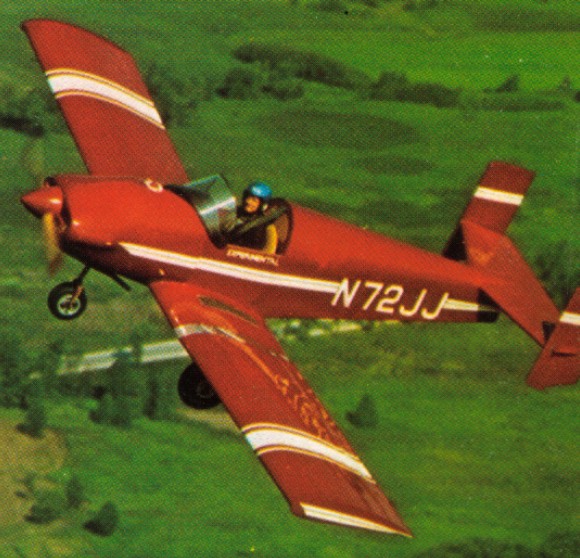
The Mini Coupe was designed by Bill Johnson and was the very first of the modern material kits. The Mini Coupe made its first flight in 1971 and was certified in 1972.
The Mini Coupe kit was purchased “complete” to the firewall in 1972, with all materials required to build the airplane. Ribs were formed along with the spars, wing skins, fuselage skins, tail assembly, controls assemblies, landing gear, brakes, tires, tubes, wheels, and about 5,000 pop rivets.
By late 1975, approximately 150 sets of plans had been sold. The Mini Coupe is a lightweight all-metal, single seat sporting aircraft powered by a 65-hp modified Volkswagen 1600-cc engine. Its wings are of constant-chord design with all-metal, stressed-skin construction with metal ailerons and no flaps or trim tabs. Its landing gear is the nonretractable tricycle type with oversize tires. The single seat is covered by a canopy or can be left open.
Price 1982: $2,850 Excludes instruments, wheels, bearings, axles, brakes, tires, tubes and cockpit covering. Units delivered to June 1981: 170.
The VW powered Mini Coupe in 2008 was available from DCS Inc.
Engines: VW-1600
Engine options: up to 100 hp
MTOW utility: 850 lb
MTOW Std cat: 900 lb
Empty Wt. 497 lb
Fuel capacity 13-15 USG
Usefull load 353 – 403 lb
Wingspan 22 ft 4 in – 24 ft
Length 16’4”
Vne 145 mph
Cruise 90-110 mph
Stall 48 mph
Climb rate 750 fpm
Ceil¬ing 12,500 ft
Takeoff run 300 ft
Landing roll 400 ft
Range 300 miles
Cabin width 24 in
Seats: 1
Undercarrage: nose wheel
Tires: 600 x 6
Chris Tena Aircraft
1980: Bill Johnson, Box 1, Hilisboro, OR 97123, USA.
LSA builder
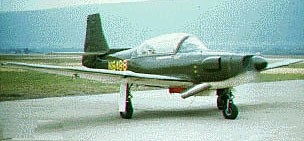
The 1956 Temco 58 was another unsuccessful design for military use. The sole example built, N848B, was apparently a modification of a Model 33.
Engine: Lycoming GSO-480-A1A6, 340hp
Wingspan: 33’3″
Length: 25’10”
Useful load: 723 lb
Max speed: 213 mph
Cruise speed: 200 mph
Seats: 2

The United States Air Force issued a requirement in 1952 for a jet-powered primary trainer, and Texas Engineering and Manufacturing Company (Temco) responded with the Model 51 Pinto. Powered by a Continental J69-T-9 turbojet, the Pinto was a tricycle-geared mid-wing cantilever monoplane, with tandem seating for the instructor and student in an enclosed cockpit.
First flown on 26 March of 1956, the prototype, N78856, was tested by the U. S. Navy, which subsequently ordered 14 of the aircraft under the designation TT-1 (144223-144236), to study the feasibility of using jet aircraft for primary training. No additional TT-1 Pinto aircraft were manufactured.
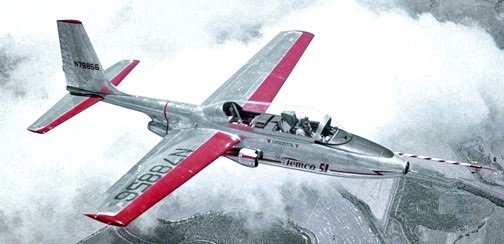
The United States Air Force issued a requirement was met by the Cessna T-37

In June 1968 American Jet Industries Inc first flew the Super Pinto, a jet primary trainer or light strike aircraft developed from TT-1 Pinto built by Temco.

One original surplus Temco TT-1 Pinto became the Super Pinto when modified with the J-85-17 engine by Frank Guzman. Registered N7753A, it first flew on 15 January 1972.
On November 8, 1976 the Philippine government bought the Super Pinto (Cali) prototype, including design and manufacturing rights.
Engine: One Continental J69-T-9 turbojet, 930 lb thrust
Wing Span: 30ft. 0in.
Length: 30ft. 9.25in.
Height: 10ft. 10.75in.
Max Takeoff Weight: 4,325 lbs.
Maximum speed: 550 kmh / 345 mph
Ceiling: 9800 m / 32,200 ft
Endurance: 1:30
Range: 450 miles

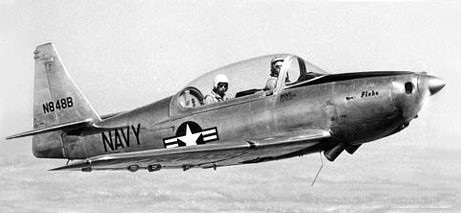
The TE-1A Buckaroo primary trainer development of Globe Swift lead in 1953 to the civil Model 33 Plebe. First flying on 23 August 1953, N848B, the sole example built, was an unsuccessful bid to replace the North American T-28.
Engine: Continental O-470-13, 225hp
Wingspan: 31’3″
Length: 24’3″
Useful load: 700 lb
Max speed: 192 mph
Cruise speed: 178 mph
Seats: 2
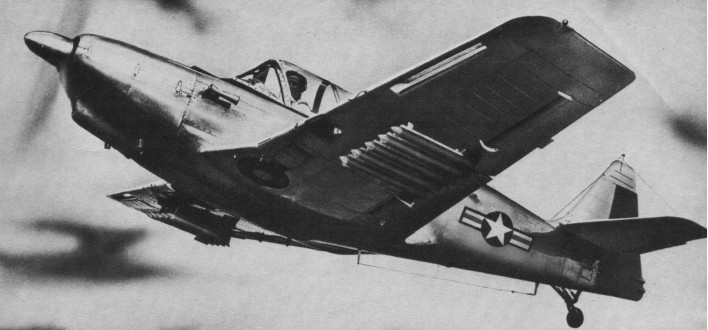
Pappy Gunn landed a post-war job as technical advisor to the Philippine Air Force, and leaked word that the PAF just might be in the market for a tiny tandem trainer that could mount a pair of machine guns in the wing to go shoot up rebellious natives or whatever. Robert McCullough, who was then president of TEMCO, asked the sales department whether a commercial version of such a plane would find a market, and when they said yes, the engineers, under Dave Tacke, got busy and hand-built a modification of a standard Swift into what was called the TE-1A.
The only changes in this initial prototype were to install tandem instead of side-by-side seats, tandem controls, a new canopy and a squared off rudder, much like that of the T-6. The sirnilarity was not accidental TEMCO was originally founded to hold together a postwar production team of outstanding skill, and more than 90% of the employees had worked for North American building T-6s and P-51 Mustangs. To come up with something in a hurry, the prototype trainer was designed originally as a converted Swift, which was already in production at TEMCO since Globe went bankrupt.
The TE-1A had tandem cockpits; 24v electrics, raised horizontal tail, strengthened wing with added fillets, and improved landing gear. In late 1948 the first TE-1A prototype was ready to fly, behind a 125-horsepower Continental, when word came that the USAF planned a competition in early 1949 for a new primary basic trainer. There was no time for a major redesign, so they cleaned up the canopy and sent the ship off to Wright Field to compete against the Fairchild T-31 and the Beech T-34, with Fairchild winning that round. Forgetting the Air Force’s interest, TEMCO decided to press on with the Buckaroo as a COIN aircraft for smaller foreign governments, brought in a noted small-plane engineer, H.G. Erickson, and went to work on a complete new program to come up with a really first class plane with no restrictions.
Scrapping the original TE-1A design, a whole new aircraft was evolved, still designated the TE-1A, of the same general weight, type, and configuration, but designed to military standards. Starting from scratch with a plaster and steel mockup, they, designed a brand new fuselage and wing center section, bulging the rear fuselage slightly, raising the deck, lengthening the nose and adding three inch’s to the overall length. Outer wing panels were stressed to 9 G’s and the tips squared off. The only vestige of its Swift lineage was to leave in the leading edge slot assembly, which gave more positive control at low airspeed.
About the only parts of the original airframe left were the cowl and canopy, neither of which survived the initial flight test stage. The canopy became a three-piece sliding type with magnesium framework, and the cowl was redesigned to provide downdraft rather than updraft cooling.
Other changes included a panel redesign to conform to the Air Force Standard Cockpit layout that originated with the T-6 Texan in World War 11, addition of an Aeromatic Model F-200H propeller with altitude control, a 24-voll electrical system, and a single fuel tank of 27.6 gallon capacity.
The finished product looked so good that in late 1949 TEMCO tooled up for limited production of 10 items, with 145-horsepower Continentals’ but just then they heard through the grapevine that the Air Force actually wanted to buy three YT-35s, as they were then called, for a new evaluation at Randolph AFB (the earlier USAF contract had been cancelled). So the horsepower went from 145 to 165 and the Buckaroo went to the lists as the TE-1B.
The official policy line was no more taildraggers in the Air Force.
The Israeli Air Force got the first TE-IA, N90080, in June, 1950, with machine guns and ten 2.75-inch rockets, one TE-1A went to the Greek Air Force, while the original three TE-1Bs, designated YT-35 Buckaroos, went to the Air Force the next month. Saudi Arabia took delivery of ten more Buckaroos, 53-4465 to 53-4474. Saudi Arabia installed two .30 wing guns and ten underwing rocket launchers.
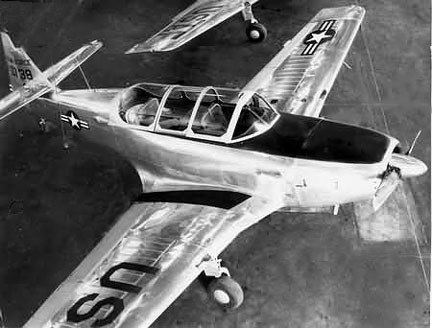
The three USAF TE-1Bs, 50-738 to 50-740, were finally shipped to San Marcos AFB as instrument trainers for Field Force Liaison Pilots, and ten months later were returned to TEMCO for factory overhaul preparatory to still another round of evaluation tests at Goodfellow AFB, against the YT-34, with a T-6 Texan serving as control ship. Thus it was that Beech beat out TEMCO and the three TE-1Bs (or YT-35s) went up for sale as military surplus.
A Jack Hardwick picked up the three Buckaroos from the government and eventually disposed of them.

YT-35
Engine: 165 h.p. Franklin 6A4-165-B3
Span: 29 ft. 2 in
Weight: 1,975 lb
Max. Speed: 156 mph
T-35 Buckaroo
Engine: Franklin 6A-165-B3, 165 hp
Wingspan: 29′ 10″
Length: 21′ 8″
Useful load: 620 lb
Max speed: 150 mph
Cruise speed: 142 mph
Stall: 56 mph
Range: 550 mi
Seats: 2 Tandem
Undercarriage: retractable
TE-1A
Engine: Continental C-145-2H, 145 hp
Wingspan: 29′ 11″
Length: 21′ 8″
Useful load: 620 lb
Max speed: 150 mph
Cruise speed: 142 mph
Stall: 56 mph
Range: 550 mi
Seats: 2
Undercarriage: retractable
TE-1B Buckaroo
Engine: Franklin 6A-165-B3, 165 hp
1945: Texas Engineering & Mfg Co Inc
Founders: Robert McCulloch, H L Howard
Dallas TX.
USA
Texas Engineering & Manufacturing Co built 329 Globe Swifts under licence before Globe went bankrupt in 1947, when it acquired rights in this aircraft.
Feb 1950: Acquired Luscombe Co in bankruptcy.
In 1952 the Texas Engineering & Manufacturing Co became Temco Aircraft Corporation. Three TE-1 A Buckaroo primary trainers (development of Globe Swift) evaluated by USAF 1951, leading in 1953 to civil Model 33 Plebe (no production) and military Model TE-1 B.
Temco also converted Navions to Twin Navions and Boeing C-97s into ambulance aircraft. In December 1953 acquired Riley Twin Navion program.
Major subcontractor in 1950s for Bell, Boeing, Convair, Douglas, Lockheed, Martin, and McDonnell military aircraft. Last own product was TT-1 Pinto two-seat jet primary trainer, flown March 1956. The company became Temco Electronics about 1960, and reappeared in the aviation industry as part of Ling-Temco-Vought when acquired by Ling-Temco-Vought in 1959.
In 1961 Chance Vought Aircraft and Temco Aircraft Corporation combined to form Ling-Temco-Vought.
 All Aero