THK THK-13

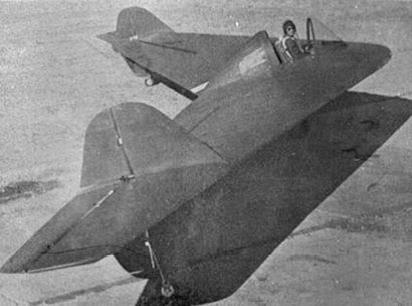
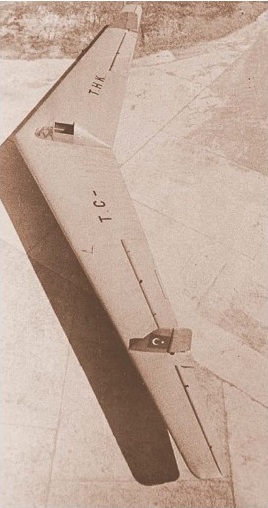
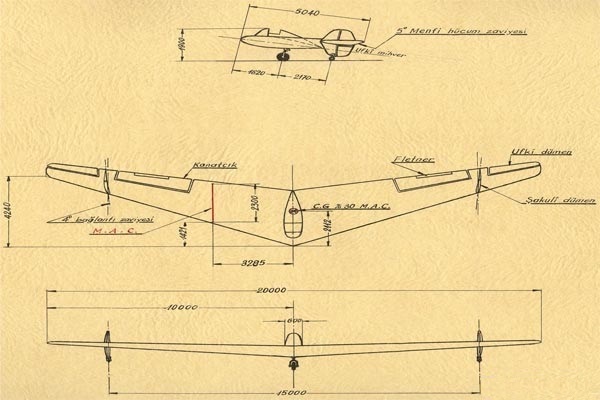
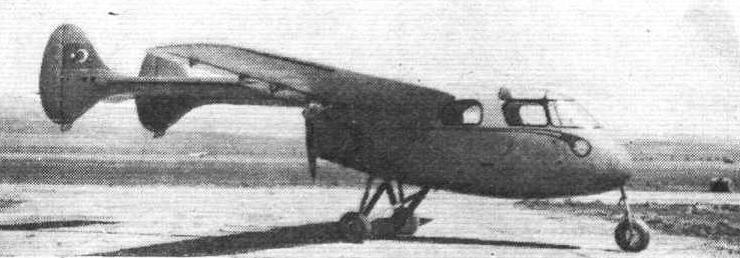
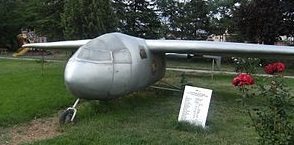
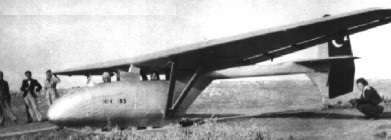
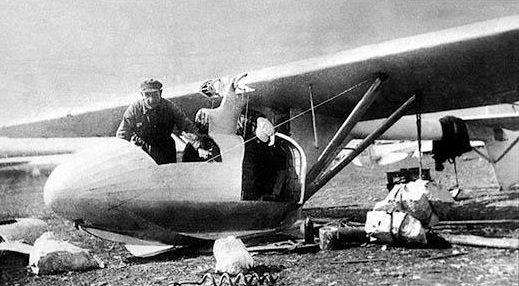
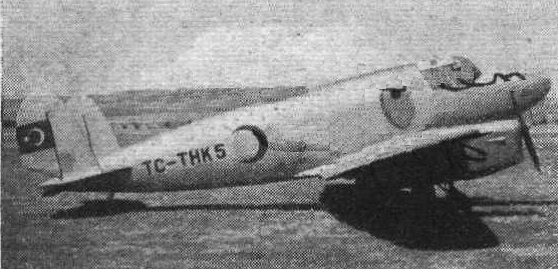
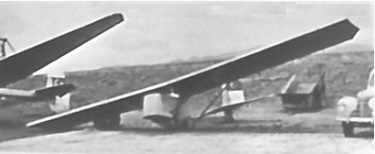
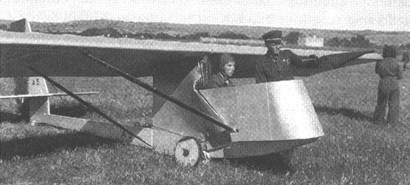
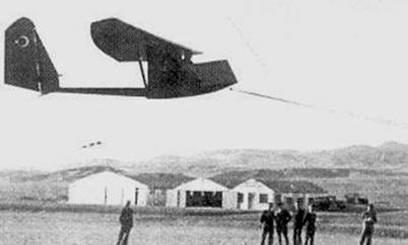
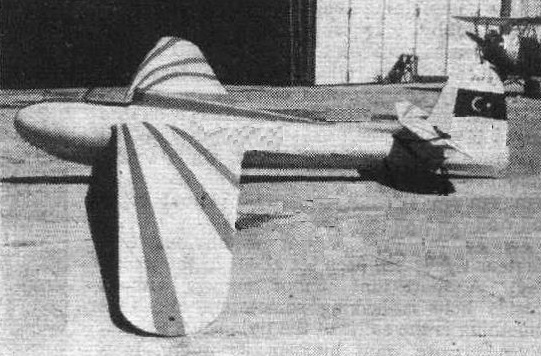
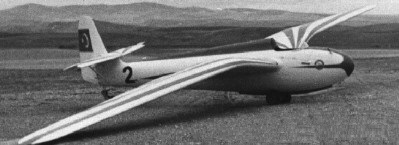
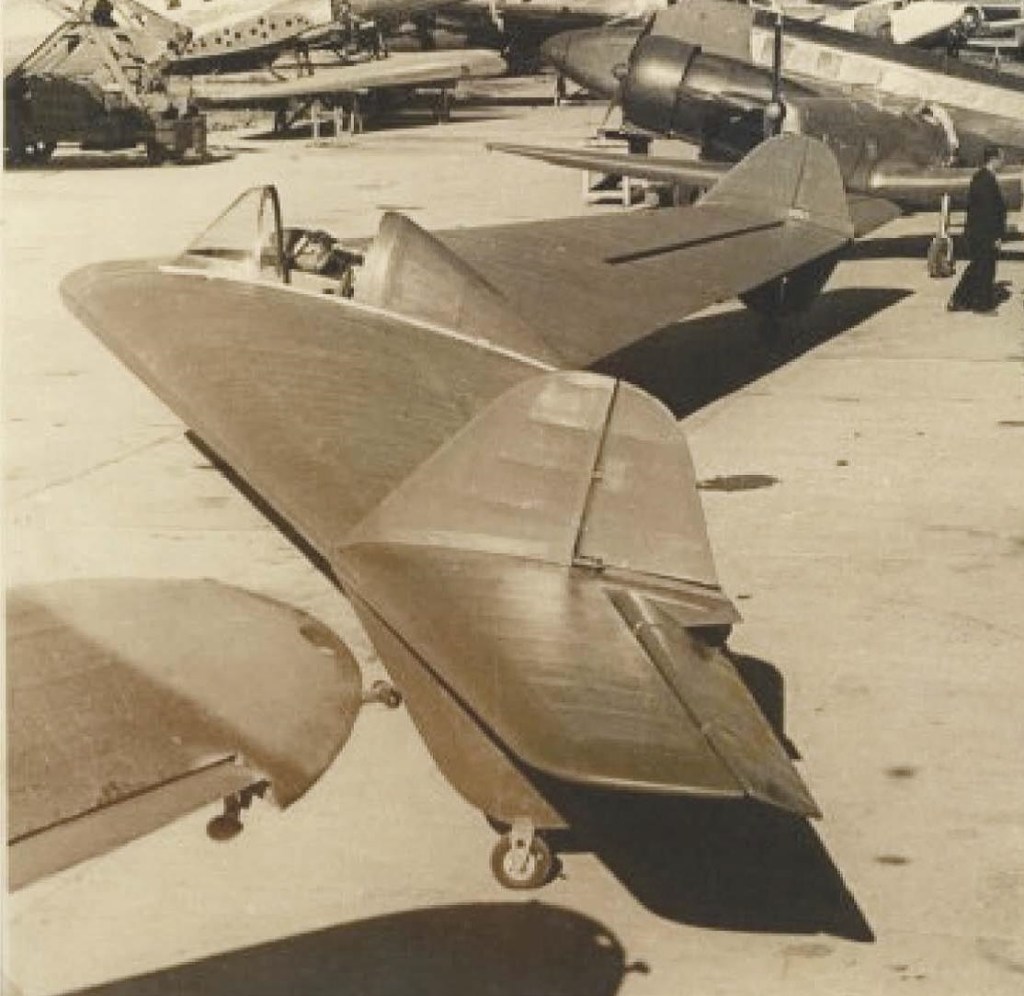
The 1948 THK-13 single-seat tailless wood and fabric glider was for aerodynamic research. It was planned to produce a Gipsy-powered version when the glider had successfully completed stability trials.

The undercarriage consists of a single main wheel under the nacelle, and small castering stabilizing wheels attached to the vertical fins.

In 1948, designed by Senior Engineer Yavuz Kansu and Y.Muh, the test flight pilots were Kadri Kavukçu and Pilot Cemal Uygun.

Exhibited at the 1949 Aerospace Exhibition in Paris.

The project was not developed after an accident.

Gallery

Wing span: 65 ft 7 in
Height: 6ft 6 in
Wing area: 431 sq ft.
Loaded weight: 1,014 lb

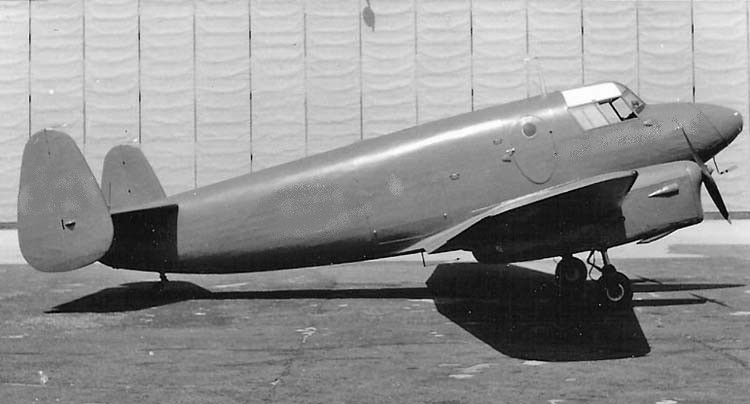
THK THK-11

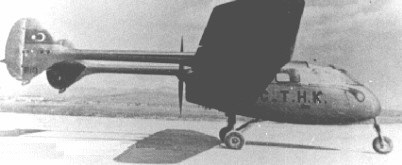
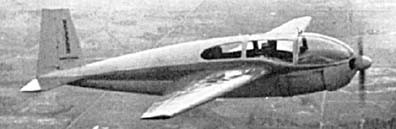
The THK-11 was a high-wing twin-boom three-seat cantilever cabin monoplane with a 135 hp (101 kW) de Havilland Gipsy Major piston engine driving a pusher propeller. It has a fixed nose-wheel landing gear and was first flown in 1947.

Designed and built by Türk Hava Kurumu (THK – Turkish Aeronautical Association), only one was built.

The sole THK-11 is on display at the Ankara Türk Hava Kurumu Müzesi – (Ankara Turkish Aeronautical Museum).

Engine: 1 × de Havilland Gipsy Major, 101 kW (135 hp)
Propeller: 2-bladed fixed-pitch pusher
Wingspan: 11.80 m (38 ft 9 in)
Wing area: 18.7 sq.m (201 sq ft)
Length: 8.44 m (27 ft 8 in)
Height: 2.59 m (8 ft 6 in)
Empty weight: 828 kg (1,825 lb)
Gross weight: 1,150 kg (2,535 lb)
Maximum speed: 201 km/h (125 mph; 109 kn)
Cruise speed: 164 km/h (102 mph; 89 kn)
Landing speed: 80 km/h (50 mph; 43 kn)
Range: 800 km (497 mi; 432 nmi) in still air
Service ceiling: 3,500 m (11,500 ft)
Rate of climb: 3.5 m/s (690 ft/min)
Wing loading: 61.5 kg/sq.m (12.6 lb/sq ft)
Power/mass: 11.4 kg/kW (18.7 lb/hp)
Crew: 2
Capacity: 1 passenger

THK THK-5 / THK-10 / MKEK Models 5

The THK-5 was a twin-engine aircraft developed in Turkey as an air ambulance. First flying in 1945, it was a conventional, low-wing cantilever monoplane of wooden construction throughout. The main units of the tailwheel undercarriage retracted into the wing-mounted engine nacelles and the THK-5 could carry two stretcher cases plus a medical attendant.

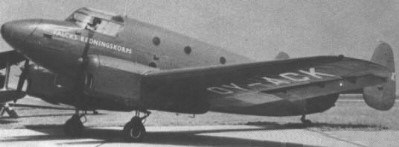
THK-5A TYRKEN (c/n 503 / OY-ACK) light ambulance a/c of the Danish FALCKS REDNINGSKORPS

This was followed in production by a six-seat utility transport version designated THK-5A and three examples of an improved version of the 5A designated THK-10. A single example of the type was exported, sold to Denmark.

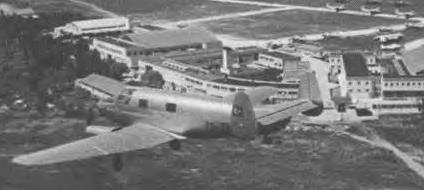
On September 6, 1951 THK-5A serial number 503 sold to Denmark was put into service with registration OY-ACK. The aircraft, which was used as air ambulance under the name TYRKEN (TURK) until logging 961 hours and 20 minutes. In 1960 it was resold and used by air taxi companies. On 18 November 1961 the airplane suffered a landing accident and was withdrawn to a children’s park in Lagunen. The wreck was eventually scrapped.

THK-10

In total 13 were built.

When THK was taken over by MKEK, this was one of the designs selected for further work. However, although the designation MKEK-5 was allocated, nothing further came of this.

Gallery

THK-5
Engine: 2 × de Havilland Gipsy Major, 123 kW (165 hp) each
Wingspan: 14.63 m (48 ft 0 in)
Length: 9.98 m (32 ft 9 in)
Height: 2.87 m (9 ft 5 in)
Empty weight: 883 kg (1,943 lb)
Gross weight: 1,920 kg (4,255 lb)
Maximum speed: 220 km/h (137 mph)
Cruise speed: 124 mph
Landing speed: 74.5 mph
Range: 646 km (404 miles)
Service ceiling: 4,000 m (13,100 ft)
Crew: Two pilots
Capacity: Two stretcher cases plus one medical attendant

THK / Turk Hava Kurumu Ucak Fabrikasi

As a forerunner of the nowadays Turkish Aeronautical Association, the Turkish Aircraft Foundation was founded on 16.02.1925. In accordance with the statute, the TTaC was to collect donations to buy new aircraft for the Turkish Air Force. In the years 1925-1935, 250 new aircraft could be procured by the actions of the TTaC. Some aircraft (like e.g. the Bréguet XIX B-2) was TTaC. In 1935 the statute of the foundation was modified. From that time it was supposed to function not as procurement organ for the Air Force, but rather execute sports activities in civilian aviation.

Upon reorganisation, the civil flying school, Turkish Bird (Türkkusu), was founded on 03.05.1935. Finally the association assumed its new name Türk Hava Kurumu (THK) on 24.05.1935. In 1936 the THK began to manufacture gliders for internal demand. Therefore a carpenter plant was built at Akköprü near Ankara. Then in 1939, when World War II began, some German and Polish aircraft designers were able to save themselves by detouring into Turkey. As the Turkish Government was also pressed badly in distress because of the world-political situation, it was decided that aircraft under license be manufactured, with the help of the experienced foreign designers. As a result a new aircraft plant was built at Etimesgut near Ankara in 1941.

Aircraft factory of the Turkish Air League formed 1941 at Etimesgut, near Ankara. At first the Miles Magister 1A Mk.I primary training aircraft was manufactured under license. Later Turkish designed aircraft were added. Built several gliders, including the THK-1 12-seat troop transport glider, and five types of light aircraft: the THK-2 single-seat aerobatic trainer; THK-5/5A twin-engined light transport/ambulance; THK-11 three-seat pusher-engined twin-boom light tourer; THK-15 tandem two-seat primary trainer; and THK-16 twin-jet trainer. Also built about 100 Miles M.14s under license, Turkish Air League control ceased 1952.

After World War II, the Turkish Government’s interest in its own aircraft production program, rapidly decreased. In addition, enormous aircraft supplies had come from the USA. Therefore it is not surprising that at the beginning of the fifties the THK aircraft plants were experiencing great difficulties. In order to prevent the worst of it, the government decided to transfer the available plants to the Mechanical and Chemical Industries Corporation (Makine ve Kimya Endüstrisi Kurumu, MKEK).

In 1952 Makina ve Kimya Endustrisi Kurumu / MKEK / Mechanical and Chemical Industry Corporation took over THK factory at Ankara, together with existing designs. THK-15 became the MKEK Model 1, THK-16 the Model 2, THK-5 and 5A the Models 5 and 5A, THK Prototype 14 the Model 6 and THK-2 the Model 7.

Türk Hava Kurumu Uçak Fabrikası – Turkish Air Agency Aircraft Factory

Numbered THK Uçak Fabrikası aircraft designations were applied only to original designs. So, for example, the licensed THK-Miles 14 Magister bears no relationship to the THK-14 (a 2-seat training glider).

Designations may be rendered as T.H.K.1 or THK.1 but the most common style seen in modern Turkish publications is THK-1.

THK designs were taken over by MKE with added ‘MKEK’ designations.

Thalman T-4

Thalman T-4 N53389

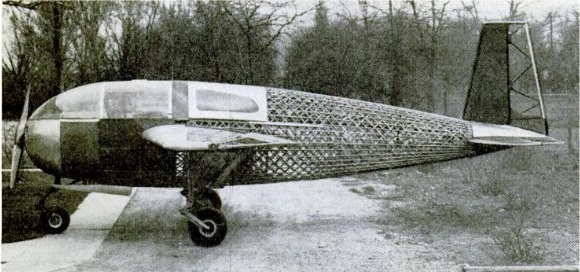
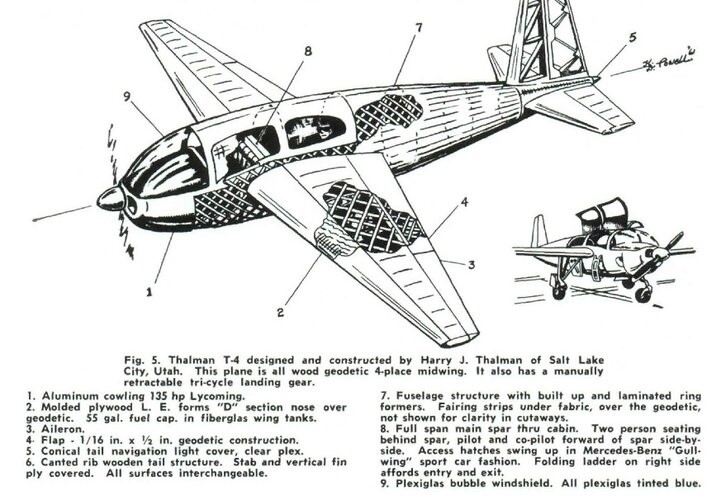
In 1949, Harry formed Thalman Aircraft Inc. at Salt Lake City. In the same year, he designed the Talman T-4 which, flew in 1951. The 1953 Thalman T-4 was a four-pace mid-wing cabin monoplane of all-wood geodetic construction. The T-4 followed the same wooden geodetic construction employed by Harry J. Thalman and William Earl Player when they helped form Plxweve Aircraft. (Construction techniques followed those of Thalman’s Oregonian mentor, George Yates – bending strips of cedar around heated former moulds.) In general construction technique, the T-3 and T-4 were similar – the T-3 being fabric-covered, the T-4 having a fibreglass covering.

Designed by Harry J. Thalman, the one built, N53389, had manually retracting undercarriage. Initially powered by a 135hp Lycoming O-290, it was later converted to T-tail with a 170hp O-340.

Convinced that serial wooden geodetic construction would be less expensive than by-then conventional metal construction, Thalman spent the next decade trying to get the T-4 into production. At one point, Thalman approached the Cache Chamber of Commerce in Utah for start-up funds of $50,000 (and a suitable workspace) to launch T-4 production – presumably near Logan, UT. The Chamber passed.

By 1960, Thalman Aircraft Corp. was doing business as Thalman Industries (sometimes given as Thalman Aircraft Industries). However, the firm was now planning to relocate to Roseburg, OR – 900 miles to the west. Roseburg businessman Lynn Andreas had become president and it was Andreas who was announcing the construction of a new factory on 5 acres of leased land at the Roseburg municipal airport. Early reports said that site ground preparation work had begun and that a “plywood plane” would be built. Harry Thalman is quoted, saying that his aircraft will sell for less than $14,000.

By 1963, Harry Thalman was working as a mechanic for Kelsey-Ellis Air Service at Salt Lake City Airport. The T-4 was in storage (and possibly disassembled by then) but Harry was still flying the T-3B. On 15 March 1963, Harry was doing flying cross-country when he flew into a blinding snowstorm. Harry Thalman died instantly when he crashed his T-3B monoplane in a gully outside of Grantsville, UT.

Engine: 135hp Lycoming O-290, later 170 hp Lycoming O-340
Wingspan: 40 ft 2.5 in
Length: 21 ft 6 in
Height: 6 ft 0 in
Empty weight: 1050 lb
MTOW: 2000 lb
Useful load: 1050 lb
Max speed: 175 mph
Cruise: 155 mph
Stall: 45 mph
Range: 700 mi
Seats: 4
Undercarriage: manual retractable

Thalman, Harry J

Harry J. Thalman: born 25 March 1911 at Challis, Idaho, USA.

George Yates of Beaverton, Oregon had been the mentor of Harry J. Thalman’s designs, Yates had been wooden geodetic construction pioneer, Thalman made several trips from Salt Lake City to Beaverton to learn about geodetic construction techniques from from Yates.

Thalman and Player were joined by a third geodetic aircraft builder – John Greenleaf of Portland, OR, to form the Plxweve Aircraft Company in 1940. Greenleaf then arranged financing through Ralph Hemphill of Los Angeles. As a result, the Plxweve Aircraft Co. became a division of another Hemphill-controlled firm – Aero Industries Technical Institute, Incorporated (Aero ITI). Ralph Hemphill became President of the Plexweve division but refused further investment. The money was run through quickly and much legal wrangling ensued.

The T-3 had first flown in 1941

At some point, the partners went their separate ways. In 1949, Harry formed Thalman Aircraft Inc. at Salt Lake City. In the same year, he designed the Talman T-4 which, flew in 1951.

By 1957 Thalman Aircraft Corp. had relocated to Mount Pleasant, UT, with plans to establish T-4 production there. In a letter to Flying Magazine (March 1957, pages 6 & 8), Mount Pleasant resident Rex C. Staker writes that the production T-4 was to be offered with 150-, 170-, or 180 hp engines. According to Aerofiles, Thalman Aircraft also took over a concept from Van Nuys-based ATS (Aircraft Technical Services Inc., Floyd E. Snow) in 1959. That ATS design was described as a 4-place mid-winged cabin monoplane (“reportedly 50 percent complete”).Thalman Aircraft then began reworking this laminar-flow winged design as a “twin-engine development”.

By 1960, Thalman Aircraft Corp. was doing business as Thalman Industries (sometimes given as Thalman Aircraft Industries). However, the firm was now planning to relocate to Roseburg, OR – 900 miles to the west. Roseburg businessman Lynn Andreas had become president and it was Andreas who was announcing the construction of a new factory on 5 acres of leased land at the Roseburg municipal airport. Early reports said that site ground preparation work had begun and that a “plywood plane” would be built. Harry Thalman is quoted, saying that his aircraft will sell for less than $14,000.

According to local media reports, the production type’s structure – under its fiberglass shell – would be an aluminum honeycomb. That jives with an article in Sport Aviation August 1961 – Geodetic Aircraft Structure by Keith D. Powell, EAA. On page 22, Powell writes that Thalman was “now working on another midwing featuring a plastic bonded honeycomb sandwich airframe.” Reportedly, circa 1958, Harry began losing interest in geodetic structures. Lynn Andreas was also president of the Oregon Red Cedar Co.

Contemporary reports say that Thalman was “working on a fifth model which will include a number of modifications, such as a more powerful motor, sweptback tail assembly, and electrically-operated landing gear and flaps.” These all sound like sensible updated for a production variant. But the The News-Review report says that an “all-hydraulic retractable landing gear” was to equip the production type. Needless to say, that Roseburg factory never materialized. In the early ’60s, some airport was holding the parked Thalman T-4 until storage fees in the order of $800 were paid.

By 1963, Harry Thalman was working as a mechanic for Kelsey-Ellis Air Service at Salt Lake City Airport. The T-4 was in storage (and possibly disassembled by then) but Harry was still flying the T-3B. On 15 March 1963, Harry was doing flying cross-country when he flew into a blinding snowstorm. Harry Thalman died instantly when he crashed his T-3B monoplane in a gully outside of Grantsville, UT.

Harry J. Thalman: died 15 March 1963.
Texas Helicopter M79 Jet Wasp II

The 1979 M79S Wasp II was a two place Ag modification of the Bell 47G. First flown on 6 January 1979.

First flown in 1979 with a piston engine, the M79T Jet Wasp II was a two-seat turboshaft powered modification of the Bell TH-13T helicopter. One was built (N1001X) in 1982.

M79S Wasp II
Engine: TVO-435, 270hp
Rotor: 37’1″
Length: 36’0″
Useful load: 1480 lb
Max speed: 106 mph
Cruise: 80 mph
Range: 300 mi
Seats: 2

M79T Jet Wasp II
Engine: Soloy-Allison 250
Seats: 2