Monroe WI.
USA
Airplane builder circa 1953.
Monroe WI.
USA
Airplane builder circa 1953.
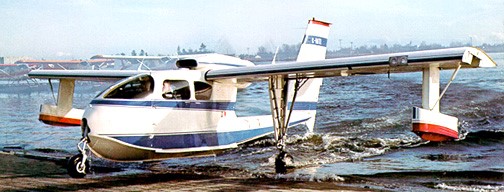
Canadian firm Trident Aircraft Ltd of Vancouver, BC, tried to resurrect the Seabee in the form of the TR-1 Trigull. Trident Aircraft was established in early 1970s to develop Trigull-320 six-seat light amphibian The factory was in Sydney, British Columbia, Canada. The Trigull resembled the Seabee closely enough to be confused with it, Spence Spencer apparently having a hand in the design. The Trigull could be distinguished from the Seabee by the angular swept tailfin, floats that retracted up to the wingtips, and tricycle landing gear, the long main gear hinging to retract outward into the wings, and the nose gear pivoting up to retract into the nose.
Two flight prototypes were built, first flown on 5 August 1973, the second taking to the air in 1973. The aircraft had a price tag of $111,360 in 1979. A Turbo Trigull was offered with turbocharged engines.
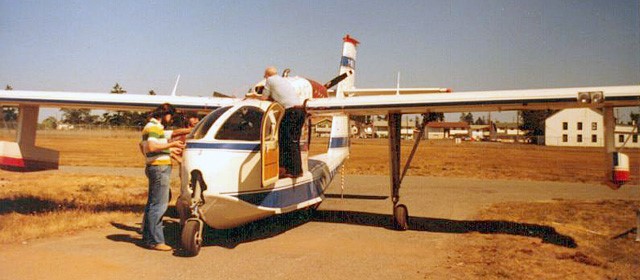
Production machines were to be powered by a Lycoming IO-540-M1A5 air-cooled flat-six engine, with 255 kW (340 HP), though the prototypes were powered by the less powerful Teledyne Continental Tiara flat-six. The Trigull was about a tenth longer and a tenth heavier than the Seabee, and could have seating for four or six, the rear seat in the six configuration apparently being intended for kids since it would be pretty cramped for adults.
The stop go progress of Trident Aircraft reached its fourth and probably final “stop” in 10 years in November 1980 as costs continued to escalate ahead of the latest funding programme. With $Can10m spent already, the company estimated that another $Can8.5m was needed to establish full production of the Tri Gull amphibian at the new plant set up for the purpose on Vancouver Island. All employees were dismissed and survival of the project appeared unlikely; the two prototypes of the Tri Gull have been put into storage, the company going under in the early 1980s.
Viking Air LTD of Vancouver obtained the rights to the Trigull; Viking, incidentally, also had rights to de Havilland Canada classics like the Beaver, Otter, and Twin Otter, performing turbo conversions of Beavers and Otters, plus building Twin Otters new. Viking has dropped hints of producing the Trigull, presumably to see if there was any interest, and saying that a production machine would have a turboprop powerplant. Apparently there wasn’t any interest, since it never happened.
1965: Trident Aircraft Corp
Founders: Chuck Herbst & Percy Spencer
Vancouver BC.
Canada
Established in early 1970s to develop Trigull-320 six-seat light amphibian, first flown August 1973 and eventually becoming TR-1 Trigull. Turbo Trigull offered with turbocharged engines.
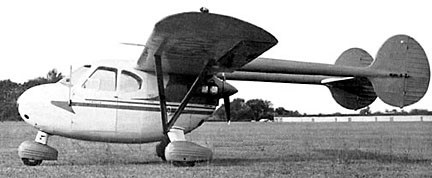
The 1949 Trella T-106 was a two place high wing cabin monoplane. All metal with twin tails on booms, the one built, N450C, was first flown in September 1949 by Paul Holst.
A highly-modified five place retractable gear twin version was planned in 1954 as T-107 never went past the mock-up stage because of funding problems.
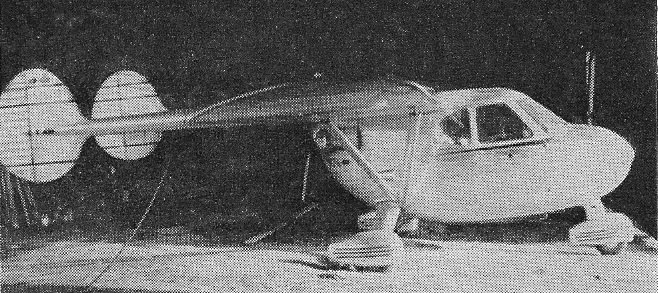
T-106
Engine: 85hp Continental C-85-12J pusher
Span: 34’0″
Length: 21’9″
Useful load: 470 lb
Max speed: 112 mph
Cruise: 102 mph
Stall: 42 mph
Range:: 400 mi
Seats: 2
Lomita CA.
USA
Airplane builder circa 1952-61.
USA
Division of Kearney & Trecker Corporation which in early/mid-1960s assembled at Milwaukee, Wisconsin, Italian Piaggio P.136L-1 s and L-2s under names Trecker Gull and Super Gull.
Brian Heath
28 Jul 13
Kearney & Trecker Milling Machine Company was — probably still is — located in Milwaukee, Wisconsin. In the 1950’s and 60’s they leased 2 hangers on the west side of General Billy Mitchell Field in Milwaukee next to the Air National Guard with it’s F-86’s. The north hanger housed the business aviation division of the milling machine company. They had a DC-3, a Cessna 182, a Piaggio Royal Gull, and an aero-coupe. Hope I got the names right.
I was 10 years old in 1958 and my dad was the mechanic for the operation, co-pilot on the DC-3, and pilot on the others. They flew milling machine sales people and maintenance people around the eastern U.S. And they often flew the company owners and brass on vacations and fishing trips.
The south hanger housed Kearney & Trecker’s other business investment — a contract with Piaggio in Italy to assemble and sell Royal Gulls. Later the P-166 executive plane was added. My recollection is that the first P-166 at Mitchell Field was a prototype. It was the only one I ever saw, but I did ride in it several times. While the two businesses were legally separate, the mechanics/pilots often consulted with each other.
I recall being there one day when a lively discussion was held between 4 or 5 people about the length of the main forward hull that floats. Mid ship there was a step, and the rear part of the fuselage was not in the water. Some of them, including dad, thought the plane would take off and land better if the floating part of the hull extended back a foot or so. Not everyone agreed, but there was a consensus to try the idea by building a block (out of wood, I think) that would extend the floating hull back. They did that and tried it out. It worked and I think that Piaggio accepted the idea and modified the design.
I went to the airport with dad when there was a vague hope of getting a plane ride. Perhaps he was going to do a short test flight after doing some work. Or perhaps he was flying a low level company person that he knew would not mind a kid on the trip. Sometimes he had to deliver a milling machine part to a customer in, say, New York. On some of those trips I got the right hand seat — several times on the Gull.
I believe it was in the early 60’s that Kearney & Trecker sold a dozen or so of the Royal Gulls to Peru’s air force. They were looking for pilots to deliver the planes and for someone to teach Peru’s pilots and mechanics how to fly and maintain them. Dad volunteered and was selected to fly one plane from Milwaukee to Peru, and then spend a month or so teaching before returning. No, I was not invited. But I thought that what he did was cool. They bought the supercharged engines for going over mountain passes and landing on mountain lakes at over 12,000 feet. Neat planes. Sounds like Kearney & Trecker got out of the airplane business shortly after dad left.
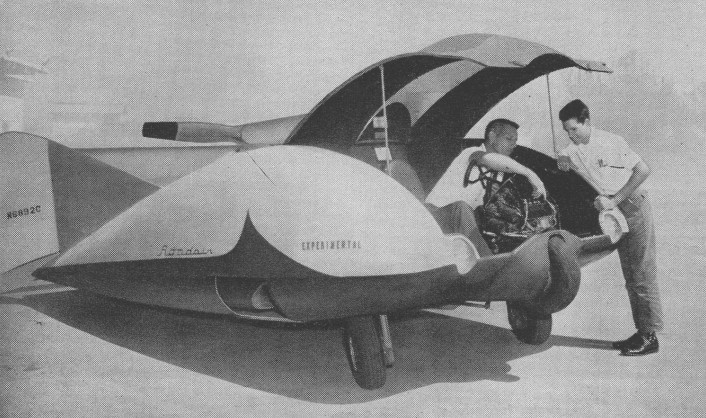
This Road Air was the first prototype, and last production model built by Herbert Trautman. The idea of making a car that could fly had always been a fascination for Herb. The idea for a plane/car combination was first conceived of in the aviation pioneer days prior to World War I but technical limitations of the time prevented any serious progress to be made. Interest was rekindled in the late 1920’s when ideas and activity flourished. It first flew in 1946. By 1950, Herb Trautmann had begun construction of the Road Airand, Herb continued to build his dream car until it was completed in 1959.
After finishing his dream flying car, Herb was ready for his maiden flight. Herb climbed in, locked the hatch, started the Road Air and began to taxi. Feeling comfortable he began to get the feel of the Road Air on faster and faster runs. Finally, he lined up into the wind, applied full power and headed down the runway. At about 90 mph the Road Air lifted off the ground to about 3 feet. As Herb soon began to loose control, he set the Road Air back on the runway averting disaster. He put it in storage, never to be flown again.
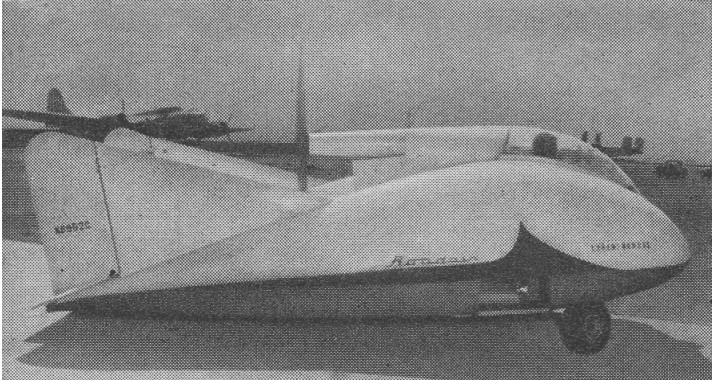
Called the Roadair, the car has a body 15 feet long and 7 feet 10 inches wide. As an auto, it rides on a tricycle gear, the single rear wheel driven by a small gasoline motor. As an airplane, the wings fold out from the body to a 25 foot wingspread. A 75-horsepower airplane engine drives the single pusher propeller. Twin rudders and elevator are located in the rear. Expected retail price was approximately $10,000.
Estimated cruising speeds are 90 miles per hour in air and up to 75 on ground. FAA experimental license has been issued. Roadair operates us auto or plane from same controls. Same action moves rudders and wheels. Wings fold up inside body.
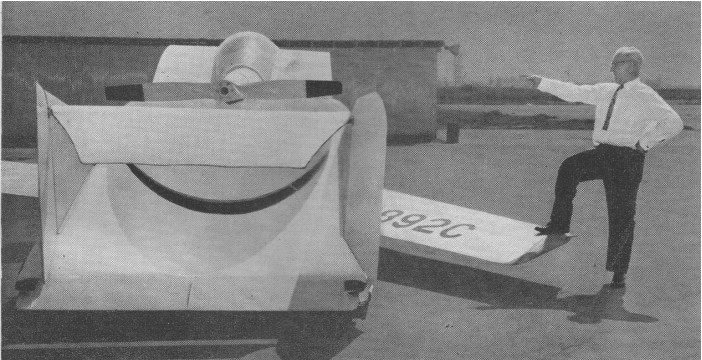
When Kermit purchased the Tallmantz Collection in 1985 the Road Air was on loan for display by Mr. Trautmann. When packing the collection for shipment to Florida, Herb, in his eighties, came out for a visit to decide what to do with his aircraft. He had no place to store it and when Kermit offered to take it back to Florida, Mr. Trautman signed over a Bill of Sale and gave it to him on the spot.
In 1996 the Road Air was restored to run-able condition. It is sometimes taken by trailer to trade shows and events as an attention getter to help promote Fantasy of Flight. On one promotional outing, the Road Air was taken down to the local U.S.A. Speedway and driven around the track for a quick demonstration.
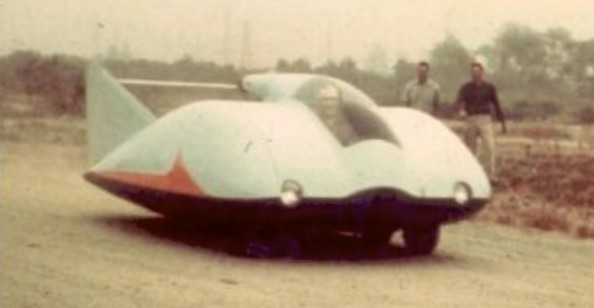
Engine: 85 hp Continental
Wingspan: 25′
Gross Weight: 1,000 lbs
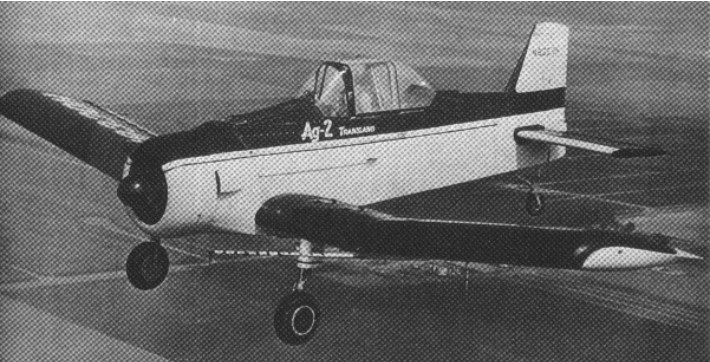
The idea of an agricultural aircraft followed a meeting between George Wing, Lloyd Stearman, Tom Watson (from Aerial Agriculture in Sydney, Australia) and George Roth (of Murryair of Hawaii and later owner/producer of Eniroth). George Roth had been instrumental in the building of the Ag-1, and he was an obvious influence in the Ag-2 design by George Wing’s team.
Construction of the first aircraft began in 1954 and the Transland Ag-2 made its first flight from Torrance as N8330H on 11 October 1956. At that stage, it was a single-seat aircraft powered by a 450-hp Pratt & Whitney R-985. Between the engine and the cockpit was housed an integral hopper of 53 cubic feet intended for solid materials and carrying a load of 3,000 lbs in the restricted category. The length of the cropduster was 28 ft, 5 inches and its height 9 ft. 8 inches.
The centre wing was built in two sections fastened to the fuselage either side of the hopper. Each section incorporated two 62.5 US gallon tanks which were intended as spray tanks totalling 250 US gallons. The wing was extremely thick – some eighteen inches deep – which gave high lift but also high drag. The aerofoil, a modified NACA 64021 section, had an aspect ratio of around 21%. A single flap extended under the fuselage between both sections. The outer wing panels also incorporated a 62.5 US gallon tank intended for aircraft fuel. The ailerons ran the full length of these panels with a top side lifting flap, which presumably kept a clean airflow over the wing and ailerons. Aluminium wing tips gave a wing span of 42 ft and a wing area of 321.6 sq.ft.
While the test flying was done on the first aircraft, a second, N8331H, was built and fitted with a 600-hp P&W R-1340. The payload was increased from 2,000 lbs to 3,000 lbs, giving an all-up weight in the agricultural category of 7,700 lbs. The empty weight of the aircraft was 3468 lbs.
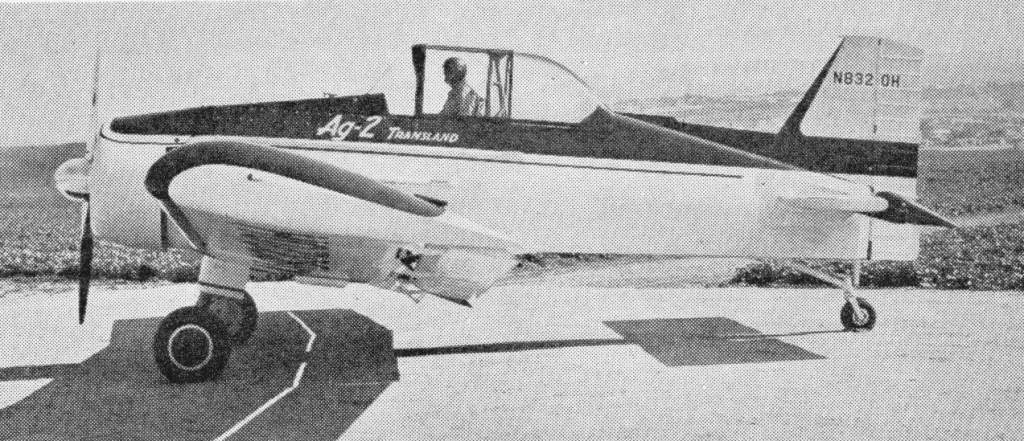
N8331H first flew from Torrance in June 1958. The first aircraft was also retrofitted with an R-1340 and the rear
cockpit modified to carry a passenger. The then Civil Aero¬nautics Administration awarded Type Certificate #4A20 to Transland Aircraft for the Ag-2 on 24 June 1958.
In 1959, a third and final aircraft, N8232H, was built and operated in Panama.
The monocoque design of the Ag-2 didn’t fail, it was twenty years ahead of its time. In the 1950s and ‘60s, the Stearmans and the Naval Aircraft N3Ns were still the “big planes” of an operator’s fleet and were able to be obtained cheaply for US$5,000, as opposed to the Ag-2’s price tag of US$25,000.
With 577 hours on the clock, N8330H was sold to Charles Chalking in Uruguay in 1962. The aircraft was flown to the South American country, where it was registered CX-AYC in May 1962. Under the name of Azucarera del Litorial SA of Paysandu, it flew some 224 hours on sugar fertilizing until 31 December 1963, when it was placed in storage. The aircraft spent 28 years in storage before being sold to an operator at Triente y Tres. Flown again on 25 September 1991, the Ag-2 had clocked up another 290 hours by 23 February 1993 before it was parked up at the airfield at Triente y Tres for seven years. Around 2000 the wings were removed and stored in a shed, while the fuselage was pushed to the edge of the airfield where weeds began to incarcerate it. In April 2003 the aircraft arrived in New Zealand for restoration, with 1091.2 flying hours. At some early stage the inside of the hopper was lined with fibreglass.
Engine: Pratt & Whitney R-985, 450-hp
Seats: 1
Length: 28 ft 5 in
Height: 9 ft. 8 in
Hopper cap: 53 cubic feet
Load cap: 2,000 lbs
Spary tank cap: 250 USG
Fuel cap: 62.5 USG
Wing span: 42 ft
Wing area: 321.6 sq.ft
Engine: Pratt & Whitney R-¬1340, 600-hp
Seats: 2
Payload: 3,000 lb
MAUW: 7,700 lb
Empty wt: 3468 lb
The Transland Company was formed in 1946, designing and manufacturing components for North American aircraft, including the T6 Texan, P-51 Mustang, F-86 Sabre and the F-100 Super Sabre. A Division of Hi-Shear Rivet Tool Company, in 1951, Transland began producing spreading equipment, hopper doors and spray gear for agricultural aircraft and among these products was the Sellers Swathmaster, widely used on Cessna 180 and 185 aircraft, as well as Fletcher FU-24s and Piper Cubs.
1946: Transland Co,
Torrance CA.
USA
Built Ag-1 agricultural research aircraft in about 1953, followed 1956 by Ag-2, using components from Vultee BT-13. Plans to build five Ag-2s in late 1950s thwarted.
1957: Transland Aircraft,
div of Hi-Shear Rivet Tool Co (pres: George S Wing).
By 1962, George Wing had moved on to the development of John Thorp’s little twin, which eventually became the Wing Derringer, and a few years later Conrad Barlow took over the assets of Transland, renaming the company the Transland Corporation and moving it to Harbour City in California.
Plans to build Ag-2s revived in 1965, but still none produced.

The Transcendental Aircraft Corporation of Glen Riddle, Pennsylvania, was the first company to claim flying a successful Tilt Rotor aircraft. The Model 1-G was a small, high-wing experimental aircraft with a fuselage-mounted engine and fixed tricycle landing gear designed and built by Mario A. Guerierri. The single pilot sat forward of the wing in a semi-enclosed fuselage. The clear plastic nose gave the pilot helicopter-like visibility. A single Lycoming 0-290-A six cylinder engine produced 160 horsepower. The fuselage measured 7.9m long, and the aluminum wing measured 6.4m. The ailerons were fabric covered. Empty weight was 655kg and take-off weight was 790kg. The projected maximum speed in helicopter mode was 190km/h, and 260km/h in airplane mode.
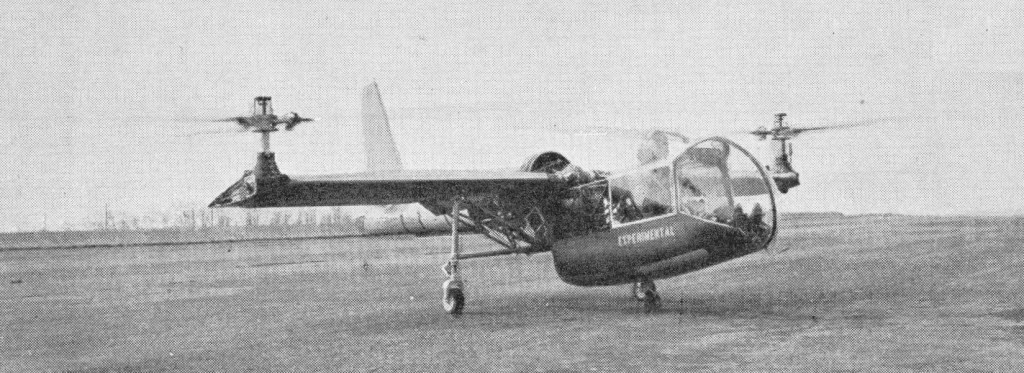
A 5.2-meter diameter, three-bladed, fully articulated rotor was mounted at each wing tip. The rotor shafts tilted from pointing vertically for hover down to 6 degrees up from horizontal for forward flight. Electric motors controlled the tilt of the rotor shafts.
Interconnecting shafts ensured that both rotors maintained the same tilt angle. Each rotor was driven through a two-speed gearbox. This allowed the pilot to lower the rotor rotation speed for more efficient cruise in forward flight.
Although the Model 1-G was a private development, the Wright Air Development Center at Wright-Patterson AFB issued contracts to study many of the Tilt Rotor’s unique peculiarities.
The first was awarded in 1952 to investigate the dynamics and structural characteristics of the rotor system. The Air Force awarded a second contract in 1953 to investigate mechanical instability problems associated with tilting the rotors.
The first hover flight was either on June 15 or July 6, 1954 (references vary). The first forward flight in hover mode occurred on December 13, 1954, and the first forward flight with rotors tilted occurred only four days later. By April 1955, conversions with the rotors tilted up to 35 degrees from vertical were completed. Eventually, the Model 1-G completed numerous transitions up to 70 degrees of tilt with the wings sustaining over 90 percent of the weight.
The engine reduction was been replaced by a two-gear reduction box, at the exit of which a gearing system has been attached which enables the rotors to be put into auto-rotation. At the engine’s maximum output of 3000 r.p.m. the rotors rotate at 633 r.p.m. as airscrews, and at 240 r.p.m. as helicopter rotors.
Three concentric tubes start from the swivelling device, the first of which moves the rotor, the second controls cyclic variation and the third variation of collective pitch. The time needed to move from the helicopter to the aircraft position is roughly three minutes. In this change-over, the rotors swivel through an angle of 82 degrees.
The Model 1-G was destroyed during a test flight on July 20, 1955. After performing a virtually complete conversion, the friction lock on the collective pitch controller slipped, throwing the aircraft into an abrupt, steep dive. The pilot initiated a recovery, but there was not enough altitude to complete the pull-up before contacting the Delaware River. The aircraft flipped on its back, resulting in irreparable damage.
During the Model 1-G’s brief career, it made over 100 flights, achieved 90% conversion (about 70 degrees forward rotor tilt), and flew 60 hours. It demonstrated excellent controllability without vibration, and reached an altitude of 1060m and an airspeed of 185km/h in helicopter mode.
A second aircraft, called the Model 2, N546A, was to fly in late 1956. Transcendental received an Air Force contract in March 1956 and completed the Model 2 in October. Compared to the Model 1-G, it was stronger and more aerodynamic, but had the same basic configuration. The enclosed cockpit had side-by-side seating. Power was by one 250 horsepower Lycoming O-435-23 six cylinder engine. The wing was a 0.3m longer, but the fuselage was 1.2m shorter. Empty and gross weights were 708kg and 1015kg. Development ended when funding from Wright Air Development Center stopped. It could not be determined if the aircraft ever flew, and eventually it was dismantled.
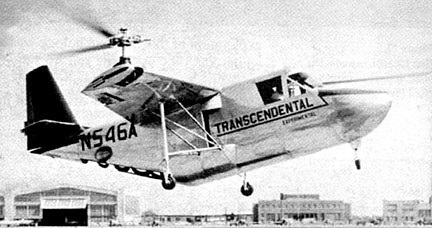
The Model 3 of 1957 was also a convertible, and an extrapolation of Model 1G, it is intended to be powered by two gas turbines, and to accommodate a crew of two and also six passengers or alternatively four stretchers. It is expected that this model will have a cruising speed comparable to that of a traditional aircraft and also the special take-off and landing properties of a helicopter.
Model 1G
Engine: 1 x Lycoming G0-290-A, 160hp
Rotor diameter: 5.18m / 17 ft
Width (rotor tip to rotor tip): 11.58m
Rotors: 2 x 3-blade on outriggers
Max rotor speed: 633rpm
Wing span: 21 ft
Length: 7.93m / 26′ 0″
Height: 2.13m
Weight fully loaded: 794kg / 1,640 lb
Empty weight: 658kg
Maximum speed (as helicopter): 196km/h
Maximum speed (as aircraft): 256km/h / 150 mph
Absolute ceiling (as aircraft): 1525m
Endurance: 90 minutes
Seats: 1
Model 2
Engine: Lycoming O-435-23, 250hp
Wingspan: 22’9″
Length: 22’1″
Rotor dia: 18’0″
Useful load: 670 lb
Seats: 2
 All Aero