The Soviet Union flight tested a modified Tu-154, designated Tu-155, incorporating engines fueled by liquid hydrogen and natural gas. The Tu-155 first flew 1988. The Tu-155’s NK-88 engines were developed by Nikolai Kuznetsov’s design engineering team. The engines and other new systems and components have been tested on specially designed rigs, with particular attention being given to fire and explosion protection.
The airframe iyself is the work of the Andrei Tupolev experimental design office in conjunction with the aeronautical industry’s Institute of Science. The cryogenic fuel tanks, which necessitated development of over 30 new systems, are installed at the rear of the passenger cabin.
Photos show two external ducts, located immediately above and below the cabin windows.
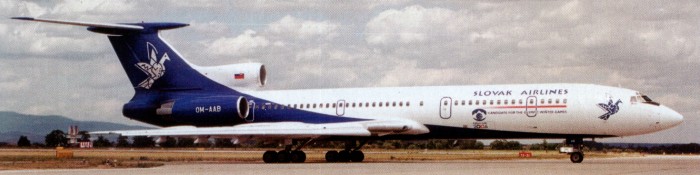
The Tu-154, announced Spring 1966, was intended to replace the Tu-104, IL-18 and An-10 on medium/long stage lengths of up to 6,000km with 128/158 passenger. With a high lift wing and six-wheel bogie undercarriage it is able to operate from airfields with a class B surface, including packed earth and gravel 7,000 ft runways. Normal flight can be maintained after shutdown of any one engine. Single-engine flight is possible at a lower altitude.
The Tu-154 is a three-crew, three-engined jet, designed for medium to long-range operation up to 3700 statute miles, with a load capacity of 16-18 tons over 1800-3000 mile stage lengths. Its design is claimed to conform with ICAO, CAB and ARB, as well as Soviet, requirements. Its first test flight is expected in 1968, with entry into service in 1970.
The three NK-8-2 by-pass engines, each of 21000 lb thrust give a cruising speed of 420-490 kt; reverse thrust is to be fitted. Cruise consumption at 36,000 ft is of the order of 0.58 1b/1b thrust. Engine TBO was expected to be 2 000-3 000 hours.
The cabin has a working pressure of 9 lb/sq.in. Cabin rate of change is regulated so as not to exceed 0.018 mmHg/sec (equivalent to 400 fpm at sea level). Hot or cold air can he fed to the cabin while on the ground. This is done by a small gas turbine which is also used for starting purposes and drives an alternator (40kVA) and a 1.2kW dynamo.
There were to be four versions of the aircraft. The first is the basic tourist variant with 49 seats in the front cabin and 104 in the rear; the second is the economy variant to take 164 passengers; a mixed version to take 24 tourist and 104 economy class passengers; and the freighter to take 20-25 tons (later 30 tons). The freight hold capacity will be 1596 cu.ft. The aircraft could also take the load in 13 containers, each of 64cu.ft capacity.
The seat layout will be: first-class, four seats per row, pitch 41 in; tourist-class, four seats per row, pitch 32 in; economy class, six seats per row, pitch 29.5 in (gangway 157 in).
The cabin height will be 82.7 in; the passenger entry doors measure 65 by 31.5 in and the freight doors 47 by 51 in.
The wing has 35 degrees sweepback, measured at 0.25 chord. It is fitted with slots over 80 percent of the span. There are triple slotted high efficiency flaps, and three spoilers on each side; the inner pair serve as air brakes and lift dumpers; the middle ones can be used in flight as air brakes and the outer ones can be used to decrease exposed aileron area. The slots can be controlled independently or be used in conjunction with the flaps. De-icing is by hot air bled from the engines for leading edge, fin and tailplane. The slots are electrically heated.
The main undercarriage legs each carry six wheels mounted in three consecutive pairs. The twin nose wheel is steerable up to 55 degrees either side.
The a.c. system is three-phase 3 by 200/115V. The source is three alternators of 3 by 40 kVA engine driven by means of a constant-speed hydraulic drive and with a constant frequency of 400 cycles ± 2 cycles. From this main source 28 V is also obtained. For the operation of the main gyro instruments there is an additional auxiliary circuit operated by two transformers of 115 V.
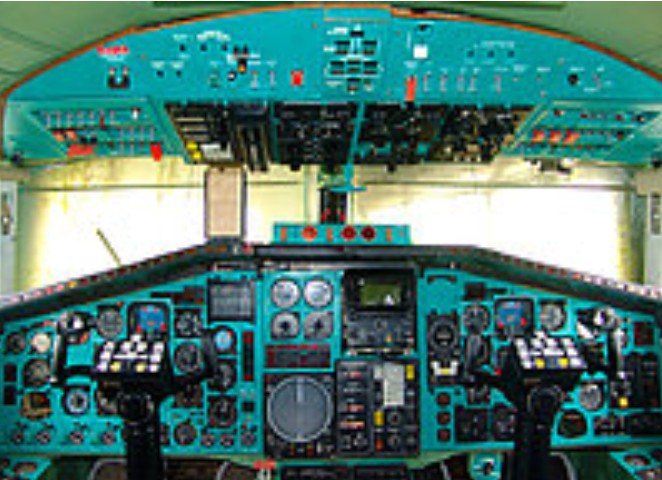
The instrumentation and navigational equipment of the aircraft will, in the first phase (1970) permit approach and landing with cloud base of 100 ft and 1300 ft visibility; in the second phase there will be full automatic landing facilities under nil visibility.
The hydraulic system is used for undercarriage operation and for the flying controls; there are three independent servo-mechanisms with automatic change-over. Each servo-mechanism has two hydraulic pumps giving a working pressure of 3 000 lb/sq.in.
The first of six prototype and preproduction models flew for the first time on 4 October 1968. The seventh Tu-154 was delivered to Aeroflot for initial route proving and crew training early 1971 between Moscow and Tbilisi. Mail and cargo flights began in May.
Regular services began 9 February 1972, over the 1,300km route between Moscow and Mineralnye Vody, in the North Caucasus. International services began with a proving flight between Moscow and Prague 1 August 1972.
Balkan Bulgarian took delivery of the first export Tu-154 in 1972, and went on to build up a mixed fleet of 25 B- and M-models by 1990. CSA Ceskoslovenske Aerolinie took delivery of seven Tu-154Ms between 1987 and 1990. The Czech Government bought six Tu-154B/Ms for VIP services.
The Tu-154M is a completely upgraded version, originally designated the Tu-164.
Tu-154M 101
A freighter version has also been produced from earlier Tu-154 and Tu-154A airframes.
It quickly became the standard medium range equipment for most of the socialist countries, with over 850 in service by 1992; this number included about 750 with Aeroflot.
Tu-154 Empty weight, 86 420 lb APS weight, 89 300 lb Max- fuel, 48 500 lb Max. take-off weight, 173,000 lb (Later 187,500 lb) Max. landing weight, 147,700 lb Cruise, 477 kt Mean operating Mach No., 0.9 Approach speed 119-125 kt Range 173,000 lb, 477 kt., 36 000 ft. 1 hr res, 2 100 st. miles Range 187,500 lb, 3,730 st. miles Take-off distance 173,000 lb MSA, 4 400 ft Landing distance (ICAO) at 60 tons, 4,760 ft Landing distance (ICAO) at 66 tom 5,100 ft
Tu-154A Engines: 3 x Kuznetsov NK-8-2U turbofans, 102.9kN Max take-off weight: 94000 kg / 207236 lb Empty weight: 50775 kg / 111940 lb Wingspan: 37.55 m / 123 ft 2 in Length: 47.9 m / 157 ft 2 in Height: 8.2 m / 27 ft 11 in Wing area: 201.5 sq.m / 2168.93 sq ft Cruise speed: 900 km/h / 559 mph Range w/max.payload: 2750 km / 1709 miles Crew: 3-4 Passengers: 140-180
Tu-154M Engines: 3 x Rybinsk D-30KU-154II turbofans, 24,000 lb
Tupolev’s son, Alexei A Tupolev, was primarily responsible for the design of the Tu 144 supersonic transport, begun in the early 1960s, the prototype being flown on 31 December 1968.
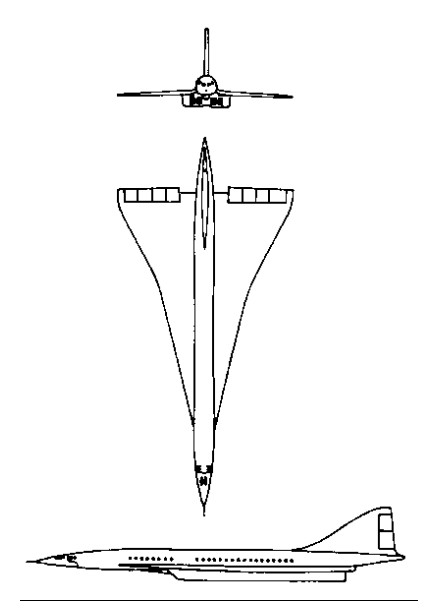
The aircraft has an ogival delta wing with the powerplants grouped at the rear of the wing and a drooping nose to improve the pilot’s view in low-speed regimes. The Russian jetliner also featured a nose that is lowered hydraulically 12 degrees to improve cockpit vision during takeoff and landing. The wings are of double-delta design with a sweep-back of 70-75 degrees on the inboard portions and about 40 degrees on the outboard sections. The main landing gear had 12 tires each (three rows of four). The tall, spindly nose gear had just two wheels. A maximum 130 passengers could be accommodated in an all-economy version, but the initial model seated 98 in mixed classes (18 in first class and 80 in tourist).
It flew at Mach 1 four months before the Concorde and at Mach 2 six months before its western rival (May 26, 1970); moreover, the entire test programme up to the autumn of 1971 had been carried out by a single prototype.
The first airliner to have exceeded Mach 2. In May 1971 it made its first appearance outside the USSR, at the Paris Air Show.
The Tu-144 was reported to be in production with design changes incorporated following the tragic crash of a prototype aircraft at the 1973 Paris Show.
The production version had a flight crew of three and 140 passengers as standard, and began 50 proving flights with cargo between Moscow and Alma Ata, the capital of Kazakhstan, on 26 December 1975. The distance of 1,864 miles (3000 km) was covered in a flight time of 1 hour 59 minutes. This variant also had retractable but non-moving canard foreplanes, lengthened fuselage, redesigned intakes, increased span and removal of pilots’ ejection seats.
Almost five years behind schedule, supersonic passenger services with the Tupolev Tu 144 were inaugurated by Aeroflot between Moscow and Alma Ata on 1 November 1977. 102 revenue services were flown before operations ended prematurely on 1 June 1978 after a fatal accident.
The air conditioning system needed to keep the airframe cool at Mach 2 was ineffective and the cabin was uncomfortably hot. It was also so noisy, along with the engines, that passengers were issued with earplugs during flight.
A modernised and modified version, the Tu-144D, with new engines, entered service in June 1979, with more economical Kolesov turbofan engines.
The last of 17 production models were the five Tu-144Ds, which had larger engines and greater range. Most had been retired by the late 80s, with only a handful retained for various research tasks at Zhukovskii.
The NATO reporting name is ‘Charger’.
In November 1996 a converted Tu-144D flew again as the Tu-144LL, used thereafter for an international High-Speed Civil Transport research program to assist in the development of a next generation supersonic transport.
Engines: 4 x Kuznetsov NK 144 afterburning turbofan, 38,580 lb (17,500 kg) Wing span: 90 ft 8.5 in (27,65 m) Length: 190 ft 3.5 in (58.00 m) Height: approx 43 ft 3 in (13.20 m) Wing area: 438 sq.m / 4714.59 sq ft Gross weight: 395,000 lb (179,150 kg) Empty weight: 85000 kg / 187394 lb Fuel capacity 209,440 lbs Operating altitude 18000 m / 59,000 ft Max cruising speed: 1,550 mph (2,500 km/h) at 65,000 ft (20,000 m) Range: 3510 nm / 4,040 miles / 6,500 km with 121 Passengers Takeoff distance (balanced) 9,845 ft Landing roll 8,530 ft Accommodation: Crew of 3 and up to 130 passengers.
In the mid-1960s, the Soviet Navy developed a requirement for a long-range anti-submarine and maritime patrol aircraft to supplement the IL-38 medium-range aircraft. With the Tu-95 and Tu-114 in operation, Tupolev was asked to prepare proposals.
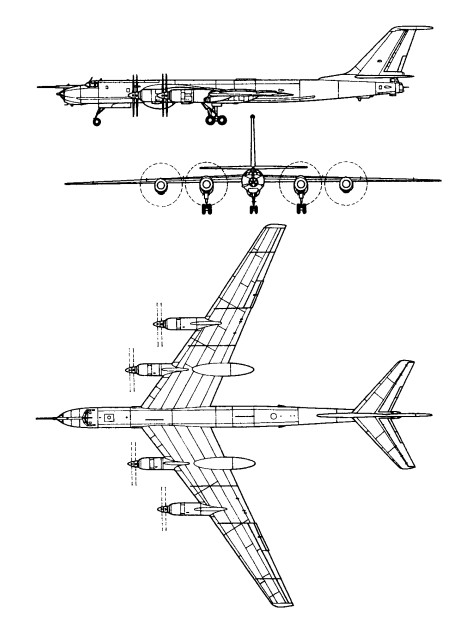
Nikolai Bazenkov was appointed chief designer for the project, which was given the number 142. He took the basic Tu-95 design but omitted all the strategic equipment. The wing was redesigned with increased span, up from 50.05m to 51.10m, which allowed more fuel to be carried, and with increased camber. Much of the defensive weaponry was also removed. Then he added the electronic equipment needed for its new role.
Featuring lengthened forward fuselage and Mod II (Tu-142M) and successive Bear-F variants having redesigned nose with revised cockpit. Bear-J is SovNavAir VLF communications version. SovAir strike version (with fuselage lengthening omitted) is Bear-H. All are powered by four NK-12MV turboprops, 14,795 ehp.
The crew in all versions is accommo¬dated in nose and rear fuselage press¬urized cabins, as well as the pressu-rized but isolated rear turret, fitted to most versions. Most operational variants have an inflight refuelling probe on the nose, but even on internal fuel it is possible to fly missions lasting 26 hours.
The prototype Tu-142 made its first flight from Zhukovski in July 1968. After flight tests by the designers and the NIl VVS, the aircraft was put into production at Kuibyshev and later at Taganrog. It entered service with Naval Long Distance Aviation in 1972; it was then the world’s largest anti-submarine aircraft. It served as Bear-F alongside the smaller IL-38 but its long-range capability made it able to launch an attack on a submarine 5,000km from the aircraft’s base. With improvements in electronics, work began in 1973 on an improved version, the Tu-142M, and its first flight was made on 4 November 1975.
The -142M was fitted with electronic equipment capable of early detection of low-noise submarines, a new and more accurate INS navigation system and automated radio communications. Its surveillance system worked on a 360 degree arc, and was more capable than that of the IL-38 at detecting magnetic abnormalities. Data was transferred immediately by satellite link back to base. With a capability to patrol for seventeen hours, the aircraft was provided with bunks for crew rest. Its internal fuel load was seventy tonnes, and it was equipped for in-flight refuelling which could extend the patrol duration beyond the seventeen hours when needed.
The VMS based its Tu-142s, which were given the NATO codename ‘Bear F’, in the Northern and Pacific regions; some were also based in Cuba and Vietnam until 1990, when political developments prompted their return to Russia.
Production was running at ten a year until 1983, when output was split between Bear F and Bear H, with five of each being produced. Bear F was identified in 1973, and later aircraft have a MAD sensor at the top of the fin.
A new version of the long-range four-turboprop Bear, carrying the subsonic 3,000km range AS-is Kent cruise missile, entered service late in 1984, according to the Pentagon. The new Bear H carries at least four AS-b5s, two under each inboard wing section, and may carry more internally. According to US estimates, some 40 Bear Hs were in service by 1986.
Production continued at Taganrog until 1988 suspended by President Yeltsin as a unilateral arms limitation measure, with one aircraft per month being completed. Total production run at both factories was 225 aircraft, including eight delivered to the Indian Navy starting in the mid- 1980s and continuing until 1988.
The standard armament of the Tu-142 was two GSh-23 cannons mounted in the tail for defensive use. It could carry up to eight Kh-35 anti-shipping cruise missiles (NATO code AS-17) mounted on pylons under the wing, and internally, 450mm calibre anti-submarine torpedoes and/or 533mm calibre anti-shipping torpedoes. Depth charges could also be dropped. With a combat load of 11,340kg, its maximum range was 12,550km. Normal take-off weight was 170 tonnes, but 188 was possible with little difficulty.
Tu-142M3 Engines: 4 x NK-12MP, 15000hp Max take-off weight: 188000 kg / 414471 lb Empty weight: 80000 kg / 176371 lb Fuel capacity: 73,000 lt Wingspan: 51.10 m / 168 ft 8 in Length: 49.50 m / 162 ft 5 in Height: 12.12 m / 40 ft 9 in Wing area: 295 sq.m / 3175.35 sq ft Max. speed: 925 km/h / 575 mph Ceiling: 13500 m / 44300 ft Range: 12550 km / 7798 miles Endurance: 25 hr Crew: 10
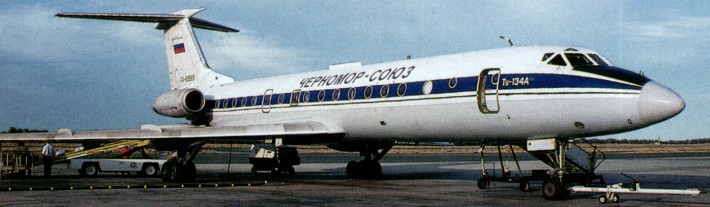
Known originally as the Tu-124A, this aircraft is a rear-engined twin-turbofan development of the Tu-124. The new aircraft, designated Tu-134, also had a T-tail and the same basic wing, with an extended centre section. Its joint military/civil design resulted in the aircraft retaining a glazed ‘bomb aimer’ nose until the early 1970s.
First flown in July 1963, it had completed more than 100 test flights when first details and photographs were released in mid-September 1964. The prototype was followed by five preproduction aircraft and the Tu-134 then went into series production at Kharkov.
It entered international service on Aeroflot’s Moscow-Stockholm route in September 1967, after a period on internal services, and was joined by the `stretched’ Tu-134A in the Autumn of 1970. Nato code name Crusty, early models seated 72 passengers, whilst the stretched A-model had a 96-seat capacity. Thrust reversers were also fitted to the twin Solviev D-30 turbofans and the landing gear strengthened.
It has been widely exported despite its high operating costs and lack of cargo/baggage storage capability, and remained in widespread service on thin routes. Aeroflot still had some 400 Tu-134s in service at the beginning of 1992, including a substantial, but unquantified, VIP fleet.
Production ceased in 1985 after 852 had been built.
Tu-134A Engines: 2 x Soloviev D-30-II turbofans, 30.26kN / 14,990 lb Wing span: 95 ft 1.75 in (29 m) Length: 122 ft 0 in (37.1 m) Height: 29 ft 7 in (9.02 m) Wing area: 127.3 sq.m / 1370.24 sq ft Empty weight: 29050 kg / 64045 lb Max TO wt: 103,600 lb (47,000 kg) Max level speed: 540 mph (870 kph) Length: 37.05 m / 122 ft 7 in Cruise speed: 605 mph Range: 3280 sm Ceiling: 11890 m / 39000 ft Range w/max.payload: 1890 km / 1174 miles Pax capacity: 96 Crew: 3
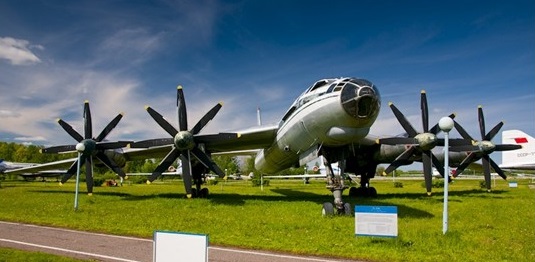
NATO code name ‘Moss’, about 10 surviving Tu-114s were retired and converted to Tu-126 ‘Moss’ configuration as airborne early warning platforms with a rotating radome pylon-mounted over the rear fuselage for the Soviet air force. The aircraft also has an inflight-refuelling probe and a number of blisters and fairings covering operational equipment. The former passenger cabin provides ample space for extensive communications, radar and signal processing equipment, and consoles for specialist operators.
First deployed in the mid-1960s, the Tu-126 carries a crew of 12. It is powered by four NK-I2MV turboprop engines and has a range of 7,700 miles at a cruise speed of 380-485 mph. The endurance at cruising speed for a 1,250-mile radius is six hours, which with flight refuelling can be extended to 17 hours.
Engines: 4 x NK-12MV, 15000hp Max take-off weight: 170000 kg / 374788 lb Wingspan: 51.20 m / 168 ft 0 in Length: 55.20 m / 181 ft 1 in Height: 16.05 m / 53 ft 8 in Wing area: 311.10 sq.m / 3348.65 sq ft Max. speed: 850 km/h / 528 mph Cruise speed: 650 km/h / 404 mph Ceiling: 13000 m / 42650 ft Range: 12550 km / 7798 miles Crew: 5 + 12 systems operators.
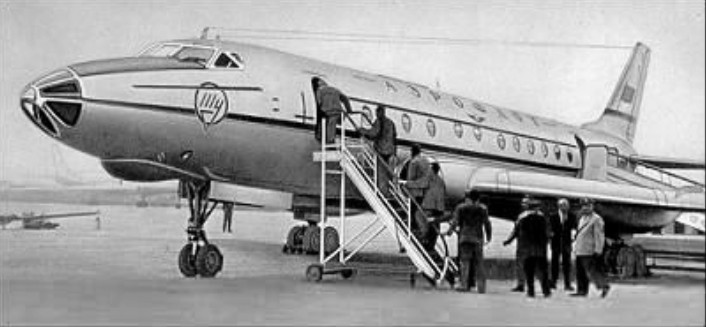
Aeroflot’s requirement for a short/ medium-range airliner to replace the llyushin IL-14 led to the design of what was basically a reduced-scale version of the Tu-104. A smaller jet, with better short-field capability, and 44-seat, the original Tu-104 was scaled down by about three-quarters and powered by two new purpose-designed turbofans.
The prototype Tupolev Tu-124 was first flown in June 1960 and introduced aerodynamic and system refinements, plus the Soloviev D-20P twin-spool turbofans.
The Tu-124 entered service with Aeroflot on 2 October 1962, but the major production version was the 56-seat Tu-124V.
Variants included the Tu-124K and Tu-124K2 with de luxe seating for 36 and 22 passengers respectively.
About 100 were built, this number including three for CSA in Czechoslovakia and two for Interflug in East Germany, but Aeroflot has now retired its Tu-124s. A small number entered military service, and it is believed that some were used for research and test purposes. The NATO reporting name is ‘Cookpot’.
Versions: Tu-124- serial variant with 44 seats Tu-124- project for 48 or 52 seats Tu-124- for 60 seats Tu-124V- serial variant for 56 seats Tu-124B- version with D-20P-125 engines Tu-124K- saloon version Tu-124TS Tu-124SPS Tu-124- VSTOL version Tu-124Sh-1 Tu-124Sh-2 Tu-127- military transport
Tu-124B Engines: 2 x Soloviev D-20P turbofans, 52.9kN Max take-off weight: 38000 kg / 83776 lb Empty weight: 22500 kg / 49604 lb Wingspan: 25.55 m / 84 ft 10 in Length: 30.58 m / 100 ft 4 in Height: 8.08 m / 27 ft 6 in Wing area: 119.0 sq.m / 1280.90 sq ft Ceiling: 11700 m / 38400 ft Range w/max.payload: 1220 km / 758 miles Crew: 3 Passengers: 44-56
The Soviet government had planned for several years that the General Secretary of the Communist Party and Premier of the Soviet Union, Nikita Khrushchev, should address the United Nations General Assembly. As a matter of national prestige, he had to travel on a Soviet airliner.
When this matter first arose, in the mid-1950s, the Soviet Union had no medium- or long-range aircraft in commercial service. Although the Tu-104 was shortly to enter service, it was not considered suitable because of its relatively short range. The -114 was in the early stages of design, but whether it would be operational before the end of the decade was difficult to determine. The Soviet Union had, of course, the remarkable Tu-95, but the nation’s leader could not travel in a strategic bomber – or could he? Tupolev was called in.
Nikolai Bazenkov was diverted from other duties to prepare a passenger version of the Tu-95. Two aircraft were taken from the production line at Kuibyshev. No armaments were fitted, and all military equipment was removed. With the original airframe of the Tu-95, a passenger compartment was installed behind the wing spar; it consisted of a pressurised cabin with two sections, each of which could accommodate twenty passengers in VIP luxury. A kitchen, toilet and service room were also installed. A fitted stairs was installed so passengers could board and disembark without a need for special airport equipment.
Although the work began only in mid-1957, the Tu-116, which was sometimes called the Tu-114D, was airborne in November 1957. Usually, the ‘D’ suffix in an aircraft designation represented ‘Dalnii’ (long distance), but this time it stood for ‘Diplomaticheskii’ (diplomatic).
In April 1958, the prototype Tu-116, Air Force Number 7801, a number probably derived from its manufacturer’s block and line number, made a high-altitude, long-distance trial flight to demonstrate its ability for the task. Flying at levels between 10,000m and 12,200m, it flew non-stop from Moscow to Irkutsk and back to Moscow, covering 8,500km at an average speed of 800km/h. After landing, it was calculated still to have fuel for another 1,500 to 2,000km. The second aircraft was intended as a reserve in the event of a problem with the first, but neither were needed. Instead, Khrushchev flew to the New York headquarters of the United Nations Assembly in the prototype Tu-114.
Never intended for normal commercial service, the two Tu-116s were little used. Originally painted in military marks (7801 and 7802), one aircraft was later given the civilian registration SSSR-76462, and is now preserved in the Ulyanovsk Museum of Civil Aviation.
While the Tu-114 was derived from the military Tu-95, it was given a totally new fuselage. However, three Tu-116s were also built, and were designated Tu-114Bs by Aeroflot and retained the much narrower fuselage of its predecessor.
Engines: 4 x NK-12MV turboprops, 15000hp Max take-off weight: 121920 kg / 268789 lb Wingspan: 51.1 m / 168 ft 8 in Length: 47.5 m / 156 ft 10 in Wing area: 311.1 sq.m / 3348.65 sq ft Max. speed: 770 km/h / 478 mph Ceiling: 12000 m / 39350 ft Range: 10500 km / 6525 miles
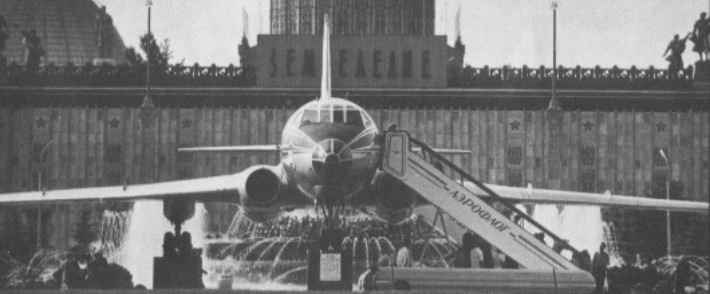
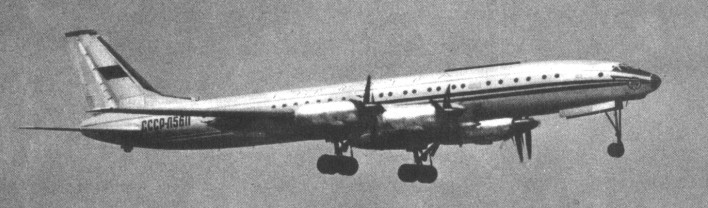
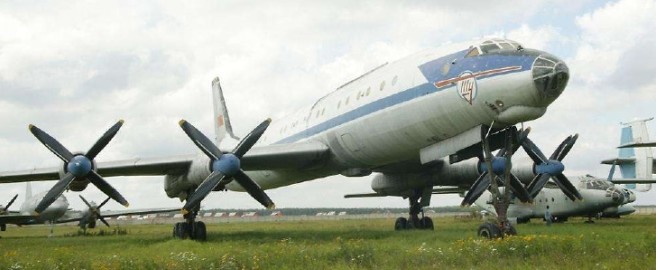
The Tu-114 flew for the first time on 3 October 1957 and remained the world’s largest and heaviest commercial aircraft until the introduction of the Boeing 747. The prototype Tu 114, named Rossiya (Russia) to celebrate the 40th anniversary of the 1917 Revolution, established a large number of speed, height and distance records with payloads of up to 66,216lb (30,035 kg). The first public appearance was at the 1959 Paris Airshow.
On April 9, 1960 Tu-114 set the world speed record with 25000kg payload on a 5000 km circuit at 877.212kph.
The production versions entered Aerofllot service since 1961. Seating 170 on internal services or 120 on intercontinental routes, the Tu-114 proved fast and reliable and operated Moscow-Havana, Moscow-Delhi, Moscow-Montreal and Moscow-Tokyo services until replaced by the four-jet Ilyushin Il-62 from 1967. Many speed-and-altitude-with-payload records set by the Tu-114 stood for many years. Its final retirement on international routes came in 1969, and the last domestic services were flown in 1973.
About 30 Tu-114s were built and about 10 surviving Tu-114s were retired and converted to Tu-126 ‘Moss’ configuration as airborne early warning platforms for the Soviet air force.
Engines: 4 x Kuznetsov NK 12MV turboprop, 14,795 eshp / 11033kW Props: 8 ft 41 in (5.60 m) diameter 8 blade contra rotating Wing span: 167 ft 8 in (51.10 m) Length: 177 ft 6 in (54.10m) Height: 15.5 m / 51 ft 10 in Wing area: 3,349 sq ft (311.1sq.m) Empty weight: 91000 kg / 200622 lb Gross weight: 376,990 lb (171,000 kg) Max cruising speed: 478 mph (770 km/h) at 29,500 ft (9,000m) Range: 3,850 miles (6,200km) with max payload of 66,140 lb (30,000 kg) Ceiling: 12000 m / 39350 ft Accommodation: Crew of 10 15 (Incl cabin staff) and 120 220 passengers
In order to meet Aeroflot’s requirement for a 100-seat jetliner, Dmitri Markov installed four 5,000shp Lyulka AL-7P engines in place of the two larger AM-3s in a slightly stretched fuselage of a Tu-104 – the stretch, of 1.2m, gave the Tu-110, as the new version was numbered, a fuselage length of 40.06m. The span was also increased by 2.96m to give space for the extra two engines to be installed. The third change was to the interior, where the cabin was divided into two sections to provide for first and economy class passengers. Take-off weight of the four-engined aircraft, at 79,300kg, was 3,300kg higher than the original Tu-104. With a maximum speed of 1,000km/h, a ceiling of 12,000m, and a range of 3,300km, there was little difference in performance.
One aircraft was built at factory N 156 from parts manufactured at factory N 22 in Kazan and brought to Moscow, and it made its first flight on 11 March 1957. Although it flew well, it offered little advance on the Tu-104, and no production orders followed, although two others were completed at Kazan. Instead, Aeroflot and Tupolev agreed that the slightly larger body should become standard on the Tu-104B, which began service in 1959.
Engines: four 5,000shp Lyulka AL-7P Length: 40.06m Span: 37.5 m Take-off weight: 79,300kg Maximum speed: 1,000km/h Ceiling: 12,000m Range: 3,300km Passengers: 100













 All Aero