Turbomeca Palouste

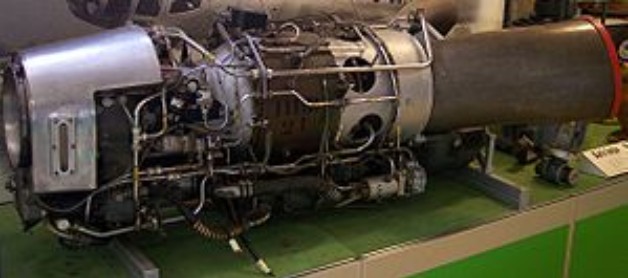
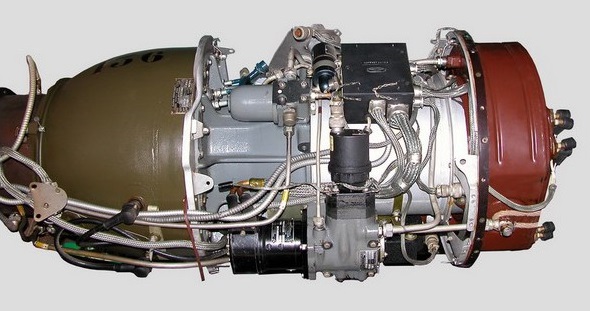
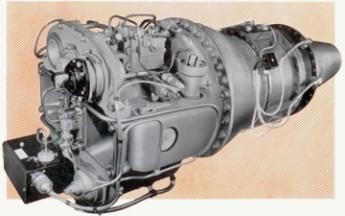
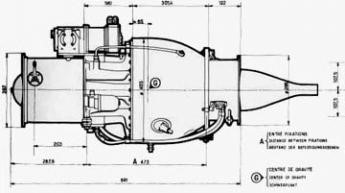
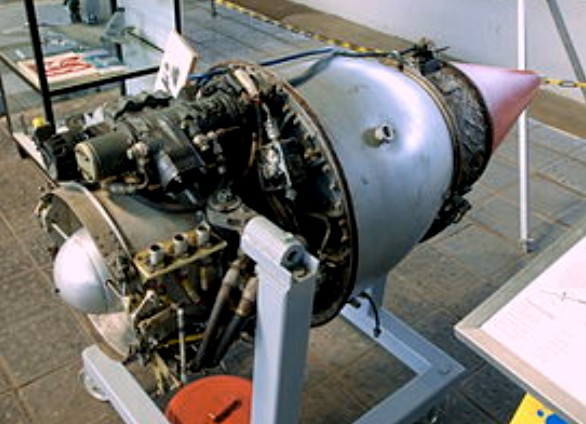
Designed and built by Turbomeca, the Palouste is a gas turbine engine, first run in 1952, and was also built under license in Britain by Blackburn, Lucas Aerospace, and Rolls-Royce. Originally conceived as an aircraft ground support equipment starter gas generator it was also used as propulsion for the Sud-Ouest Djinn and other tip jet powered helicopters.

The Palouste was a very simple unit, its primary purpose was to supply a high flow rate of compressed air to start larger jet engines such as the Rolls-Royce Spey as installed in the Blackburn Buccaneer (this aircraft had no on-board starting system). Air from the centrifugal compressor was divided between external supply (known as bleed air) and its own combustion chamber.

Several British naval aircraft were adapted to carry a Palouste in a wing mounted pod installation to facilitate engine starting when away from base.

A novel use of a surplus Palouste engine was its installation in a custom-built motorcycle known as the Boost Palouste. In 1986 this motorcycle broke an official ACU 1/4 mile speed record at 184 mph (296 km/h). The builder modified the engine to include a primitive afterburner device and noted that pitch changes which occurred during braking and acceleration caused gyroscopic precession handling effects due to the rotating mass of the engine.

Variants:

Palouste IV
The gas generator used to power the Sud-Ouest S.O.1221 Djinn and other tip-jet helicopters.

Applications:
Bell Model 65
Fairey Ultra-light Helicopter
Sud-Ouest Djinn

Specifications:
Blackburn Palouste
Type: Gas generator
Length: 33.42 in (849 mm)
Diameter: 17.72 in (450 mm)
Dry weight: 187.5 lb (85 kg)
Compressor: Single stage centrifugal
Combustors: Annular combustion chamber
Turbine: Two-stage axial flow
Fuel type: Kerosene
Oil system: Dry sump
Overall pressure ratio: 3.6:1
Air output: 1.65 lb/sec at 37 psi

Turbomeca TM 333

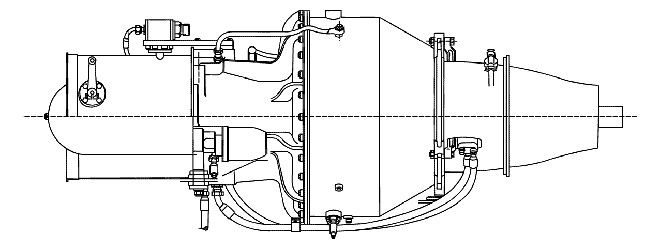
The Turbomeca TM 333 is a turboshaft engine designed for 5- to 6-ton-class helicopters. It was originally intended to power Eurocopter’s twin-engine Dauphin and Panther helicopters. The TM 333 found its first commercial application on the HAL Dhruv. First run in 1975, 250 were built.

Variants:
TM 333 2B2 (for multi-engine applications)
HAL Dhruv employed two TM 333 2B2 engines each developing 825 kW at takeoff, with growth potential to 900 kW for subsequent versions. The TM 333 2B2 is the initial production engine used on the Dhruv. Approximately 250 engines are installed on Dhruv and further production has been stopped as it is replaced by Shakti engine which is joint development by HAL & Turbomeca.

TM 333 2M2 (for single-engine applications)
Another version, the TM333 2M2, was being developed with reduced power to be fitted on the Cheetal, the upgraded version of the HAL Cheetah, and the Chetan, the upgraded version of the HAL Chetak (Alouette III).

Applications:
Eurocopter Dauphin
Eurocopter Panther
HAL Dhruv
HAL Cheetah
HAL Chetak

Specifications:
TM333 2B2
Type: Turboshaft
Length: 1045 mm
Dry weight: 166.5 kg
Compressor: 2 stage Axial compressor & single stage centrifugal compressor
Combustors: Reverse annular flow
Turbine: 2 low-pressure and 2 high-pressure stages
Fuel type: ATF K-50
Maximum power output: 801kW (1073.72 hp)
Overall pressure ratio: 10:1
Turbine inlet temperature: 1230°C

Turbomeca Piméné

First run in 1948, the Turbomeca Piméné was a small French turbojet engine produced by Turbomeca in the early 1950s. A single-stage compressor, annular combustion with rotating fuel delivery ring and single-stage turbine, the Pimémé first flew in the Fouga Cyclone powered-sailplane on July 14, 1949.

The Pimene has a single-stage centrifugal compressor with a 3.8 : 1 compression ratio.
The combustion chamber is annular, with rotary fuel injection. The fuel ring, around the periphery of which are a number of vents, is attached to the shaft connecting compressor and turbine dises and revolver with it. Fuel is fed into the inside of the ring and is vented by centrifugal force, being vaporised in the process. Fuel delivery at low thrust settings regulated by by-pass valve.

The turbine is single-stage single-piece turbine with 31 blades preceded by stator with twenty air-cooled valve. The starter is Air Equipement 24 volt electric or compressed-air starter. One igniter plug on first model, two after. The mounting has three mounting pans, two on compressor casing and one on underside of combustion chamber.

First shown at the 1949 Paris Air Show this engine passed official type tests in 1950. A variant known as the Turbomeca Orédon drove an alternator and was used as an aircraft auxiliary power unit, this name being reused for a later helicopter turboshaft design.

Applications:
EFW N-20
Fouga CM.8
Fouga CM.101R
Fouga CM.88 Gemeaux

Specifications:
Type: Turbojet
Length: 80 cm (31.5 in)
Diameter: 40 cm (15.75 in)
Dry weight: 54 kg (119 lb)
Compressor: Single stage axial plus single-stage centrifugal
Combustors: Single annular combustion chamber
Turbine: Single-stage
Maximum thrust: 1 kN (220 lbf) at 37,000 rpm
Specific fuel consumption: 1.05 lb/hr/lbf
Thrust-to-weight ratio: 1.85

Max. T.O. (static) 110 kg. (242 lb.) at 35,000 r.p.m.
Crursing (static) 80 kg. (176 lb.) at 33,000 r.p.m
Length 1,050 mm. (41.5 in.).
Diameter 400 mm. (16 in.)
Weight dry: 54 kg (118 lb.)
Turbine rpm: 35,000
Gas temperature before turbine: 700°C
Gas temperature after turbine: 600°C
Fuel Pump: Martin Moulet
Maximum pressure: 4 kg./cm.2 (57 lb./sq. in.)
Fuel: Kerosene (Jet A1
Fuel burn max. T.O. 1.05 kg./kg. s.t./hr. (1.22 lb./ lb. s.t./hr.).

Turbomeca Turmo / Changzhou / Dongan WZ-6

Turbomeca Turmo IIIB

The Turbomeca Turmo is a French turboshaft engine developed for helicopter use. A descendant of Turbomeca’s pioneering Artouste design, later versions delivered around 1,200 kW (1,610 shp). A turboprop version was developed for use with the Breguet 941 transport aircraft.

Current versions are built in partnership with Rolls-Royce, and the engine is produced under license by the Chinese Changzhou Lan Xiang Machinery Works as the WZ-6 and Romanian Turbomecanica Bucharest as the Turmo IV-CA

Variants:
Turmo IIIC
A 894.84 kW (1,200 hp) turboshaft powering the Sud-Aviation Frelon prototypes.

Turmo IIIC2
Developed from the IIIC delivering 969.41 kW (1,300 hp) maximum output

Turmo IIIC3
Maximum rating 1,118.55 kW (1,500 hp) at 33,500 rpm for production Super Frelon helicopters

Turmo IIIC4

Turmo IIIC5

Turmo IIIC6

Turmo IIIC7

Turmo IIID
Turboprop for the proposed Breguet Br 942 STOL transport, maximum rating 913.48 kW (1,225 hp).

Turmo IIID2
995.51 kW (1,335 hp) at 22,460 free turbine rpm

Turmo IIID3
1,081.26 kW (1,450 hp) at 33,500 rpm

Turmo IVB

Turmo IVC

Turmo IV-CA
Licence production in Romania

Turmo VI
Turboprop engine with two axial stages, one centrifugal compressor stage and two free power turbine stages, rated at 1,342.26 kW (1,800 hp) at 32,000 rpm.

WZ-6
Licence production at the Changzhou Lan Xiang Machinery Works in the Peoples Republic of China.

Applications:
Turboshaft
Aérospatiale Puma
Aérospatiale Super Frelon
Aérospatiale Super Puma
Bölkow Bo 46
IAR 330
SNCASE SE.3200 Frelon

Turboprop
Breguet 940
Breguet 941
Breguet 941S

Specifications:

Turmo IIIC7
Type: Two-shaft turboshaft
Length: 182 cm (71.6 in)
Diameter: 71.6 cm (28.2 in)
Dry weight: 325 kg (716 lb)
Compressor: Single-stage axial, single-stage centrifugal
Combustors: Annular, reverse-flow
Turbine: Two-stage compressor turbine, two-stage power turbine
Maximum power output: 1,217 kW (1,632 shp)
Overall pressure ratio: 5.9:1
Power-to-weight ratio: 3.74 kW/kg (2.28 shp/lb)

Turbomeca Palas / Continental Model 320 / Blackburn Palas

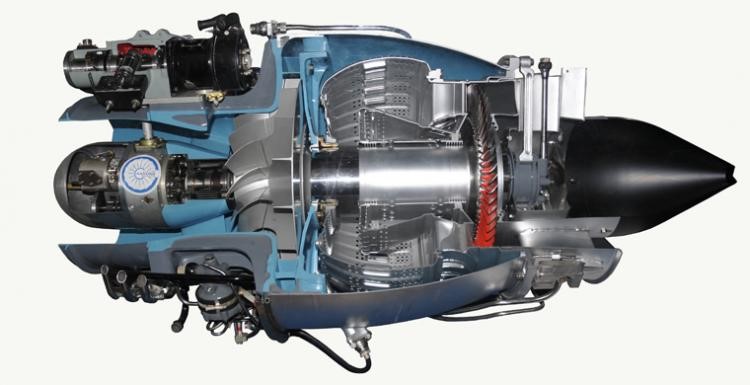
Sectioned Turbomeca Palas

In 1947, commissioned by the Air Ministry, Turbomeca begins the design of a small gas turbine. This gas turbine, TT 782, became the TR 01. The first test application, under the name Piméné, was in a modified Sylph glider on 14 July 1949.

The Palas, then Marbore I and II followed in 1950.

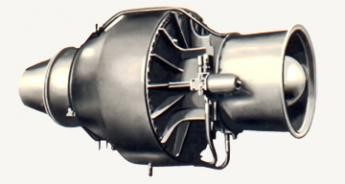
The Turbomeca Palas is a diminutive centrifugal flow turbojet engine used to power light aircraft. An enlargement of the Turbomeca Piméné the Palas has a turbofan with a centrifugal compressor stage, combustion chamber with an annular fuel distribution by injection of a wheel, and having a turbine stage. Two versions have been put on the market, the first (I) delivering 150 kgf and the second (II) delivering 160 kpg

With an annular fuel distribution by the injection of a wheel, this wheel is driven by the turbine shaft which is itself fixed to the compressor. At its periphery is formed a number of leads through which the fuel flows. When fuel is introduced into the interior of the wheel, it is vaporized and discharged in the combustion chamber by the centrifugal force. The fuel flow is regulated by a bypass valve.

The compressor is a single-stage centrifugal, with a compression ratio of 3.95 / 1 and a irflow of 3.2 kg / sec. The turbine stage has 24 (or 25) blades. It is preceded by a stator equipped with a twenty entrys. Kerosene (Jet A1) is provided by a Turbomeca pump of 4 kg. / Cm ² maximum pressure.

It can be equipped with an electric starter Air Equipment (24 volt) or ramp start compressed air. Ignition is via two ignitors and the later versions were equipped with an injection to start directly on Kerosene.

Three anchor points, two above the compressor, behind the combustion chamber, are provided for mounting.

The Palas was produced under licence by Blackburn and General Aircraft in the United Kingdom and Teledyne Continental Motors in the United States as the Continental Model 320.

Blackburn Palas 600

Applications:
Caproni Trento F.5
Curtiss C-46 Commando (two under the fuselage, the first flight in October 1952)
Curtiss Commando C-46F (2 under the wings)
CVV-6 Canguro Palas
Douglas DC-3 (as a booster engine)
Fouga CM-8 R9.8 Cyclope
Fouga CM-8 R8.3 Midget
Fouga CM.130
Ikarus 451
Ikarus S451M
Ikarus 452M
Mantelli AM-12
Miles Sparrowjet
Payen Pa 49
Short SB.4 Sherpa
SIPA S.200 Minijet
SIPA S.300
Somers-Kendall SK-1
Sud-Ouest Bretagne

Specifications
Type: Turbojet
Length: 1.2 m (47.25 in)
Diameter: 405 mm (16 in)
Dry weight: 72 kg (159 lb)
Compressor: Single-stage centrifugal
Combustors: Annular with rotary fuel injection
Turbine: Single-stage with 24 or 25 blades
Fuel type: Jet A1
Maximum thrust: 1.6 kN (353 lbf) static to 33 800 rpm
Rated normal util: 130 kgp
Overall pressure ratio: 3.95:1
Turbine inlet temperature: 700°C
Fuel consumption: 0.117 kg N-1 h-1 (1.15 lb lbf-1 h-1 )
Fuel burn A Rated normal: 1.13 kg / kgp / hr
Thrust-to-weight ratio: 22.2 N kg-1 (2.26 lbf lb-1)
Turbine rated speed: 33 800 rpm
Temperature before turbine: 700 ° C.
Temperature after turbine: 600 ° C.

Turbomeca Marboré / CAREC WP-11 / Teledyne CAE J69

Marboré II

The Turboméca Marboré was a small turbojet engine produced by Turbomeca from the 1950s into the 1970s. First flown on 16 June 1951, the most popular uses of this engine were in the Fouga Magister and the Morane-Saulnier MS-760. It was also licensed for production in the United States as the Teledyne CAE J69.

Marbore I

The first major production version was the Marboré II, which had a maximum thrust of 880 lbf (3.9 kN) at 22,500 rpm. In its most basic form, it is a single-spool, centrifugal compressor turbojet. Fuel consumption was rated at 109 gal/h. Variations include military or civilian aircraft, oil tank design, auxiliary equipment, and exhaust pipe configuration. Some variants also included one axial stage compressor for additional performance. The engine dimensions of different variants with different auxiliary components and mounting configurations.

The Marbore II has a single stage centrifugal compressor with with an annular combustion chamber and single stage turbine. Starting is by an electric starter and 2 torch igniters.

Marbore II

Marbore II was fitted on the Nord 2505 (Modified Nord 2503, powered by two 1864-kW (2,500-hp) Pratt & Whitney R-2800-CB17 radial piston engines and two Turbomeca Marboré IIE auxiliary turbojets added).

Turbomeca Marboré IIE

These were eventually replaced by the Marboré VI series which were slightly more powerful at was 1080 lbf (4.8 kN) instead of 880 lbf. Fuel consumption was only slightly higher at 119 gal/h. This was a 23% increase in thrust with slightly more than a 9% increase in fuel consumption. As a result the IV series were used to re-engine many II-series aircraft, and Marboré II engines are still available cheaply as surplus for the experimenter.

Turbomeca Marboré VI

The original Marboré, as well as Marboré III, IV, and V were not produced in significant numbers. A typical weight for this series of engines is 140 kilograms or 310 pounds. Fuel consumption is 190 gallons per hour on the Marbore VI at 15,000 feet, as compared to 138 gallons per hour on Marbore II engines (same altitude). An increase of 27% fuel consumption and a decrease in cruise range capabilities.

Variants:

Marboré I
Marboré II
Marboré IIC
Marboré IIE
Marboré III
Marboré IV
Marboré V
Marboré VI
Teledyne CAE J69: Licence production and development in the United States.

Applications:

Marboré:
Ambrosini Sagittario
Bölkow Bo 46
Fouga Magister
Fouga Zéphyr
Hispano HA-200
Morane-Saulnier MS.755 Fleuret
Morane-Saulnier MS.760 Paris
Nord Aviation CT20
SNCASO Trident

Specifications:

Marbore I
Diameter: 60 cm / 23.4 in
Length: 138 cm / 54.2 in
Weight: 120 kg / 265 lb

Marbore II
Take off thrust: 880 lbs
S.F.C: 1,15 lbs/lbs/h
Maximum continuous thrust: 705 lbs
S.F.C: 1,10 lbs/lbs/h
Weight: 322 lbs

Marboré IIC
Type: Turbojet
Length: 61.7 in (156.7 cm)
Diameter: 24.9 in (63.2 cm)
Dry weight: 358 lb (162.4 kg)
Compressor: Single stage centrifugal
Combustors: Single annular combustion chamber
Turbine: Single stage
Fuel type: Aviation kerosene Air 3405 (JP-1)
Maximum thrust: 880 lbf (3.91 kN) at 22,600 rpm
Turbine inlet temperature: 650 C
Thrust-to-weight ratio: 2.458 lbf/lb (0.024 kN/kg)

Marbore I
Marbore II

Turbay T-3

Turbay T-3A

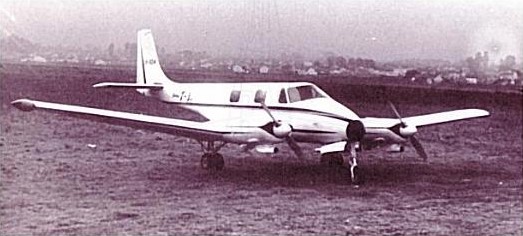
In 1957, the Argentine aircraft designer Alfredo Turbay began work on a twin-engined STOL light transport, the Turbay T-3A, with Turbay S.A. formed at Buenos Aires in January 1961 to build the new design. The T-3A was a low-wing cantilever monoplane of all metal construction. It was powered by two 130 kW (180 hp) Lycoming O-360-A1D engines driving two-bladed propellers, and was fitted with a retractable nosewheel undercarriage.

Turbay T-3A Article

Alfredo Turbay piloted the T-3A on its first flight on 8 December 1964. Production was planned of the T-3B, which was to be fitted with 190–260 kW (250–350 hp) Lycoming or Continental engines, giving improved performance. These plans did not come to fruition, with the prototype T-3B never completed, and no production occurring.

Powerplants: 2 × Lycoming O-360-A1D, 130 kW (180 hp) each
Propellers: 2-blade Hartzell HC-92 zk-2b/8447-12A metal
Wingspan: 13.52 m (44 ft 4 in)
Wing area: 24.08 m2 (259.2 sq ft)
Aspect ratio: 7.5:1
Airfoil: NACA 23024 at root, NACA 4412 at tip
Length: 9.40 m (30 ft 10 in)
Height: 3.60 m (11 ft 10 in)
Empty weight: 1,034 kg (2,280 lb) equipped
Max. zero-fuel weight: 1,725 kg (3,803 lb)
Max takeoff weight: 1,860 kg (4,101 lb) (MTOW and MLW)
Fuel capacity: 360 L (95 US gal; 79 imp gal) in four wing tanks, with provision for 2x 80 L (21 US gal; 18 imp gal) external tanks; 24 L (6 US gal; 5 imp gal) oil
Wing loading: 77 kg/m2 (16 lb/sq ft)
Power/mass: 0.1442 kW/kg (0.0877 hp/lb)
Maximum speed: 318 km/h (198 mph, 172 kn)
Econ. Cruise: 230 km/h (140 mph, 120 kn)
Max cruise: 255 km/h (158 mph; 138 kn)
Stall speed: 85.4 km/h (53.1 mph, 46.1 kn)
Never exceed speed: 342 km/h (213 mph, 185 kn)
Range: 1,380 km (860 mi, 750 nmi) with maximum payload, zero wind
Range: 1,840 km (1,143 mi; 994 nmi) with maximum fuel, zero wind
Service ceiling: 7,600 m (24,900 ft)
SE Service ceiling: 3,500 m (11,483 ft)
Rate of climb: 6.6 m/s (1,300 ft/min)
Take-off run: 118 m (387 ft)
Take-off distance to 15.25 m (50 ft): 225 m (738 ft)
Landing run: 100 m (328 ft)
Landing distance from 15 m (49 ft): 180 m (591 ft)
Crew: 1
Capacity: 6 passengers / 522 kg (1,151 lb) max. payload / tanks for 800 L (211 US gal; 176 imp gal) chemicals

Turbay sa

Turbay T-1 Toucan with Alfredo Turbay May 16, 1943

Alfredo Turbay was born in Monteros in the province of Tucuman Argentina on December 15, 1912, he grew up and studied there. He received his Civil Engineering from the National University of Tucuman in 1938 and expanded his knowledge of aeronautical distance learning courses L’Ecole d’Aéronautique of France and Cornell University in the US. He obtained the brevet of pilot in April 1937 and in March 1939 began his career as aircraft manufacturer together with other enthusiasts who built a Grunau 9 primary glider.

First design by Ing Alfredo Turbay was the T-1 Tucan parasol- wing lightplane, first flown April 1943. Six Tucans ordered from Sfreddo & Paolini were halted when the latter firm was seized and nationalized by the government and plans to revive production in 1963 were also thwarted. The T-2 five-seat twin-engined monoplane was destroyed by fire in early 1949 before it had flown; thus the next design to fly was the T-3A six-passenger light transport in December 1964. Turbay SA was formed in January 1961 to build the proposed T-3B production version and a lengthened fuselage development, theT-4, but no production was achieved.