Turner T-40A / Super T-40A / T-40C / T-77 Ophelia Bumps

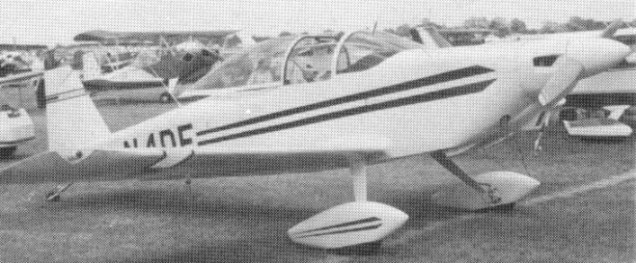
The T-40 was so successful that it collected 18 awards and convinced Turner that the only thing wrong with it was that nobody could ride along to enjoy the reading on the airspeed indicator; thus he created the T-40A. It is a two-place version of its predecessor. Turner simply divided the entire fuselage of the T-40 down the middle and in¬creased the cabin width from 24 to 40 inches. Flight tests showed that the 85-hp engine would still deliver 163 mph top speed with a fuselage nearly twice as wide as before and with considerably more airframe weight. Both Turners feature folding wings.

A Super T-40A with a 125hp motor appeared in 1972, and 1981 saw the entry of T-40C, or T-77, with a 150hp Lycoming.

T-40A
Engine: Lycoming, 125 hp
HP range: 100-125
Height: 6 ft
Length: 20 ft
Wing span: 25.4 ft
Wing area: 96 sq.ft
Empty weight: 1050 lb
Gross weight: 1600 lb
Fuel capacity: 22 USG
Top speed: 160 mph
Cruise: 147 mph
Stall: 56 mph
Range: 475 nm
Rate of climb: 850 fpm
Takeoff dist: 1250 ft
Landing dist: 1200 ft
Service ceiling: 12,000 ft
Seats: 2
Landing gear: nose or tailwheel

“Super” T-40A
Engine: Lycoming, 125 hp
Height: 6 ft
Length: 20 ft
Wing span: 27.67 ft
Wing area: 96 sq.ft
Weight empty: 1050 lbs
Gross: 1600 lbs
Fuel cap: 22 USG
Speed max: 170 mph
Cruise: 147 mph
Range: 475 sm
Stall: 56 mph
ROC: 850 fpm
Take-off dist: 1250 ft
Landing dist: 1200 ft
Service ceiling: 12,000 ft
Seats: 2
Landing gear: nose or tail wheel
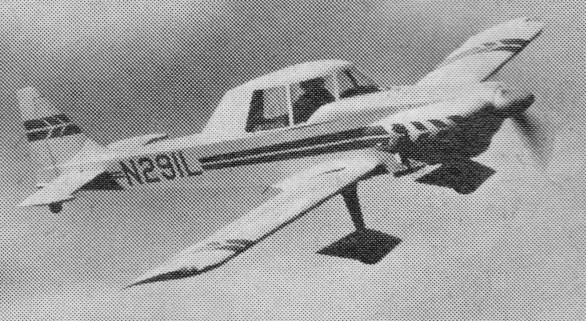
Turner T-40

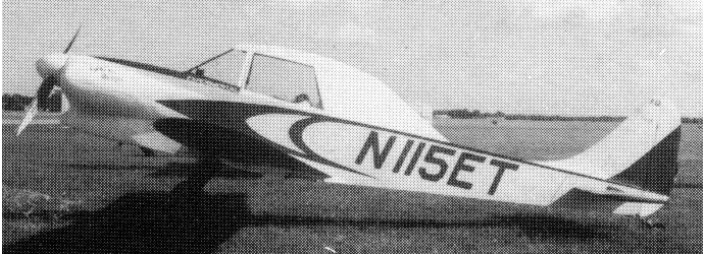
The Turner airplane family got started in 1958. First aircraft in the series was the T-40, a sleek, hot little single-seater which won the 1961 Outstanding Design Trophy at the Experimental Aircraft Association Fly-In. Of all-wood construction and featuring a sliding hood canopy, the T-40 was first powered by a 65-hp engine and did without all the frills associated with an electrical system. First flying on 3 April 1961, in this form it cruised at 128 and blitzed along at 145 with the throttle firewalled. It featured folding wings for storage in a single-car garage. Later, an 85-hp package was added. Both Turners feature folding wings.

Engine: Continental, 85 hp
HP range: 60-125
Height: 5.42 ft
Length: 19.75 ft
Wing span: 22.25 ft
Wing area: 78 sq.ft
Weight empty: 750 lbs
Gross: 1060 lbs
Fuel cap: 19 USG
Speed max: 170 mph
Cruise: 145 mph
Range: 525 sm
Stall: 55 mph
ROC: 1100 fpm
Take-off dist: 600 ft
Landing dist: 400 ft
Service ceiling: 12,500 ft
Seats: 1
Landing gear: nose or tail wheel
Turner Aircraft Inc

1960: M L Turner
Oklahoma City OK.
USA

1961: (Eugene L) Turner Aircraft
Fort Worth TX.
USA

1980: Turner Aircraft. 5803 Waterview Dr, Arlington, TX 76016, USA.

Offers plans to build T-40A side-by-side two-seat wooden low-wing monoplane, plus Super T-40 with increased wingspan and more engine power.

1995: Rte 4, Box 115AB3, Grandview, TX 76050, USA.

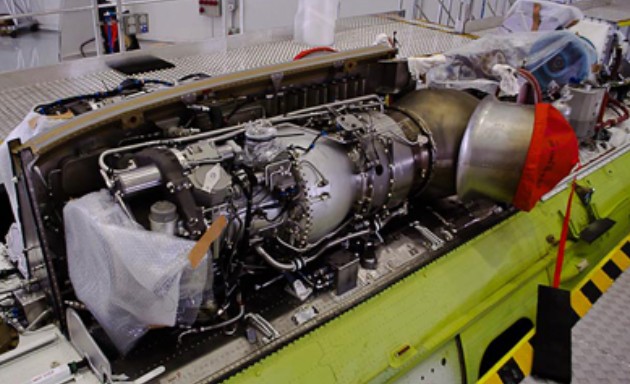
Turbomeca Makila

The Turbomeca Makila is a family of French turboshaft engines for helicopter use, first run in 1976 and flown in 1977.

Typical power output is around 1,300 kW (1,700 hp). As of 2012, some 2,200 had been built.

Applications:
Puma HC Mk 2
Aérospatiale Super Puma
Denel Rooivalk
Eurocopter AS532 Cougar
Eurocopter EC225 Super Puma
Eurocopter EC725
IAR 330 SM

Variants:
Makila 1A
Makila 1A1
Makila 1A2
Makila 1A4
Makila 2A
Makila 2A1

Specifications:
Makila 2A
Type: Free-turbine turboshaft
Length: 1,836 mm (72 in)
Diameter: 498 mm (20 in)
Dry weight: 278,9 kg (including FADEC)
Compressor: 3-stage axial flow LP, single-stage centrifugal flow HP
Combustors: Annular
Turbine: 2-stage axial flow free turbine
Maximum power output: 1,801kW (2,415 shp)

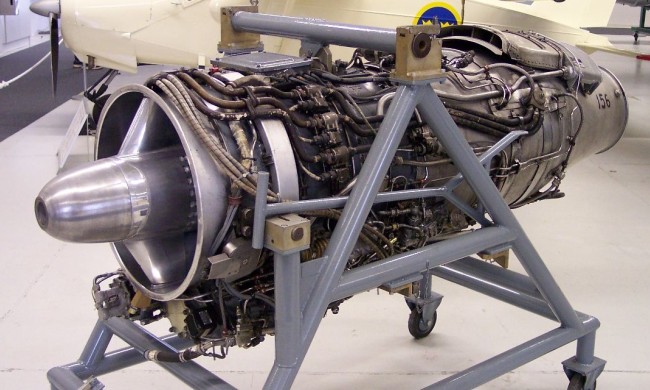
Turbomeca Gabizo

The Turbomeca Gabizo was a small turbojet engine produced by Turbomeca and first run in 1954. The components were designed to take the stresses of high-speed fighter aircraft with some variants featuring afterburner.

Applications:
Fouga CM.171 Makalu
Dassault Étendard II
SNCASO Trident

Specifications:
Gabizo
Type: Turbojet
Length: 86 in (218.4 cm)
Diameter: 26.5 in (67.3 cm)
Dry weight: 560 lb (254.0 kg)
Compressor: Single stage axial plus single-stage centrifugal
Combustors: Single annular combustion chamber
Turbine: Single-stage
Maximum thrust: 2,426 lbf (10.78 kN)(maximum thrust) 1,940 lbf (8.62 kN)(maximum continuous thrust)
Overall pressure ratio: 5.1:1
Specific fuel consumption: 1.04
Thrust-to-weight ratio: 4.332 lbf/lb (0.042 kN/kg)

Turbomeca Aubisque / RM9

The Turbomeca Aubisque was a small turbofan engine designed and produced by Turbomeca andfirst run in 1961. Its only application was the Saab 105 military trainer aircraft as the RM9.

The engine is named after the Col d’Aubisque in the Pyrenees mountains, in line with company tradition.

The earlier Turbomeca Marboré turbojet was originally intended for the Saab 105, but when Saab needed more thrust than the Marboré produced, Turbomeca offered the Aubisque turbofan. Basically a turbofan version of the Turbomeca Bastan turboprop, the Aubisque went into the production for the Saab 105. About 300 were produced. They were in service for 30 years until replaced in the mid-90’s, by the Williams FJ44 turbofan, for the remaining Swedish Air Force Saab 105s.

Aubisque
Type: Low-bypass turbofan
Length: 2,067 mm (81.4 in)
Diameter: 564 mm (22.2 in)
Dry weight: 243 kg (535.7 lb)
Compressor: Geared fan stage + single stage axial + single stage centrifugal
Combustors: Annular chamber
Turbine: Two stage
Maximum thrust: 6.9 kN (1,543 lbf) at 32,500 rpm
Overall pressure ratio: 6.9:1
Fuel consumption: 420 kg (925.9 lb)/hr
Thrust-to-weight ratio: 0.062 kN/kg (2.88 lbf/lb)

RM9B Turbomeca Aubisque

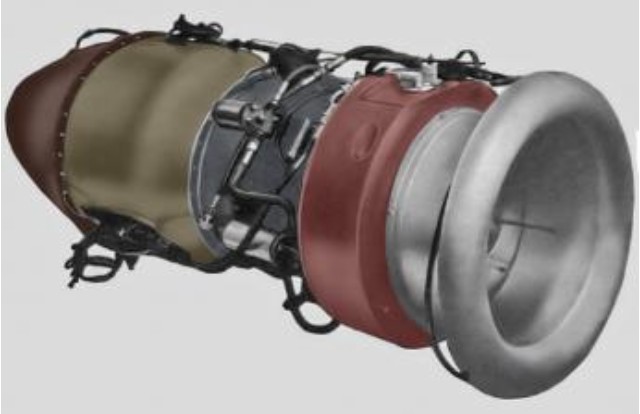
Turbomeca Aspin

The Turbomeca Aspin was a small French turbofan engine produced by Turbomeca and first run in 1951. This geared turbofan design was the first turbofan to fly, powering the Fouga Gemeaux test-bed aircraft on 2 January 1952.

Fixed inner cone, annular turbine nozzle and outer pipe wherein the jet efflux and by passed secondary air mix. Annular air entry containing one row of variable-incidence entry vanes, a single stage compressor fan and one row of fixed straightening vanes. Fan is driven by compressor shaft through coupling and reduction gear. After fan the air is divided into primary and secondary flows, the former passing to the power section and the latter by-passing that section in an annular casing to the tailpipe where it mixes with the primary jet efflux.

A single-stage centrifugal compressor, with single-sided impeller, and the combustion chamber is annular type, with rotary fuel injection. The turbine is two-stage axial flow turbine, and the jet pipe has a fixed inner cone, annular turbine nozzle and outer pipe wherein the jet efflux and by passed secondary air mix.

Single throttle lever determine the fuel flow and position of variable incidence vanes. Egine speed controled by centrifugal governor. For rapid manoeuvrability a push button operates and electro-hydraulic servo-motor with over-rides manual control and at maximum rotation speed the throttle lever can be used solely to control the entry vanes to obtain rapid variation of thrust without having to oercome the inertia of the rotating assembly.

Throttle at “starter” setting only controls fuel delivery. Entry vanes are closed and engine speed governor is ineffective. Normal starter spins rotating assembly. When engine reaches a rotating speed of 70 per cent. of maximum governor and vane become operative.

Variants:
Aspin I
200 kg (440 lb) thrust

Aspin II
350 kg (770 lb) thrust

Specifications:
Aspin I
Type: Geared turbofan
Maximum thrust: 200 kg (441 lb)
Diameter: 600 mm / 23.6 in
Length: 1210 mm / 47.5 in
Weight with accessories: 127 kg / 279 lb
Fuel burn: 0.628 kg/kg (0.628 lb/lb) trust/hr

Turbomeca Artouste / Marcadau / Continental 231 / T-51

Turbomeca Artouste IIIB

The Turbomeca Artouste is an early French turboshaft engine, first run in 1947. Originally conceived as an auxiliary power unit (APU), it was soon adapted to aircraft propulsion, and found a niche as a powerplant for turboshaft-driven helicopters in the 1950s.

Artoustes were licence-built by Bristol Siddeley in the UK, Hindustan Aeronautics Limited in India, and developed by Continental CAE in the USA as the Continental T51. Power is typically in the 300 kW (400 hp) range.

Variants:
Artouste I
Artouste II
Artouste IIB
Artouste IIC – 373 kW (500 hp)
Artouste IIC6
Artouste IIIB – 410 kW (550 hp)
Artouste IIID

Continental T51
Licence production and development of the Artouste in the United States

Turbomeca Marcadau
A turboprop variant, the Marcadau was a development of the Artouste II, producing 1300 kW (402 hp) through a 2.3:1 reduction gearbox.

Applications:
Artouste –
Aérospatiale Alouette II
Aérospatiale Alouette III
Aerospatiale Lama
Aerotécnica AC-14
Atlas XH-1 Alpha
IAR 316
IAR 317
Handley Page Victor – as APU
Hawker Siddeley Trident – as APU
Piasecki VZ-8 Airgeep
Vickers VC10 – as APU
SNCASO Farfadet

Marcadau –
Morane-Saulnier Epervier

Specifications:
Artouste IIC
Type: Turboshaft
Length: 1,440 mm (56.7 in)
Diameter: 545 mm (21.5 in) – height, 390 mm (15.4 in) – width
Dry weight: 115 kg (253.5 lb) – dry
Compressor: Single stage centrifugal
Combustors: Annular combustion chamber
Turbine: Three stage turbine
Fuel type: Aviation kerosene to AIR 3405
Oil system: Oil grade AIR 3512, pressure lubrication
Maximum power output: 500 hp (372.85 kW) at 34,000 rpm for take-off
Fuel consumption: 153 kg (337.3 lb)/hour at maximum continuous power
Power-to-weight ratio: 3.24 kW/kg (1.972 hp/lb)

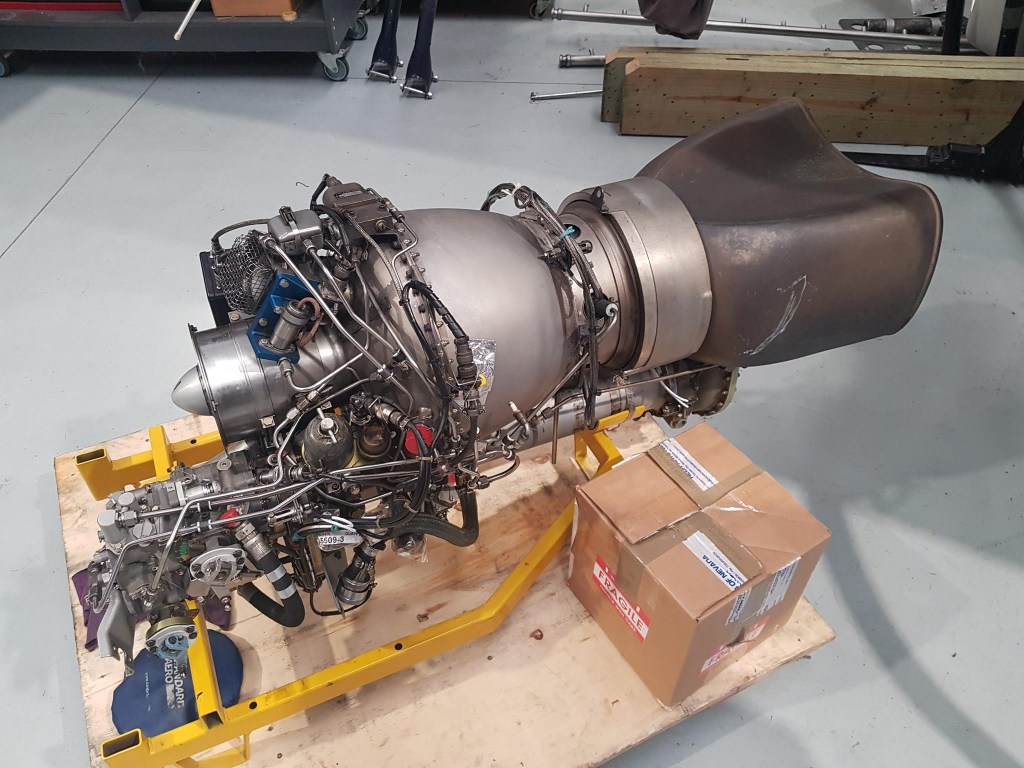
Turbomeca Arriel / Safran Arriel

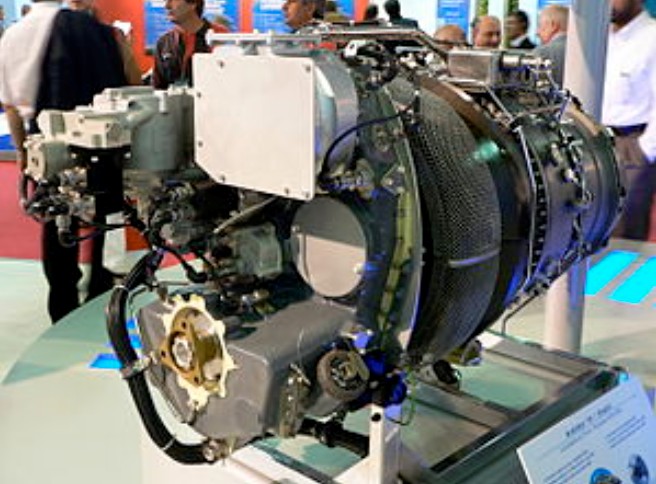
The Turbomeca Arriel is a series of French turboshaft engines that first ran in 1974. Weighing 109 kg (240 lb), the Arriel 1 has a power output of 520 kW (700 hp). 10,000 examples had been produced by 2012.

Arriel IB

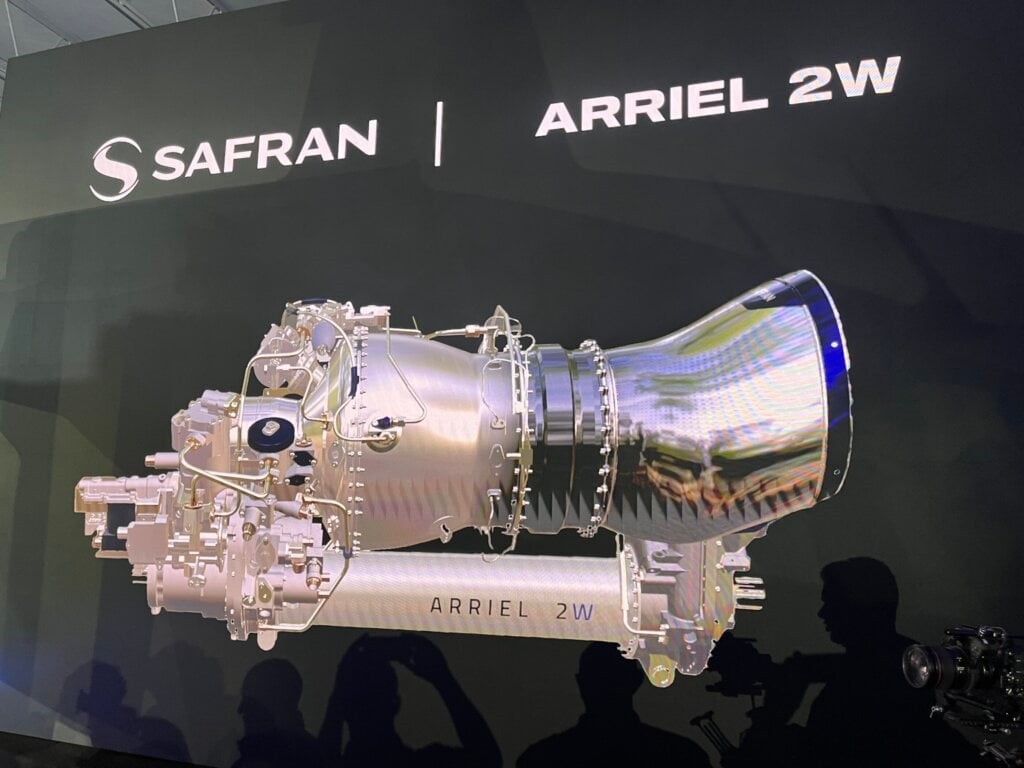
The Robinson R88 is powered by a Safran Arriel 2W engine — marking a first partnership between Robinson and Safran.

Applications:
Agusta A109
Eurocopter Dauphin
Eurocopter Ecureuil
MBB/Kawasaki BK 117
Eurocopter EC145
Sikorsky S-76

Gallery

Specifications:
Arriel 1
Type: Twin-spool free turbine turboshaft
Length: 44.2 in
Diameter: 23.5 in
Dry weight: 245 lb
Compressor: Single-stage axial plus single-stage centrifugal
Combustors: Annular combustion chamber
Turbine: Single-stage power turbine, two-stage gas generator turbine
Fuel type: Jet A1
Maximum power output: 681 shp (508 kW)
Turbine inlet temperature: 840 C

Turbomeca Ardiden / Hindustan Aeronautics Limited (HAL) Shakti

Turbomeca Ardiden

In 1961, Turbomeca granted a manufacturing license for the Artouste turboshaft engine to equip the Indian Chetak and Cheetah helicopters. The development of the Shakti/Ardiden 1H project was initiated in 1999 by HAL and Turbomeca to power the HAL Dhruv helicopter. However, several factors including the US embargo following India’s 1998 nuclear tests forced the project to run behind schedule. Hence, early models of the Dhruv used the less powerful Turbomeca TM 333-2B2 engine as a contingency. The first test flight of the Dhruv with the new Shakti engine took place on 16 August 2007. By late 2007, HAL started fitting the Shakti engines for Dhruvs produced from then.

The Ardiden 1H series engines have a radial air intake and a two-stage centrifugal compressor driven by a single stage axial gas generator turbine. Airflow is directed through a reverse flow annular combustion chamber, through the gas generator turbine and then through and a two-stage axial free power turbine. Output power is transmitted to a front-mounted reduction gearbox by a shaft concentrically mounted within the gas generator rotor assembly. The accessory gearbox, also mounted at the front end, is driven by the gas generator. Control is by means of a dual-channel digital engine electronic control unit (DECU).

By December 2013, 280 had been built at a unit cost of US$1.73 million.

Variants:
Ardiden 1H
Certified by EASA in December 2007.

Ardiden 1H1 (Shakti)
Certified by EASA in March 2009.
powering the HAL Dhruv, LCH

Ardiden 3G
powering the Ka-62, Z15

Applications:
HAL Dhruv
HAL Light Combat Helicopter
Kamov Ka-62 – Ardiden 3G

Specifications:
Type: Turboshaft
Length: 1,250 mm (49 in)
Diameter:
Dry weight: 205 kg (452 lb)
Compressor: Two centrifugal compressor stages, coupled to a single-stage high-pressure turbine.
Maximum power output: 1,032 kW (1384 shp)