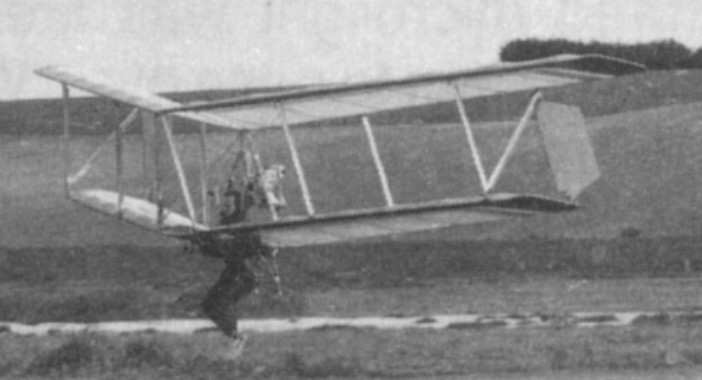
UFM Easy Riser

The Easy Riser biplane was designed by Larry Mauro and which under the name Icarus II was one of the earliest hang gliders to be motorised, back in 1975 by John Moody. A rigid wing tailless biplane flown by supplemental weight-shift. A variety of engines could be fitted, including the 125cc McCulloch 101 go cart engine, UFM selling the machine as a hang-glider. Control method: Standard tip rudder and weight-shift pitch axis, optional 2 or 3 axis control. First year built 1976. Units delivered by June 1981 2,500. Many options in power and landing gear were available. It is strut and cable braced.
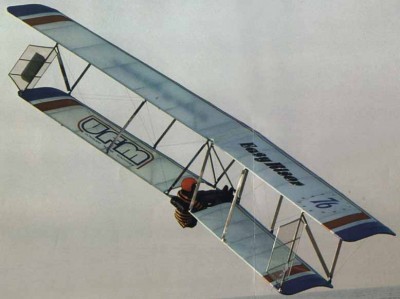
UFM Easy Riser Article

The Easy Riser is a progression from the Icarus II but the wing is a modified monowing with a double surfaced rigid airfoil. Wingtip rudders are mounted on ball bearings and drag brakes are fitted. Wing tips are fully contoured. Wing covering is 1.3oz dacron sealed with aircraft dope.

The spars are made from 6061-T6 aluminium tubing with foam core spruce ribs. Wing bracing is both aluminium struts and cable. All rigging is aircraft grade. All hardware is aircraft grade, fastened with pop rivets and bolts.

The pilot has a tube cockpit support with an optional swing seat.

The Easy Riser won the 1976 World Open Hang Gliding Championships.

The Easy Riser is offered as a hang glider, and engine and landing gear packages to use with this aircraft are offered separately by other companies. Power and landing gear optional. Standard tip rudder and weight-shift pitch axis, optional 2 or 3 axis control.
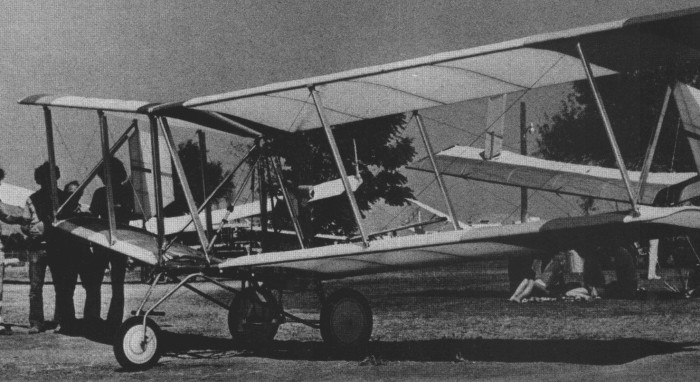
Gallery

Easy Riser 1
Wingspan 30’
Wing area 170 sq.ft
Aspect ratio 8.8
Empty weight 55 lbs. (without engine or landing gear)
Gross wt: 350 lbs
Empty wt: 110-150 lbs
Max pilot wt: 200 lbs

Easy Riser
Chord length: 3.41 ft
Wing span: 30 ft
Wing area: 170 sq,ft
Aspect ratio: 8.8
Wing sweep: 15˚
Weight: 50 lb
Pilot weight: 200 lb
Takeoff speed: 17 mph
Stall speed: 16 mph
Max speed: 45 mph
Best glide ratio (L/D): 10-1
Best L/D speed: 18 mph
Min sink: 180 fpm
UFM of Kentucky

Founded in 1972.

1981: 2960 Corvin Dr, Santa Clara, CA 95051, USA.

During 1981 UFM shifted operations from Santa Clara, California.

1983: P.O. Box 2967, Turlock, CA 95381, USA.

1983: Ultralight Flying Machines (UFM) of Kentucky Inc, 2700 Freys Hill Road, Louisville, Kentucky 40222, USA.

1984: 2700 Freys Hill Rd, Dept GR-1, Louisville, KY 40222, USA.

1990: Ultralight Flying Machines, Turlock, California, USA.

Turner TSW-2

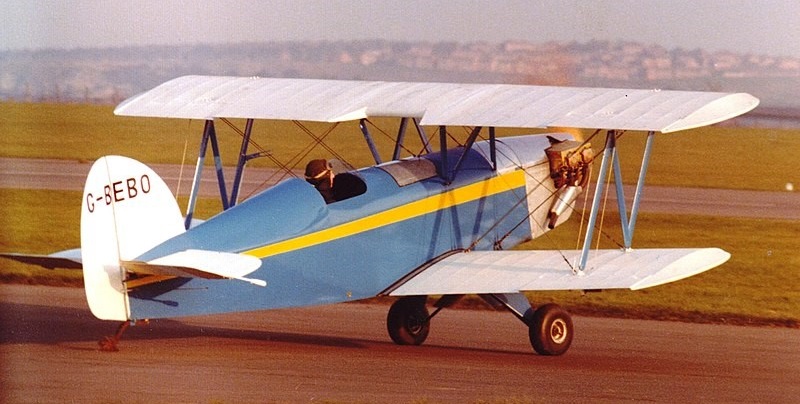
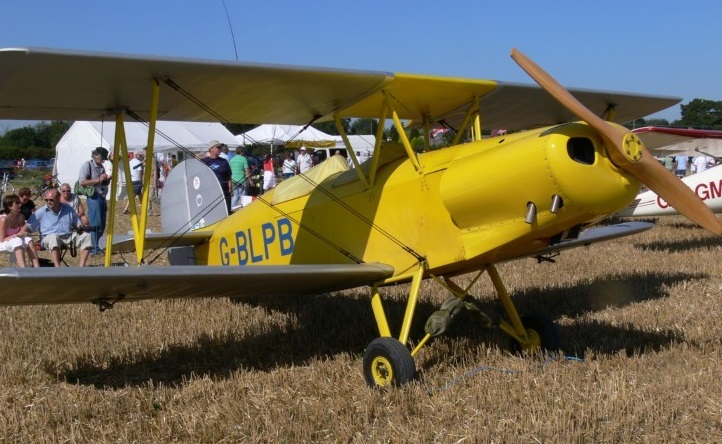
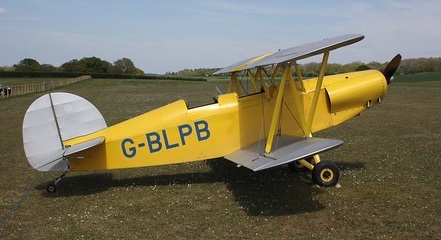
Turner TSW-2 PFA 046-10606 G-BLPB

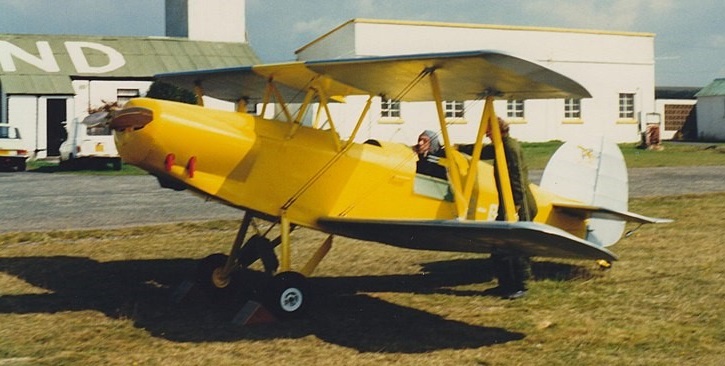
The Turner Two Seat Wot (TSW-2) is a biplane aircraft designed for amateur construction by Chris Turner in 1976. The aircraft was originally conceived as a two-seat version of the Currie Wot, however few component parts of the original Wot were retained by the time the design had been finalised. The Turner TSW-2 has a reduced wingspan, four ailerons and uses a different aerofoil section for the staggered wings. The aileron bellcrank fittings are made to the Currie Wot drawings.

The Turner Two Seat Wot’s structure is primarily of wood with metal interplane struts, cabane struts, undercarriage and engine mount. Two examples were constructed G-BEBO and G-BLPB. The prototype G-BEBO was fitted with a 125 hp (93 kW) Lycoming O-290-3 engine and G-BLPB a 150 hp (112 kW) Lycoming 0-320-A1A engine.

Chris Turner was awarded the Best New Design Award at the 1987 Popular Flying Association Rally at Cranfield, Bedfordshire.

The prototype Turner TSW-2, G-BEBO, was built by its designer Chris Turner. It was registered with the Civil Aviation Authority on 30 June 1976 and first flown from Sunderland Airport in 1978. The aircraft was destroyed in a hangar fire at Hunday Farm and de-registered in January 2003.

This second example, G-BLPB, was built by James Woolford and Kingsley Thomas in Mullion Cornwall between 1980 and 1986. It first flew from Land’s End Airport on 31 August 1986. This aircraft is still airworthy and in 2017 was based on a farm strip in Wiltshire.

The Turner TSW-2 was the subject of a test flight report in Popular Flying by John Harper, who stated that the aircraft was capable of executing the Aerobatics Association’s Beginners Sequence of aerobatic manoeuvrers.

Turner T-40B

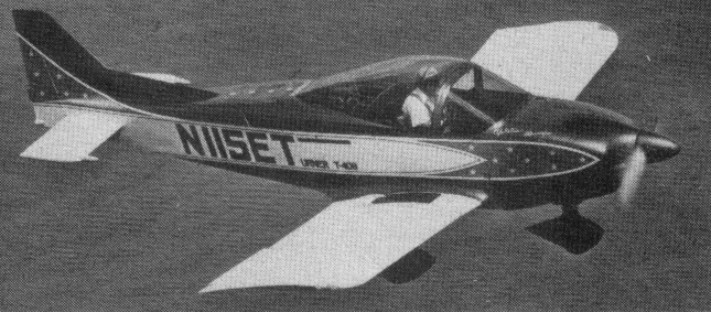
The Turner T-40B is basically the same as the T-40A, but with tricycle landing gear and other improvements. Development of the prototype began in 1966 and the first flight was made in 1969. Originally an 85-hp engine was used, but it was replaced by a 125-hp Lycoming in order to improve high altitude performance. Other refinements on the basic T-40A frame are: a bubble canopy, hydraulically-operated double-slotted flaps, and a fixed leading-edge droop.

Engine: Lycoming, 150 hp
HP range: 100-150
Height: 6 ft
Length: 20.8 ft
Wing span: 29.6 ft
Wing area: 106 sq.ft
Weight empty: 1050 lbs
Gross: 1640 lbs
Fuel cap: 30 USG
Speed max: 170 mph
Cruise: 155 mph
Range: 525 sm
Stall: 62 mph
ROC: 1200 fpm
Take-off dist: 1100 ft
Landing dist: 900 ft
Service ceiling: 14,500 ft
Seats: 2
Landing gear: nose or tail wheel