VFW Fokker H-5

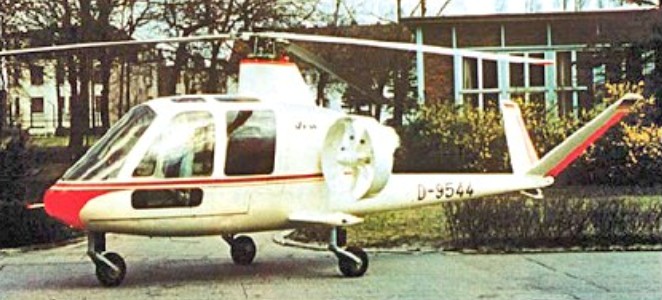
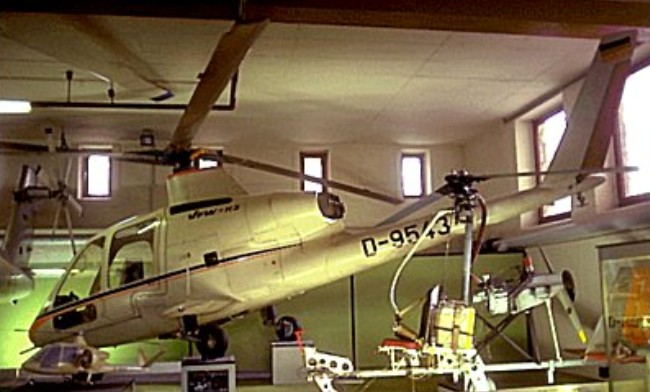
The success of the H3 version resulted in the construction of a follow-on 1969 H5 prototype which bore marked similarities to its predecessor. The H5 incorporated many H3 components, including rotor blades (although 0.6m longer), a modified H3 landing gear, along with H3 controls, tail, and tail boom. The cabin could also be opened with left-side seats capable of folding for litter loading and unloading. The larger H-5 cabin had five seats.

Like the H3, there was also no hydraulic system with the H5.

It was intended that the H-5 would be followed by the H-7 7/8 seater (construction of which was apparently started but not completed) and the much larger H-9. As it turned out, however, further development was abandoned in 1972 following the merger of VFW and Fokker.

VFW Fokker H3 Sprinter

In 1960 VFW began research to develop a VTOL concept that exceeded the capabilities of current helicopters. More than a dozen different concepts were investigated, and the concept that evolved promising the best growth potential, productivity, speed, and cost effectiveness was the H3-E Compound Helicopter configuration.

The H3-E was built with a mission as a three-seat executive transport, two-stretcher ambulance aircraft, or an agricultural system with a payload of up to 315kg.

The design incorporated a compressed air and blade tip-drive rotor. The separate forward-thrust system consisted of fuselage-mounted fans.

The H3-E had a take-off weight of about 950kg and an empty weight of 500kg. The craft provided a payload weight of 265kg. The model had the capability of carrying a payload of almost 270kg with a fuel load of 205kg.

The completely enclosed fuselage was built around an aluminum alloy load-bearing keel which supported the cabin, landing gear, and engine bay structure, low-set tailboom with a V-tail, and a tricycle undercarriage. The cabin skin was fabricated of a glass-fiber reinforced plastic laminate.

The power unit was an Allison 400 shaft horsepower turbine engine which had a dual purpose. First, it was used to drive a centrifugal compressor in the hover mode. A duct delivered the compressed air through a flexible sleeve to the air distributor around the rotor shaft. Then, the high-pressure air traveled via flexible hose into the roots of the fully-articulated blades.

The overhead rotor consisted of a three-blade configuration and the blades used the NACA 23015 airfoil section. The speed range for the rotor varied from 280 to 480 revolutions per minute with a maximum loading of 15.7kg/sq.m.

When the air reached the end of each rotor, it was thrust through flush-mounted slot nozzles. A gearbox contained two bevel gears for the fans and a brake on the compressor shaft for switching the power to the compressor or to the fans. The mechanical layout of the system effectively eliminated the need for conventional transmission and driveshaft systems, hydraulic systems, and a tail rotor.

The technique to achieve near-vertical flight occurred when the rotor was slightly rotated in a standard helicopter style. With the increase in speed, the side-mounted fans were caused to free-wheel within their containing shrouds.

At a certain point in the trajectory, a decision that was made by the pilot, the transformation to full utilization of the fans could be made. Since the fans were already in a windmilling situation, the transition to full fan speed took only about two seconds to accomplish.

Hovering stability was mainly affected by blade hinge offset, blade pitch, angular velocity, disk loading, gross weight and mass moment of inertia of the aircraft,

Early in its program the H3-E underwent a number of test programs. An extensive blade fatigue test attempted to simulate the temperature and pressure cycles inside the blades. The test rig was fully automated, and every five minutes, the temperature and pressure increased and stabilized for 45 seconds before the blade vibrated.

The only two prototypes of the H3 were constructed in 1968. Before flight, though, there were considerable ground shake tests accomplished. A sophisticated test rig excited the rotor head with a constant force independent of frequency. Ground tests also showed that the vehicle had certain mechanical instabilities at high rotor speeds. The first of two prototype H-3s (H3-E1, D-9543) flew in early 1970 without the external fan propulsion units.

Engine: 1 x Allison 250-C20 turboshaft, 300kW
Main rotor diameter: 8.70m
Rotor disc area: 60 sq.m
Length with rotors turning: 9.29m
Max height: 2.5m
Landing gear track: 2m
Max take-off weight: 968kg
Empty weight: 495kg
Max speed: 300km/h
Max cruising speed: 250km/h
Normal cruising speed: 242 kph
Max vertical rate of climb: 2m/s
Service ceiling: 3900m
Endurance: 2hr

VFW Fokker H2

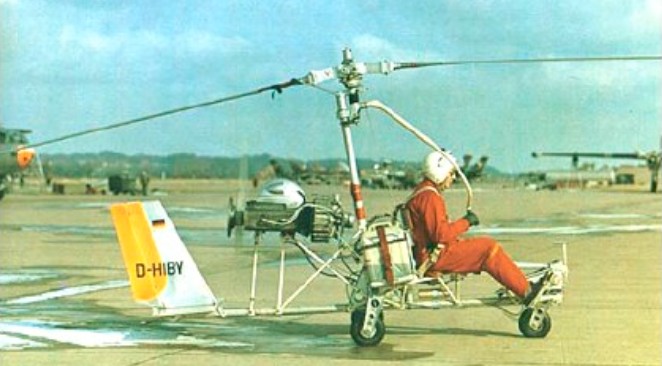
In 1968, VFW (Vereingte Flugtechnische Werke) built an experimental open gyrocopter modelled on the Bensen B.8M. This VFW-H2 was unusual in having ducted rotor blade tip jets supplied from the 72hp McCulloch engine. The engine itself was mounted behind the pilot and drove a two-blade pusher propeller.

The H-2 (D-HIBY) was followed by a more sophisticated machine – the H-3 Sprinter which had a completely enclosed fuselage structure with a three-seat cabin, slim low-set tailboom with a V-tail, and a tricycle undercarriage.

VFW Fokker VAK-191B

The VAK concept of NATO and the German Armed Forces required an aircraft that was able to take off from unprepared airfields without runways. Its mission was close air support. In addition it had to be able to fly long distances in extreme-low-altitude in order to prevent attacks of antiaircraft weapons and radar detection. Because of this the VAK was designed with short wings and a minor extension so it would provide its pilots a tolerable flight and bear aerodynamically difficult extreme low altitude flights.

VFW Fokker VAK-191B Article

The first prototype flew on September 10, 1971, powered by one 10,150-lb (4604-kg) thrust Rolls-Royce/MTU RB.193 vectored-thrust turbojet and two 5577-lb (2530-kg) thrust RB.162 lift turbojets. It had small, vertically mounted jets in the front and rear of the fuselage for direct lift, plus a third engine of the vectored ¬thrust type for forward propulsion and transitions between horizontal and vertical flight. It uses “puffer jets” at the nose, tail and wingtips to stabilise it during low speed and hovering man¬oeuvres. In terms of design, it is intended for experimental work only.
The first transition – the transfer of vertical flight in horizontal and vice versa as well as turning off and on the lift-engines – was achieved on October 26, 1972 in Manching, Bavaria, at a speed of 400 km/h.
All three VAK 191B experimental aircraft completed a total of 91 flights that lasted all together 12 hours.

Despite successful flight trials it was not ordered into production as the Harriers of RAF Germany were already fulfilling the need for which the VAK-191B had been conceived.

VAK 191B
Engines: 1 x Rolls-Royce/MTU RB 193-12, 45.2kN + 2 x Rolls-Royce RB 162-81 F 08, 26.5kN
Max take-off weight: 8507 kg / 18755 lb
Empty weight: 5562 kg / 12262 lb
Wingspan: 6.16 m / 20 ft 3 in
Length: 14.72 m / 48 ft 4 in
Height: 4.30 m / 14 ft 1 in
Wing area: 12.5 sq.m / 134.55 sq ft
Max. speed: 1100 km/h / 684 mph
Cruise speed: 740 km/h / 460 mph
Range: 400 km / 249 miles
Payload: 2945kg
Crew: 1

VFW Fokker / Vereinigte Flugtechnische Werke Fokker GmbH

Vereinigte Flugtechnische Werke GmbH (VFW)

Germany
Established late 1963 as Vereinigte Flugtechnische Werke GmbH (VFW), from merger of Focke-Wulf GmbH and Weser Flugzeugbau GmbH, joined in 1964 by Ernst Heinkel Flugzeugbau.
During 1968-1969, acquired 65% holding in Rhein-Flugzeugbau GmbH, later becoming 100% owner of RFB. Henschel joined VFW in 1969. From 1 January 1969 became joint partner with Fokker of the Netherlands, mainly for marketing purposes, renamed VFW-Fokker GmbH, partnership lasting until 1980.
Programmes in late 1960s/early 1970s included VAK-191B V/STOL and VJ 101 tilt-engine research prototypes, H2 (autogyro) and H3 (compound helicopter) experimental rotorcraft.
VFW was involved in major licence production of Lockheed F-104G Starfighters (with Fokker), Sikorsky CH-53Gs (with Dornier and MBB) and Bell UH- 1D helicopters, and was overall programme manager for Transall C-160 heavy military transport (built with Nord/Aerospatiale and HFB/MBB).
Was involved in design/construction of Dornier Do 31E VTOL transport; built major components for Fokker Fellowship, Airbus A300B and Panavia Tornado; was major overhaul facility for several important military and civil aircraft; also member of European Spacelab consortium.
Principal late aircraft programme was VFW 614 twin-turbofan shorthaul transport (first flown July 1971), but production of this halted 1978.
Taken over by MBB 1981.

Veliplane-Sofrec Strato

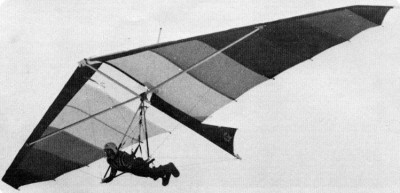
A 1978 hang glider regarded as difficult to fly, but it was an incredible construction for the time, sail stretched like a drum, slats shaped, and twisting at the wing tip.

Strato 17
Wing area: 16.3 m²
Wing span: 9.2 m
Aspect ratio: 5.19
Minimum pilot weight: 55 kg
Maximum pilot weight: 75 kg
Packed length: 4.88 m
Number of battens: 8
Nose angle: 123°

Strato 18
Wing area: 17.3 m²
Wing span: 9.2 m
Aspect ratio: 4.89
Minimum pilot weight: 70 kg
Maximum pilot weight: 90 kg
Packed length: 4.88 m
Number of battens: 8
Nose angle: 123°

Veliplane-Sofrec Starga

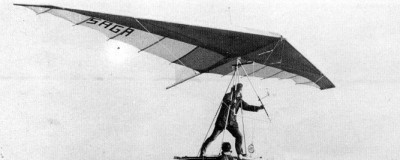
A 1979 hang glider for advanced pilots.

Starga 150
Wing area: 15 m²
Wing span: 9.14 m
Aspect ratio: 5.5
Hang glider weight: 22 kg
Maximum pilot weight: 65 kg
Packed length: 4.85 m
Number of battens: 12
Nose angle: 140°

Starga 165
Wing area: 16.5 m²
Wing span: 9.4 m
Aspect ratio: 6.5
Hang glider weight: 26 kg
Maximum pilot weight: 80 kg
Packed length: 4.85 m
Number of battens: 12
Nose angle: 140°

Starga 175
Wing area: 17.5 m²
Wing span: 10.40 m
Aspect ratio: 6.2
Hang glider weight: 26 kg
Maximum pilot weight: 100 kg
Packed length: 4.85 m
Number of battens: 12
Nose angle: 140°