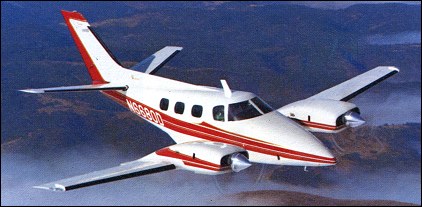
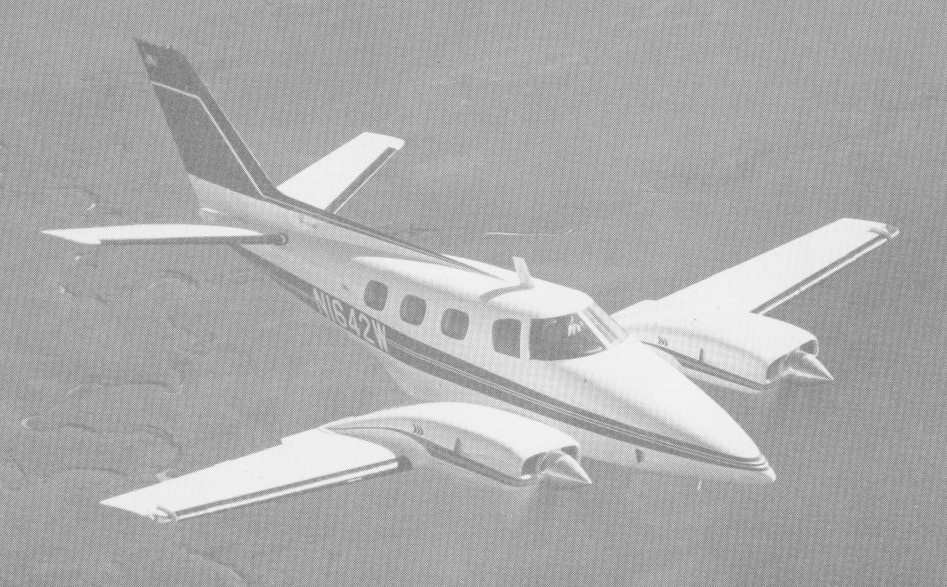
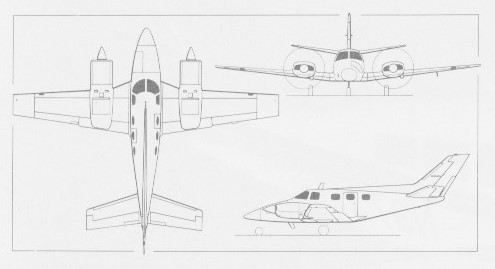
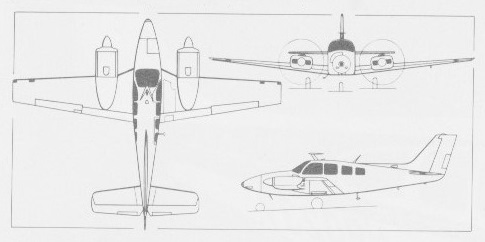
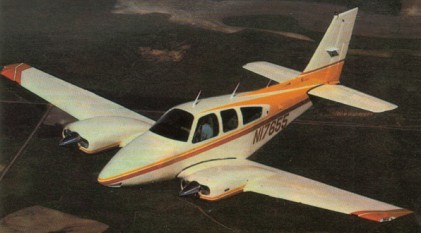
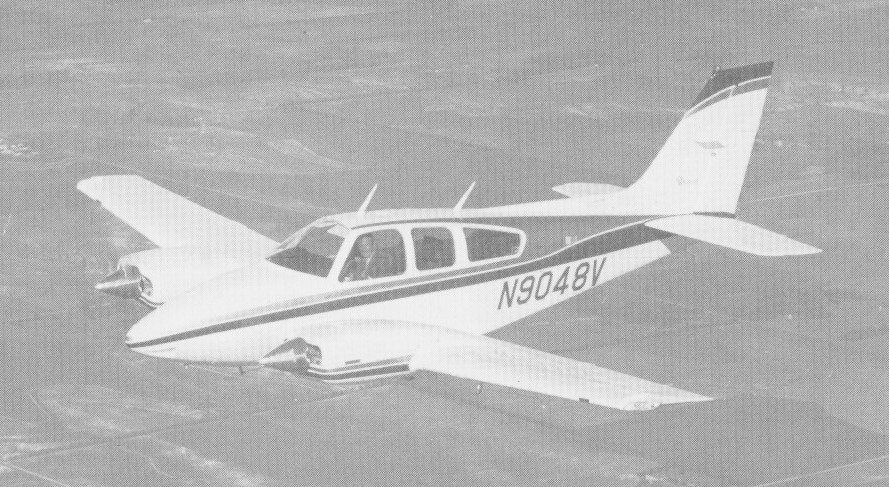
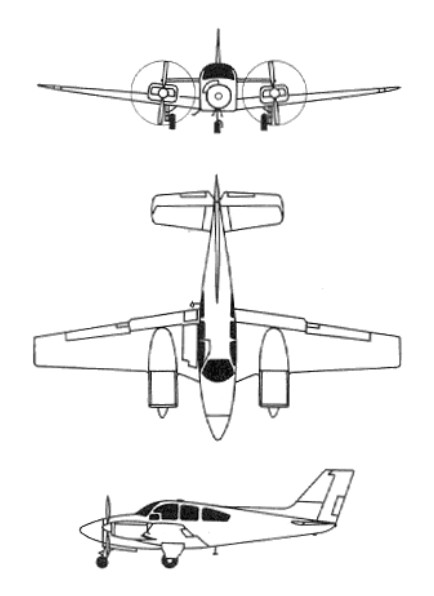
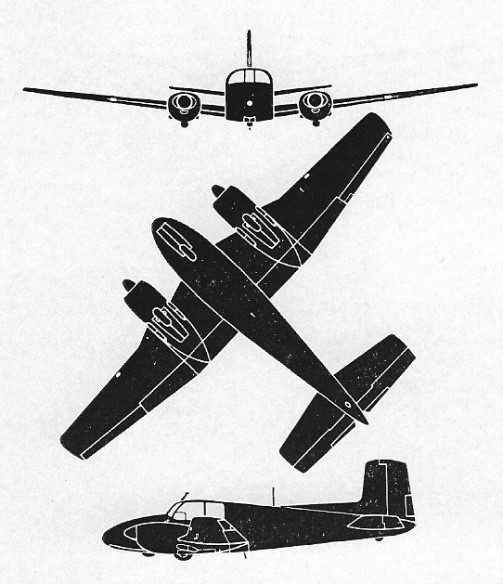
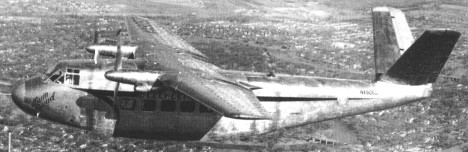
Beech entered the field of pressurised general aviation aircraft following a first flight of the Beech Model 60 Duke on 29 December 1966. The Duke was intended as a luxury four/six-seat aircraft, and overall configuration was similar to other Beech twins. It was intended for operation at higher gross weights and had strengthened landing gear, and much more powerful Avco Lycoming TIO-541-E1C4 380-hp turbocharged engines.
The Duke uses turbo bleed air to obtain 4.6 psi cabin pressure, which will maintain a 10,000-foot cabin altitude all the way to 24,800 feet. Two separate baggage compartments in the nose and aft fuselage handle 500 and 315 pounds of luggage, respectively. The spacious Duke cabin provides a center aisle separating the seats, plus dividers between the flight deck and passenger cabin. A 20 per cent increase in range and new landing lights on the retractable gear were the changes for 1976. As an option, the pressurized twin can hold up to 232 gallons of usable fuel by adding wet wing tips. This boosts the fuel load by 90 gallons over the 142 gallons standard fuel load. The previous option allowed a maximum of 202. In 1977, the Duke advertised a higher cruise speed, improved exterior lighting and a standard Collins avionics package. In 1980, a Hoskins fuel-flow system indicates flow in gallons and pounds per hour, plus fuel remaining. Timing modes calculate flying time remaining and elapsed time since engine start.
A60 Duke
Only two revised versions of the original Model 60 appeared during the production run, the Model A60 and Model B60 introduced in 1971 and 1974 respectively. The first provided a 23kg increase, in maximum take-off weight, the second a slightly larger cabin and increased fuel capacity. Such an aircraft was by no means cheap and, by American standards, was built in comparatively small numbers, with a total of 596 completed by the end of production in 1983.
BE-A60 Duke Engines: 2 x Lycoming TIO 541 EIA4 6 cylinder turbocharged, 380 hp each. Length: 33 ft 10 in. Wingspan: 39 ft 3 in. Speed: 286 mph. Ceiling: 31,000 ft. Range: 973 mls.
BE-B60 Duke First built: 1968. Engines: Lycoming TIO-541-E1C4, 380 hp each. TBO: 1600 hrs. Props: Hartzell 3-blade, 74-in, constant speed, full feathering. Seats: 4/6. Wingspan: 11.97 m / 39 ft 3 in Length: 10.31 m / 33 ft 10 in Height: 3.76 m / 12 ft 4 in Wing area: 19.78 sq.m / 212.91 sq ft Wing aspect ratio: 7.2. Cabin length: 11 ft 10 in / 3.61 m Cabin width: 4 ft 2 in / 1.27 m Cabin height: 4 ft 4 in / 1.32 m Maximum ramp weight: 6819 lbs. Maximum takeoff weight: 6775 lb / 3073 kg Empty weight equipped: 4235 lb / 1921 kg Standard empty weight: 4425 lbs. Maximum useful load: 2394 lbs. Maximum landing weight: 6775 lbs. Wing loading: 31.8 lbs/sq.ft. Power loading: 8.9 lbs/hp. Maximum usable fuel: 232 USG/1392 lbs. Best rate of climb: 1,601 fpm @ 120 kts. Climb gradient: 801 ft/nm. Rate of climb @ 8,000 ft: 1460 fpm. Certificated ceiling: 30,000 ft. Service ceiling: 30,800 ft / 9390 m 8000ft cabin alt @: 21,600. Maximum single-engine rate of climb: 307 fpm @ 110 kts. Single-engine climb gradient, sea level: 165 ft/nm. Single-engine service ceiling: 15100 ft. Maximum speed: 246 kts. Max cruise 79% pwr 25,000ft/7620m: 241 kt / 278 mph / 447 kph Cruise @ 65% pwr @ 8,000ft: 185 kts. Cruise @ 65% power @ 18,000ft: 201 kts. Fuel flow @ 65% pwr @ 18,000 ft: 223 pph. Endurance at 65 % pwr @ 18,000 ft: 6 hrs: Range 45% 15,000ft/4750m opt fuel 45min res: 1023 nm / 1177 mi / 1893 km Range 75% 25,000ft/7620m opt fuel 45min res: 837 nm / 963 mi / 1550 km Stalling speed clean: 81 kts. Stalling speed gear/flaps down: 73 kts. Turbulent-air penetration speed: 160 kts. Nose baggage capacity: 50 lb / 226 kg / 32 cu.ft / 0.91 cu.m Cabin rear capacity: 315 lb / 143 kg / 28.25 cu.ft / 0.80 cu.m
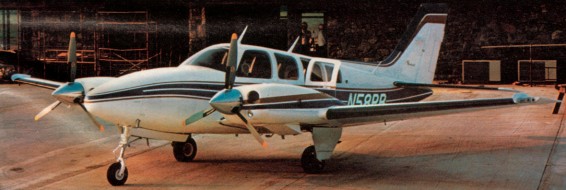
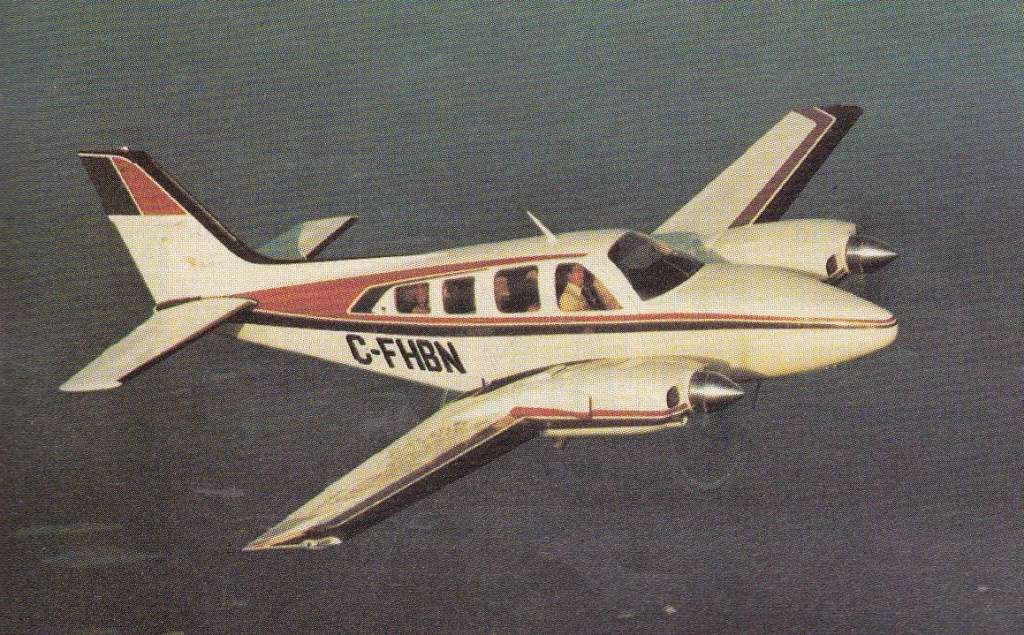
First flown in June 1969, the Baron 58 became a part of the lineup in 1970, replacing the 56TC, and used the 285-hp Continental engine. It had the fuselage lengthened by 0.25m to provide a more spacious cabin, and an extension of the wheelbase. Ready acceptance of this improved Baron, with delivery figures that averaged about two per week for more than 12 years, resulted in the introduction of a pressurised Model 58P, with first deliveries in late 1975. Beechcraft has added two new versions, the 58P for over-the-weather pressurized comfort and the Baron 58TC for high-altitude performance. The Baron 58P, Continental TSIO 520 L, 310 hp each, was priced at $200,750 (1976), with propeller synchrophasers as standard. Both these additions use the same 310-hp turbocharged Continental engines enabling them to have a service ceiling of 25,000 feet and above. The Model 58P combined the Model 95-B55 wings, Model 58 tail unit, a strengthened Model 58 fuselage to cater for pressurisation, and main landing gear units as developed for the Model 60 Duke.
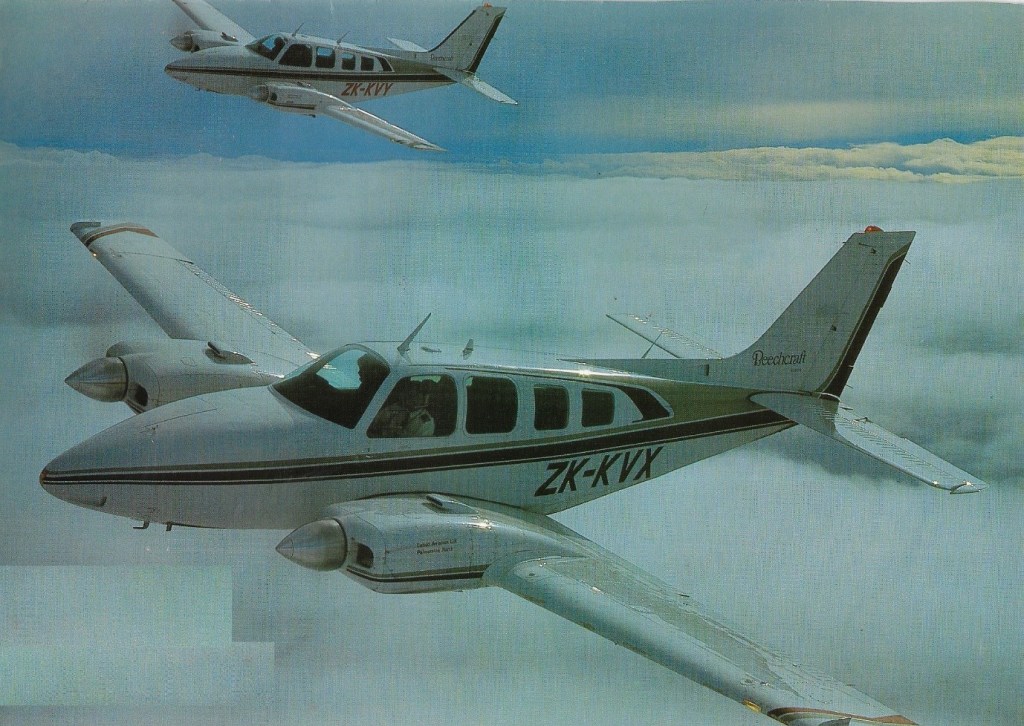
58 Baron ZK-KVX – Simon Davidson & ZK-KVY Andy Simkinson
All Baron 58s have accommodations for four to six passengers with optional club seating where the rear two pairs face other. By mating the turbocharged powerplants and beefier wings of the pressurized Baron with the lighter fuse-lage of the Model 58, Beech has developed a versatile light twin that capitalizes on the performance advan¬tages of turbocharging without adding the cost and weight of pressurization. Everything about the 58TC that doesn’t involve pressurization is identical to the equivalent part of the Baron 58P: its wings and landing gear accept the same increased gross weight of 6,100 pounds, its en¬gines also are 310 hp Continental, and its fuel tanks hold an optional capacity of 190 usable gallons. But the 58TC doesn’t require the extensive pressurization hardware, wider window posts and smaller rear door that characterize the 58P. The standard Baron 58 fuselage with its convenient double rear entry doors has been retained to produce an aircraft with the alti¬tude performance of the 58P but with a considerably lower empty weight, a 35 percent higher floor loading capacity and a lower price tag. Automatic wastegate turbocharging, which is the type used on the Baron 58TC, allows an engine to deliver its rated horse¬power up to the altitude where the wastegate is fully closed and no more exhaust can be diverted to the turbocharger. For the 58TC, that “critical altitude” is higher than its certif¬icated ceiling of 25,000 feet, which was es¬tablished on the basis of the 58P design re¬quirements, since FAR 23 places additional structural requirements on pressurized air¬craft operating above FL 250. (The 58TC and the 58P share the same type certificate.) By conditionally restricting the maximum rpm to 2,600, Beech was able to certificate the 58TC to the noise standards that were scheduled to become law in 1980, but that also reduced the normal operating power of each engine from the P Baron’s 310 at 2,700 rpm to 301 hp. The pressurized Bar¬on therefore enjoys slightly better twin en¬gine takeoff performance compared with the 58TC because it has three percent more power available continuously from its en¬gines, but single engine performance and op-erations below 97 percent power are the same for both aircraft whenever they are flown at identical weights. Unlike earlier Barons, the 58P and 58TC are certificated under FAR Part 23, amend¬ments 1 through 12. The 58P went through an en¬tire certification process (as opposed to a testing of only the things that have been changed). The wings of the P and the TC have been strengthened with heavier spars, thicker leading edge skin and an extra attach point on a stub spar as on the Duke, which is built in the same plant. And while they were at it, Beech’s designers also put Duke landing gear and brakes on the new Barons. Beechcraft 58P pressurized Baron looks like a Baron 58 but the windows are slightly smaller. A quarter inch comes off all the way around in the process of adding beef to the structure for pressurization. There’s a door at the left rear as well as the standard right front door. Some side mounted airscoops adorn the engine nacelles, and the nacelles are slightly longer than on the other Barons. Comparing the Pressurized Baron with the regular 58, there are two basic differences: the 58’s engines are not turbocharged, and its cabin is not pressurized. The airplanes have about the same speed down low; the 58P starts to move away up high, where the turbochargers do their thing. However, because climbing time must be considered, the time en route on most trips would be very close, unless the 58P were to find a more favorable wind up high. The cabins are the same, and the useful loads are close. In operational range, the 58 has a rather clear advantage over the 58P. It also has almost twice the single engine rate of climb at sea level, but the 58P’s turbo-chargers turn the tables on that score at altitude. An increase in structural capacity allows the 58TC to carry 350 pounds more than the Baron 58. In 1977, a new three-blade propeller is standard on the 58P. Two inches shorter, it improves maximum speed and in-creases the climb rate by more than 100 fpm. That year, club seating in all models, simplified fuel management, and increased optional fuel capacities were added.
Baron 58P
Beech made significant changes in the 58P for 1979. Horsepower increased from 310 to 325 per side, with the Continental TSIO 520 WB replacing the 520 Ls used previously. A heavier crankcase and improved pistons and crankshaft were the main internal changes, allowing the maxi¬mum manifold pressure to be raised from 38 to 39.5 inches. The extra power permitted not only a 100 pound increase in maximum gross weight, but also a higher single engine rate of climb. The cabin pressure differential also went up from 3.7 pounds per square inch to 3.9 psi, giving a cabin altitude of 11,800 feet when the airplane is at its 25,000 foot maximum certificated ceiling. Optional 196 USG fuel tanks (190 usable), comprising four interconnected quick ¬drain cells in each wing. 4700 Barons had been delivered by 1980, by January 1989 2,182 Model 58s had been delivered. Optional equipment on the 58, E55 and B55 are heavy-duty brakes that offer up to 50 per cent greater stopping power. In 1979, the pressurized Baron’s performance was enhanced by an increase in horsepower from 310 to 325 with the Continental TSlO-520-WB six-cylinder engine. Providing a higher degree of performance, the turbocharged, fuel-injected engine is exclusively a Beech powerplant — shared only by the 58TC. With the additional horsepower, the Baron 58P has a top speed approaching 300 mph. The P Baron’s pressurization system fea¬tures a variable rate controller, which allows cabin climb to be adjusted in relation to air¬craft climb: you can smoothly reach maxi¬mum pressure differential (3.7 psi) at the same time you reach cruise attitude. The same is true on letdown. Maximum cruise speed for the 58TC was increased to 277 mph. Pressurization differential in the 58P was increased from 3.7 psi to 3.9 psi, providing a sea-level cabin up to 8350 feet. At 25,000 feet, the Baron’s service ceiling, the cabin is a comfortable 11,900 feet. The Baron’s range is increased by as much as 253 miles with optional wet wing tips added to the existing fuel cell system. The Baron 58’s capacity will be increased by 28 gallons and the 58P and 58TC by 24 gallons with the addition of the wet wing tips. In addition to Beech production Barons, at least two turboprop conversions have been developed by other constructors. These include the SFERMA Marquis, produced in small numbers in France, and combining Beech-built Baron airframes with 328kW Turbomeca Astazou engines; and the American Jet Industries Turbo Star Baron powered by two 298kW Allison 250-B17 turboprops.
Baron 58 Engines: 2 x Continental IO-520-C, 285 hp Wing span: 37 ft 10 in / 11.53 m Length: 29 ft 10 in / 9.09 m Cabin length: 12 ft 10 in / 3.01 m Cabin max width: 3 ft 6 in / 1.07 m Cabin max height: 4 ft 2 in / 1.27 m Cabin volume: 135.9 cu.ft / 3.85 cu.m Baggage compartment fwd: 18 cu.ft / 0.51 cu.m / 300 lb / 136 kg Baggage compartment rear: 37 cu.ft / 1.05 cu.m / 400 lb / 181 kg Extended rear baggage compartment: 10 cu.ft / 0.28 cu.m / 120 lb / 54 kg Empty weight equipped: 3268 lb / 1482 kg MTOW: 5400 lb / 2449 kg Max cruise 75% pwr 7000ft / 2135m: 200 kt / 230 mph / 370 kph Max ROC SL: 1694 fpm / 516 m/min Service ceiling: 17,800 ft / 5425 m Range 65% pwr 11,00ft / 3355m: 1052 nm / 1212 mi / 1950 km +res Seats: 4-6
BE-58 BARON 58 First year built: 1970. Engines, Two Continental IO-520-CB @ 285hp each. TBO: 1700 hrs. Props: Hartzell 2 blade 78 in. Seats: 4/6. Max speed, 208kts. Cruise speed, 6,000ft: 200kts, Cruise speed, 8,000ft @ 65% pwr: 190 kts, Cruise speed, 10,000ft: 195kts, Cruise speed, 12,000ft: 184kts. Fuel flow @ 65% pwr @ 8000 ft: 161 pph. Endurance @ 65% pwr @ 8000 ft: 7 hr. Cruise range: 1108-1339nm. Climb rate: 2eng – 1660fpm @ 104 kts, Climb rate: 2 Eng. @ 8000ft: 960 fpm. Climb rate: 1eng – 390fpm @ 100 kts. Climb gradient: 958 ft/nm. SE climb gradient: 234 ft/nm. Service ceiling 2 eng – 18,600 ft Service ceiling 1 eng – 7,000ft. Stall speed: 84 kts Stall speed gear/flaps down: 74kts. Take-off dist: 1336ft – to 50’: 2101ft. Landing dist: 1439ft, From 50ft: 2498ft. Empty wt: 3361lbs. Max ramp wt: 5424lbs. Max T/O wt: 5400lbs. Max ldg wt: 5400lbs. Useful load: 2063lbs. Wing area: 199.2 sq ft. Wing span: 37ft 10in. Wing aspect ratio: 7.2. Wing loading: 27.1 lbs/sq.ft. Power loading: 9.5 lbs/hp. Length: 29ft 10in. Height: 9ft 6in. Useable fuel: 136, 166 or 194 gal. Turbulent air penetration speed: 156 kts.
BE-58P BARON 58P First year built: 1975. Engines: 2 x Continental TSlO-520-WB, 325 hp. TBO: 1600 hrs. Props: Hartzell 3 blade 78 in. Seats: 4/6. Max speed: 261 kts. Cruising Speed: 65% pwr @ 8000 ft: 191 kts. Cruising Speed: 65% pwr @ 18,000ft: 211 kts. Cruising Speed: 75% power @ 20,000 ft: 247 mph, Cruising Speed: 65% power @ 20,000 ft: 232 mph. Fuel flow @ 65% pwr @ 18,000 ft: 189 pph. Endurance @ 65% pwr @ 18,000 ft: 5.8 hrs. Stall Speed: 84 kts, gear/flaps down: 78 kts. Vmc: 81 kt. Rate of Climb: Two engines 1475 fpm @ 115 kts ROC @ 8000 ft: 1281 fpm, One engine 205 fpm @ 115 kts/SL, 107 fpm @ 115 kts/10,000ft. Climb gradient: 770 ft/nm. SE climb gradient: 141 ft/nm. SE ceiling: 13,490 ft. Takeoff (50 ft obstacle): 2761 ft. Takeoff: 1654 ft. Range: 75% power @ 20,000 ft: 937 mi, 65% power @ 20,000 ft: 1021 mi. Certificated ceiling: 25,000 ft. 8,000 ft cabin alt @: 19,250 ft. Turbulent air penetration speed: 170 kts. Empty Weight 4010 lbs. Max T/O Weight 6200 lbs Max useful load: 2230 lbs. Max landing wt: 6200 lbs. Wing Loading 32.4 lbs/sq.ft. Power Loading 9.5 lbs/hp. Fuel Capacity 166 gals, 1140 lbs. Wingspan 37 ft 10in. Length 29 ft 11 in. Height 9 ft 2 in Wing Area 188.1 sqft. Wing aspect ratio: 7.6.
Baron 58P Engines: 2 x Continental TSIO 520 L, 310 hp. TBO: 1,400 hrs. Props: constant speed, full feathering, three blade, 80 in dia. Length: 29 ft. 11 in. Height: 9 ft. 2 in. Wingspan: 37 ft. 10 in. Wing area: 188.1 sq. ft. Wing loading: 32.4 lb/sq.ft. Seats: 6. Empty wt: 4,374 lbs. Useful load: 1766 lbs. Max ramp wt: 6,140 lbs. Gross wt: 6,100 lbs. Pwr loading: 9.8 lb/hp. Fuel cap: 166 USG/996 lbs. Minimum runway requirement: 2,761 ft. ROC: 1,424 fpm. SE ROC: 205 fpm. Max op alt: 25,000 ft. SE service ceiling: 13,220 ft. Max speed: 231 kt. Cruise (75% power @ 20,000ft): 215 kt. Cruise (67% power @ 20,000ft): 202 kt. Range (75% power @ 20,000 ft, 45 min res): 814 nm. Range (67 % power 20,000 ft, 45 min res): 887 nm. Duration @ 67 % power, no res: 5.5 hrs. Stall speed (clean): 80 kt. Stall speed (gear, flaps down): 76 kt.
BE-58TC Baron TC First built: 1976. Engines: Continental TSIO-520-WB, 325 hp each. TBO: 1600 hrs. Props: Hartzell 3-blade, 78-in. Seats: 4/6. Length: 29.9 ft. Height: 9.2 ft. Wingspan: 37.8 ft. Wing area: 188 sq.ft. Wing aspect ratio: 7.6. Maximum ramp weight: 6240 lbs. Maximum takeoff weight: 6200 lbs. Standard empty weight: 3793 lbs. Maximum useful load: 2447 lbs. Zero-fuel weight: 5700 lbs. Maximum landing weight: 6200 lbs. Wing loading: 33 lbs/sq.ft. Power loading: 9.5 lbs/hp. Equipped useful load: 2191 lb. Payload max fuel: 1051 lb. Range max fuel/cruise: 1077nm/4.4hr. Range max fuel /range: 1403nm/7.0hr. Maximum usable fuel: 1140 lbs. Best rate of climb: 1,475 fpm @ 115 kts. Climb gradient: 770 ft/nm. Rate of climb @ 8,000 ft: 1329 fpm. Certificated ceiling: 25000 ft. Maximum single-engine rate of climb: 270 fpm @ 115 kts. Single-engine climb gradient: 141 ft/nm. Single-engine service ceiling: 13490 ft. Maximum speed: 261 kts. 75% cruise: 241 kt. 55% cruise: 202 kt. Vmc: 65 kt. Vso: 77 kt. Cruise @ 65% pwr @ 8,000ft: 191 kts. Cruise @ 65% power @ 18,000ft: 211 kts. Fuel flow @ 65% pwr @ 18,000 ft: 189 pph. Endurance at 65% pwr @ 18,000 ft: 5.8 hrs: Stalling speed clean: 84 kts. Stalling speed gear/flaps down: 78 kts. Turbulent-air penetration speed: 170 kts.
BE-58TC Engines Continental TSIO 520 L, 301 hp @ 2,600 rpm. TBO: 1,400 hrs. Propellers Hartzell three blade, 78 in. diameter. Length: 29 ft. 11 in. Height: 9 ft. 2 in. Wingspan: 37 ft. 10 in. Airfoil NACA 23016.5 root, 23010.5 tip. Aspect ratio 7.16. Wing area 188.1 sq. ft. Wing loading 32.42 lbs./sq. ft. Power loading 10.13 lbs./hp. Seats: 6. Gross weight: 6,100 lbs. Empty weight: 4,016 lbs. Useful load: 2,039 lbs. Payload with full fuel 899 lbs. Fuel capacity (standard) 116 USG/996 lbs. Fuel capacity (optional) 190 USG/1,140 lbs. Baggage area 28 cu. ft. Baggage capacity 470 lbs. Minimum runway requirement 2,495 ft. Rate of climb 1,461 fpm. Single engine rate of climb 204 fpm. Service ceiling 25,000 ft. Single engine service ceiling 14,400 ft. Maximum level speed 249 knots. Cruise (74% @ 25,000 ft.) 231 knots. Economy cruise (55 % @ 25,000ft) 202 knots. Range @ maximum cruise (optional tanks, 45 min res) 1,020 nm. Range @ economy cruise (optional tanks, 45 min res) 1,265 nm. Duration @ max cruise (no res) 5 hrs. Duration @ economy cruise (no res) 8.25 hrs. Maneuvering speed 170 knots. Stall speed (clean) 83 knots. Stall speed (gear, flaps down) 75 knots.
2008 Beechcraft Baron G58 Engine: Continental IO-550C, 300 hp@SL TBO: 1700 hr Fuel type:100LL Propeller type: CS Landing gear type: Tri./Retr. Max ramp weight:5524 lb Gross weight: 5500 lb Landing weight: 5400 lb Maz zero-fuel weight: 5215 lb Empty weight, std: 4050 lb Useful load, std: 1450 lb Payload, full std. fuel: 286 lb Usable fuel, std: 194 USgal Wingspan: 37 ft. 10 in. Overall length: 29 ft. 10 in. Height: 9 ft. 9 in. Wing area: 199 sq. ft Wing loading: 27.6 lbs./sq. ft Power loading: 9.2 lbs./hp Wheel size: 6.00 x 6 in Seating capacity: 6 Cabin doors: 2 (3) Cabin width: 42 in Cabin height: 50 in Cruise speed 75% power: 202 kt Cruise speed 65% power: 192 kt Cruise speed 55% power: 177 kt Max range 75% power: 1052 nm Max range 65% power: 1101 nm Max range 55% power: 1388 nm Vso : 75kt Best rate of climb, SL: 1700 fpm Best rate of climb, SE: 390 fpm Service ceiling: 20,688 ft Service ceiling, SE: 7284 ft Takeoff ground roll: 2300 ft Landing ground roll: 1300 ft
Developed from the earlier Model 95 Travel Air, the Beech Model 95-55 Baron was first flown on 29 February 1960. It differed mainly by having more powerful 260-hp Continental IO 470 series engines, plus design refinements that included swept vertical tail surfaces, and improved all-weather capability. The B55 Barons are powered by 260 hp Continental engines, which have 1,500 hour TBOs, provided their exhaust valves are either nickel coated or nimonic; otherwise a 1,200 hour TBO applies.
Deliveries of the 95-55 began in November 1960 with a list price of US$58,000, and this twin-engined four/five-seat aircraft resulted in further improvement and development of the type. The original 55 Baron became the A55 model. The Model B55, introduced in 1963, had four-seat and optional five/six-seat accommodation, and in 1965 an additional Model C55 was made available with more powerful 213kW / 285-hp Continental IO-520-C engines. The Model C55 incorporated a number of improvements, including increased tailplane span and an extended nose baggage compartment, and was developed later as a separate Baron model distinct from the B55.
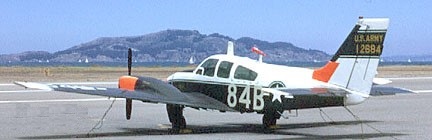
A few months before the introduction of the C55, the US Army announced that the Model 95-B55 had been chosen for military service as an instrument trainer, which was ordered in an initial quantity of 55 under the designation T-42A Cochise (65-12679/12733).
Beech T-42A 65-12684
Ten more were procured for US Army service (66-4300/4309) plus, in 1971, five for delivery to the Turkish army (71-21053/21057) under the Military Assistance Program. By 1984, production of civil and military 95-B55 Barons was in excess of 2,400 and 1,201 examples of the Model E55 (formerly C/D55) had been delivered when production ended.
In September 1967 deliveries began of a new Model 56TC Baron. This introduced two 283kW / 380-hp Avco Lycoming TIO-541-E1B4W turbocharged engines, providing improved performance. Air-conditioning was available as an option. The higher cost of this version of the Baron attracted only 93 sales, and production ended in December 1971. The C55 became the D55 and finally the E55, Beechcraft’s high performance, high payload Baron. Optional equipment on the 58, E55 and B55 are heavy-duty brakes that offer up to 50 per cent greater stopping power.
95-55 1960 Engines: 2 x Continental IO-470-L, 260 hp Seats: 4-5 Sweptback fin and rudder
A55 1962 Optional 6th seat
BE-B55 Baron / T-42A Cochise First built: 1961. Engine: 2 x Continental IO-470-L, 260 hp. TBO: 1500 hrs. Prop: Hartzell 2 blade, constant speed 78 in. Seats: 4/6. Length: 28 ft. Height: 9 ft. 7 in Wingspan: 37 ft. 10 in Wing area: 199 sq.ft. Wing aspect ratio: 7.2. Max ramp wt: 5121 lbs. Max take off wt: 5100 lbs. Standard empty wt: 3236 lbs. Max useful load: 1885 lbs. Max landing wt: 5100 lbs. Wing loading: 25.6 lbs/sq.ft. Power loading: 9.8 lbs/hp. Fuel, std: 136 USG Max useable fuel: 816 lbs. Climb rate: 1693 fpm @ 107 kts. Climb gradient: 949 ft/nm. Rate of climb @ 8000 ft: 1000 fpm. Service ceiling; 19,300 ft. SE rate of climb: 397 fpm @ 100 kts. SE climb gradient: 238 f/nm. SE ceiling: 6400 ft. Max speed: 201 kts. Cruise @ 65% power @ 8,000ft: 180 kts. Cruise speed, 8,000 ft 75% power: 188 kt Fuel flow @ 65% power @ 8,000ft: 136 pph / 23.7 USgph Fuel consumption 75% power: 27.3 USgph Endurance @ 65% power @ 8,000ft: 5.7 hr. Max range (w/ res) 75% power: 798 nm Max range (w/ res) 65% power: 830 nm Stalling speed clean: 79 kts. Stall speed gear/flaps down: 73 kts. Turbulent air penetration speed: 157 kts. Retractable undercarriage. Takeoff ground roll: 1400 ft Landing ground roll: 1467 ft Cabin width: 42 in Cabin height: 50 in Baggage capacity: 700 lb
C55 1964 Engines: 2 x Continental IO-520-C, 285 hp
D55 1968
E55 1970
Colemill Presidential 600 / Beech Baron B55 Engines: 2 x Continental IO-520-E, 300 hp. Seats: 6. Wing loading: 25.6 lb/sq.ft. Pwr loading: 8.5 lb/hp. Max TO wt: 5100 lb. Empty wt: 3200 lb. Equipped useful load: 1777 lb. Payload max fuel: 925 lb. Range max fuel/ 75% cruise: 1040 nm/4.4 hr. Service ceiling: 19,700 ft. 75% cruise: 204 kt. Vmc: 66 kt. Stall: 66 kt. 1.3 Vso: 86 kt. ROC: 2500 fpm. SE ROC: 490 fpm @ 94 kt. SE ceiling: 13,500 ft. Min field length: 1840 ft. Fuel cap: 852 lb.
C55 Engines: 2 x 285 hp Continental IO 520. Fuel cap: 144 USG.
BE-E55 Baron First built: 1966. Engine: 2 x Continental IO-520-CB, 285 hp. TBO: 1700 hrs. Prop: Hartzell 2 blade, constant speed 78 in. Seats: 4/6. Length: 29 ft. Height: 9.2 ft. Wingspan: 37.8 ft. Wing area: 199 sq.ft. Wing aspect ratio: 7.2. Max ramp wt: 5324 lbs. Max take off wt: 5300 lbs. Standard empty wt: 3291 lbs. Max useful load: 2033 lbs. Max landing wt: 5300 lbs. Wing loading: 26.6 lbs/sq.ft. Power loading: 9.3 lbs/hp. Max useable fuel: 996 lbs. Climb rate: 1682 fpm @ 101 kts. Climb gradient: 999 ft/nm. Rate of climb @ 8000 ft: 1000 fpm. Service ceiling; 19,100 ft. SE rate of climb: 388 fpm @ 100 kts. SE climb gradient: 233 f/nm. SE ceiling: 6600 ft. Max speed: 208 kts. Cruise @ 65% power @ 8,000ft: 190 kts. Fuel flow @ 65% power @ 8,000ft: 161 pph. Endurance @ 65% power @ 8,000ft: 6 hr. Stalling speed clean: 83 kts. Stall speed gear/flaps down: 73 kts. Turbulent air penetration speed: 156 kts. Retractable undercarriage.
The Twin Bonanza first flew in November 1949 (TC 5A4). Widening the Model 35 Bonanza fuselage to accommodate three abreast and placing an engine on each wing equalled the Twin Bonanza.
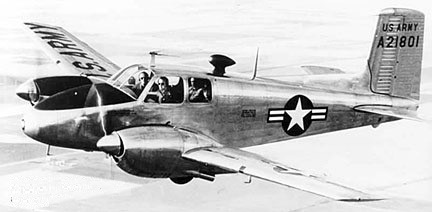
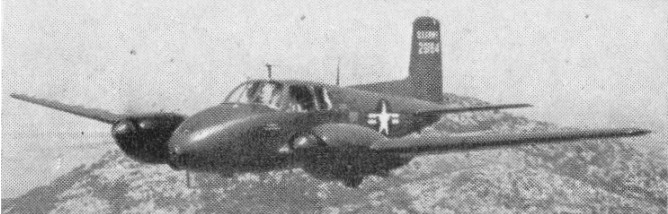
The US military used the Twin Bonanza as the L-23 Seminole, redesignated as U-8 in 1962. Four YL-23 were purchased in 1952 [52-1800/1803]. These were followed by 55 L-23A models [52-6162/6216] (most rebuilt later as L-23D.
Beech YL-23 62-1801
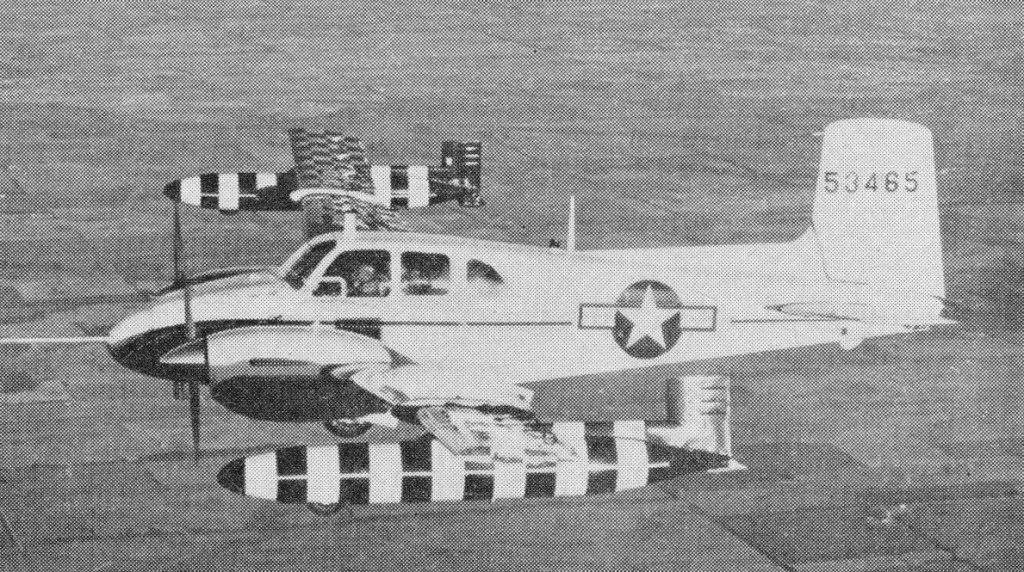
Forty L-23B [53-6153/6192] were purchased and a single XL-23C [55-3465] in 1955, converted to U-8G.
L-23 trials included “flying fuel tanks” to greatly increase fuel loads with the extra wing area attached to the tanks offsetting the greater weights involved.
Both civil and military versions continued to be developed through various marks. By 1955, 96 L-23As and Bs were built.
L-23B
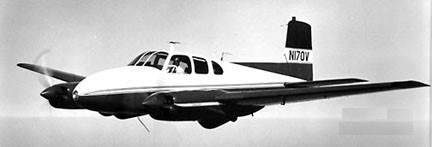
In 1958 the US Army sought an upgrade which lead to the development of the L-23F with its enlarged cabin. It was the first post-war light twin to reach quantity production in the United States, and late models grossed 7300 pounds. Built with 260, 275, 295, and 340-hp Lycoming engines, the Twin Bonanza design has proved highly versatile. Beech produced the military U8 Seminole, the civil Queen Air and early King Airs from the Twin Bonanza wing, and Swearingen has marketed a conversion of the basic Twin Bonanza as the Excaliber.
Swearingen Excalibur N170V
The design started life as a six-seater, and a seventh was added on the J model in 1960. There is so much room inside that numerous luxury executive interiors have been custom-installed. The aircraft has also been successful as an ambulance plane with room for a stretcher and medical attendants, in addition to the crew.
From the L23F derivative of the Model 50 Twin Bonanza Beech developed the civil Model 65 Queen Air with it first flying on 28 August 1958.
C50 Engines: two 275-hp Lycoming GO-480-F6 Wing span: 45 ft 3.5 ft Wing area: 277.06 sq.ft Length: 31 ft 6.5 in Height: 11 ft 4 in Gross Wt. 5500 lb Empty Wt. 3800 lb Fuel capacity 33 USG Top 205 mph Cruise 65%: 197 mph at 10,000 ft Stall 64 mph Initial climb rate 1450 fpm Ceiling 20,000 ft Range 920 sm Takeoff distance (50’) 1350 ft Landing distance (50’) 1210 ft Seats 4-6
D50A-E Engines two 295-hp Lycomings Seats 6. Gross Wt. 6300 lbs. Empty Wt. 3981 lbs. Fuel capacity 180 USG. Top speed 214 mph. Cruise 203 mph. Stall 71 mph. Initial climb rate 1450 fpm. Ceiling 20,000 ft. Range 1650 sm. Takeoff distance (50’) 1260 ft. Landing distance (50’) 1452 ft.
Beechcraft 1958 D50A Twin Bonanza Engine: Lyc. GO-480G2D6, 295 hp TBO: 1400 hr Fuel type:100LL Propeller: Const. spd. Landing Gear type: Tri./Retr. Gross weight: 6300 lb Empty weight, std: 4090 lb Useful load: 2210 lb Fuel: 134 USgal Payload, full std. fuel: 624 lb Wingspan: 45 ft. 3 in. Overall length: 31 ft. 6.5 in. Height: 11 ft. 4 in. Wing area: 277 sq. ft Seating capacity: 7 Cabin width: 54 in Cabin height: 51 in Baggage capacity: 500 lb Cruise speed, 8,000 ft 75% power: 203 kt Cruise speed, 8,000 ft 65% power: 201 kt Max range (w/ res) 65% power: 825 nm Fuel consumption 70% power: 37 US gph Fuel consumption 65% power: 34 US gph Stall speed (gear, flaps down): 71 kt Best rate of climb: two engines: 1450 fpm Best rate of climb: one engine: 300 fpm Service ceiling two engines: 20,000 ft Service ceiling one engine: 7000 ft Takeoff ground roll: 905 ft Landing ground roll: 700 ft
Beechcraft E-50 Twin Bonanza Business Twin, USA, 1957 Engine : 2 x Lycoming GSO 480 B1 B6, 316 hp Length: 31.529 ft / 9.61 m Height : 11.516 ft / 3.51 m Wingspan : 45.21 ft / 13.78 m Wing area : 276.958 sq.ft / 25.73 sq.m Max take off weight : 4795.9 lb / 2175.0 kg Weight empty : 5009.8 lb / 2272.0 kg Max. weight carried : 1991.1 lb / 903.0 kg Max. speed : 198 kt / 366 km/h Initial climb rate : 1614.17 ft/min / 8.20 m/s Service ceiling : 24606 ft / 7500 m Wing load : 17.43 lb/sq.ft / 85.0 kg/sq.m Range : 864 nm / 1600 km Endurance : 5 h Crew : 2+5
J50 Engines two 340-hp Lycomings. Seats 6-7. Gross Wt. 7300 lbs. Empty Wt. 4460 lbs. Fuel capaci.ty 230 USG. Top speed 235 mph. Cruise 223 mph. Stall 82 mph. Initial climb rate 1270 fpm. Range 1650 sm. Ceiling 29,150 ft. Takeoff distance (50’) 1450 ft. Landing distance (50’) 1840 ft.
Excalibur / Beech Twin Bonanza Engines: 2 x Lycoming IGSO-540-A1A, 380 hp. Seats: 6/7. Wing loading: 22.7 lb/sq.ft. Pwr loading: 9.6 lb/hp. Max TO wt: 7300 lb. Empty wt: 4768 lb. Equipped useful load: 2200 lb. Payload max fuel: 820 lb. Range max fuel/ 75% cruise: 797 nm/3.5 hr. Range max fuel / 55% cruise: 1343 nm/ 6.7 hr. Service ceiling: 30,000 ft. 75% cruise: 226 kt. 55% cruise: 202 kt. Vmc: 78 kt. Stall: 72-78 kt. 1.3 Vso: 93 kt. ROC: 1900 fpm. SE ROC: 340 fpm @ 102 kt. SE ceiling: 17,500 ft. Min field length: 2612 ft. Fuel cap: 1380 lb.
Excalibur Excalibur 800 / Beech Twin Bonanza Engines: 2 x Lycoming IO-720-A1B, 400 hp. Seats: 6/7. Wing loading: 22.7 lb/sq.ft. Pwr loading: 9.5 lb/hp. Max TO wt: 7600 lb. Empty wt: 4768 lb. Equipped useful load: 2500 lb. Payload max fuel: 1120 lb. Range max fuel/ 75% cruise: 901 nm/4.4 hr. Range max fuel / 55% cruise: 1156 nm/ 6.3 hr. Service ceiling: 22,200 ft. 75% cruise: 204 kt. 55% cruise: 185 kt. Vmc: 78 kt. Stall: 71-80 kt. 1.3 Vso: 92 kt. ROC: 1870 fpm. SE ROC: 440 fpm @ 102 kt. SE ceiling: 11,800 ft. Min field length: 2178 ft. Fuel cap: 1380 lb
YL-23
L-23A Engines: 2 x 260hp O-435
L-23B Engines: 2 x 260 h.p. Lycoming GO-435-17 Span: 45 ft. 3 in. Weight: 5.500 lb. Max. Speed: 202 m.p.h. Sats: 6 Range: 985 miles at 190 m.p.h.
XL-23C
L-23D / E/F-50 / U-8D / RU-8D / RU 8D Seminole 1958 Engines: 2 x 340hp O-480 Useful load: 2026 lb Max speed: 233 mph Cruise speed: 203 mph Range: 1355 mi Seats: 6 No built: 85 [56-3695/3718, 57-6029/6094, 57-3084/3101, 58-1329/1353, -1357/1364, -3048/3092, 59-2535/2543, -4990/4992], included remanufactured L-23As.
RL 23D Radar photo-observation, from civil E50 No built: 9
L-23E / U-8E / D-50 Engines: 2 x 295hp GO-480 No built: 6 [56-4039/4044], plus 1 civil to military to civil [N1779G=66-15360=N5375G=N888JE=N74GV].
The Beechcraft Model 40A was an experimental twin-engine aircraft based on the Bonanza. Only one prototype was built in 1948. It featured a unique over/under arrangement of two 180-hp Franklin engines mounted on top of each other and driving a single propeller.
The plane had a different engine cowl from a standard Bonanza, and the nose gear could not fully retract, but otherwise it greatly resembled the production Bonanzas of the time.
Certification rules demanded a firewall be fitted between the two engines, however, thus stopping development.
First flying on 4 January 1968, the single-engine Model 36 Bonanza was introduced in 1968 to compete with Piper’s Cherokee Six and the 200-series from Cessna. The A36 was developed by lengthening (0.25m) the fuselage of the Model 33, and using the same wing, landing gear and Continental engine of the Baron family, and the tail unit of the Model 33. Six seats were available, and with club-seating arrangements and a foldout table, it became a flying office. In 1975, the A36 outsold all other Bonanza models for the first time. With a longer cabin and wide double doors, the Bonanza A36 offers greater utility and convenience without sacrificing performance and economy. In 1977 the A36 was offered with factory-installed electric trim, formerly available only on aircraft equipped with an autopilot. The A36 accounted for 50% of the total Bonanza production in 1977, and that percentage increased in 1978. Beech added a turbocharged version of its Bonanza A36 in mid-1979. The aircraft is certified to a maximum operational altitude of 25,000 feet and has approximately the same takeoff distance as the A36. Power is supplied by a 300 hp Continental engine, which conforms to the minimum horsepower concept introduced on the Baron 58P and 58TC in 1977. The A36TC has a gross weight of 3,650 pounds, which is 50 pounds more than the standard A36. A shortened three-blade propeller reduces tip speed, increases ground clearance, and reduces noise. Standard features on late models of both the normally aspirated and turbocharged versions are an extended rear compartment for up to 70 pounds of baggage, bringing the baggage total to 470 pounds with four seats occupied; 15-degree approach flap setting; and optional propeller anti-icing. In 1982, Beechcraft replaced the A36TC with the B36TC Turbo Bonanza. The new design mated the longer Baron wing to the Model 36 fuselage, and fuel capacity was increased from 74 gallons to 102 gallons. Service ceiling for the A36TC and B36TC remained at 25,000 feet. Production of Model 36 Bonanzas totalled some 3,390 by early 1989. The final year of production for turbocharged Bonanzas was 2001. The B36TC’s production run ended in 2001. Beginning in 2005, the six-seat Beech came to market with an all-glass panel. Brief mention must be made of two military versions of the A36 Bonanza. Designated QU-22B, a number were provided with special avionics equipment under the USAF’s ‘Pave Eagle’ programme. They were deployed in Vietnam to pick up and relay to a ground station the data transmitted from acoustic sensors. Intended to keep track of enemy movements in the dense jungle, the sensors were air-dropped along known or suspected transport routes. To meet the requirements of the USAF’s ‘Pave Coin’ competition, Beech developed a close-support two-seat armed version of the A36. Designated Model PD 249, this prototype was evaluated with a wide variety of weapons, carried on underwing racks that could accommodate loads of up to 535kg, but no production examples were built.
1975 A36 Bonanza Engine: Continental IO-520-BA, 285 hp TBO: 1700 hr Fuel Type:100/100LL Propeller type: McCauley CS Landing Gear type: Tri./Retr. Max ramp weight: 3612 lb Gross weight: 3600 lb Landing weight: 3600lb Empty weight, std: 2096lb Useful load, std: 1504 lb Payload, full std. fuel: 1060 lb Usable fuel: 74 US gal Wingspan: 33 ft. 6 in. Overall length: 27 ft. 6 in. Height: 8 ft. 5 in. Wing area: 181 sq. ft Wing loading: 19.9 lbs./sq. ft Power loading: 12.6 lbs./hp Wheel base: 7 ft. 10 in. Wheel size: 6.00 x 6 in Seating capacity: 6 Cabin doors: 3 Cabin width: 42 in Cabin height: 50 in Baggage capacity:70 lb Cruise speed 75% power @ 6,000 ft: 170kt Cruise speed 65% power @ 10,000 ft: 162 kt Cruise speed 45% power @ 12,000 ft: 148 kt Max range (w/ res) 75% power: 694 nm Max range (w/ res) 65% power 749 nm Max range (w/ res) 45% power 769 nm Fuel consumption 75% power: 15.2 USgph Fuel consumption 65% power: 13.3 Usgph Fuel consumption 45% power: 11.5 USgph Stall speed (gear, flaps up): 63 kt Stall speed (gear, flaps down): 53 kt Best rate of climb: 1015 fpm Best rate of climb (12,000 ft): 550 fpm Service ceiling: 16,000 ft Takeoff ground roll: 1257 ft Takeoff over 50-ft. obstacle: 2167 ft Landing ground roll: 833 ft Landing over 50-ft. obstacle: 1575 ft
BE-A36 Engine: 1 x Continental IO-520-BB, 285 hp. TBO: 1700 hr Prop: McCauley 2 blade, constant speed 84 in Seats: 4/6 Length: 27.5 ft Height: 8.4 ft Wingspan: 33.5 ft Wing area: 181 sq.ft Wing aspect ratio: 6.2 Max ramp wt: 3612 lb Max take off wt: 3600 lb Standard empty wt: 2195 lb Max useful load: 1417 lb Max landing wt: 3600 lb Wing loading: 19.9 lbs/sq.ft Power loading: 12.6 lbs/hp Max useable fuel: 444 lb Climb rate: 1030 fpm @ 96 kt Climb gradient: 644 ft/nm Rate of climb @ 8000 ft: 570 fpm Service ceiling: 16,600 ft Max speed: 179 kt Cruise @ 65% power @ 8,000ft: 158 kt Fuel flow @ 65% power @ 8,000ft: 79 pph Endurance @ 65% power @ 8,000ft: 5.4 hr Stalling speed clean: 62 kt Stall speed gear/flaps down: 52 kt Turbulent air penetration speed: 140 kt Retractable nose wheel undercarriage
Beechcraft A36 Bonanza Engine: Continental IO-550B, 300 hp TBO: 2000 hr Fuel type: 100/100LL Propeller: CS Landing gear type: Tri/Retr. Max ramp weight: 3650 lb Gross weight: 3650 lb Landing weight: 3650 lb Empty weight, std: 2247 lb Useful load, std: 1403 lb Payload, full std. fuel: 959 lb Usable fuel, std: 74 US gal Wingspan: 33 ft. 6 in. Overall length: 27 ft. 6 in. Height: 8 ft. 5 in. Wing area:181 sq. ft Wing loading: 20.2 lbs./sq. ft Power loading: 12.2 lbs./hp Wheel track: 7 ft. 1 in. Wheel size: 6.00 x 6 in Seating capacity: 6 Cabin doors: 2 Cabin width: 42 in Cabin height: 50 in Cruise speed: 169kt Vs: 59 kt Vso: 59 kt Best rate of climb, SL:1210 fpm Best rate of climb, 8000 ft: 800 fpm Service ceiling: 18,500 ft. Takeoff ground roll: 971 ft Takeoff over 50-ft. obstacle:m1913 ft Landing ground roll: 913 ft Landing over 50-ft. obstacle: 1473 ft
BE-A36TC First built in 1979 Engine: 1 x Continental TSIO-520-UB turbo charged, 300 hp TBO: 1600 hr Prop: McCauley 3 blade, constant speed 80 in Seats: 4/6 Length: 27.5 ft Height: 8.4 ft Wingspan: 33.5 ft Wing area: 181 sq.ft Wing aspect ratio: 6.2 Max ramp wt: 3666 lb Max take off wt: 3650 lb Standard empty wt: 2278 lb Max useful load: 1388 lb Max landing wt: 3650 lb Wing loading: 20.2 lbs/sq.ft Power loading: 12.2 lbs/hp Max useable fuel: 444 lb Climb rate: 1165 fpm @ 110 kt Climb gradient: 635 ft/nm Rate of climb @ 8000 ft: 1070 fpm Certificated ceiling: 25,000 ft Max speed: 214 kt Cruise @ 65% power @ 8,000ft: 161 kt Cruise @ 65% pwr @ 18,000 ft: 175 kt Fuel flow @ 65% power @ 18,000ft: 85 pph Endurance @ 65% power @ 18,000ft: 5 hr Stalling speed clean: 67 kt Stall speed gear/flaps down: 57 kt Turbulent air penetration speed: 139 kt Retractable nose wheel undercarriage
2009 BONANZA G36 Engine: Continental IO-550-B, 300 hp TBO: 1700 hr Fuel type: 100LL Propeller type: 3-blade, CS Landing gear type: Tri./Retr. Gross weight: 3650 lb Empty weight, std: 2530 lb Useful load, std: 1120 lb Usable fuel, std: 74 US gal /444 lb Payload, full std. fuel: 676 lb Wingspan: 33 ft. 6 in. Overall length: 27 ft. 6 in Overall height: 8 ft. 7 in Wing area: 181 sq. ft Wing loading: 20.2 lbs./sq. ft Power loading: 12.2 lbs./hp Seating capacity: 6 Cabin doors: 3 Cabin width: 42 in Cabin height: 50 in Cruise speed 75% power, 6000 ft: 176 kt Cruise speed 65% power, 10,000 ft.: 171 kt Cruise speed 55% power, 10,000 ft.: 153 kt Range 75% power, 6000 ft.: 671 nm Range 65% power, 10,000 ft.: 775 nm Range 55% power, 10,000 ft.: 916 nm Best rate of climb, SL: 1230 fpm Service ceiling: 18,500 ft Vso: 59 kt Takeoff ground rol: 1913 ft Landing ground roll: 950 ft
First flown on 22 December 1945, The test pilot claimed there was nothing unusual in flying the V-tail. Powered by a 185 hp Continental engine, the airplane cruises at 175 mph and can achieve a maximum speed of 184 mph. Its gross weight was 2550 lb and it could carry 40 USG of fuel. The pilot’s primary complaint was that it stalled with little warning. A situation that the company remedied by installing a stall warning light as standard. Beech expected to sell the Bonanza for $7345.
The Bonanza was introduced as a production model in 1947 and was labeled the Model 35. The first Bonanza 35 was delivered in 1947. In 1947, 1,299 were built. Powered by a Continental 165 hp, the top speed was 184 mph and cruise 175 mph. Subsequent aircraft were designated A35, B35, C35, etc. until the S35, after which the letter V was placed in front of the model number and the lettering process began all over again. Early models were fitted with 185-hp engines and seated four persons. In 1952, the C-model appeared with enlarged tail surfaces and a 205-hp engine. The 225-hp Continental was first used in 1954 with the E35. The H35 utilized a 240-hp engine and the J through M models were fitted with 250-hp Continentals.
1960 35M
The 35M was distinguishable by squared and cambered wingtips and other small refinements.
By 1960 more than 6000 Bonanzas had been sold since the war.
The 260-hp engine was introduced in the N35, and the 285-hp engine first appeared in 1964 in the S35.
In 1965 the USAF conducted tests with a V-tail Bonanza (model S35) that had been modified with a conventional cruciform tail unit and six wing hardpoints with the inner pylons stressed for 600 lbs and the two outer pylons on each wing stressed to 300 lbs. Testing took place at Eglin AFB, Florida.
Early-model Bonanzas are still highly competitive on the used plane market and are highly prized as personal transportation aircraft. All were four seaters until the S35, after which all have accommodations for up to six. Like other Bonanzas, the V35B model benefits from the new 15-degree flap setting and the 28-volt electrical system to support optional propeller deicing equipment. The V35B Bonanza is certificated in the utility category. This provides a 4.4 G positive manoeuvring load factor compared with 3.8 Gs for the normal category.
V35B
From 1966 to 1970, Beech built a handful of airplanes labeled the V35TC, V35ATC and V35BTC. These were turbocharged versions of the V tail Bonanza. Unfortunately, the program was nipped in the bud by the 1969 70 recession. Beech had to cut back somewhere, and the blown Bonanza was it. At the beginning of 1972 Model V35B Bonanza 9,288 had been built. Early 1979, Beech re entered the turbo market with a new turbocharged Bonanza, the A36TC. During the nine years between the demise of the V35BTC and the introduction of the A36TC, the normally aspirated Model 36 became the best seller in the Bonanza line, so it was logical to turbocharge it rather than bring back the V35BTC. The most obvious physical difference between the normally aspirated A36 and the A36TC is the presence of five sets of gills and louvers on the sides of the TC’s cowling. Also, the cowl flaps have been replaced with fixed lips, as on early Debonairs. By contrast, the V35TC had an intricate arrangement of four cowl flaps. Beech originally used cowl flaps on the A36TC, too, but found them to be ineffective under certain conditions. With its gills and louvers, along with some baffle changes, tests showed the A36TC could climb out at 110 knots (best rate of-climb speed) on a 100 degree day without overheating. Under the demanding conditions of high altitude, maximum cruise power setting and high outside air temperature, the airplane will not exceed temperature limits, even at its maximum certificated altitude of 25,000 feet. The pilot never has to touch a cowl flap or install winter baffles, and sufficient cooling is not at the expense of an excessively rich mixture. In 1979 both the normally aspirated and turbo models have extended baggage areas behind the last row of seats that will accommodate 10 cubic feet and 70 pounds of bags, equalling the Baron 58’s cabin baggage capacity. The large double doors to the rear of the cabin facilitate loading and can be removed for flight. Production of Bonanzas of all types amounts to about 15,000, production extended over 35 years. The Bonanza also provided the foundation for the design of the conventional tailed T 34 Mentor, for many years a primary trainer for the US and foreign services.
A35 Initial 4 seat version Engine: Continental E-185-1, 185 hp
B35 1950
C35 1951 Engine Continental E-185-11, 205-hp Gross Wt. 2725 lbs. Empty Wt.1675 lbs. Fuel capacity 39-59 USG. Top speed 190 mph. Cruise 180 mph. Stall 55 mph. Initial climb rate 1100 fpm. Ceiling 18,000 ft. Range 775 sm. Takeoff distance (50’) 1375 ft. Landing distance (50’) 970 ft. Seats 4.
D35 1953 Engine Continental E-185-11, 205-hp Seats 4. Gross Wt. 2725 lbs. Empty Wt.1675 lbs. Fuel capacity 39-59 USG. Top mph 190. Cruise mph 180. Stall mph 55. Initial climb rate 1100 fpm. Ceiling 18,000 ft. Range 775 sm. Takeoff distance (50’) 1375 ft. Landing distance (50’) 970 ft.
E-35 1954 Engine Continental E-185-11, 205-hp Gross Wt. 2775 lbs. Empty Wt. 1722 lbs. Fuel capacity 39 USG. Top mph 194. Cruise mph 184. Stall mph 55. Initial climb rate 1300 fpm. Range 775 sm. Ceiling 19,000 ft. Takeoff distance (50’) 1300 ft. Landing distance (50’) 970 ft. Seats 4.
F35 1955 Engine: Continental E-225-8, 225 hp Wingspan: 32 ft 10 in Wing area: 177.6 sq.ft Length: 25 ft 2 in Height: 6 ft 6 in Empty weight: 1697 lb Loaded weight: 2750 lb Max speed: 194 mph at SL Cruise: 184 mph at 8000 ft ROC: 1300 fpm Seats: 4
F35 1955 Engine: Continental E185-11, 200 hp Wingspan: 32 ft 10 in Wing area: 177.6 sq.ft Length: 25 ft 2 in Height: 6 ft 6 in Max speed: 190 mph at SL Cruise: 180 mph at 6000 ft ROC: 1100 fpm Seats: 4
G35 1956
H35 1957 Engine: Continental O-470-G, 240 hp
J35 1958 Engine: Continental O-470-C, 250 hp
K35 1959 Engine: Continental IO-470, 250 hp TBO hrs: 1500 Fuel type: 91/96 Propeller type/diameter: CS Landing gear type: Tri./Retr. Max ramp weight: 2950lb Gross weight: 2950 lb Landing weight, std: 2950lb Empty weight, std: 1832 lb Useful load, std: 1118 lb Payload, full std. fuel: 818 lb Usable fuel: 49 US gal Wingspan: 33 ft. 5 in. Overall length: 25 ft. 1 in. Height: 6 ft. 5 in. Wing area: 177.6 sq. ft Wing loading: 16.6 lb/sq. ft Power loading: 11.8 lb/hp Wheel size: 6.00 x 6 in Seating capacity: 4 Cabin doors: 1 Cabin width: 42 in Cabin height: 50 in Baggage capacity: 180lb Cruise speed 75% power @ 10,000 ft.: 150 kt Cruise speed 75% power @ 20,000 ft.: 164 kt Cruise speed 65% power @ 10,000ft: 141 kt Cruise speed 65% power @ 20,000 ft: 152 kt Max range (w/ reserve) 75% power @ 10,000 ft.: 541 nm Max range (w/ reserve) 75% power @ 20,000 ft.: 568 nm Fuel consumption 75% power: 19.1 US gph Fuel consumption 65% power: 16.7 US gph Fuel consumption 55% power: 14.0 US gph Vs: 62 kt Vso : 54 kt Best rate of climb (SL): 1050 fpm Service ceiling: 27,000 ft Takeoff ground roll: 910 ft Takeoff over 50-ft. obstacle: 1740 ft Landing ground roll: 735 ft Landing over 50-ft. obstacle: 1395 ft Optional fifth seat
M35 1960 Squared-off wingtips
N35 1961 Engine: Continental IO-470-H, 260 hp
1961 Bonanza “N” V35 Engine: Cont IO-470 N, 260 hp TBO: 1500 hr Fuel Type: 100 Propeller type: CS Landing Gear type: Tri./Retr. Max ramp weight: 3125 lb Gross weight: 3125 lb Max landing weight: 3125lb Empty weight: 1855 lb Useful load: 1270 lb Payload (full fuel): 826 lb Usable fuel: 74 US gal Wingspan: 33 ft. 6 in. Overall length: 25 ft. 2 in. Height: 6 ft. 5 in. Wing area: 181 sq. ft Wing loading: 17.3 lbs./sq. ft Power loading: 12.0 lbs./hp Wheel size: 6.00 x 6 in Seating capacity: 4 Cabin doors: 1 Cabin width: 42 in Cabin height: 50 in Baggage capacity: 270 lb Cruise speed 75% power @ 24,000 ft.: 170 kt Cruise speed 65% power: 162 kt Max range (w/ reserve) 75% power: 800 nm Stall speed (gear, flaps up): 58 kt Stall speed (gear, flaps down): 52 kt Best rate of climb (SL): 1150 fpm Service ceiling: 19,200 ft Takeoff ground roll: 1050 ft Landing ground roll: 650 ft
P35 1962 Engine: Continental IO-470-C, 260 hp
N-P35 Engine 260-hp Continental. Seats 4-5. Gross Wt. 3125 lbs. Empty Wt. 1855 lbs. Fuel capacity 49-78 USG. Top speed 205 mph. Cruise 195 mph. Stall 60 mph. Initial climb rate 1150 fpm. Ceiling 19,200 ft. Range 690-1215 sm. Takeoff distance (50’) 1050 ft. Landing distance (50’) 840 ft.
S35 1964 Engine: Continental IO-520-B, 285 hp Optional 6th seat, extra cabin window, redesigned wingtips
V35 1965
V35B Engine: Continental IO 520 BA, 285 hp. TBO: 1,500 hrs. Prop: Constant speed, two blade 84 in. diameter (three blade opt.). Length: 26 ft. 5 in. / 8.05 m Height: 7 ft. 7 in. Wingspan: 33 ft. 6 in. / 10.21 m Wing area: 181 sq. ft. Wing loading: 18.8 lbs./sq.ft. Cabin length: 8 ft 1 in / 2.46 m Cabin width: 3 ft 6 in / 1.07 m Cabin height: 4 ft 2 in / 1.27 m Seats: 4 6. Empty wt: 2,204 lbs. Useful load: 1,196 lbs. Payload with full fuel: 752 lbs. Gross wt: 3,400 lbs. / 1542 kg Power loading: 11.9 lbs/hp. Fuel capacity, opt: 74 USG/444 lbs. Baggage compartment cap: 270 lb / 122.5 kg Baggage compartment volume: 35 cu.ft. / 0.99 cu.m Minimum runway requirement: 1,870 ft. ROC: 1,136 fpm / 346 m/min Service ceiling: 17,500 ft. / 5335 m Max speed: 182 kts. Cruise (75% power @ 6,500 ft/1980m): 176 kt / 203 mph / 327 kph Economy cruise (45 % power @ 12, 000 ft.): 142 knots. Range (75 % power @ 6,500 ft/ 1980m, 45 minute res): 710 nm / 816 mi / 1313 km Range (45 % power @ 12,000 ft/3660m, 45 min res): 873 nm / 100mi / 1620 km Duration at 75 % power, no res: 4.8 hrs. Stall speed (clean): 64 kts. Stall speed (gear and flaps down): 55 kts.
V35B Engine: 1 x Continental IO-520-BB, 285 hp. TBO: 1700 hrs. Prop: McCauley 2 blade, constant speed 84 in. Seats: 4/5. Wingspan: 10.21 m / 33 ft 6 in Length: 8.05 m / 26 ft 5 in Height: 2.31 m / 7 ft 7 in Wing area: 16.81 sq.m / 180.94 sq ft Wing aspect ratio: 6.2. Max ramp wt: 3412 lbs. Max take off wt: 1542 kg / 3400 lbs. Standard empty wt: 2110 lbs. Max useful load: 1302 lbs. Max landing wt: 3400 lbs. Wing loading: 18.8 lbs/sq.ft. Power loading: 11.9 lbs/hp. Max useable fuel: 444 lbs. Climb rate: 1167 fpm @ 96 kts. Climb gradient: 729 ft/nm. Rate of climb @ 8000 ft: 670 fpm. Service ceiling: 17,858 ft. Max speed: 182 kts. Cruise @ 65% power @ 8,000ft: 163 kts. Fuel flow @ 65% power @ 8,000ft: 80 pph. Endurance @ 65% power @ 8,000ft: 5.3 hr. Stalling speed clean: 64 kts. Stall speed gear/flaps down: 51 kts. Turbulent air penetration speed: 134 kts. Retractable nose wheel undercarriage.
1966 Beech V35TC Bonanza Engine: TSIO-520D, 285hp 16,000 ft. TBO: 1400 hr Fuel Type: 100/100LL Propeller type: CS Landing Gear type: Tri./Retr. Max ramp weight: 3400 lb Gross weight: 3400 lb Landing weight: 3400 lb Empty weight, std: 2021 lb Useful load, std: 1379 lb Payload, full opt. fuel: 935 lb Usable fuel: 74 US gals Wingspan: 33 ft. 5 in. Overall length: 25 ft. 5 in. Height: 6 ft. 7 in. Wing area: 181 sq. ft Wing loading: 18.8 lb/sq. ft Power loading: 11.9 lbs./hp Wheel track: 9 ft. 7 in. Wheel size: 6.00 x 6 in Seating capacity: 4 Cabin doors: 1 Cabin width: 42 in Cabin height: 50 in Baggage capacity: 270 lb Cruise speed 75% power @ 24,000 ft: 200 kt Cruise speed 65% power @ 6,500 ft: 176 kt Cruise speed 45% power @ 16,000 ft: 144 kt Max range (w/ reserve) 75% power: 826 nm Max range (w/ reserve) 65% power: 887 nm Max range (w/ reserve) 45% power: 940 nm Stall speed (gear, flaps up): 64 kt Stall speed (gear, flaps down): 55 kt Best rate of climb (SL): 1225 fpm Service ceiling: 29,500 ft Takeoff ground roll: 950 ft Takeoff over 50-ft. obstacle: 1320 ft Landing ground roll: 647 ft Landing over 50-ft. obstacle: 1177 ft
The Twin Quad was an unpressurized, 20-passenger entrant into the feeder-line market. The name ‘Twin Quad’ came from the two horizontally-opposed, 400hp (300kW) Lycoming GSO-580 engines buried transversely in each wing to drive a single propeller through a common gearbox. The Twin Quad also had a V-tail similar in shape to that of the Bonanza. The first flight of the prototype was on October 1, 1947, at Wichita, Kansas. Following more than a year of flight testing, it was damaged beyond economical repair in a forced landing. By then, Beech had learned that the feeder-line market could not support a new design. Even had there, the unique powerplant installation would have required considerable development to achieve the reliability needed for airline service.
Despite large demand for the V-tailed Model 35, there were many potential buyers who considered this tail unit to be a gimmick that might present problems. To meet their needs, Beech introduced the Model 33 Debonair, following a first flight on 14 September 1959. With a conventional tail unit, and with a slightly lower-powered engine, the Debonair seated a pilot and three passengers. It represented a lower-cost version of the Bonanza, and was built and marketed in parallel until production of the Debonair, as such, ended in 1966, by when almost 1,200 had been built.
1960 33 Debonair
The Model 33 Debonair was produced in four-seat versions with a 225-hp Continental, six-cylinder engine. It had a simplified interior and less elaborate equipment than the Model 35. In 1961, the aileron and elevator trim tabs were improved; larger rear windows and a restyled cabin interior with bucket seats were featured.
Offered by Beechcraft in 1964 for European sale was a Debonair beefed up with a stronger empennage, horizontal stabiliser, rudder cables and vertical stabiliser to meet British requirements for a three-turn spin.
In 1966, the option of a 285-hp powerplant was added.
In 1967, the Debonair name was dropped and the subsequent aircraft, now a part of the Bonanza family, were simply designated E33, F33 and G33. During these years all model numbers ending in “A” featured the 285-hp Continental. All others retained the 225-hp engine.
The Debonair was replaced in 1967 by the Model E33 Bonanza, a four/five-seat version that was virtually identical to the V-tail Model 35, except for the provision of a conventional tail unit with sweptback vertical surfaces. This version, in F33A standard and F33C aerobatic/utility versions, remained available in late 1989, by which time production of Model 33 Debonairs/Bonanzas was approaching a total of 3,000. Examples of these aircraft have been used for civil or military training by organisations that include the air force of Iran, Lufthansa, the Mexican navy, the Netherlands government, Pacific Southwest Airlines, and the Spanish air ministry/air force.
F33A Bonanza
The Bonanza F33C is an aerobatic version of the Bonanza F33A.
Spains’s EdA used the F.33C Bonanza designated E.24.
In 1972, the G33 was introduced with a 260-hp Continental. In 1980 only the F-33A remained in production. Since its introduction as the Beechcraft Debonair, more than 2230 Model 33s have been produced. New standard features for all Bonanza models are a 15-degree approach flap setting and a 28-volt electrical system. The approach flaps are identical to the Baron models and will allow for a maximum extension speed of 175 mph. The new electrical system speeds up the landing gear cycle and allows Bonanzas to be equipped with propeller deicing. Also, all Bonanzas will offer increased oxygen capacity.
Around 1967 the US military used militarized, supercharged Debonair with increased wingspan and wingtip tanks adapted to surveillance duties in Vietnam, relaying information to tactical fighters and gunships as the U-22. Six, 68-10531/10536, were used as unmanned, radio-controlled drone version as QU-22A, and 69-7699, 70-1535/1548 as -22B.
Beech QU-22B 69-7699
The civil D33 N5847K was used in 1970 by USAF testing in the PAVE COIN program as ground-attack as the YAU-22A 70-7859.
The Islamic Republic of Iran Air Force staff of the logistic-support command repair centre developed the Parastu-14 (Persian: پرستو ۱۴) as a training aircraft for the Iranian Air Force from Beechcraft F33 Bonanza.
Parastu 14
Parastu-14 trainer aircraft was introduced during an unveiling ceremony in “Hunting base of Shahid Major General Pilot Hossein Lashgari” in September 2013, and was added to Iran’s military air-force.
A33 Debonair Engine: Continental IO 470-J, 225-hp. Gross Wt. 2900 lb Empty Wt. 1730 lb Wing span: 33.5 ft (10.2m) Fuel capacity 64 USG Top speed: 195 mph. Cruise speed: 185 mph. Stall: 60 mph. Initial climb rate: 930 fpm. Range: 650 sm. Ceiling: 17,800 ft. Takeoff distance (50’) 1288 ft. Landing distance (50’) 1298 ft. Seats 4/5.
1963 Debonair B33 Engine: Continental IO-470-K, 225 hp TBO hours: 1500 Fuel type: 80/87 Propeller type: CS Landing Gear type: Tri./Retr. Max ramp weight: 3000 lb Gross weight: 3000 lb Landing weight: 3000 lb Empty weight, std: 1745lb Useful load, std: 1255lb Usable fuel, std: 74US gal Payload, full std. fuel: 811 lb Wingspan: 32 ft. 10 in. Overall length: 25 ft. 6 in. Height: 8 ft. 3 in. Wing area: 177.5 sq. ft Wing loading: 16.9 lb/sq. ft Power loading: 13.3 lb/hp Seating capacity: 4 Cabin doors: 1 Cabin width: 42 in Cabin height: 50 in Cruise speed, 6,500 ft 75% pwr: 161 kts Max range (w/ res) 55% power: 991 nm Stall speed (flaps up): 62kt Stall speed (flaps down): 52kt Best rate of climb, SL: 960 fpm Service ceiling: 18,400 ft Takeoff ground roll: 982 ft Takeoff over 50 ft. obstacle: 1288 ft Landing ground roll: 643 ft Landing over 50 ft. obstacle: 1298 ft
1966 Debonair C33A Engine: Continental IO-520-B, 285 hp TBO: 1700 hours Fuel type: 100 Propeller type: CS Landing Gear type: Tri./Retr. Max ramp weight: 3300 lb Gross weight: 3300 lb Landing weight: 3300 lb Empty weight, std: 1888lb Useful load, std: 1412lb Payload, full std. fuel: 968lb Usable fuel, std: 74 USgal Wingspan: 32 ft. 10 in Overall length: 27 ft. 6 in. Height: 8 ft. 7 in Wing area:181 sq. ft Wing loading: 20.2 lbs./sq. ft Power loading: 12.2 lbs./hp Seating capacity: 6 Cabin doors: 2 Cabin width: 3 ft. 6 in. Cabin height: 4 ft. 2 in. Cruise speed @ 6,500 ft 75% power: 174 kt Max range (w/ res) 55% power: 939 nm Stall speed (flaps up): 63 kt Stall speed (flaps down): 53kt Best rate of climb: 1200 fpm Service ceiling: 18,300 ft Takeoff ground roll: 880 ft Takeoff over 50 ft. obstacle: 1225 ft Landing ground roll: 625 ft Landing over 50 ft. obstacle: 1150 ft
1968 E33A Bonanza Engine: Continental IO-520-B/-BA, 285 hp TBO: 1700 hr Fuel type: 100/100LL Propeller type: Hartzell /CS Landing gear type: Tri./Retr. Max ramp weight: 3300 lb Gross weight: 3300 lb Landing weight: 3300 lb Empty weight, std: 1915 lb Useful load, std: 1385 lb Useful fuel: 80 US gal Payload, full std. fuel: 945 lb Wingspan: 32 ft. 10 in. Overall length: 25 ft. 6 in. Height: 8 ft. 3 in. Wing area: 177.6 sq. ft Wing loading: 18.6 lbs./sq.ft Power loading: 11.6 lbs./hp Wheel size: 6.00 x 6 in Seating capacity: 5 Cruise speed: 75% power: 174 kt Vso: 53 kt Best rate of climb, SL: 1200 fpm Service ceiling: 18,300 ft Takeoff ground roll: 880 ft Takeoff over 50-ft. obstacle: 1225 ft Landing ground roll: 625 ft Landing over 50-ft. obstacle: 1150 ft
F33A Engine: 1 x Continental IO-520-BB, 285 hp. TBO: 1700 hrs. Prop: McCauley 2 blade, constant speed 84 in. Seats: 4/5. Length: 26.7 ft. Height: 8.3 ft. Wingspan: 33.5 ft. Wing area: 181sq.ft. Wing aspect ratio: 6.2. Max ramp wt: 3412 lb Max take off wt: 3400 lb Standard empty wt: 2125 lb Max useful load: 1287 lb Max landing wt: 3400 lb Wing loading: 18.8 lbs/sq.ft. Power loading: 11.9 lbs/hp. Max useable fuel: 444 lb Climb rate: 1167 fpm @ 96 kt Climb gradient: 729 ft/nm. Rate of climb @ 8000 ft: 670 fpm. Service ceiling: 17,858 ft. Max speed: 182 kts. Cruise @ 65% power @ 8,000ft: 163 kts. Fuel flow @ 65% power @ 8,000ft: 80 pph. Endurance @ 65% power @ 8,000ft: 5.3 hr. Cruise speed (75% power): 199mph. Maximum range (75% power): 956mi. Equipped payload (750 miles fuel, 75% pwr): 895 lb Stalling speed clean: 64 kts. Stall speed gear/flaps down: 51 kts Turbulent air penetration speed: 134 kt Retractable nose wheel undercarriage Cabin width (elbow to elbow): 45.0in.
G33 1971 Shorter span wings Engine: Continental IO-470-N, 260 hp
H33 Bonanza Engine: Cont. O-470-G, 240hp Propeller type/diameter: Beechcraft 278 CS/84 in. Landing Gear type: Tri./Retr. Gross weight: 2900 lb Landing weight :2900 lb Empty weight, std: 2046 lb Useful load, std: 854lb Wingspan: 32 ft. 10 in. Overall length: 25 ft. 1 in. Height: 6 ft. 6 in. Wing area:177.6 sq. ft Power loading: 12.1 lbs./hp Wheel size, mains: 6.5 x 8 in Seating capacity: 4 Cabin doors: 1 Baggage capacity: 270 lb Cruise speed 75% power @ 7500 ft: 165 kt Cruise speed 65% power @ 11.500 ft.: 160 kt Cruise speed 55% power @ 12,500 ft.: 150 kt Max range (w/ reserve) 75% power @ 7500 ft: 610 nm Max range (w/ reserve) 65% power @ 11,500 ft: 621 nm Max range (w/ reserve) 55% power @ 12,500 ft: 665 nm Fuel consumption (gph @ .42 lbs./hp/hr. sfc) 75% power @ 7500 ft.:13.2 Fuel consumption (gph @ .42 lbs./hp/hr. sfc) 65% power @ 11,500 ft.:11.4 Fuel consumption (gph @ .42 lbs./hp/hr. sfc) 55% power @ 12,500 ft.:9.4 Estimated endurance (65% power with 1-hr. reserve): 3 hrs. 54 mins. Stall speed (dirty): 50 kts Best rate of climb: 1250 fpm Service ceiling: 19,800 ft Takeoff ground roll: 705 ft Takeoff over 50 ft. obstacle: 1320 ft Landing ground roll: 925 ft Landing over 50 ft. obstacle: 1530 ft
QU-22 Engine: TCM GTSIO-520
A36 1968 Engine: Continental IO-520-BA, 285 hp Wing span: 33 ft 6 in / 10.21m Length: 27 ft 6 in / 8.38m Cabin length: 10 ft 11 in / 3.39m Cabin width: 3 ft 6 in / 1.07m Cabin height: 4 ft 2 in / 1.27m Empty equipped weight: 2096 lb / 951 kg MTOW: 3600 lb / 1633 kg Baggage capacity 400 lb / 181 kg Max cruise 75% 6500ft/1980m: 170 kt / 196 mph / 315 kph Max ROC SL: 1015 fpm / 309 m/min Service ceiling: 16,000 ft / 4875 m Range 55% at 12,000ft/3660m with opt fuel: 769 nm / 886 mi / 1425 km + res Seats: 6