Vickers (Aviation) Ltd / Vickers-Armstrong

Vickers was formed in Sheffield as a steel foundry by the miller Edward Vickers and his father-in-law George Naylor in 1828. Naylor was a partner in the foundry Naylor & Sanderson and Vickers’ brother William owned a steel rolling operation. Edward’s investments in the railway industry allowed him to gain control of the company, based at Millsands and known as Naylor Vickers and Company. It began life making steel castings and quickly became famous for casting church bells. In 1854 Vickers’ sons Thomas (a militia officer known familiarly as ‘Colonel Tom’) and Albert joined the business and their talents – Tom Vickers as a metallurgist and Albert as a team-builder and salesman – were key to its subsequent rapid development. “Its great architects,” the historian Clive Trebilcock writes, “Colonel T.E. (1833-1915) and Albert (1838-1919) Vickers… provided both inspired technical leadership… and equally astute commercial direction. Both men were autocrats by temperament, but neither shunned advice or avoided delegation; each, but particularly Albert, had a marked gift for the selection of talented subordinates.”

Vickers (Aviation) Ltd / Vickers-Armstrong Article

In 1863 the company moved to a new site in Sheffield on the River Don in Brightside.

The company went public in 1867 as Vickers, Sons & Company and gradually acquired more businesses, branching out into various sectors. In 1868 Vickers began to manufacture marine shafts, in 1872 they began casting marine propellers and in 1882 they set up a forging press. Vickers produced their first armour plate in 1888 and their first artillery piece in 1890.

Vickers bought out the Barrow-in-Furness shipbuilder The Barrow Shipbuilding Company in 1897, acquiring its subsidiary the Maxim Nordenfelt Guns and Ammunition Company. at the same time, to become Vickers, Sons & Maxim.

Ordnance and ammunition made during this period, including World War I, was stamped V.S.M.

The yard at Barrow became the “Naval Construction Yard”. With these acquisitions, Vickers could now produce a complete selection of products, from ships and marine fittings to armour plate and a whole suite of ordnance. In 1901 the Royal Navy’s first submarine, Holland 1, was launched at the Naval Construction Yard. In 1902 Vickers took a half share in the famous Clyde shipyard John Brown and Company.

Further diversification occurred in 1901 with the acquisition of a proposed business which was incorporated as The Wolseley Tool and Motor Car Company and in 1905 the goodwill and patent rights of the Siddeley car. In 1911 a controlling interest was acquired in Whitehead and Company, the torpedo manufacturers.

Vickers Airships Article

In 1911 the company name was changed to Vickers Ltd and expanded its operations into aircraft manufacture by the formation of Vickers Ltd (Aviation Department) on March 28, 1911, under Capt. H. F. Wood, and a Vickers School of Flying was opened at Brooklands, Surrey on 20 January 1912. Production rights for Esnault-Pelterie REP tractor monoplane obtained in 1911; several variants built before First World War.

In 1912 Vickers produced Type 18 Destroyer for Admiralty; pusher-engined gun-carrying fighter from which evolved, via successive E.F.B. (Experimental Fighting Biplane) prototypes, the F.B.5 and F.B.9 “Gunbus” fighters of First World War. Later front-gunned tractor-engined F.19 was less successful. During war also built RAF B.E.2 series, B.E.8, F.E.8, and S.E.5a and Sopwith 1 1/2-Strutters under license. Vickers Vimy of 1917 remained standard RAF bomber throughout 1920s: one used by Alcock and Brown for first non-stop Atlantic crossing by airplane on June 14/15 1919. Vimy Commercial was 11 -passenger airliner with enlarged fuselage; Vernon troop transport developed from this.

In 1919, the British Westinghouse electrical company was taken over as the Metropolitan Vickers Electrical Company; Metrovick. At the same time they came into Metropolitan’s railway interests.

Vimy and Vernon succeeded respectively by Virginia and Victoria in mid-1920s, followed by Pegasus engined development, the Valentia.

By the end of 1924 Armstrong’s was virtually bankrupt. The bank of England discreetly moved in, and eventually brought pressure to force a merger with Vickers, using the Sun Insurance Company as their front to guarantee the new company, now called Vickers Armstrong. It was a condition of the rescue that the new company would restrict themselves to ship building, heavy engineering, and predominantly armaments.

A reorganisation during 1926 led to the retention of the rolling stock group: Metropolitan Carriage wagon and Finance Company and The Metropolitan -Vickers Company and the disposal of: Vickers-Petters Limited, British Lighting and Ignition Company, the Plywood department at Crayford Creek, Canadian Vickers, William Beardmore and Co, and Wolseley Motors.

In 1927, Vickers merged with the Tyneside based engineering company Armstrong Whitworth, founded by W. G. Armstrong, to become Vickers-Armstrongs, Ltd. Armstrong Whitworth had developed along similar lines to Vickers, expanding into various military sectors and was notable for their artillery manufacture at Elswick and shipbuilding at a yard at High Walker on the River Tyne. Armstrongs shipbuilding interests became the “Naval Yard”, those of Vickers on the west coast the “Naval Construction Yard”. Armstrong Whitworth Aircraft was not absorbed by the new company.

In 1928 the Aviation Department became Vickers (Aviation) Ltd and four months later acquired Supermarine, which became the “Supermarine Aviation Works (Vickers) Ltd”. In 1938, both companies were re-organised as Vickers-Armstrongs (Aircraft) Ltd, although the former Supermarine and Vickers works continued to brand their products under their former names. Supermarine became Vicker-Supermarine in 1929. 1929 saw the merger of the acquired railway business with those of Cammell Laird to form Metropolitan Cammell Carriage and Wagon (MCCW); Metro Cammell.

Vickers’ own products continued in early 1930s with Vildebeest torpedo- bomber and Vincent general-purpose biplane. June 1935 saw first flight of Pegasus engined long-range Wellesley bomber, first RAF aircraft to use system of geodetic construction devised by Dr. B. N. (later Sir Barnes) Wallis, who remained head of research until early 1970s. Subcontract production included Armstrong Whitworth Siskin IIIAs (1929-1930), Hawker Harts (1932-1934) and Hart Trainers (1936). In March 1936 the prototype was flown of R. J. Mitchell’s supreme design, the Supermarine Spitfire; and in June 1936 prototype of Vickers Wellington twin-engined bomber.

Vickers’ main concern up to and during Second World War was production of Wellington bomber and Avro Lancaster; Wellington replaced at end of war and early postwar by its non-geodetic successor, the Warwick. In August 1946 came first flight of VC1 Viking, first postwar British transport to enter airline service. Subsequent products included four-jet Valiant (first British V-bomber); world’s first turboprop airliner to enter production/service, the Viscount; and in 1959 the four-turboprop Vanguard airliner.

In 1960 the aircraft interests were merged with those of the Bristol, English Electric Company and Hunting Aircraft to form the British Aircraft Corporation. This was owned by Vickers, English Electric and Bristol (holding 40%, 40% and 20% respectively). BAC in turn owned 70% of Hunting. The Supermarine operation was closed in 1963 and the Vickers name for aircraft was dropped in 1965. Under the terms of the Aircraft and Shipbuilding Industries Act BAC was officially nationalised in 1977 to become part of the British Aerospace group, which exists today in the guise of BAE Systems.

The Aircraft and Shipbuilding Industries Act also led to the nationalisation of Vickers’ shipbuilding division as part of British Shipbuilders. These had been renamed Vickers Armstrong Shipbuilders in 1955, changing again to Vickers Limited Shipbuilding Group in 1968. This division was privatised as Vickers Shipbuilding and Engineering Ltd (VSEL) in 1986, later part of GEC’s Marconi Marine. It remains in operation to this day as BAE Systems Submarine Solutions.

With their steelworking operations also nationalised into British Steel the remnants of Vickers became Vickers plc. In 1986, Vickers acquired the armaments manufacturer Royal Ordnance Factory, Leeds, which became Vickers Defence Systems. Other acquisitions included automotive engineers Cosworth in 1990, waterjet manufacturer Kamewa in 1986 and Norwegian marine propulsion and engineering company Ulstein in 1998. 1998 also saw the sale of Rolls-Royce Motors and Cosworth to Volkswagen Group for £430 million, beating out BMW’s offer of £340 million.

Vickers remained independent until 1999 when the then Vickers plc was acquired by Rolls-Royce plc who sold the defence arm to Alvis plc, which became Alvis Vickers. Vickers plc and the subsidiaries retained by Rolls-Royce were renamed Vinters in March 2003. This Vickers name lived on in Alvis Vickers, until the latter was acquired by BAE Systems in 2004 to form BAE Systems Land Systems.

BAE Systems announced on 31 May 2012 that the ex Vickers Defence Systems factory on Scotswood Road, Newcastle would close at the end of 2013.
Viberti

Italy
Formed shortly after Second World War by Dr. Angelo Viberti to build light aircraft. First product, Musca 1 two-seat tourer/trainer low-wing monoplane, first flown 1948; slightly modified Musca 1Ws appeared in 1949. There were designs for Musca 2 three-seat cabin monoplane and Musca 4 high-wing version of 1, and floatplane variant, but doubtful if they were built. Probably dissolved about 1950-1951.

Vertol 76 / VZ-2

Vertol began involvement with Tilt-Wing investigations in the 1950s with work on its company-designated Model 76 program. The research would be affirmed with a joint Army/Navy contract, signed on April 15, 1956, for a tilt wing convertiplane, defined as the VZ-2A program. The design and development contract was for $850,000.

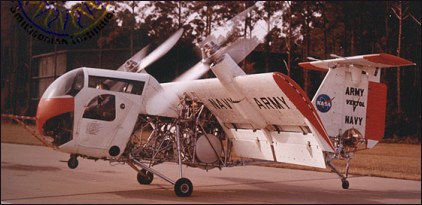
This VTOL configuration had not previously been tested in flight and the object of the programme was to build a test bed as quickly and as simply as possible. This was achieved by using available parts for several components – ¬a Bell helicopter canopy, wing actuators from the Piasecki XH 16, Piasecki HUP helicopter tail oleo struts as main undercarriage legs on the test bed and a number of parts from the Piasecki H 21. The Vertol Model 76, as the VZ 2 was known, was ready for flight in less than a year from the contract being placed.

The principal advantage of the tilt wing type of convertiplane is that it can be in most respects a conventional aircraft for cruising flight and therefore has good performance. In this respect it is similar to the tilting rotor type such as the Bell XV 3, there being some advantage in having the rotor/propeller assembly solid with the wing and tilting the whole component.

The vehicle, with much of the fuselage being of open-tubular construction, had a cockpit located far forward of the wing pivot point and featuring side-by-side seating for the two-man crew.

There were dual controls which could move control surfaces on the vertical stabilizer topped with a flat horizontal “T” configuration. The complexity of the concept was increased with the addition of a pair of ducted fans for pitch and yaw control, both being located in the tail.

A 660 horsepower Lycoming YT53-L-1 turboshaft was mounted by struts above the fuselage. The exhaust was vented outward to the left side of the rear stabilizer. Since the propellers were not attached to actual engines, the units that transferred the power from the fuselage-mounted engine resulted in considerably smaller wing units.
A portion of the turbine power was also transmitted through shafting to two ducted fans, one in the vertical and the other in the horizontal stabilizer. These fans, through a pitch-changing mechanism, were used for pitch and yaw control of the craft during hovering and transition flight.

Through a complex system which incorporated a cross shaft arrangement, the power was transferred to the pair of wing-mounted rotors which were located close to the center point of each wing. The rotors were large in diameter, at nine and one-half feet in span, and each carried three blades. The variable-pitch rotors, in addition to their primary power requirement, also provided supplemental roll control.

The craft proved to be extremely maneuverable, but was extremely slow with a maximum speed of only 215km/h. For safety purposes, the propellers were interconnected.

For aerodynamic reasons, the rear fuselage of the plane would later be skinned for smoother air flow.

Vertol test pilot Leonard La Vassar made the first flight in the VZ 2 (single example produced 56 6943) on April 13th, 1957, with the wings fixed for vertical flight. On January 7th, 1958, he made the first flight with wings horizontal and then set about ‘closing the gap’ to achieve a full transition in flight. This he did on July 15th, 1958.

Between then and September 23rd, 1959, Vertol completed 30 hours’ flying and then delivered the VZ 2 to N.A.S.A. at Langley Research Center. The first stage of N.A.S.A. testing involved another 20 hours’ flying in the next year. In this period, several modifications were introduced. A Martin Baker ejection seat was fitted changing the contours of the cockpit the rear fuselage was covered in and additional dorsal and ventral fin area was fitted.

N.A.S.A. also fitted a droop snoot leading edge to the wing. This was designed to delay the stall of the wing, which occurred initially at an incidence of 25 30 degrees, causing buffeting and control difficulties. In May 1961, Vertol was granted a new contract covering further modifications, including fitting of trailing edge flaps on the wing, which was originally flapless. With flaps, the aircraft has some characteristics of the deflected slipstream types and the stalling characteristics of the wing are further improved.

Another modification in the 1961 programme was to increase the rating of the Lycoming to 700 h.p. After testing by Vertol, the VZ 2A was returned to Langley Field. At the time the contract was placed, 448 flights had been made in the 50 hours, and 34 full and 239 partial conversions had been made.

Upon its retirement, the VZ-2A was given a place at the Smithsonian Institution.

Gallery

VZ-2A
Engine: Lycoming YT-53-L-1, 630kW / 860-shp
Rotor diameter: 2.90m
Wingspan: 7.60m
Fuselage length: 8.2m
Height: 3.15m
Take-off weight: 1443kg
Empty weight: 1128kg

Vertol 44

In 1958 New York Airways introduced the Vertol 44 single engine, tandem rotor helicopter into scheduled service, in and around the New York metropolitan area.

1955 Royal Swedish Navy
Two were used by the French Government as VIP transport

44
Engine: 1275hp Wright R-1820
Rotor diameter: 44’0″
Length: 52’6″
Useful load: 5420 lb
Max speed: 127 mph
Cruise speed: 101 mph
Range: 360 mi

44A
19p cargo version

44B
15p passenger version.

44C
Deluxe version of 44B

Vertol Aircraft Corp

USA
A wholly-owned subsidiary of Vertol Aircraft Corporation, the Canadian Company was operated as completely independent. It was formed in February 1954, on former RCAF airfield at Arnprior, Ontario, initially to service and overhaul helicopters. Vertol Aircraft Corp was the title from March 1956 of former Piasecki Helicopter Corporation of Morton, Pennsylvania.
Entered production with the Model 42A, a modified version of the Piasecki (Vertol) H-21 helicopter. A tandem-rotor general-purpose helicopter, it accommodated a crew of 1/2 and 18 passengers.
Helicopter products included Model 107 (civil), and CH-46 Sea Knight for naval supply. The latter was built by Kawasaki in Japan in 1978 as KV-107/II. Nearly 600 Vertol H-21 Work Horse military transport helicopters, Model 43 (military export version) and Model 44 (commercial transport based on H-21) were completed. Tilt-wing Model 76 VTOL research aircraft evaluated by USAF as VZ-2. Model 114/CH-47 Chinook heavylift military helicopter begun by Vertol, but primary development and production by Boeing Vertol.
Vertol was acquired by Boeing Company and became Vertol Division of the Boeing Company on 31 March 1960, later known as Boeing Vertol Company.

Canadian Vertol Aircraft Ltd, a wholly owned subsidiary of Vertol Aircraft Corporation, was formed February 1954 at the former RCAF air base Arnprior, west of Ottawa, to repair and overhaul RCAF/RCN Vertol helicopters. Sizes and weights

VFW Fokker SG 1262

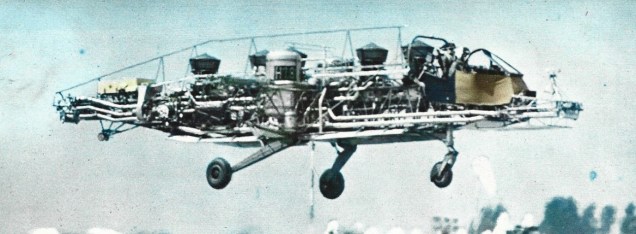
The German VFW SG 1262 Schwebegestell (hover rig) was designed and built in 1965 by Vereinigte Flugtechnische Werke (VFW) as an experimental aircraft to assist with the development of several vertical takeoff and landing (VTOL) military aircraft types that included the VFW VAK 191B, the EWR VJ 101 and the Dornier Do 31 transport. The 1262 designation relates to the initial numbering of the VAK 191B project by Focke-Wulf.

As part of the development of the VFW-Fokker VAK 191B vertical take-off aircraft, it was necessary to configure and test the monitoring of its flight control system. In order to minimise costs and risks during the development of the 191B the SG 1262 rig was designed and built in 1966 to simulate essential functions. Of high importance was the necessity to test the fly-by-wire flight control system, a redundant flight controller and a self-diagnosis system. A total of approximately 650 hours of simulation time, 2,000 hours of test runs on system test benches and 6,900 hours of wind tunnel tests were documented during the design phase of the project.

The aircraft was based on a trapezoidal frame without any skin panels. Deviating from the vectored thrust engine concept of the VAK 191B, five Rolls-Royce RB.108 turbojet lift engines with 9 kN (2,000 lbf) thrust each were mounted vertically. In addition to extensive sensor equipment, the rig used an auxiliary gas turbine for autonomous electrical power supply supply, it was also fitted with a Martin-Baker ejection seat.

The aircraft was based on a trapezoidal frame without any skin panels. Deviating from the vectored thrust engine concept of the VAK 191B, five Rolls-Royce RB.108 turbojet lift engines with 9 kN (2,000 lbf) thrust each were mounted vertically. In addition to extensive sensor equipment, the rig used an auxiliary gas turbine for autonomous electrical power supply supply, it was also fitted with a Martin-Baker ejection seat.

The control commands were transmitted via an electrical control (fly-by-wire) system with mechanical feedback. The flight control system had triple redundancy and double electro-hydraulic servo units with integrated self-monitoring. The control commands for the three axes were accomplished with compressed air nozzles that were actuated by a 280 bar (4,000 psi) high-pressure hydraulic system, movement of the main engines for control purposes was deliberately omitted. A direct mechanical back up of the compressed air control system was provided for emergencies.

40 tethered flights were initially carried out using a fixed telescopic apparatus before the aircraft flew in free flight for the first time on 5 August 1966. 150 free flights were made during the 18-month test program, including a demonstration flight at the 1968 Hanover Air Show at Hanover-Langenhagen.

Despite the discontinuation of all German vertical take-off programs the findings from experiments with the SG 1262 and experience gained from the VAK 191B project were used by German engineers during the development of the Multi Role Combat Aircraft (MRCA) project which became the Panavia Tornado.

The SG 1262 is preserved and on display at the Bundeswehr Museum of German Defense Technology in Koblenz.

Powerplant: 5 × Rolls-Royce RB.108 turbojet, 9 kN (2,000 lbf) thrust each
Gross weight: 3,900 kg (8,598 lb)
Fuel capacity: 800 kg
Maximum speed: 75 km/h (47 mph, 40 kn)
Endurance: 12 minutes
Service ceiling: 200 m (660 ft)
Thrust/weight: 1.15
Crew: 1

VFW Fokker Fanliner

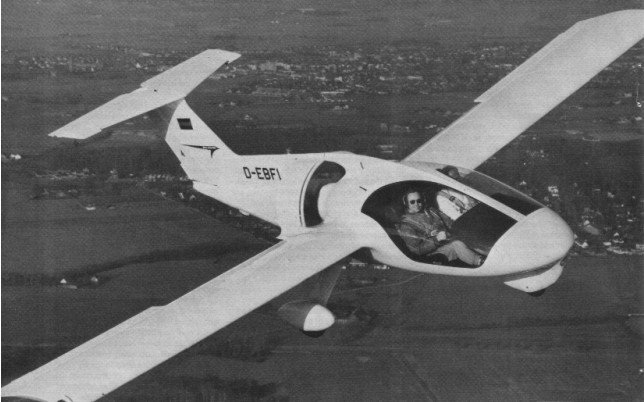
Built in collaboration with Grumman-American the Fanliner two-seat light aircraft with Wankel rotary engine, first flown in 1973. Grumman American decided not to market the Fanliner in the U.S. but VFW Fokker did borrow the Cheetah wing and horizontal tail to build their pusher.
It was re-engined in 1976 with a Dowty Rotol ducted propulsor. Based on the Fanliner’s promise, the Federal German Government awarded a contract for two Fantrainer prototypes with ducted fan engines, first flown in 1977 and 1978.

VFW Fokker VFW-614

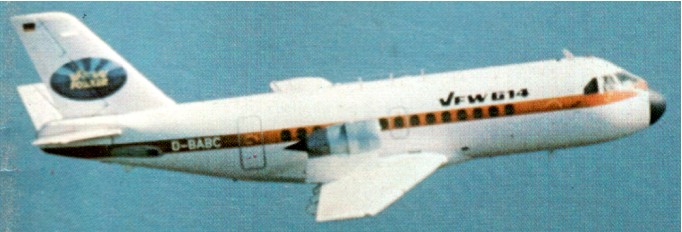
The VFW 614 twin-turbofan shorthaul transport was first flown in July 1971. German certification had been gained on 23 August 1974 and the first production aircraft had flown on 28 April 1975, but only 19 aircraft (including prototypes) were completed, and most ended up in storage at Bremen after very short working lives. Production was halted in 1978.

VFW Fokker VFW-614 Article

The VFW Fokker VFW 614 short-haul transport entered service with the Danish airline Climber Air in November 1975.

Engine: 2 x Rolls-Royce M45H
Wing span: 70 ft 6.5 in
Length: 67 ft 7 in