IAR IAR-817

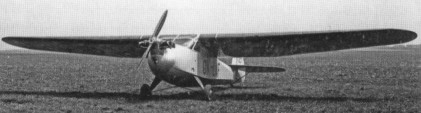
In 1955, a prototype of a new utility aircraft, the IAR-817, was first flown at the URMV-3 works of Industria Aeronautică Română at Brașov. The URMV-3 works had been formed at the Sovromtractor tractor factory, itself on the site of the Industria Aeronautică Română aircraft works. It was a single-engine high-wing monoplane with a pod-and-boom type fuselage of welded steel tube construction and fabric-covered wooden wings. It had a fixed tricycle undercarriage. The aircraft was powered by a single 120 kW (160 hp) Walter Minor 6-III air-cooled six-cylinder inverted inline engine.

An air-ambulance version of the IAR-817, the IAR-817S, entered production in 1957, with over 60 built.

The type formed the basis of the IAR-818, built from 1961.

Engine: 1 × Walter Minor 6-III, 120 kW (160 hp)
Propeller: 2-bladed variable-pitch
Wingspan: 12.6 m (41 ft 4 in)
Wing area: 25.4 m2 (273 sq ft)
Length: 9.8 m (32 ft 2 in)
Height: 3.4 m (11 ft 2 in)
Empty weight: 800 kg (1,764 lb)
Max takeoff weight: 1,150 kg (2,535 lb)
Maximum speed: 175 km/h (109 mph, 94 kn)
Cruise speed: 165 km/h (103 mph, 89 kn)
Stall speed: 70 km/h (43 mph, 38 kn)
Range: 560 km (350 mi, 300 nmi)
Ferry range: 930 km (580 mi, 500 nmi)
Service ceiling: 3,000 m (9,800 ft)
Time to 1,000 m (3,300 ft): 7 minutes 30 seconds
Take-off run: 150–180 m (490–590 ft)
Landing run: 60 m (200 ft)
Crew: 1 or 2
Seats: 4-5

CNIAR / IAR / Industria Aeronautica Romania / ICA Brasov / IAR-SA Brasov / Regia Autonoma Industria / Aeronautica Romana / Intreprinderea de Constructii Aeronautice / URMV-3 / Sovromtractor

In 1925 was established in Brason the first large Romanian aircraft named “Societate Anonima Industria Aeronautica Romana” (IAR) to build aircraft and aero engines. Between 1925 and 1945 this company built around 1000 aircraft of 25 different types of which eight were under foreign licence including the Potez 25, Morane-Saulnier 35, Fleet 10-G, PZL11 c and XXIV. Indigenous designs included the IAR.15 single-seat fighter monoplane.
The most known aircraft entirely conceived and built by this company was the IAR-80 combat plane, ranked the fourth in the world at the time of its appearance in 1939.
Renamed Regia Autonoma Industria Aeronautica Romana in 1940, but still using IAR for types.
Came under joint Soviet/Romanian control as Sovromtractor from 1946, with Brasov works known as URMV-3 between 1950 and 1959. Only a team of enthusiastic specialists led by Iosef Silimon continued to design, build, and repair light aircraft.
Aircraft development at Brasov by mid-1956 included IAR 811 piston trainer (first flown 1949), IAR 813 two-seat lightplane, IAR 814 twin-engined transport of 1953 and IAR 817 single-engined general-purpose light transport of 1955. Aircraft from LFIL factory at Reghin included RG-6 tandem two-seat sports and training monoplane.
The ICA-Brasov or Intreprinderea de Constructii Aeronautice Brasov (Aircraft Construction Factory Brasov) is responsible for all sailplane development and production in Romania, and their principal designer is Professor losif Silimon, who has created a long series of sailplanes that are widely used in the national clubs; these are prefixed by the letters ‘IS’ which form the Professor’s initials.

In 1968 it was decided to restore the the aircraft factory under the new name “ICA Brasov”. Undertook repair and overhaul of light aircraft; built aircraft of its own design, such as the IAR-824 six seat general-purpose light aircraft and IS-28/IS-29 sailplanes, manufactured Aerospatiale SA 316B Alouette III helicopters under license, participated in license-construction of the Britten-Norman BN-2A Islander and carried out series production of nationally designed aircraft.
In 1976 the IS28M2 motor glider began manufacture, and in 1977 the tandem two-seat IS28M1 motor glider prototype had been completed, from which the IAR-34 was derived.
Name changed to IAR-SA Brasov in 1991. Has built Aerospatiale Alouette helicopter as IAR 316B (280), Russian Ka-126 helicopter, and French Puma helicopter (as IAR 330L Puma) under license, with Puma 2000 upgraded IAR 330L model offered with more engine power, Hellfire antiarmor missiles and advanced avionics among changes. Has agreement with Eurocopter to construct up to 80 AS 350BA and AS 355N helicopters. Made agreement with Bell Helicopter Textron of U.S.A. to license build 96 AH-1W SuperCobra attack helicopters for the Romanian armed forces as AH-1RO Draculas, with Bell taking a majority shareholding in the privatizing company as part of the agreement. Kraiova works to license-manufacture Russian Beriev Be-32K. Own products include IAR 46 two-seat lightplane (first flown 1993), IAR-35 glider, and IS-28 series of gliders/motorgliders.
2008: IAR Brasov No. 1, Aeroportului Street P.O. Box 198 Brasov 2200 Romania

Compagnia Nazionale Aeronautica / CNA D / D.4

The CNA D, often known as the CNA D.4, was a four-cylinder, air-cooled, horizontally opposed engine built in Italy between 1940 and 1951 to power light aircraft.

Specifications:
Bore: 100 mm (3.9 in)
Stroke: 95 mm (3.7 in)
Displacement: 3.0 L (182 cu in)
Compression ratio: 5.3:1
Rated Power: 45 kW (60 hp) at 2,100 rpm
Fuel consumption at rated power: 0.34 kg/kW hr (0.56 lb/hp hr)
Weight: 80 kg (180 lb)

Applications:
Adam RA-14 Loisirs
Ambrosini SAI.10
CNA PM.1
CNA MPL
CVV Tartaca
Druine Condor
GCA Pedro
GCA Etabeta
Lombardi FL.3
Lombardi FL.5
Lombardi FL.7
Macchi MB.308

Clutton FRED

Designed by Eric Clutton of Stoke-on-Trent in conjuction with E.Sherry during 1957 to 1963. FRED stands for “Flying Runabout, Experimental Design,” but the design is now far from experimental, says its designer – Eric Clutton. A parasol-type single-seater, FRED has folding wings for road-towing. It has steel spring shocks for rough-field operations. Volkswagon powered.

Clutton started building the first, G-ASZY PFA.1311 cn EC/ES/1A in 1957 at Stoke-on-Trent, finished at Meir and first flown from there on 3 November 1963 with a modified Triumph 5T as FRED Series 1. It was re-engined with a Scott A.2S in 1965 to demonstrate the wide range of engines it can take. It was further re-engined in 1966 with a Lawrence radial as FRED Series II.

Fred G-ASYZ 1966 Lawrence radial

From 1968 it was used as a testbed for the Clutton belt-reduced VW of various sizes and drives, eventually with an EC/VW1500.

Fred G-ASYZ 1971 geared VW

Badly damaged at Meir in 1974, it was rebuilt and flown again in mid-1975 in WW1 German markings including lozenge markings.

Sywell 1975

Engine: VW, 65 hp.
HP range: 55-65.
Height: 6 ft.
Length: 16 ft.
Wing span: 22.5 ft.
Wing area: 110 sq.ft.
Speed max: 85 mph.
Cruise: 70 mph.
Stall: 29 mph.
ROC: 500 fpm.
Take-off dist: 900 ft.
Landing dist: 450 ft.
Fuel cap: 14 USG.
Weight empty: 550 lbs.
Gross: 800 lbs.
Seats: 1.
Landing gear: tail wheel.

CKD-Praga E-114 Air Baby / E.115 / Hilton Praga

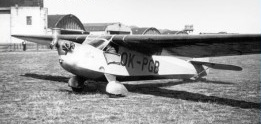
The 40 hp Praga B powered prototype, OK-PGA, first flew in Seqtember 1934 and was Praga’s first civil project.
Sixty-three were built.

Following a demonstration tour in the UK in 1935, F.Hills & Sons on Manchester, acquired a licence to build the E.114 as the Hillson Praga. The first Hills & Sons Ltd licence-built Praga E.114 was sold to Australia, and the second registered G-AEEU became the company’s demonstrator in April 1936. Total production by Hills amounted to twenty-eight aircraft, plus seven uncompleted during 1936 and 1937, selling for £385-435.

Praga E-114 Air Baby

In 1936 H.L.Brook set a new Lympne to Cape Town record of 16 days in one of the British built examples.
The E.114bis was fitted with a 65 hp Praga D engine. The prototype E.114bis, OK-PGF, was flown before the Second World War, as was the E.115, an improved version with a shorter wing.

After the war, the Air Baby was relaunched as the E.114D.

CKD-Praga E.114 Air Baby
Engine: Praga B, 29 hp
Length: 21.654 ft / 6.6 m
Wingspan: 36.089 ft / 11.0 m
Wing area: 163.613 sqft / 15.2 sqm
Max take off weight: 1080.5 lb / 490.0 kg
Weight empty: 639.5 lbs / 290.0 kg
Max. speed: 94 kts / 175 km/h
Cruising speed: 79 kts / 147 km/h
Service ceiling: 11483 ft / 3500 m
Wing load: 6.56 lb/sq.ft / 32.00 kg/sq.m
Range: 297 nm / 550 km
Crew: 2

CKD-Praga E.114 Air Baby
Engine: Praga D 1, 75 hp.

E.114bis
Engine: 65 hp Praga D