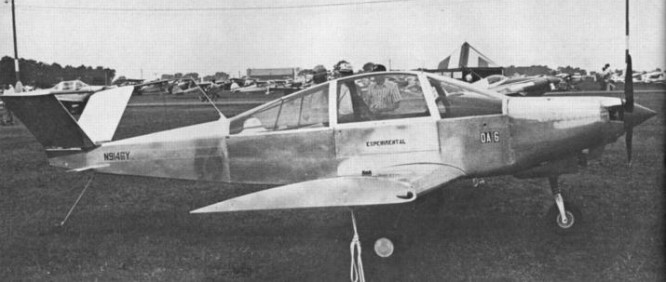
The first DA-6, registration N9146Y, was built by Leeon D Davis in 1981. DA-6 and later use the USA 35B airfoil modified with a flat bottom.
Engine: Lycoming O-235
Wingspan: 22 ft
Empty Weight: 850 lb
Gross Weight: 1580 lb
Seats: 3-4
The first DA-6, registration N9146Y, was built by Leeon D Davis in 1981. DA-6 and later use the USA 35B airfoil modified with a flat bottom.
Engine: Lycoming O-235
Wingspan: 22 ft
Empty Weight: 850 lb
Gross Weight: 1580 lb
Seats: 3-4
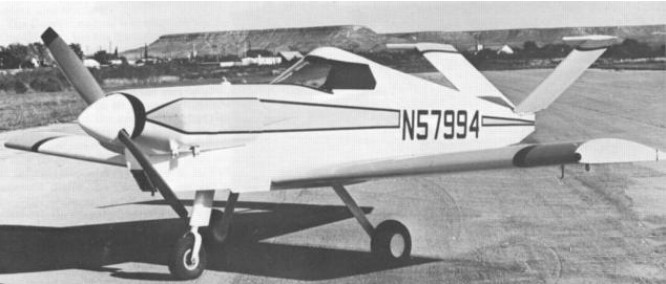
The DA-5A single-seat, low-wing monoplane makes use of the same V-type tail as the DA-2A. The pilot sits inside an enclosed canopy behind a 65-hp Continental turning a fixed-pitch prop. Both the wings and fuselage are alight alloy structure with stressed skins, and the landing gear is the non-retractable tricycle type.
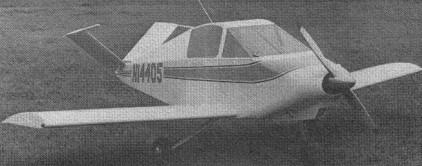
Many DA-5 and DA-5A aircraft have been built from plans. DA-1 through DA-5 used the Clark Y airfoil.
DA-5
1974
Engine: Cont A-65
Wingspan: 15′ 7″
Length: 15′ 9″
Empty Weight: 460 lb
Gross Weight: 770 lb
Seats: 1
DA-5A
Engine 65-hp Continen¬tal.
Gross Wt. 775 lbs.
Empty Wt. 460 lbs.
Fuel capaci¬ty 17 USG.
Wingspan 15’7”.
Length 15’9”.
Wing area: 82.5 sq.ft.
Top speed 160 mph.
Cruise 140 mph.
Stall 60 mph.
Climb rate 800 fpm.
Ceiling 14,500 ft.
Takeoff run 600 ft.
Landing. roll 600 ft.
Range 450 sm.
Seats: 2
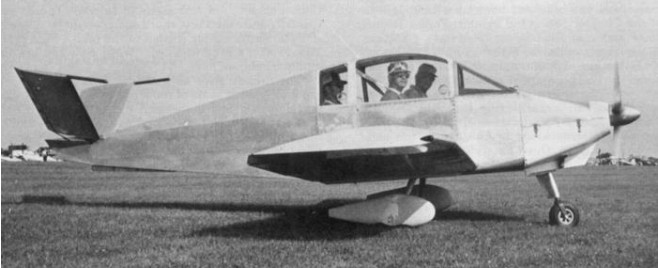
A stretched version of the DA-2A. DA-1 through DA-5 used the Clark Y airfoil.
Engine: Continental O-200
Wingspan: 22 ft 3 in
Length: 19 ft 8 in.
Empty weight: 820 lb
MTOW: 1600 lb
Seats: 3-4
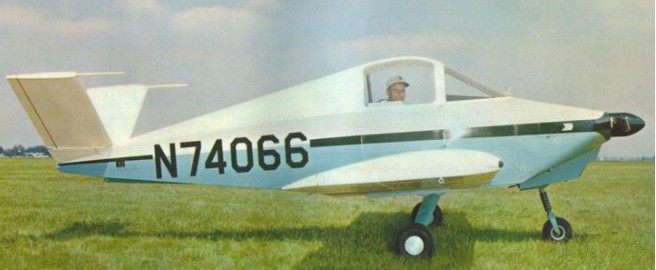
In 1966, the Davis all-metal design was voted the most popular at the Rockford EAA Fly-in. It requires little work on the part of the builder because of its simple construction, with no compound curves or ex-pensive fittings. The Davis design uses the 100-hp Continental and is one of the few do-it-yourself planes with a V-tail. Of low-wing, two seat side-by-side and nose undercarriage. The prototype DA-2 nosegear used a spring instead of rubber doughnuts. Engine range 65-100 hp.
Many DA-2A and DA-2B aircraft have been built from plans. DA-2A scratchbuilding plans describe both DA-2A and DA-2B versions. DA-1 through DA-5 used the Clark Y airfoil.
The DA-4 was completed as DA-2C. The DA-4 was intended as the production version of the DA-2, but was sold unfinished. Brent Hughes finished it as DA-2C N26146. This should not be confused with the D2C “Bandit” mods.
DA-2A
Engine: Cont A-65
Wingspan 19’3”.
Length 17’l0”.
Gross Wt. 1125 lbs.
Empty Wt. 610 lbs.
Fuel capacity 20 USG.
Top speed 120 mph.
Cruise 115 mph.
Stall 62 mph.
Climb rate 400 fpm.
Takeoff run 800 ft.
Landing roll 700 ft.
Range 450 sm.
Seats: 2
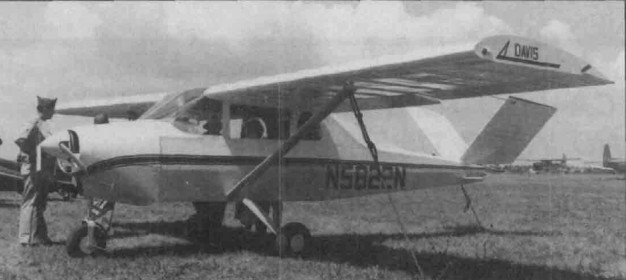
The Davis DA-1 was a light aircraft designed in the United States in the 1950s which never progressed beyond the prototype stage.
Leeon D. Davis constructed his DA-1 starting on 24 April 1957. It was a strut-braced high-wing single-engine all-aluminum airplane designed around the new Lycoming O-360 engine. The fixed-nosegear-equipped piston-engine DA-1 was of otherwise conventional configuration, but a V-tail.
Wings and tail surfaces of the DA-1 used external heat treated ribs; those surfaces were of constant chord. DA-1 through DA-5 used the Clark Y airfoil.
Power for the DA-1 was a horizontally-opposed Lycoming O-360 of 180 hp (134 kW), which gave a top speed of 125 mph (201 km/h).
Registered N5822N, it was first flown on 24 May 1958, initial test flights showed that there was not enough elevator authority with full flaps, and the plane was very loud. Soundprofing, and aerodynamic modifications were applied. Davis tried to bring the plane to market as a certified aircraft (his goal was a selling price of under $10,000), but was not successful.
DA-1
Powerplant: 1 × Lycoming O-360, 180 hp (134 kW)
Length: 22 ft 3 in ( m)
Wingspan: 32 ft 0 in (9.76 m)
Wing area: 167 ft2 ( m2)
Empty weight: 1,200 lb (545 kg)
Gross weight: 2,370 lb (1,080 kg)
Maximum speed: 125 mph (201 km/h)
Range: 475 miles
Crew: One pilot
Capacity: 4 passengers
Number built 1
Between 1958 and 1961 Leon D.Davis began development of the five-seater DA-1 light aircraft. Designed subsequently a number of light aircraft for construction by amateur enthusiasts. Davis was a very active designer with some 11 subsequent designs in his name (only the DA-10 was not built and the DA-4 was completed as DA-2C).
1980: Leeon D. Davis, Box 207, North St. Paul, Stanton, TX 79782, USA.

On 10 July 1969 a project called Alpha Jet was started by the governments of Germany and France to cooperatively create a light aircraft for advanced jet training and for the tactical support role. The contenders were the following: Dassault-Brequet joined up with Dornier with the TA-501, Aérospatiale with MBB with the E-650 Eurotrainer and VFW with their own T-291 project. On 23 July 1970, the TA-501 project from Dassault-Dornier was selected, a tandem seat twin-engined jet trainer and light attack aircraft.
Dassault-Breguet / Dornier Alpha Jet Article
Dassault-Brequet was responsible for building the front fuselage and assembly of the trainer variant as well as the export orders. Dornier in Germany produced the rear fuselage, the tail, wings and assembled the attack variants. The Alpha Jet is power by two Larzac jet engines, which were designed by Turbomecca, SNECMA, MTU and KHD. On 30 November 1972 the first mock up was accepted by both governments and a contract for the production of four prototypes.
On 26 October 1973 prototype 01 made the first flight, sixth months ahead of the contract scheduled date. The official presentation flight was flown on 23 November in 1973 at Isres, France.
On 9 January 1974, the second prototype made its maiden flight, followed by prototype 03 on 4 May and prototype 04 on October 11th. Alpha Jet E entered production in 1977. The first production Alpha Jet E 1 was flown at Istres, France, on 4 November 1977. The aircraft features a DEFA 30mm cannon.
The German Alpha Jet A entered production a year later. Production aircraft were delivered starting in 1978, with French aircraft operating as pure trainer aircraft, while German aircraft were employed as light attack aircraft. The two types can be distinguished visually by the rounded nose of the French aircraft compared with the pointed nose of German aircraft. The aircraft feature a simple but sophisticated design, utilizing fixed leading edges and air intakes, and an area ruled fuselage to minimize transonic drag. The Alpha Jet was also designed to be turned between sorties quickly, and features single-point refueling, and no required ground-support equipment. Alpha Jet A was the light attack variant for the Luftwaffe designed to replace the Fiat G.91R/3s in the light attack and close air support role. The A is therefor equipped with a more advanced nav/attack system including HUD, Doppler navigation radar and twin-gyro INS. The German versions were equipped with a 27mm Mauser cannon, replacing the French DEFA. Alternatively a Super Cyclone recce pod could be carried on the centeline station.

Principal customers were the air arms of the partner countries, the French Air Force taking 176 between 1978 and 1985, and the Luftwaffe 175 between 1979 and 1983.
The Alpha Jet E was produced for the French Air Force and several export customers, including Egypt, where it is known as the MS1.

The Arab Organisation for Industrialisation’s Helwan factory assembled 37 Alpha Jets from CKD kits between 1982 and 1985, and also produced some components under licence. The Egyptian Air Force also received eight aircraft assembled in France.
The close-support version (Alpha Jet A) was built for the West German Air Force; while the alternative close support version, with a new navigation/attack system, was sold to the Cameroon and Egypt as the M52. The Alpha Jet Nouvelle Generation pur l’Ecole et l’Appui (NGEA), now known as the Alpha Jet 2, incorporates the navigation/attack system of the M52 together with uprated Larzac 04-C20 engines and Magic 2 AAMs. No NGEA sales have been achieved, but Egyptian M52s are to be upgraded to NGEA standard. The fifth version, announced in 1985, is the Alpha Jet Lancier. Derived from the NGEA, the Lancier is intended for day/night ground attack, anti-shipping strikes, and anti-helicopter duties. In addition to the NGEA systems it has a Flir, Thomson-CSF Agave multimode radar, active and passive ECM, anti-shipping missiles, and laser guided bombs. No orders for the Lancier have been achieved to date. The Alpha Jet 3 is an advanced training version for use with FLIR, laser and ECM systems.
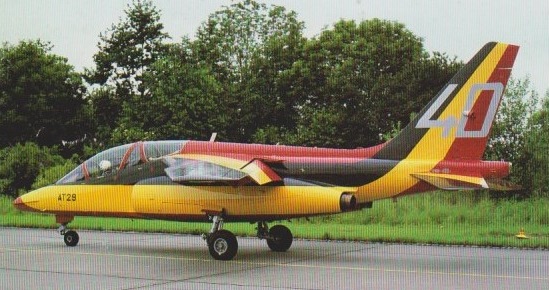
Under an independent programme, the Luftwaffe is retrofitting more powerful Larzac 04-C20 engines to boost performance. A limited armament and avionics upgrade had been approved for the Luftwaffe’s Alpha jet fleet for service from 1992.
By early 1986 more than 480 Alpha Jets had been delivered, against orders for 501 for ten customers.
The German Luftwaffe was the sole operator of the Alpha Jet A light attack version until the 1990s. The first production aircraft flew in 1979 and three years later Dornier closed the production line. The 175 Luftwaffe Alpha Jets replaced the Fiat/Aeritalia G.91R, of which 300 were operated in the tactical support and light attack role. In the 1990s the Alpha Jet was slowly withdrawn from service, the last example being officially retired on 31 December 1998. A large number of aircraft was sold to other nations and about 40 aircraft were put into storage at Fürstenfeldbruck. Two examples have been bought and restored for flying with the Flying Bulls, a display team sponsored by Red Bull.
The Alpha Jet E trainer version for France entered service with the Armée de l’Air replacing the Fouga Magister, Lockheed T-33 and the Dassault Mystère IVA.
The Belgian Air Force needed an advanced trainer and was interested in the development of the Alpha Jet since the start of the project. Belgium operated 28 aircraft, which have been upgraded prolonging their service life until at least 2015. The upgrade was carrier out by SABCA (Société Anonyme Belge de Constructions Aéronautiques), the first upgraded example being delivered back to the air force on 21 April in 2000. The upgrade features a new flightstick, advanced HUD, GPS, ILS and a multi function display in the rear cockpit.
In 1994 50 ex-Luftwaffe Alpha Jets were sold to the Portuguese Air Force. In service with Squadrons 103 Caracóis (Snails) for complementary flying training and operational conversion training and with Squadron 301 Jaguares (Jaguars) on the offensive air support role, both squadrons operated from Beja airbase.
Operators: Belgium, Cameroon, Egypt, France, Ivory Coast, Marocco, Nigeria, Portugal, Qatar, Thailand, Togo.
In 2017 Alpha Jets were still in service with the militaries of France, Belgium, Egypt, Portugal, Thailand, and are operated by EPNER and Empire Test Pilot School.
Breguet Alpha Jet
Engines: 2 x SNECMA / Turboméca Larzac 04-C5, 13244 N
Length: 40.322 ft / 12.29 m
Height: 13.747 ft / 4.19 m
Wingspan: 29.888 ft / 9.11 m
Wing area: 188.37 sqft / 17.5 sqm
Max take off weight: 13230.0 lb / 6000.0 kg
Weight empty: 6945.8 lb/ 3150.0 kg
Max. speed: 535 kts / 991 km/h
Initial climb rate: 11614.17 ft/min / 59.00 m/s
Service ceiling: 44948 ft / 13700 m
Wing load: 70.32 lb/sq.ft / 343.00 kg/sq.m
Range: 680 nm / 1260 km
Range (max. weight): 432 nm / 800 km
Crew: 2
Armament: 1x MK 30mm, 2500kg ext.
Alpha Jet
Engine: 2 x Snecma/Turbomeca Larzac 04-C6.
Installed thrust: 26.5 kN.
Span: 9.1 m.
Length: 12.3 m.
Wing area: 17.5 sq.m.
Empty wt: 3855 kg.
MTOW: 7940 kg.
Warload: 2720 kg.
Max speed: 1000 kph.
Initial ROC: 3420 m / min.
Ceiling: 14,600+ m.
T/O run: 410 m.
Ldg run: 610 m.
Fuel internal: 1900 lt.
Range/Endurance: 1230 km / 3.5 hr.
Combat radius: 350-1075 km.
Armament: 1 x 27/30 mm, 2 x AAM.
Hardpoints: 4/5.
Alpha Jet
Max Speed: 550 KIAS / .95 M
Ceiling: 47,000 ft
G-Limits: +8 / -5
Payload: 1,360 lb on each inner pylon, 635 lb on each outer pylon
EW: Wired for ALQ-167 and ALQ-188
Endurance: 2.5+ hr with 2 drop tanks
Empty Weight: 7,850 lb
Useful load: 8,600 lb
Alpha Jet E
Engines: two 13.24 kN (2,976 lb st) SNECMA/Turbomecca Larzac 04-C6 non-afterburning turbofan
Wing span 9.11 m (29 ft 10¼ in)
Wing area: 188,4 sq,ft / 17,50 sq m
Length 11.75m (38 ft 6½ in)
Height 4.19m (13 ft 9 in)
Empty weight 3345 kg (7,374 lb)
Max Take-Off Weight 8.000 kg (17,637 lb)
Max level speed at sea level 1000 km/h (621 mph)
Service ceiling 14,630m (48,000 ft)
Climb to 30,000ft/9145m: 7 min 0 sec
Radius: 764 mi / 1230 km
Armament: one Mauser 27mm or DEFA 30mm ventral cannon pod with 125 rpg
Ordnance: 2500 kg (5,511 lb)
Hardpoints: 4
Following agreement between the French and German governments in 1969 to procure a new subsonic basic and advanced training aircraft, suitable for deployment also in a close-support or battlefield reconnaissance role, Dassault-Breguet and Dornier developed Alpha Jet, with involvement also by SABCA in Belgium and other French and German companies. Powered by twin turbofan engines, Alpha Jet first flown in October 1973; production eventually totaled 504, the majority going to Armee de I’Air and Luftwaffe, but others to Belgium, Cameroon, Egypt (assembled by AOI), Ivory Coast, Morocco, Nigeria, Qatar, and Togo. The final versions available were the Alpha Jet basic trainer, Alpha Jet 2 strike aircraft, and Alpha Jet ATS advanced trainer with an advanced “glass”cockpit, laser designation, ECM, and more.
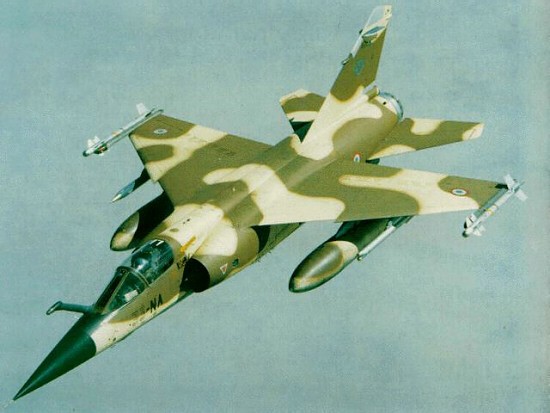
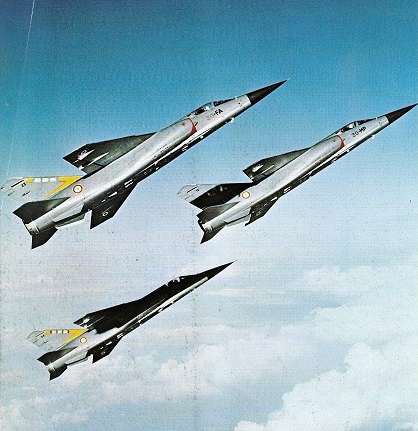
In the 1960s Dassault designed the Mirage F1 as a successor for the Mirage III family. Loss of energy in low-level manoeuvring flight of the delta-winged Mirage III led to development of a traditional layout for the wing.
Evolved in parallel with the Mirage F2 as a scale-down, multi-role single-seat fighter employing a SNECMA Atar turbojet, the Mirage F1 was the subject of a government contract awarded in 1964. Possessing a conventional sweptback wing equipped with high-lift devices, and conventional swept tail surfaces, the private venture prototype F1 flew on 23 December 1966.
On 23 December 1966 the first prototype made its maiden flight. Three pre-series aircraft were ordered in September 1967, the first of these flying on 20 March 1969.
The initial production model for France’s Armee de l’Air was designated F1C, placed emphasis on the intercept mission, was powered by an Atar 9K-50 turbojet affording 7200kg with afterburning, and had an armament of two 30mm cannon, two Matra 550 Magic and two Matra R 530 or Super 530 AAMs. An initial order for the F1C for the Armee de l’Air was placed in 1969, 162 being procured by that service (plus 64 recce F1CRs and 20 two-seat F1B trainers), initial operational capability being achieved in 1974. Many of the Armee de l’Air aircraft were delivered in, or retroactively modified to, F1C-200 standard with an 8cm fuselage plug to accommodate a removable flight refuelling probe.
The Mirage F.1C entered service with France’s air defence command (CAF-DA) in 1973, equipped with Thomson-CSF Cyrano IV all-sector fire-control radar. This type has also met with considerable success on the export market, customers including Ecuador, Greece, Iraq, Jordan, Kuwait, Libya, Morocco. South Africa and Spain. Production of 81 of this variant was followed by 89 Mirage F.1C-200 fighters fitted with a fixed inflight-refuelling probe at the base of the windscreen. The F.1-CR-200 became operational in July 1983, and carries cameras and infrared sensors internally with additional sensors in an under-fuselage pod. Improved navigation systems, radar, and a flight refuelling probe fitted as standard.
The Armée de l’Air (French Air Force) operated the F1C as its main interceptor fighter until the service entree of the Mirage 2000 in 1984.
The first flight was made by the Dassault Mirage F.1B two seat dual role trainer/tactical aircraft on 26 May 1976. Twenty Mirage F.1B conversion trainers (based on the Mirage F.1C but lacking its internal cannon) have also been received. It proved attractive to overseas customers, initial orders being received from Ecuador, Iraq, Jordan, Kuwait, Libya, Morocco and Spain.

Single-seat aircraft, including the F.1A with its slightly increased fuel tankage, have a notional maximum weapon-carrying capacity of 13,889 lb (6 300 kg), excluding the fitted cannon. This total is made up of 4,630 lb (2 100 kg) on the centreline; 220 lb (100 kg) of chaff/flare dispensers on the fuselage shoulder; 2,866 lb (1 300 kg) at the inner wing; 1,213 lb (550 kg) on the outer wing pylons, and 331 lb (150kg) on the wing-tip AAM positions. Maximum FIC/E internal fuel capacity is 946 Imp gal (4 300 1) or 7,568 lb (3 433 kg) of Jet A-1 /Avtur whilst three external tanks can hold a further 1,012 Imp gal (4 600 1) or 8,096 lb (3 672 kg). Fuel and weaponry must be traded-off between the confines of a 16,314 lb (7 400 kg) empty weight and 35,715 lb (16 200 kg) max take¬off weight.
French Air Force F.1-Cs were delivered as or converted to F.1-C-200s by the installation of detachable flight refuelling probe.
The Mirage F1E was a dedicated strike and attack aircraft which incorperated upgraded systems, including radar. Dassault also designed a two-seat version of the F1E for training, designated F1D.
A simplified version, lacking certain avionics such as the Cyrano radar, was produced for South Africa (F1AZ and F1CZ for the interceptor variant) and Libya for the clear-weather attack role with ranging radar as the Mirage F.1A, with Aida radar in a slimmer nose filled with much of the electronics previously located behind the cockpit, where more fuel could now be stored. Other additions were Doppler navigation, an inertial platform. and a laser rangefinder. Libya, together with Iraq, Jordan, Morocco, Qatar and Spain, also bought the multi-role Mirage F.1E. An export model, the Mirage F.1E, is based on the F.lC with upgraded Cyrano IVM radar offering terrain-avoidance, air-to-surface ranging, and look-down capability. The model also has an inertial platform, digital computer, and improved head-up display. The Mirage F.1E entered service in 1976, and offered multi-role capability, including anti¬ship attack with the AM.39 Exocet missile.
According to Dassault data the Mirage F1E’s LO-LO combat radius with one centreline Exocet, two Magics, two ECM pods and two 264 Imp gal (1 200 1) external tanks is 435 mls (700 km), including the missile’s range of 37-43 mls (60-70 km). This is achieved at a cruising speed of 400 kts (742 km/h), apart from the first 59 mls (95 km) of the homeward flight, which are flown at 550 kts (1 019 km/h). Radius can be increased to 559 mls (900 km) with one “buddy” refuelling. A larger, 484 Imp gal (2 200 lt), tank is also available, but can be fitted only singly on the centreline pylon and has hitherto been employed mainly for ferrying. With one large and two small tanks and a H1-LO-HI mission profile, the Mirage F.IE’s radius may be increased to 870 mls (1 400 km), but only if the Magics and ECM pods are left at home and the weapon load reduced to just two 250-kg (55l-lb) bombs.
Production of the AM.39 Exocet armed Mirage F.1-EQ6 for the Iraqi Air FoU continued until late 1988. The French Air Force has received the last of its Mirage F.1-CR-200 reconnaissance fighters.
The specialized reconnaissance model is the Mirage F.1CR (based on the Mirage F.1C-200 and with a secondary attack capability) and this replaced the 50 or so Mirage IIIR/RD aircraft which equiped the 33e Escadre at Strasbourg, the French air force’s sole tactical reconnaissance unit. Selected in February 1979, two Mirage F.ICR prototypes were produced for test duties, the first making its maiden flight on 20 November 1981. These two machines being followed by 62 production examples. Mission-related equipment includes OMERA cameras carried internally together with an infra-red sensor, while additional electromagnetic or optical sensors can be housed in an external pod fitted beneath the aircraft’s belly. Air-to-air missiles can also be carried for defensive purposes, while inflight-refuelling gear is also fitted as standard.
First flown on 22 December 1974, and built as an engine test bed under official contract, the Mirage F1.M53 was also envisaged as the basis for a contender in the contest to find a successor for the Lockheed F-104G in service with Belgium, Denmark, the Netherlands and Norway. Evolved from the basic Atar 9K-50 turbojet-powered Mirage F1C, the Mirage F1.M53 – referred to for a brief period as the “F1E”, the suffix letter signifying Exportation and the designation subsequently being reassigned – was powered by the SNECMA M53 turbofan rated at 5550kg dry and 8500kg with maximum afterburning. M53 installation involved significant fuselage structural redesign, and to provide suitability for ground attack and long-range interdiction tasks in addition to that of interception, provision was made for multi-role avionics. By comparison with the F1C, the F1.M53 had increased fuel capacity, enlarged engine air intakes and strengthened undercarriage. The nose profile was revised to provide for the introduction of a retractable flight refuelling probe. The installed armament remained two 30mm cannon and it was proposed to distribute up to 4000kg of ordnance between seven external stations. The other contenders for the multi-national fighter contract were the Saab 37 Viggen and the General Dynamics F-16. With choice of the F-16 as winner of the competition, plans to produce a second prototype F1.M53 for testing and integration of systems were discarded.
Variants of the basic aircraft offered for export, in addition to the F1C, were the F1A with simplified avionics for operation under VFR conditions and the F1E multi-role air superiority/ground attack/reconnaissance version. Export customers were Ecuador (16 F1AJs), Greece (40 F1CGs), Iraq (113 F1EQs), Jordan (17 F1CJs and 17 F1EJs), Kuwait (27 F1CKS), Libya (16 F1ADs and 16 F1EDs), Morocco (30 F1CHs and 20 F1EHs), Qatar (12 F1EDAs), South Africa (32 F1AZs and 16 F1CZs) and Spain (45 F1CEs and 22 F1EEs). Production of the Mirage F1 was completed in 1990 with 731 built (including F1B and F1D two-seat trainers and F1CR reconnaissance aircraft). In 1991, work began on the adaptation of 30 F1C-200S as F1CT ground attack fighters.
In the 1991 Gulf War, the Mirage F1 was operated on both sides. In the 1980s Dassault sold a large number of Mirage F1E and some F1B aircraft to Iraq (designated F1EQ and F1BQ respectively). When coalition forces struck numerous hardened aircraft shelters to neutralize the Iraqi Air Force in support of operation Desert Storm, many of these aircraft were destroyed. Taking part in the coalition was France, supporting air operations with F1CR and F1CT aircraft.
The last French F1 Mirage was retired from active service in June 2014, and stored at Châteaudun air base, near Paris, while waiting for a buyer. Replaced in the French Armée de l’air by the Dassault Mirage 2000 and Dassault Rafale, it was still in use in five air forces around the world. Draken International was after the retired French planes. Instead, in December 2017, it acquired 22 Mirage F1 fighter jets from the Spanish Air Force.
Mirage F1C
Powerplant: one 70.21 kN (15,873 lb st) SNECMA Atar 9K-50 turbojet
Length 15.23m (49 ft 11½ in)
Height 4.50m (14 ft 9 in)
Wing span (over tip missiles) 9.32m (30 ft 10 in)
Wing area: 25 sq.m / 269.10 sq ft
Empty weight: 7400 kg / 16314 lb
Max Take-Off Weight 16.200 kg (35,714 lb)
Max level speed at 12,000m (39,370 ft) Mach 2.2 or 2350 km/h (1,460 mph)
Landing speed: 124 kts / 230 km/h
Cruising speed: 478 kts / 885 km/h
Initial climb rate: 41338.58 ft/min / 210.0 m/s
Service ceiling 20,000m (65,615 ft)
Range w/max.payload: 900 km / 559 miles
Armament: two DEFA 553 30mm cannons (135 rounds/gun), up to 4000 kg (8,818 lb) ordnance
Hardpoints: 7
T/O run: 670 m.
Ldg run: 610 m.
Combat radius lo-lo-lo: 740 km.
Fuel internal: 4300 lt.
Air refuel: Yes.
Crew: 1
Mirage F.1CR
Powerplant: one SNECMA Atar 9K-50 turbojet rated at 7200-kg (15,873-lb) afterburning thrust.
Maximum speed at sea level 1475 km/h (917 mph) or Mach 1.2
Maximum. speed at altitude 2335 km/h (1450 mph) or Mach 2.2
Ferry range 300 km (2,050 miles)
Empty weight 7400 kg (16,314 lb)
Maximurn take-off 16200 kg (35,715 lb)
Wingspan 8.40 m (27 ft 6¾ in)
Length 15.00 m (49 ft 2½ in)
Height 4.50 m (14 ft 9 in)
Wing area 25.00 sq.m (269.1 sq.ft)
Mirage F.1E
Engine: one 15,873-lb (7,200-kg) reheated thrust SNECMA Atar 9K-50 turbojet.
mximum speed, clean Mach 2.2 speed (1,321 mph / 2,125 km/h) at 36,090 ft (11,000 m)
Initial climb rate 39,370 ft (12,000 m) per minute
Service ceiling 20000 m (65,615 ft)
Endurance 3 hours 45 minutes
Radius 265 miles (425 km) on a hi-lo-hi mission with a 7.716-lb (3,500-kg) warload.
Empty weight 7400 kg (16,314 lb)
Maximum take-off 16200 kg (35,714 lb)
Wingspan 8.40 m (27 ft 6 ¾ in)
Length 15.00 m (49 ft 2 ½ in)
Height 4,50 m (14 ft 9 in)
Wing area 25.00sq.m (269.1 sq ft).
Armament: two 30-min DEFA 553 cannon (125 rpg) up to 4000 kg (8,818 lb) ordnance
F1.M53
Max take-off weight: 15200 kg / 33510 lb
Empty weight: 8024 kg / 17690 lb
Wingspan: 8.45 m / 27 ft 9 in
Length: 15.53 m / 50 ft 11 in
Height: 4.56 m / 14 ft 12 in
Wing area: 25.00 sq.m / 269.10 sq ft
Max. speed: 2335 km/h / 1451 mph
Range: 1200 km / 746 miles
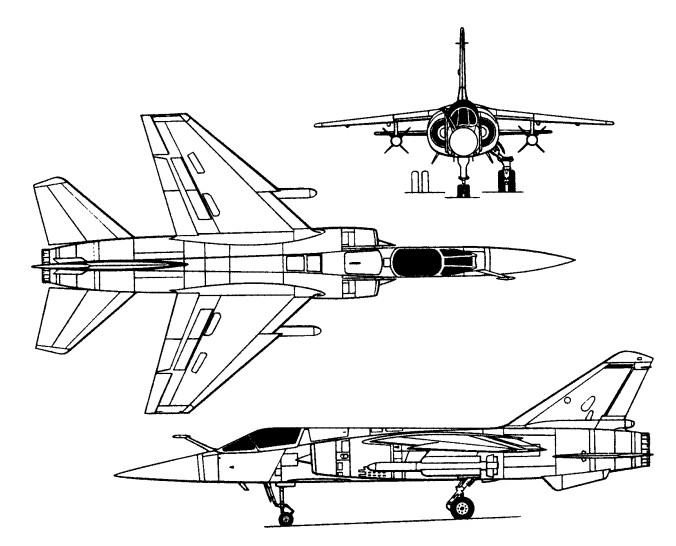
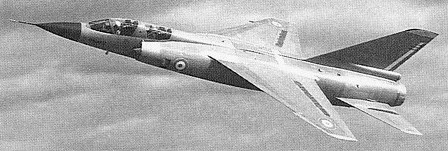
In 1964 Dassault received a contract to develop a successor to the Mirage III for the low-altitude penetration role, and an order followed for a single prototype of a tandem two-seat aircraft. The intended powerplant was a SNECMA (Pratt & Whitney) TF-306 turbofan. The new fighter featured a high-mounted swept wing with horizontal tail surfaces, and was assigned the designation Mirage F2. It was first flown on 12 June 1966 with a Pratt & Whitney TF30 turbofan rated at 8400kg with afterburning. After being re-engined with a TF-306 of 9000kg, it attained M=2.0 on its second flight, on 29 December 1966.
Work had begun on a single-seat version, the Mirage F3 with a 10350kg TF-306E engine, but changes in Armee de l’Air requirements saw interest transferred to a simpler version of the basic Mirage F1. Development of which had been pursued in parallel by Dassault, and further development of the Mirage F2 was discontinued.
Engine: 1 x Pratt & Whitney TF30 turbofan, 9000kg
Take-off weight: 18000 kg / 39683 lb
Empty weight: 9500 kg / 20944 lb
Wingspan: 10.5 m / 34 ft 5 in
Length: 17.6 m / 57 ft 9 in
Height: 5.8 m / 19 ft 0 in
Max. speed: 2333 km/h / 1450 mph
Ceiling: 20000 m / 65600 ft