Robin Haynes, founder and president of the Waspair Corporation which originally produced the Tomcat, designed this unique machine at the end of 1979. It only became the Tomcat after a succession of names, the first production models having been sold under the name The Baron.
1983: 1881 Enterprise Blvd, West Sacramento, CA 95691, USA.
Post WW2
Wasp Wing Gliders Super Wasp
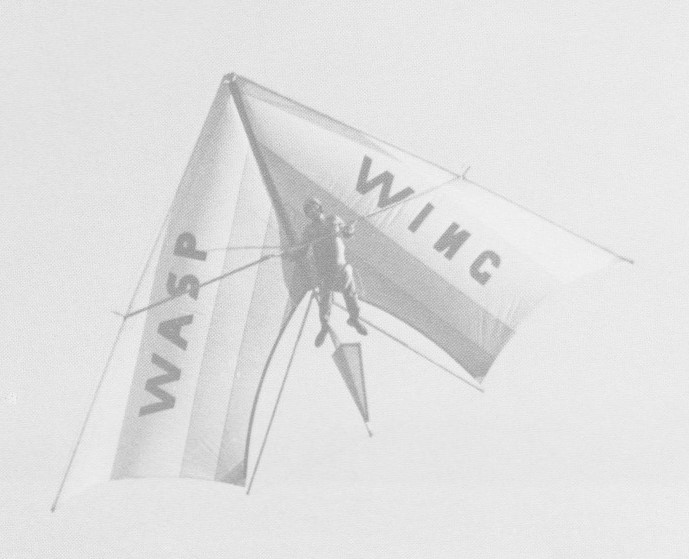
The Super Wasp is a very stable, slow flying glider that is ideal for general flying and soaring. It has a low sink rate, a glide ratio of over 6-1 and forgiving handling charastics for all classes of pilots. Its stability is achieved by use of a vertical and horizontal stabiliser attached to the rear of the keel and the flying wires.
It has an adjustable billow that can be set at 3°, 3.5° and 4° for advanced, intermediate or beginning pilots respectively. Has safety lines to prevent the plot from hitting the keel with his head in a rough landing.
The airframe is made from 6061-T6 1.5in x 0.049 anodised aluminium. The kingpost and control bar are 6061-T6 1in x 0.083.
Rigging is 3/32in 7 x 7 vinyl coated stainless steel. All hardware is aircraft quality and the sail is 3.8oz stabilised dacron. The pilot support was seated or prone harness.
19 x 16
Leading edge: 19 ft
Keel length: 16 ft
Wing span: 27.5 ft
Wing area: 190 sq,ft
Aspect ratio: 4
Nose angle: 90-92˚
Sail billow: 4-3˚
Weight: 50 lb
Pilot weight: 140-220 lb
Takeoff speed: 15 mph
Stall speed: 15 mph
Max speed: 45 mph
Best glide ratio (L/D): 6-1
Best L/D speed: 18 mph
Min sink: 250 fpm
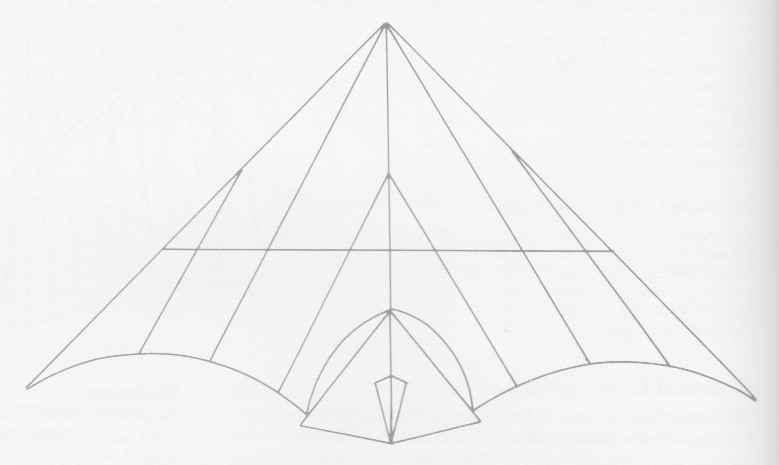
Wasp Wing Gliders Type A

The Wasp ‘A’ Type Rogallo has 19 ft wing booms, an 80 deg nose angle, 5 deg billow, 220 sq ft. The sail material is ripstop nylon.
Four were built during 1972 and 1973. Plans were supplied to other enthusiasts.
Wasp Wing Gliders Laser

Made in 1979, the Laser was designed for the intermediate to advanced pilot and is suitable for competition, cross country thermaling or just plain ridge soaring. The machine took over a year to develop and this produced an intermediate glider with good sink rate and glide angle, so that when the winds freshen its excellent penetration will be appreciated. The Laser slices through turbulence with its cambered fully floating battened sail. Having no deflexers and a strong easy to rig airframe it allows the maximum time possible in the air.
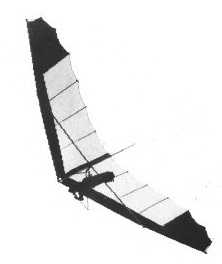
It has been described as giving good performance, quite difficult to start and land.
Laser 190
Leading edge: 20 ft
Keel: 8 ft (effective)
Sail area: 190 sq ft
Nose angle: 120 deg
Aspect ratio: 6.2
Span: 34 ft 6 in
Billow: 0 deg
Wasp Wing Gliders Gryphon

The Gryphon 3 was advertised in May 1978 as ‘Developed from Miles Handley’s brilliant original concept is Gryphon 3, a hybrid hang glider which embodies the features of both flexwing and rigid wing types. The braced airframe has meant the elimination of cross booms together with their attendant drag, weight and rigging penalties. For soaring pilots it can be flown relaxed and drifted into the flattest 360’s ever. The wing could be banked to 90 deg faster than anything around’.
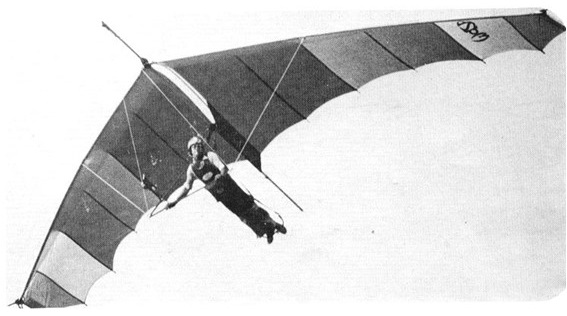
The 1979 Gryphon was for advanced pilots.
The Gryphon B bowsprit glider was apparently designed by Miles Handley (UK).

Wasp compensated for the lack of maneuverability with a slight reverse dihedral, hence a spiral instability always tiring to counter, and sometimes dangerous. The mania could be substantially improved by causing the cables controlling the deflection to communicate towards the rear of the leading edges. She became the queen of the lazy 8 thanks to her kinetic energy. Wing very sensitive to the profile of the slats.
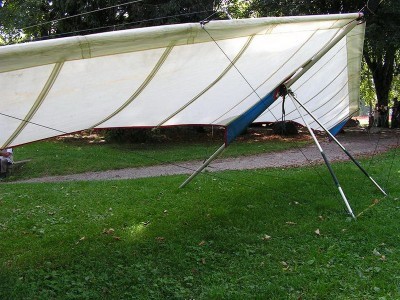
The Gryphon Mistral and Gryphon Sierra were 1980 versions.
Griphon B
Wing area: 15.23 m²
Wing span: 10.2 m
Aspect ratio: 6.85
Hang glider weight: 25 kg
Minimum pilot weight: 65 kg
Maximum pilot weight: 95 kg
Packed length: 5.63 m
Packed length short: 3 m
Number of battens: 10
Nose angle: 127°
Gryphon Mistral
Wing area: 15.3 m²
Aspect ratio: 7.3
Hang glider weight: 27 kg
Minimum pilot weight: 55 kg
Maximum pilot weight: 90 kg
Packed length: 3.80 m
Packed length short: 2.10 m
Nose angle: 127°
Gryphon Sierra
Wing area: 17.65 m²
Aspect ratio: 6.8
Hang glider weight: 27 kg
Minimum pilot weight: 55 kg
Maximum pilot weight: 90 kg
Packed length short: 3.5 m
Nose angle: 127°
Gryphon 3
L/D ratio: 11:1
Sink rate: 2.5 ft per second
Wasp Wing Gliders Gannet
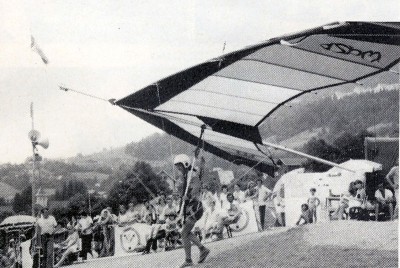
In 1979 the Wasp Gannet was a new cross boom-less machine designed by Bob England and was to be produced by Wasp.
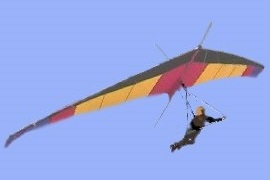
Gannet
Leading edge: 19 ft 5 in
Span: 35 ft 6 in
Nose angle: 136 deg
Aspect ratio: 8:1
Root chord: 7 ft
Sail area: 155 sq ft
Wasp Wing Gliders CB240

First made in 1974, the leading edges of the CB 240 are designed to incorporate the high-efficiency cylindrical concept. The cones produced by this configuration have their centre lines running through the leading edges rather than the nose of the aircraft, this increases the effective lifting area of the wing surface, reduces optimum flying speed and minimising movement of the centre of pressure. Additionally the design incorporates a significant degree of washout at the wing tips which greatly enhances roll and pitch control. This slow flying and stable hang glider therefore has an excellent L/D ratio, without the control difficulties associated with either cylindrical or high aspect ratio conical Rogallos. Sustained soaring flights can be achieved with this glider in the kind of light winds that conventional Rogallos are unable to exploit.
Six CB 240s were hand built for the ’75 World Championships. A few copies were also produced during ’75, although first generation gliders are by now obsolete.

CB 240
Leading edge: 19 ft
Nose angle 108 deg
Sail area 240 sq ft
Wing span 30 ft
Chord 18 ft 11 in
Keel 18 ft 11 in
Weight 47 lbs.
Wasp Wing Gliders Type B / Type C
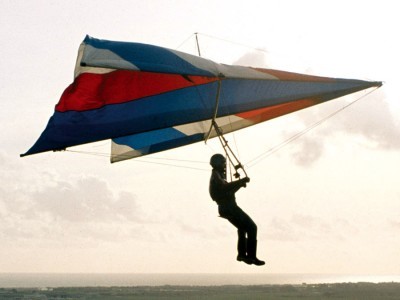
The 229 B3 followed established conical Rogallo principles, but great attention has been paid to reducing unnecessary weight, eliminating possible areas of failure, and improving all aspects of performance. The sail was of 2 and later 3 oz. ripstop nylon. Consequently the aircraft was unique in that although a high-performance hang glider, its inherent stability enables the novice pilot to gain experience on junior slopes before progressing to advanced flying, including ridge soaring. Long soaring flights are easily achieved in light winds of 16 mph +.
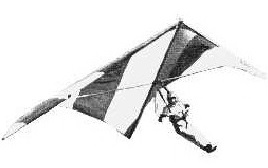
After the 1973 model 229B3, the 221C4 was produced. The first number is the size of the sail (sq.feet) and C4 stands for height of controlbar (4feet).
Reportedly the 221C4 had a lot less wrinkles in the sail than the 229B3.
Made in 1974 the C4 is constructed from terylene sail and the design incorporates separate leading edge pockets, anodised control bars for seated or prone and has a high class finish. The C4 is produced in 3 sizes 241, 221 and 201.

Also made in 1974, the C5 has cylindrical leading edges and deep scallop sail. This glider is the first Wasp model to fit deflexers.

229B3
Wing area: 18.20 m² / 229 sq.ft
Span: 24 ft 3 in
Length 18 ft 6 in
Hang glider weight: 22 kg 42 lb
221C4
Wing area: 221 sq.ft
Leading edges: 18 ft 4 in
Nose angle: 82 deg
Root chord/keel: 18 ft 4 in
Span: 24 ft 5 in
Billow: 4 deg
C5
Billow: 3.7 deg
Wasp Wing Gliders Falcon
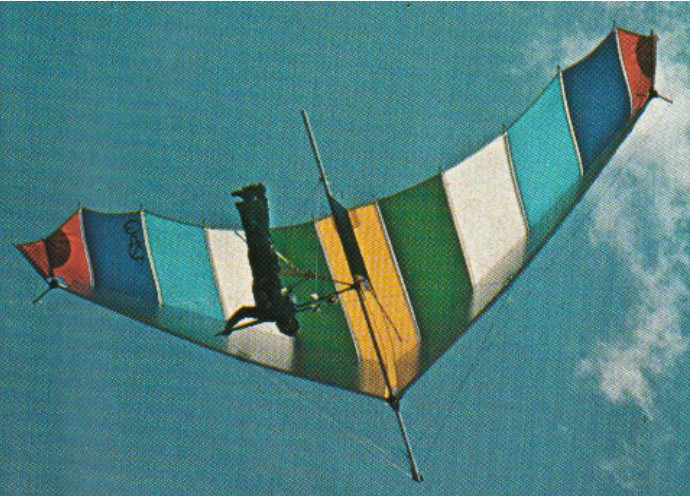
The 1976 Falcon 3 is the first British hang glider to feature cylindricised inflatable leading edges, a pre-cambered keel and slightly elliptical tips. These features were developed from experience with the Nova and Sting Rogallos. Despite its second generation format it is claimed that the Falcon 3 can be parachuted with little tendency to drop a wing. Penetration is reported to be good and the glider has been regularly soared in winds of 35 + mph. They were priced at £ 335.00 ex VAT in 1976.
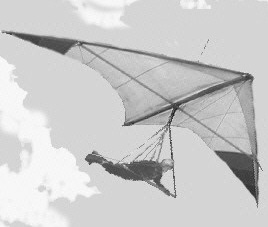
From the beginning the Wasp Falcon 4 was named Falcon Floater. The 1976 Falcon IV was a wing for intermediate pilots, rather than beginners with the Falcon III.
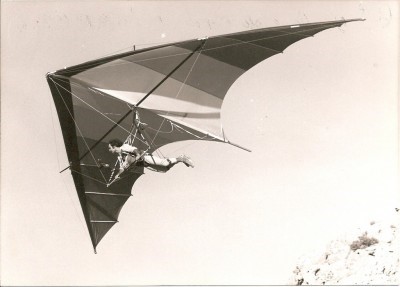
The 1977 Falcon 4 wass for intermediate and advanced flyers, though it may also be suitable for the more promising novice. Due to the machine’s large wing span and superior roll rate and pitch response it was not suitable for flyers with minimal experience.
One of the glider’s greatest virtues is the low stall speed. In still air it can be launched in a few strides and flown extremely slowly. Top landings in light winds are remarkably easy as the wing can be held on the stall in complete safety. Top landings are also assisted by its excellent stability which allows it to absorb turbulence. The stall is well indicated by definite mushing and is easily corrected even before the nose begins to fall away. The glide angle and sink rate are exceptional and therefore the pilot must make allowances against overshooting the landing area. In summary, the Falcon 4 is an outstanding competition machine due to its slow flying capabilities, parachuting qualities, high L/D and low sink rate.
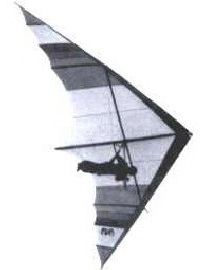
As late as April ’78 the Falcon 4, Falcon 4 Junior, Falcon 3 Sport were being offered for sale. Identification of early F4s can be made by rounded bottom of A frame. Later models have knuckle joints.
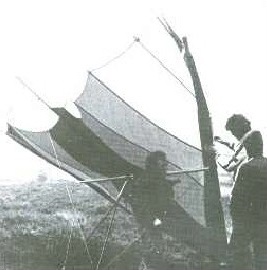
The 1978 Falcon 5 was designed for the beginner through to intermediate and is a slow flying easy to handle, easy to land glider. The design features a cambered sail, defined tips and two degrees of billow. The airframe is completely anodised and can be supplied in a breakdown version folding to just two metres. There are no deflexers.
There was a series of evolution in the model. The 1979 model was the Falcon V.
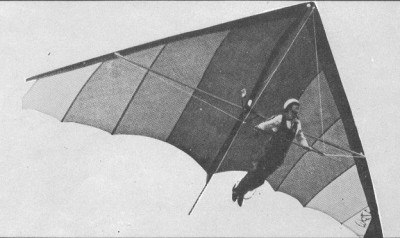
Falcon 3
Sail area 215 sq ft
Leading edge 20 ft
Keel 16 ft
Span 28 ft 3 in
Aspect ratio 3.72
Nose angle 90 deg
Billow 3 deg
Weight 39 lbs
Pilot weight 140-180 lbs
L/D (prone) 6.1:1
Speed for L/D max 30 mph
Max speed 40 + mph
Stall speed 12 mph
Min sink rate 6 ft /sec
Min sink speed 20 mph
Falcon 4 Junior
Wing area: 16 m²
Wing span: 9 m
Aspect ratio: 5
Hang glider weight: 18 kg
Minimum pilot weight: 50 kg
Maximum pilot weight: 70 kg
Packed length: 6 m
Packed length short: 3 m
Number of battens: 6
Nose angle: 100°
Falcon 4 Senior
Aspect ratio: 5
Hang glider weight: 18 kg
Minimum pilot weight: 70 kg
Maximum pilot weight: 90 kg
Packed length: 6 m
Packed length short: 3 m
Number of battens: 6
Nose angle: 100°
Falcon 4
Leading edge: 21 ft
Nose angle: 100 deg
Root chord: 14 ft 6 in
Keel: 16 ft in
Billow: 2.25 deg
Sail area: 200 sq ft
Span: 32 ft 6 in
Aspect ratio: 5.18
Glide angle: 8:1 at 20 mph
Sink rate: 3 ft 6 in per sec at 14 mph
Falcon 5
Leading edge: 18 ft 7 in
Keel: 12 ft 0 in
Sail area: 190 sq ft
Nose angle: 102 deg
Billow: 2 deg
Aspect ratio: 4.45
Span: 28ft 6in
Glider weight: 46 lb
Wasp Wing Gliders
Amongst the early enthusiasts who were amongst the first to buy, build or fly a hang glider during early seventies who later went on to become manufacturers was the Haynes Bros who founded Wasp.
 All Aero