Electric Boat, set up by American lawyer Isaac Rice, had merged with other companies in the 1950s including Convair aircraft, to make up a new company called General Dynamics.
A major reorganization in 1961 resulted in General Dynamics’ 12 operating divisions being divided into two major groups. On the aerospace side, the Western Group contained components of the Convair division, which itself had originated in 1923 as the Consolidated Aircraft Corporation, merging in 1943 with Vultee Aircraft Inc. to form Consolidated Vultee Aircraft Corporation. Before this, Consolidated had taken over two other aircraft companies, Thomas Morse and Hall Aluminium. In 1954 Consolidated Vultee merged with the General Dynamics Corporation to become the Convair Division, at which time the CV-880 and -990 jet transports were in production, together with F-102 and F-106 fighters, and the B-58 Hustler was at an advanced stage to provide the USAF with its first supersonic bomber (first flown November 1956). Two USAF wings eventually flew B-58As. In December 1964 the first flight took place of the F- 111, a variable-geometry tactical fighter-bomber which entered USAF operational service from 1968, followed by the FB-111A strategic bomber variant which replaced B- 58As from 1970. In January (officially February) 1974 the first flight took place of the F-16 lightweight fighter for the USAF; selected for engineering and manufacturing development in 1975, but with ground-attack options and provision for radar and navigation avionics suited to all-weather operations. Chosen also for service by European air forces, with European assembly, F-16 deliveries began 1979 (nearly 4,000 delivered by 1999 to many forces worldwide). Light aircraft manufacturer Cessna bought in 1985, but sold to Textron in 1992. The Tactical Military Aircraft division of General Dynamics was bought by Lockheed Corporation in March 1993, becoming Lockheed Fort Worth Company; taking over programs including F-16 and the General Dynamics share in the F-22 (previously a program of three manufacturers: General Dynamics, Lockheed, and Boeing). General Dynamics acquired Cessna in 1985 but in 1992 sold the company to Textron. Defense giant General Dynamics bought the business jet maker Gulfstream Aerospace in a stock deal estimated to be worth about $5.3 billion in 1999.
Established in 1970 by Dott Ing Stelio Frati, designer of a series of light aircraft from the Ambrosini F.4 to F.250 (subsequently developed as the SIAI SF.260), to develop aircraft of Frati design mostly for manufacture by other concerns. First was the F.20 Pegaso light twin; two prototypes built (first flown 1971) and an agreement was reached for production aircraft to be manufactured by Italair. Also designed the Canguro transport (developed by SIAI-Marchetti but became a VulcanAir type) and the Jet Squalus (see Promavia and Alberta Aerospace). Produces F.22 Pinguino two-seat aerobatic lightplane and trainer in several versions with retractable or fixed undercarriages (first flown June 1989), the F.22 Bupp variant with only fixed undercarriage and other changes, plus the F.220 Airone four-seat development.
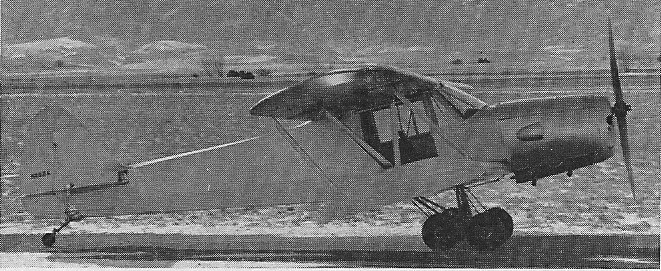
The General Airplane Service Model 11 is a modified biplane Piper Cub for crop dusting. Created by General Airplane Service of Sheridan, Wyo, it was modified to a reverse-tagger biplane, the plane is fitted with tandem one-wheel landing gear. The fuselage of a J-3 Cub with a Piper PA-18 top cabin structure, wing and tail. Power was a Ranger 200 hp in a Fairchild PT-19 cowling.
The first flight was on October 12,1953.
Engine: Ranger 200 hp Span: 32 ft 2.5 in Length: 24 ft Height: 6 ft 8 in Empty weight: 1200 lb Gross weight: 3000 lb Payload: 1500 lb Operating speed: 40-100 mph
USA Fixed-base operator at Sheridan, Wyoming, in early 1950s. Converted Piper J-3s, PA-11 s and PA-12s for agricultural work by installation of bigger engines. Company’s Model II ag-plane was a mixture of Piper parts with a 200 hp Ranger engine from Fairchild PT-19 and a new lower wing to make it a biplane; first flight October 12,1953.
General Aircraft Corporation announced plans in 1969 for a 36- seat STOL transport, the GAC-100, powered by four Pratt & Whitney PT6A-40 turboprop engines.
El Segundo, California, USA General Aircraft Corporation announced plans in 1969 for a 36- seat STOL transport, the GAC-100, powered by four Pratt & Whitney PT6A-40 turboprop engines.
Long Island, New York, USA The company was established at Lowell, Massachusetts to build an aircraft designed by Doctor Otto C. Koppen, a professor of aeronautics from the Massachusetts Institute of Technology. The aircraft was the G1-80 Skyfarer, a two-seat cabin high-wing braced monoplane.
Before the company could produce the aircraft in any numbers the Second World War intervened, and the Skyfarer programme was abandoned after 17 examples had been built. Situated on Long Island, New York, the company became a manufacturer of the Waco CG-4A troop glider and the interests in the Wayfarer were sold to Grand Rapids Industries in 1943.
In 1969, the company bought the Helio Aircraft Company which specialised in building STOL aircraft for use by government agencies in south east Asia. The company ceased to manufacture aircraft in October 1976 when it sold the production rights and assets of its Helio Aircraft division.
South Africa Durban-based (Genair / General Aircraft (Pty.) Ltd.) built the Piel Emeraude two-seat light aircraft under the name Aeriel Mk II. First prototype flown in October 1959, and first production aircraft in February 1960. Aeriel was subsequently built by Southern Aircraft Construction and Robertson Aircraft Sales, but in September 1962 Durban Aircraft Corporation was formed to continue its construction.
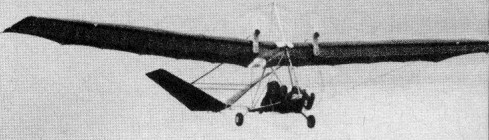
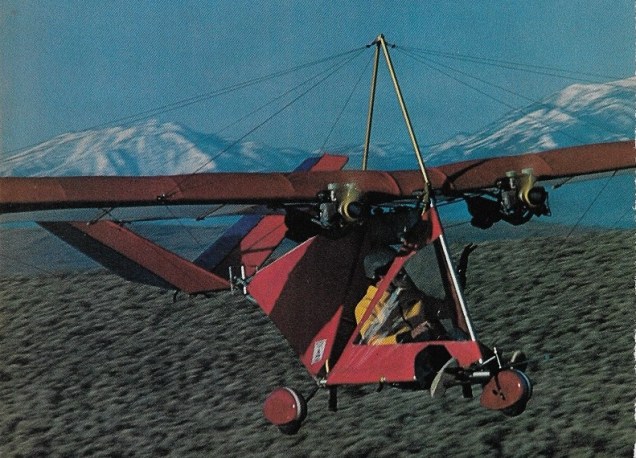
The Gemini Hummingbird 103 and Hummingbird Super 103 are single seat twin engined high wing mono¬plane with conventional three axis control. Wing has unswept leading edge, swept forward trailing edge and tapering chord; V tail. Pitch/yaw control by elevon; roll control by ailerons; control inputs through stick for pitch/roll and pedals for yaw. Wing braced from below by struts; wing profile; double surface. Undercarriage has three wheels in tricycle formation; no suspension on nosewheel and steel spring suspension on main wheels. Push right go right nosewheel steering connected to yaw control. Optional brake on nosewheel; optional brakes on main wheels. Aluminium tube framework, without pod (Hummingbird 103), totally enclosed (Hummingbird Super 103). Engines mounted at wing height driving tractor propellers. Two tractor Solo 210 engines, direct drive (two 20-hp Solos, 3:1 reduction unit, tuned exhaust optional). The Super 103 is the same basic configuration as the Standard 103 but POWERPLANT: Two Solo 210s, 3:1 reduction unit, tuned exhaust.
First year built: 1979. The 103 marks a change in marketing policy for the company, as it is the first kit built machine offered by the firm, taking two days to build. A wide range of options is available on the 103, including wheel spats and a fabric covering for the fuselage, with Lexan windows to make a fully enclosed cockpit. Thus modified, the aircraft is known as the Hummingbird Super 103 and costs $6185, as against $5495 for the Hummingbird 103, in 1982. Other notable options are floats, amphibious floats into which the wheels retract, disc or drum brakes on the main wheels, a nosewheel brake, heavy duty 16 inch (41 cm) wheels and a ‘Super Wing’ high performance wing. Reduction drive is optional. Units delivered by June 1981 48. The Hummingbird Prospector had the wing braced from above by kingpost and cables, from below by cables. Aluminium tube framework, without pod (total enclosure optional). The Hummingbird Prospector was the flagship of the Gemini range in that it came complete and test flown from the factory, unlike the Hummingbird 103 and Hummingbird Super 103. It was an older design, easily distinguished from the 103s by its retention of kingpost and cable bracing. The Prospector was sold with two Solo 335 engines. However, there were plenty of Prospectors around with Limbach 275 cc engines. Latest power units for the Hummingbird Prospector were reduction drive Solos.
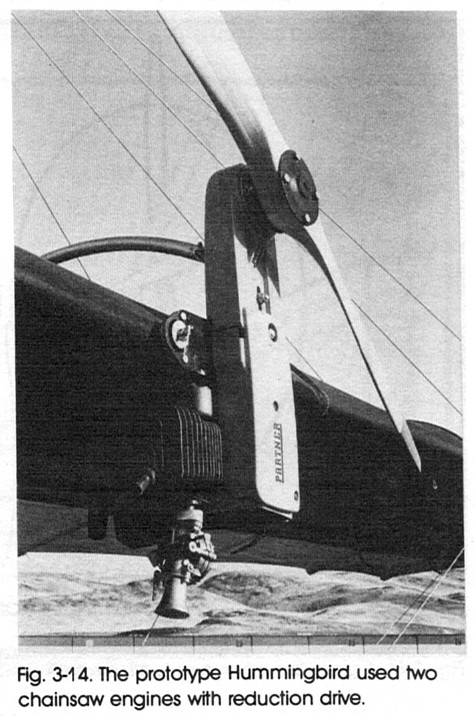
The Tractorplane is a utility ultralight version of Prospector. The Sport Hummingbird is a mono-wing with upright V-tail. Mixed three-axis controls make use of true ailerons for roll control and a separate elevator on the V-tail for pitch control. Construction is aluminum-tubing frame with the wings and tail surfaces covered with presewn 3.8-ounce Dacron. The engines are mounted in tractor position on the leading edge of each wing, and operated separately. Reduction drive turns each two-blade wooden Gemini propeller. Fuel tank is polypropylene. LANDING GEAR: Solid tricycle with steerable nosewheel. Wheels measure 16 inches.
Hummingbird 3-axis conventional (rudder, aileron, elevator). Gross weight 415 lb. Empty weight 163 lb (can be modified to 155). Max pilot weight 230 lbs. First year built 1979.
Hummingbird Standard 103 Engines: 2 x Solo 335, 20 hp at 7200 rpm. Propeller diameter and pitch 52 x 27 inch, 1.32 x 0.69 m. V belt reduction, ratio 3.0/1. Max static thrust 340 lb, 154 kg. Power per unit area 0.24 hp/sq.ft, 2.6 hp/sq.m. Fuel capacity 4.4 US gal, 3.7 Imp gal, 16.6 litre. Length overall 21.0 ft, 6.40 m. Height overall 5.0ft, 1.52m. Wing span 36.0ft, 10.97m. Chord at root 5.0ft, 1.52m. Chord at tip 3.9ft, 1.16m. Dihedral 4 deg. Sweepback 0 deg Tailplane span 5.0ft, 1.52m. Height of in¬clined fixed surface 5.0 ft, 1.52 m. Total wing area 163 sq.ft, 15.1sq.m. Total aileron area 18.0sq.ft, 1.67sq.m. Inclined fixed area 18.0sq.ft, 1.67 sq.m. Total elevon area 14.0 sq.ft, 1.30 sq.m. Wing aspect ratio 7.9/1. Wheel track 6.0ft, 1.82m. Wheelbase 5.0ft, 1.52m. Nosewheel diameter overall 6 inch, 15cm. Main wheels diameter overall 6 inch, 15cm. Optional floats: length 8.0ft, 2.43m. Optional skis: length x width 6.0 ft x 3.5 inch, 1.82 x 0.08 m. Empty weight 240 lb, 109 kg. Max take off weight 560 lb, 254 kg. Payload 320 lb, 145 Max wing loading 3.43 lb/sq.ft, 16.7 kg/sq.m. Max power loading 14.0 lb/hp, 6.3kg/hp. Load factors +4.5, 3.5 design; +5.0, 4.0 ulti¬mate. Max level speed 62 mph, 100 kph. Never exceed speed 70 mph, 113 kph. Max cruising speed 57 mph, 92 kph. Economic cruising speed 45 mph, 72 kph. Stalling speed 22 mph, 35 kph. Max climb rate at sea level 941 ft/min, 4.8 m/s. Min sink rate 207 ft/min at 30 mph, 1.0 m/s at 48 kph. Best glide ratio with power off 11/1 at 42mph, 67 kph. Take off distance 100 ft, 30 m. Land¬ing distance 120ft, 38m. Service ceiling 27,000ft, 8235m. Range at average cruising speed 100 mile, 160km.
Hummingbird Super 103 Engines: 2 x Solo 335, 20 hp at 7200 rpm. Propeller diameter and pitch 52 x 27 inch, 1.32 x 0.69 m. V belt reduction, ratio 3.0/1. Max static thrust 340 lb, 154 kg. Power per unit area 0.24 hp/sq.ft, 2.6 hp/sq.m. Fuel capacity 4.4 US gal, 3.7 Imp gal, 16.6 litre. Length overall 21.0 ft, 6.40 m. Height overall 5.0ft, 1.52m. Wing span 36.0ft, 10.97m. Chord at root 5.0ft, 1.52m. Chord at tip 3.9ft, 1.16m. Dihedral 4 degs. Sweepback 0 deg. Tailplane span 5.0ft, 1.52m. Height of in¬clined fixed surface 5.0 ft, 1.52 m. Total wing area 163 sq.ft, 15.1sq.m. Total aileron area 18.0sq.ft, 1.67sq.m. Inclined fixed area 18.0sq.ft, 1.67 sq.m. Total elevon area 14.0 sq.ft, 1.30 sq.m. Wing aspect ratio 7.9/1. Wheel track 6.0ft, 1.82m. Wheelbase 5.0ft, 1.52m. Nosewheel diameter overall 6 inch, 15cm. Main wheels diameter overall 6 inch, 15cm. Optional floats: length 8.0ft, 2.43m. Optional skis: length x width 6.0 ft x 3.5 inch, 1.82 x 0.08 m. Empty weight 240 lb, 109 kg. Max take off weight 560 lb, 254 kg. Payload 320 lb, 145 Max wing loading 3.43 lb/sq.ft, 16.7 kg/sq.m. Max power loading 14.0 lb/hp, 6.3kg/hp. Load factors +4.5, 3.5 design; +5.0, 4.0 ulti¬mate. Max level speed 62 mph, 100 kph. Never exceed speed 70 mph, 113 kph. Max cruising speed 57 mph, 92 kph. Economic cruising speed 45 mph, 72 kph. Stalling speed 22 mph, 35 kph. Max climb rate at sea level 941 ft/min, 4.8 m/s. Min sink rate 207 ft/min at 30 mph, 1.0 m/s at 48 kph. Best glide ratio with power off 11/1 at 42mph, 67 kph. Take off distance 100 ft, 30 m. Land¬ing distance 120ft, 38m. Service ceiling 27,000ft, 8235m. Range at average cruising speed 100 mile, 160km.
Hummingbird Prospector Engines: Twin Solo 210 cc , 12.5 hp, 3:1 reduction unit, tuned exhaust. Undercarriage: Standard tricycle, steerable nosewheel. Wingspan 34 ft. Wing area 153 sq.ft. Aspect ratio 7.5:1. Length 22 ft. Empty weight: 240 lbs. Payload 400 lbs. Gross weight 640 lbs. Wing loading 4.18 lbs/sq.ft. L/D 10:1. Cruise speed 33 mph. Stall speed 21 mph. Vmax 63 mph. Takeoff/landing roll 75 ft. Climb rate 600 fpm. Fuel capacity 4.5 USG.
Hummingbird Tractorplane Engines: Two Solo 210s, 3:1 reduction unit, tuned exhaust. Undercarriage: Standard tricycle, steerable nose-wheel Wingspan 34 ft. Wing area 153 sq.ft. Aspect ratio 7.5:1. Length 22 ft. Empty weight: 163 lbs. (can be modified to 155). Max pilot wt: 230 lbs. Payload 420 lbs. Wing loading 4.18 lbs/sq.ft. L/D 10:1.
Sport Hummingbird Engine: Twin Gemini/Partner K-1200 100cc, 7 hp Static thrust, 51 lbs each. Wingspan, 34 ft. Wing area: 186 sq.ft. Aspect ratio, 7.5:1. Empty weight, 138 lbs. Usable payload (include fuel), 200 lbs. Wing loading, 1.07 lbs/sq.ft. L/D power-off glide ratio, 11:1. Cruise speed (85% power), 30 mph. Stall speed, 15 mph. Approach speed, 25 mph. Flair speed, 20 mph. Liftoff speed, 17 mph. Takeoff roll distance, 150 ft. Rate of climb, 250 fpm. Fuel capacity, 1.75 USG. Range at cruise, 50 sm.


 All Aero