Weybridge Man Powered Aircraft Group Dumbo

Financed by the Royal Aeronautical Society, the Weybridge Man Powered Aircraft Group’s Dumbo, which took 10,000 man hours to build and had wings which spanned 36.6 m (120 ft) and drooped down at rest. It has a structure of metal tube covered in see-through ‘Melinex’. All the flying surfaces are capable of being warped to act as control surfaces.

The aircraft has a bullet-shaped fuselage with a four-unit tailplane mounted at the extreme ear with a pusher propeller behind that. The pilot sits in the nose.

The wing is internally braced and set low on the fuselage.

It first flew at Weybridge on 18 September 1971.

Wingspan: 120.00 ft
Wing area: 480 sq.ft
Aspect ratio: 30-1
Empty weight: 125 lb

Westward Airways Fairey Flycatcher

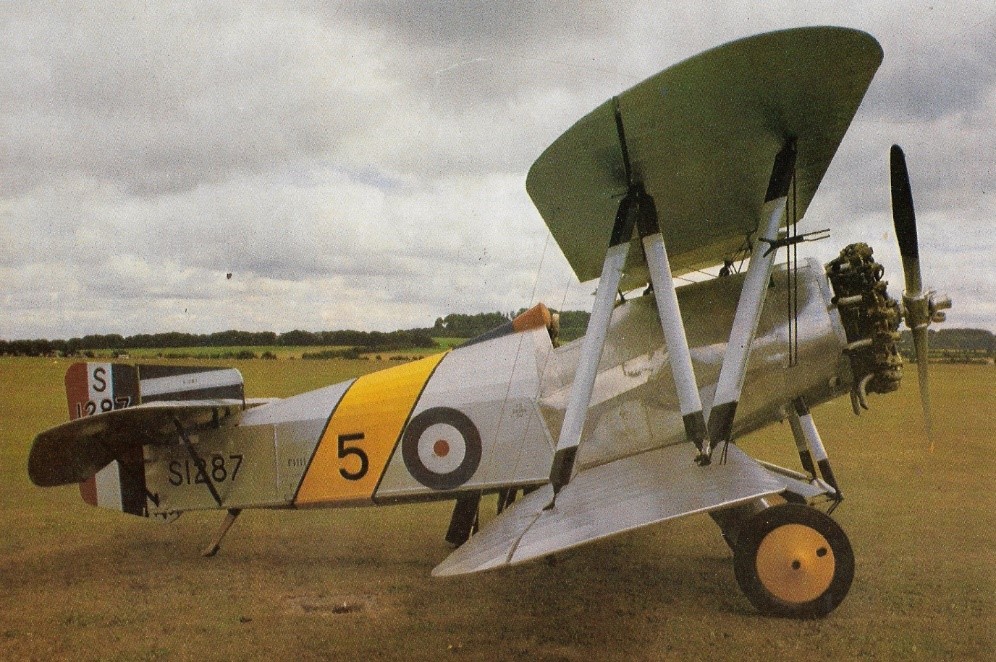
In January 1977 construction of Fairey Flycatcher replica S1287 was started by Robinson Aircraft at Blackbushe, later transferred to Rod Bellamy, whereas the CAA Aircraft Register states Westward Airways, Lands End, England as the manufacturer

On 17 July 1977 it was registered as G-BEYB to John Fairey, and powered by a Pratt & Whitney R-985-AN-14B engine, making its first flight, at Middle Wallop, on 23 July 1979. The first public display was at the Middle Wallop Air Show on 28 July 1979.

It was damaged following a take-off accident on 4 October 1980, flying again following repair on 23 July 1981.

On 01 September 1995 it was flown to Lee-on-Solent for a static role at the Fleet Air Arm Officers Association reunion, the last public function before sale to FAAM.

On 05 June 1996 it was flown to RNAS Yeovilton by John Fairey and put into 12 hanger (FSAIU).

In July 1996 it moved into the FAAM and onto public display.

By 2012 it was in the Reserve Collection at Cobham Hall Store.
Westland Westminster

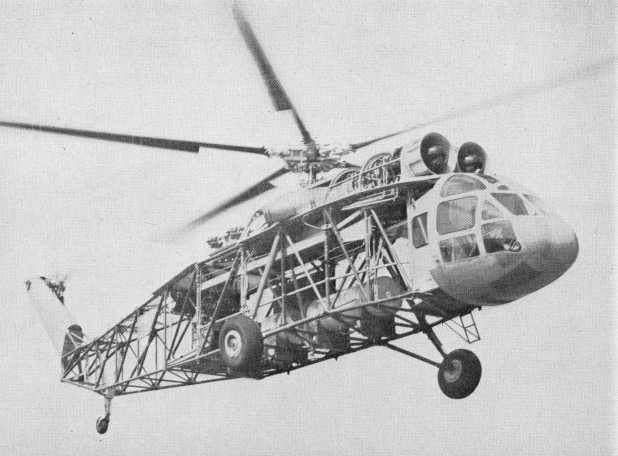
A private venture by Westland, based on the single main 5-blade rotor, gearbox, and hydraulic controls from the Sikorsky S-56 Mojave, Westland redesigned the fuselage using steel tube construction to create a medium sized troop and passenger carrying helicopter, witth tailwheel u/c. Up to 40 passengers were to be carried, with metal cladding for passenger role or open frame for utility/crane role.

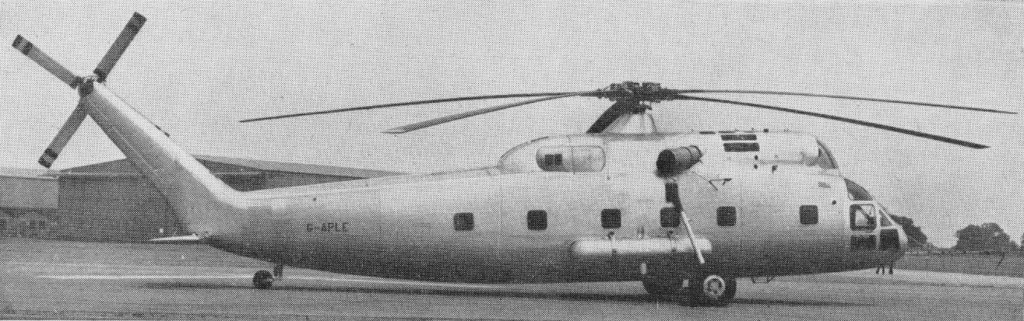
First flown at Yeovil on 15 June 1958 (G-APLE), the prototype Westland Westminster was powered by two 2920shp Napier Eland E220 turboshafts. Two prototyprs were built.

After the type’s appearance at the 1960 Farnborough Air show, it was cancelled in September of that year.

The Westminster appeared in June 1960 with its fuselage framework faired in. Late a six-blade rotor was fitted.

Gallery

Westminster
Engines: 2 x Napier Eland E.229A turboshaft, 2090kW
Rotor diameter: 21.95m
Length: 27.4m
Max take-off weight: 14965kg
Empty weight: 10125kg
Max speed: 241km/h
Cruising speed: 184km/h
Hovering ceiling, IGE: 2750m
Range: 330km
Crew: 2
Passengers: 40