In the mid-1960s, engine manufacturer Williams Research developed a light turbofan engine, the “WR19”, with a thrust of 1.91 kN (195 kgp / 430 lbf), which was used in a “flying belt” that could be strapped on somebody’s back to allow flights of up to 20 minutes. It was a sexy toy but of no particular usefulness, and it was canceled in 1969.
Williams continued to tinker with the idea, coming up with a one-man flying platform powered by the WR19 or a derivative engine, known as the “WASP”, which was later renamed the “X-Jet”. This machine looked something like a flying trashcan on skids, and could carry a pilot directing the machine with two grip-type controls. It was evaluated in the 1980s; videos of its flight suggest it performed very nicely and was easy to handle. Noises were made about a more capable successor, but apparently its endurance was too limited and, as was the case with most of the other one-person flying machines, it was hard to understand that it offered any utility proportional to its expense and complexity.
One X-Jet is now on display at the USAF Museum in Ohio, while another is on display at the Seattle Museum of Flight. The WR19 and its descendants did prove to be useful powerplants for long-range cruise missiles.
The Williams FJ44 is a family of small, two-spool, turbofan engines produced by Williams International/Rolls-Royce for the light business jet market. Although basically a Williams design, Rolls-Royce was brought into the project, at an early stage, to design, develop and manufacture an air-cooled high-pressure (HP) turbine for the engine. The FJ44 first flew on July 12, 1988 on the Scaled Composites/Beechcraft Triumph aircraft.
Production started in 1992 with the 1900 lbf (8.45 kN) thrust FJ44-1A, which comprises a 20.9 in (531 mm) diameter single stage blisk fan plus a single intermediate pressure (IP) booster stage, driven by a 2 stage low pressure (LP) turbine, supercharging a single stage centrifugal high pressure (HP) compressor, driven by a single stage uncooled high pressure (HP) turbine. The combustor is an impingement cooled annular design. Fuel is delivered to the combustor through an unusual rotating fuel nozzle system, rather than the standard fuel-air mixers or vapourisers. The bypass duct runs the full length the engine. Specific fuel consumption at 1900 lbf (8.45 kN) thrust at SLS, ISA is understood to be 0.456 lb/hr/lbf. A derated version, the 1500 lbf (6.67 kN) thrust FJ44-1C has an SFC of 0.460 lb/hr/lbf.
An uprated version, the 2300 lbf (10.23 kN) thrust FJ44-2A, was introduced in 1997. It has a larger 21.7 in (551 mm) diameter fan, with two additional booster stages to increase core flow. Owing to stressing considerations, the centrifugal compressor is throttled-back aerodynamically to a lower HPC pressure ratio than the -1. Other features include an exhaust mixer and an electronic fuel control unit. The 2400 lbf (10.68 kN) thrust FJ44-2C is similar to the -2A, but incorporates an integrated hydromechanical fuel control unit.
Further updates include the 2004 introduction of the 2820 lbf (12.54 kN) thrust FJ44-3A, which is similar to the -2A, but features an increased diameter fan and dual channel FADEC (Full Authority Digital Engine Control) unit. The 2490 lbf (11.08 kN) thrust FJ44-3A-24 is a derated version of the -3A.
In 2005, a new low end version, the FJ44-1AP, was introduced, with a 1965 lbf (8.74 kN) takeoff thrust, 5% better specific fuel consumption, and lower internal temperatures. The -1AP is similar to the -1A, except for a higher pressure ratio fan, a new combustor and LP turbine, a new full length bypass duct/exhaust mixer and a dual channel FADEC.
Released in 2007 was the new 3600 lbf (16.01 kN) thrust FJ44-4, which has a hi-tech fan of larger diameter than the -3 unit. As of March 2010, this engine was only in use on the Cessna CJ4.
The F129 is the military designation for a derated FJ44 with 1500lbf (6.672kN) power output.
The Williams FJ33 is a smaller engine based on the basic FJ44 design.
WR44
In February 1978 Foxjet International signed an agreement with WRC for exclusive supply over three years of the 8001b WR44-800 to power the new Foxjet light executive jet. Under the agreement Foxjet would pay for certification and other costs of the engine programme.
The new turbofan replaced the original WR19-3-1, giving WRC its first entry into the general-aviation market. A derivative of the WR19, the WR44 has had its bypass ratio reduced from 5:1 to 3:1, and its pressure ratio increased.
Applications: FJ44 Beechcraft Premier I Eviation Jets EV-20 Vantage Jet Cessna CitationJet Emivest SJ30 Grob G180 SPn Hawker 200 Lockheed Martin RQ-3 DarkStar Lockheed Martin Polecat Pilatus PC-24 Piper PA-47 PiperJet Piper PiperJet Altaire Saab 105 Scaled Composites Proteus Scaled Composites Triumph Virgin Atlantic GlobalFlyer
F129 Cessna 526 CitationJet
Specifications:
FJ44-1A Thrust: 1,900 lbf / 8,452 N Specific Fuel Consumption: 0.456 lb/hr/lbf Dry Weight: 460 lb / 209 kg Overall Length: 53.3 in / 1,354 mm Approximate Fan Diameter: 20.9 in / 531 mm Bypass ratio: 3.28
FJ44-1C Thrust: 1,500 lbf / 6,672 N Specific Fuel Consumption: 0.460 lb/hr/lbf Dry Weight: 460 lb / 209 kg Overall Length: 53.3 in / 1,354 mm Approximate Fan Diameter: 20.9 in / 531 mm Bypass ratio: 3.28
FJ44-1AP Thrust: 1,965 lbf / 8,741 N Dry Weight: 468 lb / 212 kg Overall Length: 57.9 in / 1,471 mm Approximate Fan Diameter: 20.7 in / 526 mm
FJ44-2A Thrust: 2,300 lbf / 10,231 N Dry Weight: 530 lb / 240 kg Overall Length: 59.8 in / 1,519 mm Approximate Fan Diameter: 21.7 in / 551 mm Bypass ratio: 4.1
FJ44-2C Thrust: 2,400 lbf / 10,676 N Dry Weight: 520 lb / 236 kg Overall Length: 59.8 in / 1,519 mm Approximate Fan Diameter: 21.7 in / 551 mm
FJ44-3A Thrust: 2,820 lbf / 12,544 N Dry Weight: 535 lb / 243 kg Overall Length: 62.4 in / 1,585 mm Approximate Fan Diameter: 22.9 in / 582 mm
FJ44-3A-24 Thrust: 2,490 lbf / 11,076 N Dry Weight: 535 lb / 243 kg Overall Length: 62.4 in / 1,585 mm Approximate Fan Diameter: 22.9 in / 582 mm
FJ44-4 Thrust: 3,600 lbf / 16,014 N Dry Weight: 650 lb / 295 kg Overall Length: 68.6 in / 1,742 mm Approximate Fan Diameter: 25.2 in / 640 mm
After the Aeroplane Geoff Williams immediately commenced building a third aeroplane, a low wing monoplane also powered by a Volkswagen engine. This aircraft largely still existed in 2003 and was stored in Alex Armstrong’s hangar at Taieri in the form of the wings and fuselage. Also stoutly built, it was prone to be underpowered by the tired Volkswagen engine Geoff had two lucky escapes when it crashed due to lack of power. The first was while climbing up the Lindis Valley in Otago when he realised too late that the ground was climbing more rapidly than his aeroplane, and he was unable to turn because of the proximity of hills either side. His last flight was at Tarras when the plane crashed on take off, again because of lack of power. He never flew again, but resolved to build a fourth aircraft.
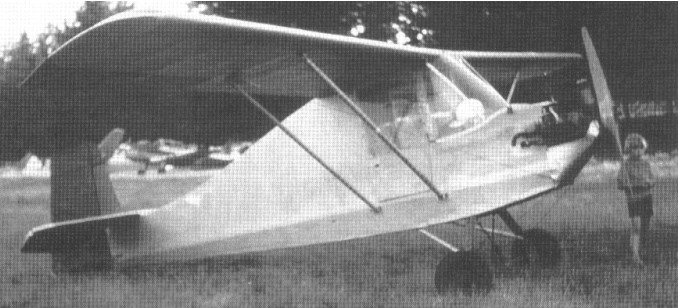
Based on a model and built in the 1970s without official blessing. The aircraft was kept at Wickcliffe Bay, Otago Peninsula, New Zealand, and flown by the builder/owner. By all accounts, the aircraft flew rather well. Built Geoff [or Jeff] Williams. To achieve the correct scale, the builder is said to have sat on a chair and scaled the plans around himself. This was flown from an old wartime emergency air¬strip situated on a farm owned by the Neil family on the Otago Peninsula. Both air¬craft are said to have been soundly con-structed, no doubt the builder’s occupa¬tion having some influence here, but the engine installation, undercarriage and other fittings left something to be desired. The fuel tank in the high wing craft was nothing more than a twenty litre can hung by its handle behind the pilot’s seat. The fuel line a flexible rubber hose pushed over a cooper tube protruding through the instrument panel. When the aircraft re-quired refuelling it was a simple task to remove the can and take it to the nearest service station. As well as the Omarama incident, the little homebuilt was flown to Cromwell where it landed on the main road. On another occasion Williams turned up at Queenstown in the VW-powered aircraft where he attempted to purchase fuel from a local helicopter operator who refused to cooperate. Apparently he was less than impressed by the craft. I’m led to believe CAD finally caught up with the wayward flyer, confiscating the engine and thus bringing his illegal activities to a halt. For a number of years the aircraft re¬mained dismantled in a shed on the Neil farm until the property changed owner¬ship, when both airframes and the stor¬age shed were destroyed. Geoff flew this aircraft successfully all over Otago while refusing to register it with CAA. They eventually threatened to pros¬ecute him unless he signed a declaration stating he would never fly it again. During this time he had about 65 hours of flying and many incidents.
The first machine built by Geoff Williams was constructed by Geoff in the family home in Stewart Street, Dunedin, while he was still at school, but it proved on a number of occasions to be too much of a handful and thus he moved on to the Aeroplane. The biplane was badly damaged in an argument with a hedge before any significant flights had been undertaken, was flown from an old wartime emergency airstrip situated on a farm owned by the Neil family on the Otago Peninsula, New Zealand.
A 1948 Midget racer named Estrellita and piloted by Clifford “Kip” Mone, N44183, powered by an 85hp Continental C-85. A single place cabin, mid-wing monoplane
With an elliptical wing, it was destroyed at an air show on Sep 4, 1950.


 All Aero