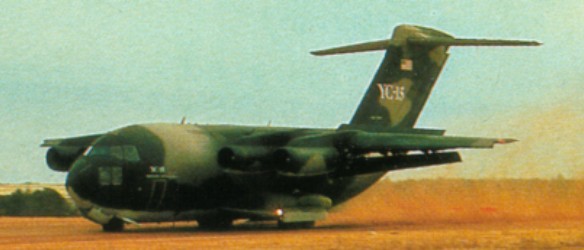
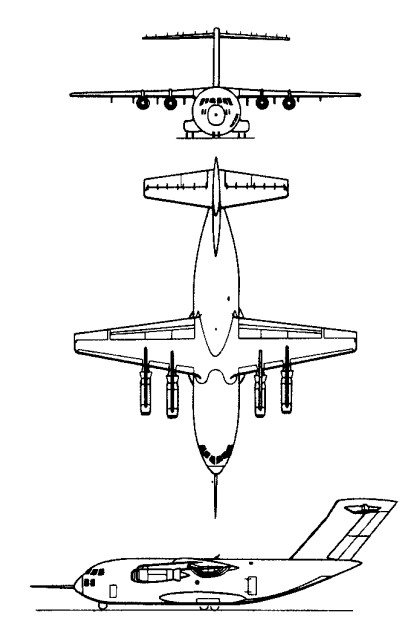
The McDonnell Douglas YC 15 first prototype (72 1875), an advanced military STOL transport, made the type’s maiden flight on 26 August 1975. Designed to contend against Boeing YC 14 pro¬totypes for the USAF’s advanced medium short take off and landing transport (AMST) requirement, it had an externally blown flap system that depended on the slipstream from four turbofan engines. The first flight was made three months ahead of schedule and the two YC-15 prototypes flew for three years before the test program ended.
YC-15 Engines: 4 x Pratt & Whitney JT-8D-17, 71.1kN Max take-off weight: 68000 kg / 149915 lb Wingspan: 33.6 m / 110 ft 3 in Length: 37.9 m / 124 ft 4 in Height: 13.2 m / 43 ft 4 in Wing area: 161.7 sq.m / 1740.52 sq ft Max. speed: 805 km/h / 500 mph Range w/max.fuel: 4800 km / 2983 miles Crew: 2-3
Douglas files bankruptcy and was forced to sell at a knocked down price to McDonnell of St. Louis, which had been making handsome profits out of its F-4 Phantom, supplied to the air force in Vietnam. McDonnell-Douglas was created 28 April 1967 by merger of Douglas and McDonnell. Continued development and production of F-4 at St Louis (until 1979). On December 23,1969 received contract for F-15 Eagle air-superiority fighter, first flown July 27,1972, (first production F- 15E flown December 1986) suited to both air superiority and long-range interdiction. Evolved F/A-18 Hornet multi-mission carrier bome and land-based combat aircraft suited to fighter and attack missions (first flown November 1978, with the F/A-18E and F Super Hornet variants, first flown November 1995, placed into production by Boeing), STOVL AV-8B Harrier II and II Plus with British Aerospace for U.S. Marine Corps (first flights November 1981 and September 1992 respectively; and T-45 Goshawk naval jet trainer (first flown April 1988) from British Hawk.
Long Beach and Palmdale factories continued production of A-4 Skyhawk attack aircraft until 1979, DC-8 fourjet airliner (until the early 1970s, and in the 1980s instituted a re-engine program) and DC-9 twin-jet airliner (first tlown February 1965 and produced until the end of the 1970s, when the new designation MD-80 was adopted for developed models), and developed wide-body triple-engined DC-10 (first flown August 29,1970 and the last delivered in 1989, when replaced by the MD-11).
Purchased Hughes Helicopters January 1984, taking over that company’s range that included small helicopters and the AH-64 Apache, plus the NOTAR (no tail rotor) anti-torque system. Hughes Helicopters became McDonnell Douglas Helicopters.
Merger of McDonnell Douglas with Boeing announced in December 1996, and from August 1997 the combined company began operating as a single unit under the collective name The Boeing Company.
Boeing has sold its civil helicopter production line, formerly manufactured by McDonnell Douglas, to Dutch company MD Helicopters. The sale, coming only two years after Boeing themselves purchased the range through a merger. The sale includes the MD500, 520N, 530F and 600N models, as well as the twin-engined MD Explorer and the licence to incorporate the no tail rotor (NOTAR) system on future aircraft. Boeing does, keep the ownership of the NOTAR technology. Boeing was to continue to produce the machines, under contract to the new Dutch owners, until early 2000.
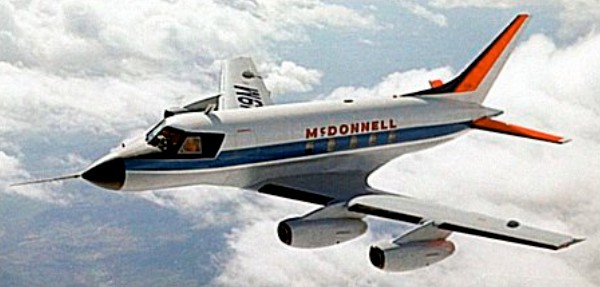
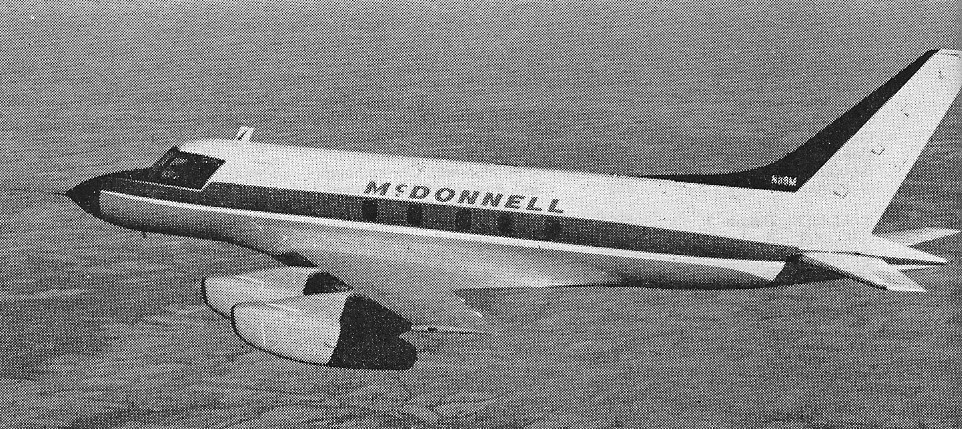
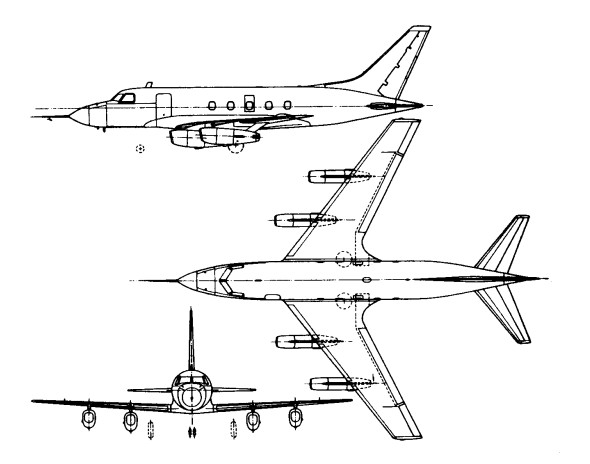
In the early 1960s Lockheed, McDonnell and North American were each vying for a military utility aircraft con¬tract and built commercial derivatives of their Air Force offerings to enter into the bizjet market.
First flown on 11 February 1959, the prototype was powered by 3250 lb Westinghouse J34 turbojets. They were to be replaced by newer 2900 lb Pratt & Whitney J60s.
The four engine McDonnell Model 220 only saw service as a one of a kind corporate barge for McDonnell executives.
The Model 119/220 was the first business, non-airline-type jet aircraft to receive an FAA Class I provisional type certificate as airworthy in the transport category.
Max take-off weight: 20560 kg / 45327 lb Empty weight: 10529 kg / 23213 lb Wingspan: 17.55 m / 57 ft 7 in Length: 20.27 m / 66 ft 6 in Height: 7.21 m / 23 ft 8 in Wing area: 51.10 sq.m / 550.04 sq ft Max. speed: 901 km/h / 560 mph Cruise speed: 837 km/h / 520 mph Ceiling: 13685 m / 44900 ft Range: 3765 km / 2340 miles
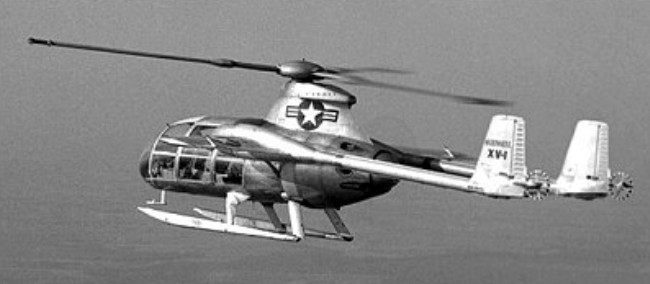
Initially designated XL-25 in the liaison aircraft category, then XH-35 in the helicopter class, and finally XV-1 as the first type in the new vertical lift category of aircraft designations, this machine worked on the unloaded rotor principle. Designed by Friedrich von Doblhoff, the Austrian helicopter pioneer responsible for the wartime WNF 342, the XV-1 was the result of an experimental programme undertaken jointly by McDonnell, the US Army Transportation Corps, and the USAF Air Research and Development Command.
Initiated by a Letter of Intent dated 20 June, 1951, the XV-1 project proceeded through mock-up inspection in November 1951, and the first aircraft (53-4016) was completed some 22 months later.
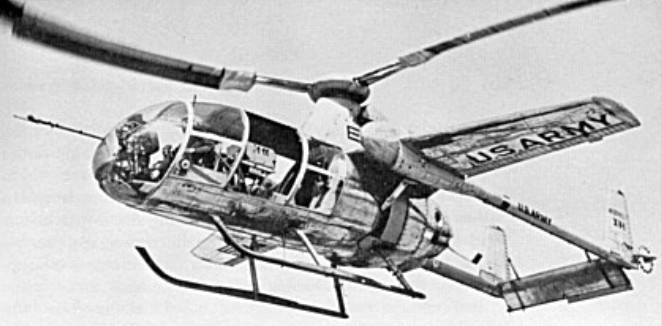
Combining the features of a twin-boom, twin-tail, fixed-wing aircraft with those of a single-rotor helicopter, the XV-1 was powered by a 525hp / 391kW Continental R-975-19 seven-cylinder radial. For vertical flight this engine drove two compressors which fed air through tubes to small pressure jets at the tips of the three-blade rotor, with the pressure jets operating on the principle of ignition and expansion of the fuel gases. For forward flight, the engine drove a two-blade pusher propeller mounted aft of the fuselage between the tail booms while the rotor autorotated. The XV-1 was intended to take-off and land as a helicopter, with transition from helicopter flight mode to conventional flight being made by transferring power from rotor to propeller as soon as the forward speed exceeded the stalled speed of the wing. Side-by-side accommodation was provided for a pilot and a co-pilot with room behind them for test instrumentation. Alternatively, accommodation could have been provided for a pilot and three passengers or a pilot and two stretchers.
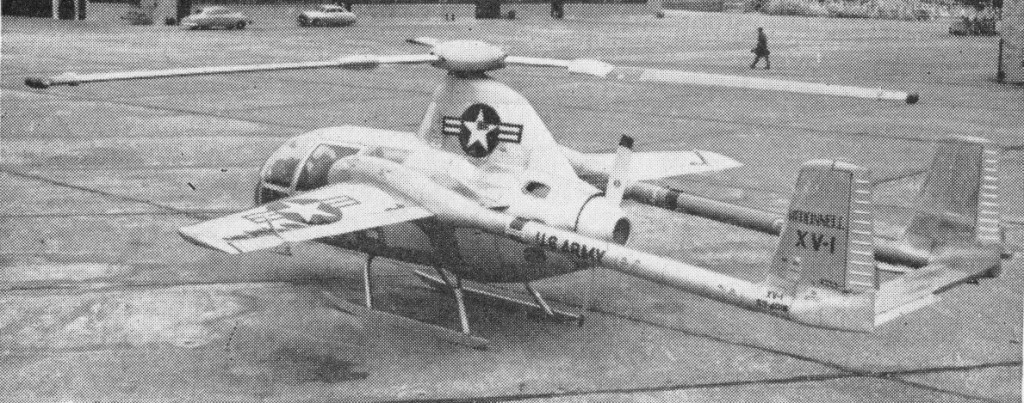
The 9m long fuselage, mounted on skid landing gear, and mid/high-set wings mounted twin tailbooms with twin vertical surfaces (about 3m in height), inter-connected by tailplane and elevator.
The 7.9m span fixed wing featured a slight sweep on both the leading and trailing edges, although the angle of sweep was greater on the leading edge. It was also designed with a high aspect ratio and joined the fuselage at the same level as the top of the cockpit, directly below the mounting for the upper rotor. The wing terminated in the fuselage into a large bulbous housing on either side of the fuselage.
Project test pilot John R. Noll began tethered hover flights on 11 February, 1954, but difficulties with the pressure jet system delayed initial free flight until 14 July, 1954. The first successful transition from helicopter flight to conventional flight was made on 29 April, 1955. The flight test programme revealed several design deficiencies which were progressively corrected through the introduction of such modifications as a cut-down rotor pylon, small anti-torque rotors fixed to the end of each taitboom, redesigned landing skids, and other minor detail changes. During the preceding months, the second XV-1 (53-4017) had joined the flight trials programme. This machine differed from the first prototype in having a bulkier but streamlined undercarriage and cut-down rotor pylon to reduce interference drag. Numerous detail improvements, including the addition of a small steering rotor behind each boom, were progressively incorporated.
In evaluating the program, the consensus was that the basic concept was sound, but the piston engine powerplant could not provide the needed performance to optimize the design. It was felt that use of a gas turbine engine in this application would solve the problem.
Although on 10 October, 1956, the second prototype XV-1 had become the world’s first rotary wing vehicle to reach a speed of 322km/h, the gain in performance over conventional helicopters did not warrant the added complexity of the convertiplane configuration. Furthermore, the potential of the McDonnell XV-1 was seriously limited by its use of a piston engine instead of gas turbines as adopted to power European convertiplanes which preceded or followed it.
The programme was terminated in 1957 after the two prototypes had been flown for a total exceeding 600 hours. The first XV-1, 53-4016, then went to the Army Aviation Center Museum at Fort Rucker, Alabama, and the second, 53-4017, was donated to the Smithsonian Institution’s National Air and Space Museum, in Washington, DC.
McDonnell Aircraft Co had invested in Platt-LePage Aircraft in mid-1942, in exchange for having McDonnell personnel learn helicopter design. In 1943 McDonnell authorized Constantine M. Zakhartchenko and a small group of engineers to undertake research on design and construction of rotors. He was appraised of Platt-LePage’s preliminary work on a twin-engined, twin-rotor helicopter to meet Army requirements. Although that PL-9 design eventually proved unsuccessful in the Army competition (the AAF selected the Kellet XR-10), it fared better in a different guise as McDonnell, in return for an increase in his investment as finalized in June 1944, obtained Platt-LePage’s agreement allowing the McDonnell Aircraft Corporation to initiate the parallel development of the twin-engined, twin-rotor concept.
On the strength of both this agreement and the work accomplished by Zakhartchenko’s team, McDonnell proposed a helicopter of this design to the Navy to serve either as a testbed or as an anti-submarine warfare platform. As a testbed, the proposed Model 65 was intended to be used for the study of the effects of rotor diameter, disk loading, variations in rotor blade flap and lag angles, and other variables. In the ASW role, it was to be able to carry an adequate load of detection gear and weapons.
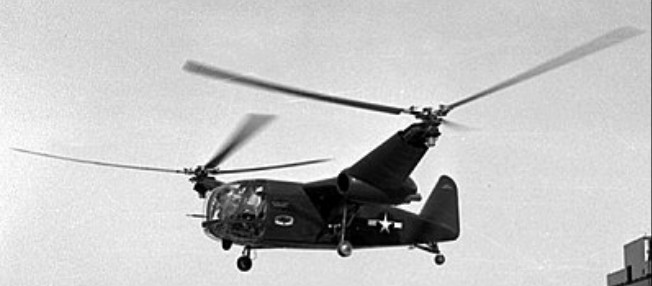
Considering the side-by-side rotor arrangement proposed by McDonnell to be a most suitable configuration for large helicopters capable of operating in the ASW role, the Bureau of Aeronautics issued a Letter of Intent on 15 May, 1944, covering the design, construction, and testing of one XHJD-1. This Letter of Intent was confirmed on 23 March, 1945, when Contract NOa(s)-3703 was awarded.
At the time of contract award, design of the Whirlaway, entrusted to a team led by Constantine Zakhartchenko, was well underway and ground testing was begun early in 1946. Piloted by Charles R. Wood Jr, the XHJD-1 made its first hover flight at Lambert Field, St Louis, on 27 April, 1946.
Designed to carry up to ten occupants but normally flown as a two-seater with up to 816kg of test instrumentation, the Whirlaway was fitted with twin side-by-side rotors mounted on pylons extending outboard of the engine nacelles. The nacelles, each housing a 450hp Pratt & Whitney R-985-AN-14B seven-cylinder radial engine, were attached to short wings which supported approximately 10 per cent of the gross weight during cruise and as much as 30 per cent of the weight in power-off autorotation, with consequent substantial improvement in overall performance efficiency. This feature, combined with the ability to transmit power from either engine to both rotors by transmissions and gear boxes, enabled the XHJH-1 to maintain level flight at full gross weight on the power of only one engine.
From April 1946 until June 1951, the XHJD-1 was used for numerous flying research tests including the evaluation of performance, stability balance and vibration characteristics peculiar to its twin-rotor configuration. In the process, the Whirlaway had its original 15.24-m diameter rotors replaced by rotors of varying diameters and had a braced tailplane with externally balanced control surfaces added before translation flights began. Once vibration and resonance problems with its unsynchromzed three-blade rotors were alleviated through the use of shock-absorbing rotor mounts, the XHJD-1 was considered to handle well and was flown some 250 hours without serious mishap. It was flown not only by McDonnell and Navy pilots but after being fitted with a rescue winch, was also evaluated in November 1949 by USAF pilots from the Arctic Rescue Helicopter Board.
As helicopter technology had made significant progress since development of the Whirlaway had been initiated, neither the XHJD-1 nor its proposed Model 65C development was put into production. Upon completion of its trials programme, the XHJD-1 – the first helicopter to bear the McDonnell name and the world’s first successful twin-engined, twin-rotor helicopter was donated to the National Air and Space Museum.
XHJD-1 Engine: 2 x Pratt & Whitney R-985-AN-14B Wasp Junior, 336kW / 450 hp Rotor diameter: 14.02-15.24m depending on configuration Overall span: 26.52m Fuselage length: 9.8m Height: 3.73m Empty weight: 3629kg Loaded weight: 4990kg Rotor loading: 13.7-16.2kg/sq.m Power loading: 5.5kg/hp Maximum speed at 1525m: 193 kph Cruising speed: 145km/h Rate of climb: 6.6m/s Absolute ceiling: 3930m Range: 485km
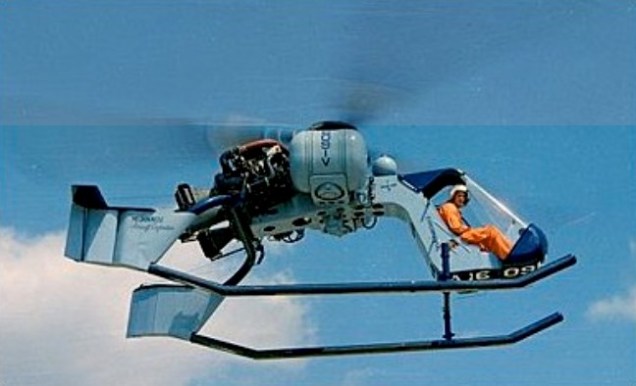
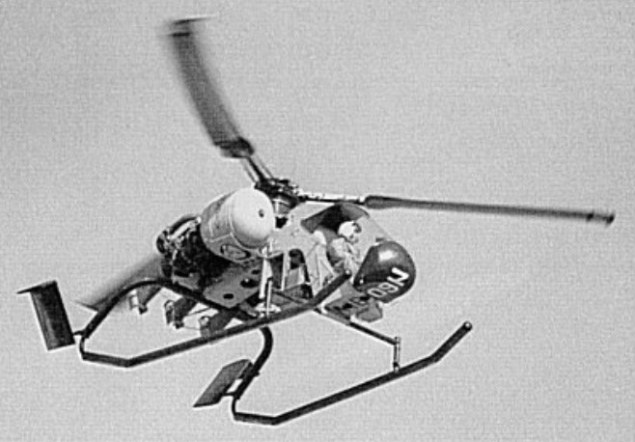
Since 1949 the McDonnell Helicopter Engineering Division had attempted to develop a rotor system capable of high-speed operation. Such a system driven by tip-mounted pressure jets had been successfully tested on the XV-1 convertiplane and its use as a pure helicopter rotor was thought to offer many significant advantages, including (1) inherent angle of attack stability; (2) increased inherent pitch and roll damping; (3) greatly improved dynamic helicopter stability; (4) ability to start and stop in high winds; (5) no need for tracking and no dampers required; (6) no possibility of mechanical instability or ground resonance; (7) very low vibration; (8) low maintenance due to absence of highly loaded bearings, reduction gears, shafting, and anti-torque rotor; and (9) automatic rotor speed control. Accordingly, McDonnell decided in December 1956 to undertake as a private venture the design, development, and testing of a small single-seat crane helicopter using the XV-1 rotor.
The mock-up of the Model 120, which was designed by a team led by Project Engineer Lloyd R. Novak, was completed in January 1957, and the first (N6081V) of two prototypes was flown on 13 November of that year by John R. Noll. This helicopter was of simple design, with the pilot seated centrally and the fuel tanks mounted on each side of the upper fuselage beneath the rotor head. Three AiResearch GTC-85-135 gas-turbine compressors, which fed pressure jets at the tips of the three-blade rotor, were located below and behind the rotor head. A wide-spaced skid undercarriage enabled large loads to be slung beneath the centre of gravity, or specialized pods to be fitted to carry up to 12 troops, firefighting equipment, or cargo containers.
In spite of some powerplant teething problems, the Model 120 demonstrated a maximum load-to-weight ratio of 1.5:1. Unfortunately, in spite of having been judged ‘one of the most outstanding helicopters evaluated to-date in its weight class’ when flown at the Naval Air Test Center, NAS Patuxent River, in September 1959, the Model 120 remained experimental as McDonnell failed to win either military or civil orders for this competent design. The termination of this programme in February 1960 marked the end of McDonnell’s independent efforts in this field as 13 months earlier the US Marine Corps had terminated the development of the XHCH-1 crane helicopter. McDonnell Douglas, however, came back to the helicopter field in 1984 with its acquisition of Hughes Helicopters, Inc.
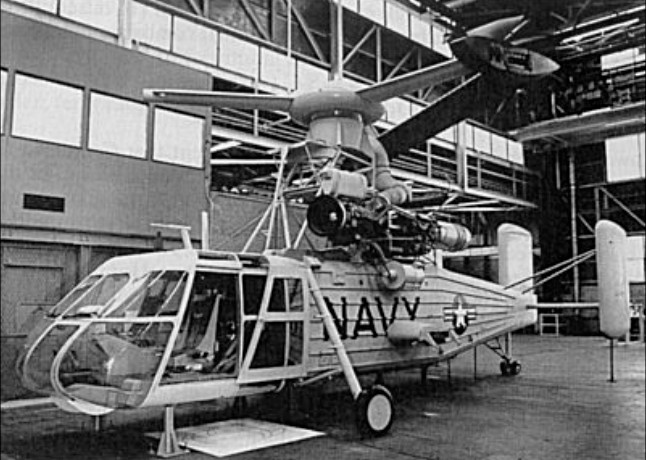
The McDonnell Model 86 was the first helicopter specially designed for the Navy vert-rep (vertical replenishment) mission – carrying supplies and ammunition between ships—and for the Marine logistic support mission—carrying heavy loads for short distances from ship-to-shore or from marshalling areas ashore to front-line units.
Emphasis was placed during its design on extreme simplicity, ease of maintenance, and good flying characteristics while carrying underslung loads of up to 6804kg when operating at normal gross weight, or 9979kg when operating at overload gross weight. The powerplant installation, derived from that developed for the XHRH-1, consisted of two 3750eshp Allison XT56-A-2 turbines mounted atop the fuselage and providing compressed-air to the 726kg thrust McDonnell 12JP20 pressure jet at the extremity of each rotor blade. The crew of two consisted of a pilot on the starboard side and an aft-facing winch operator to port. There was no provision for carrying loads internally. Loads were to be carried externally on a sling, in a net, or in a specially-developed pod. This pod was to be fitted with a detachable tail unit to stabilize the load in flight and with large wheels to enable it to be towed on uneven ground after it had been delivered to forward bases. Consideration was also given to using the Fairchild pod which had been designed for the XC-120 twin-engined cargo aircraft.
Three XHCH-1 prototypes (BuNos 138654/138656) were ordered on 11 April, 1952, under Contract NOa(s)52-947 and a mock-up was inspected on 22 and 23 May, 1953. However, the programme was later cut back due to lack of funds. No prototypes were completed but a much revised mock-up was inspected on 15 and 16 November, 1956, and a full-scale rotor was tested on a hot-whirling bench beginning in December 1957. Additional budget cuts forced the Navy to terminate the contract on 18 January, 1959, before completion of a prototype. Nevertheless, McDonnell kept working on the Model 86 sky crane until June 1961.
XHCH-1 Rotor diameter: 19.81m Length: 11.45m Height: 5.07m Empty weight: 6749kg Loaded weight: 16026kg Maximum weight: 19051kg Maximum speed at sea level: 185km/h Rate of climb: 16m/s Hover ceiling out of ground effect: 2285m Combat radius: 37km
In 1950, after trials with the XH-20 had been terminated, McDonnell engineers remained convinced that for certain specialized applications the intrinsic simplicity of this system would outweigh its uneconomical fuel consumption rate. Hence, after failing to attract the interest of the Army in a proposed light scout and observation vehicle using a ramjet-driven rotor, they turned their attention to the agricultural market in the belief that an easily maintained, low cost helicopter would find a ready market.
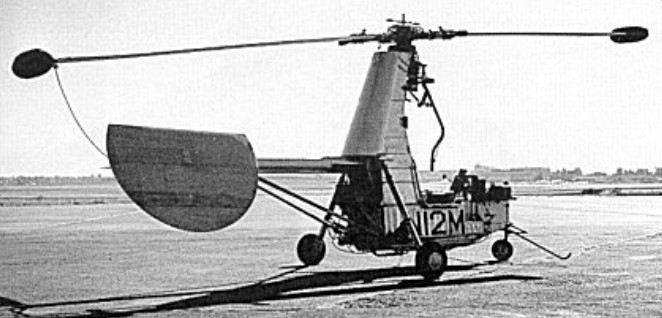
As described in a specification report dated 26 September, 1950, the Model 79 was essentially similar in concept and construction to the Model 38 (XH-20) but was somewhat larger with the diameter of the two-bladed rotor being increased from 5.49m to 8.23m. It differed further from the Model 38 in having tail surfaces consisting of a fixed ground adjustable tailplane and a universally mounted movable rudder. Open accommodation was provided for a pilot, and alternate alighting gears, consisting of either a tricycle gear or twin skids, were offered. Power was provided by a pair of McDonnell 8RJ4 ramjets, one at the tip of each rotor blade, and 379 litres of fuel was carried in two tanks. For ferry purposes auxiliary tanks could be fitted to increase fuel capacity to 681 litres.
Designed as a utility helicopter, the Model 79 was intended to be used for pest or weed control, defoliation, fertilizing, seeding, or many other varied uses such as carrying mail or cargo. To that end, it could be fitted with either (1) dual liquid chemical tanks with a total capacity of 439 litres and dual spray booms; (2) dual dust or seed bins with a total capacity of 0.44cu.m and a dust outlet pointing downward and aft of the rotor disc; or (3) dual mail or light cargo bins with a total volume of 1.13cu.m. As a further alternative, the design provided for the installation, either during construction or as rapid modification kits, of cockpit floor extensions and removable plastic panels to convert the single-seat Model 79 into the two-seat Model 79A with dual controls.
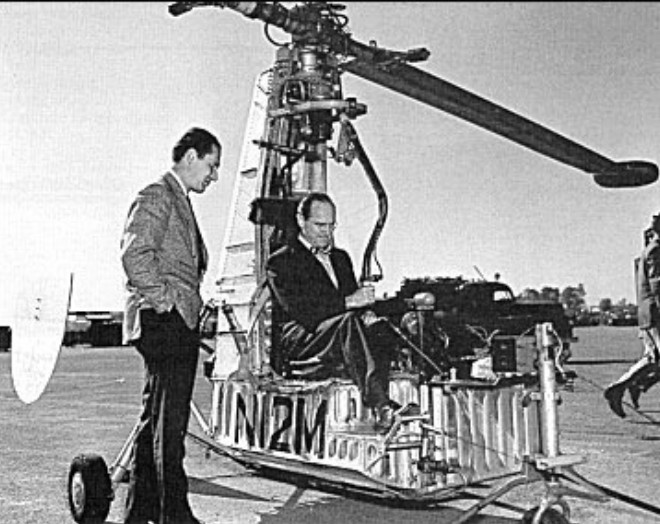
Charles R. Wood Jr. first flew the single seat Model 79 demonstrator, which was registered N12M, on 26 March, 1952. Although trials proved relatively uneventful and confirmed that the basic design was sound and easy to fly and maintain, development of the Model 79 had to be abandoned in mid-1953 as the type had failed to attract commercial interest due to high fuel consumption rate and noise level.
Steve Cole 15.03.2012 My Grandfather, Willis Cole Jr. worked for McDonnell. Somehow he acquired most of Big Henry when the project was cancelled. There are pictures of it sitting in the family driveway. Up until a few years ago, the landing gear, instrument panel and a piece of the fuselage (with the N12M number) were still floating around his garage. Willis Cole Jr. passed away 3-16-2012.
Model 79 Rotor diameter: 8.23m Fuselage length: 4.72m Height: 2.54m Empty weight: 293kg Loaded weight: 816kg Maximum weight: 907kg Maximum speed: 138km/h Rate of climb: 5m/s Hover ceiling in ground effect: 1160m Service ceiling: 3050m Endurance: 62 min
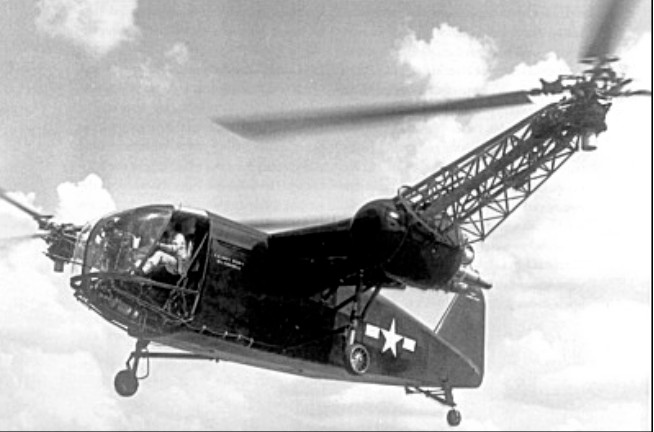
Design of the Model 78 was started in 1950 in answer to a request for proposals for an assault transport helicopter which had been issued by the Navy Department on behalf of the US Marine Corps. Intended to operate from CVE-105 class (USS Commencement Bay) carriers, the new helicopter was to fit on 13.41m by 12.80m deck elevators. Its primary mission was to carry 30 troops to objectives up to 100 naut miles away and return to the carrier without the need to refuel ashore.
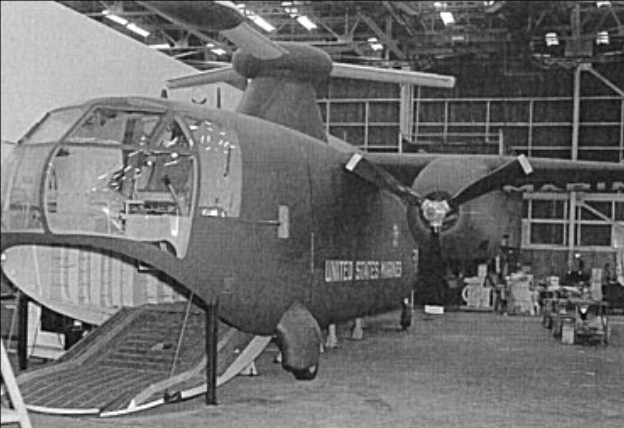
To fulfil what were then most demanding requirements, McDonnell designed a compound helicopter with a three-bladed rotor and short wings on which were mounted two 3507shp Allison XT56-A-4 turbines. For vertical flight, air from engine-driven auxiliary compressors was to be ducted to 726kg thrust McDonnell 12JP20 pressure jets, one at the extremity of each rotor. For forward flight, each engine was to drive a three-bladed propeller, with transition from helicopter flight mode to conventional flight being made by transferring power from the auxiliary compressors to the propellers as soon as the forward speed exceeded the stalled speed of the wing. Normal accommodation was to have been provided for a crew of two and 30 fully-equipped troops. Alternatively, accommodation could have been provided for 36 troops or 24 litter patients, or two Jeep-sized vehicles could have been carried internally. Larger loads (up to a maximum weight of 5224kg) could be carried externally. Another noteworthy design feature was the inclusion of a hydraulically-operated loading ramp in the forward fuselage, beneath the cockpit. Folding wings, rotor blades, and tail unit were to have enabled the Model 78 to fit on the deck elevators of CVE-105 carriers.
The Navy selected the McDonnell design on 15 March, 1951, and two and a half months later issued a Letter of Intent for three XHRH-1 prototypes (BuNos 133736/133738) to be built under Contract N0a(s)-51-1201. A full-scale mock-up of the XHRH-1 was inspected on 22 and 23 October, 1952, and construction of the prototypes was begun. However, after the Korean War had ended, budget cuts and concern over anticipated developmental problems led to the cancellation of the contract before completion of a single XHRH-1. All work on the project ended in April 1954.
XHRH-1 Rotor diameter: 19.81m Wingspan: 13.72m Length with rotor blades and tail folded: 16.33m Height: 5.09m Wing area: 30.84 sq.m Empty weight: 8695kg Loaded weight: 13795kg Maximum weight: 16329kg Maximum speed at sea level: 444km/h Climb rate: 12m/s Hover ceiling out of ground effect: 3050m Combat radius: 185km
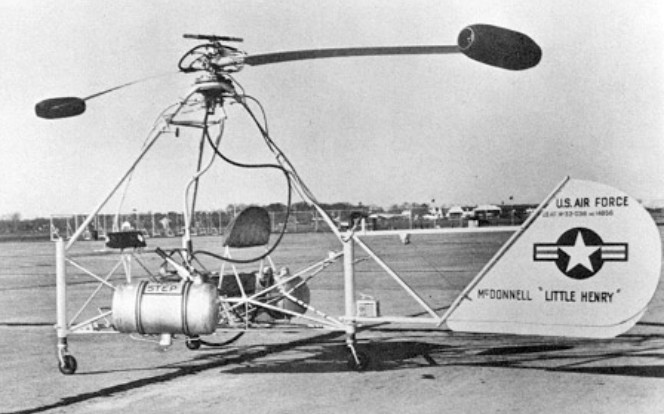
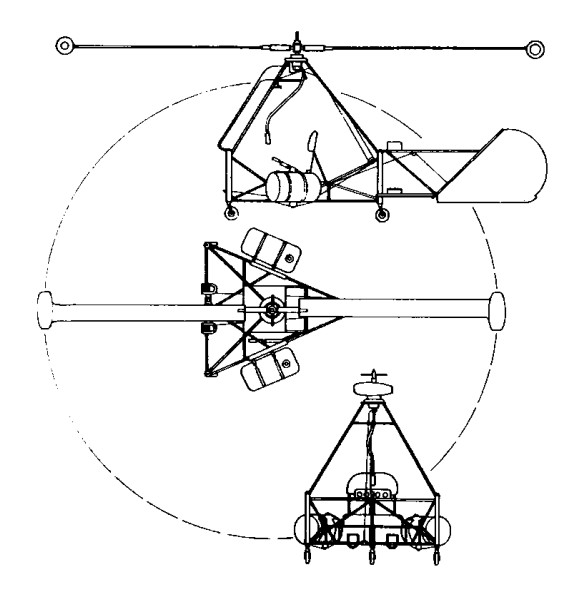
The XH-20 “Little Henry” was developed by a team led by Marvin Marks in close co-operation between the Helicopter and Propulsion Division of McDonnell and the AAF/USAF Rotor Wing Branch, Propeller Laboratory and Rotary Wing Unit, Aircraft Projects Section, Wright-Patterson AFB. At the time of its inception, the XH-20 was unique in being powered by two McDonnell-developed 18.42cm ramjet units weighing only 4.5kg each, mounted at the tips of the two-blade rotor and fed from tanks beside the pilot. The fuel, originally propane but later gasoline (motor car petrol), was boosted through a feed line to a delivery valve on the rotor head. From there centrifugal force took over to convey the fuel through the blades to the tip-mounted ramjets.
Having undertaken privately-funded studies of ramjets as powerplants for helicopters, McDonnell submitted an unsolicited proposal to the Air Materiel Command at Wright Field in the spring of 1946 and in July was awarded a contract for the development and testing of two experimental machines. It was then hoped that the powerplant would make it feasible to build small, lightweight helicopters by reducing or eliminating complex and heavy engine parts, gear systems, and transmissions. It was claimed that this powerplant installation would result in increased efficiency and would completely eliminate the need for a conventional anti-torque rotor. Accordingly, the two XH-20s were ordered as flying test-beds and were not intended as production prototypes. Their airframe was kept as simple as possible and consisted of welded tubes carried on three vertical legs ending with free-castoring wheels. Conventional helicopter controls were fitted, and the pitch lever incorporated a motorcycle-type throttle to regulate the fuel flow.
Fitted as a single-seater, the first of two prototypes (46-689 and 46-690) made both its first tethered flight on 5 May, 1947, and its first free flight on 29 August in St Louis with Charles R. Wood Jr. at the controls. With the project team then benefitting from the experience of Friedrich von Dobhloff, the Austrian engineer who had pioneered the application of jet principles to helicopters during the war, tests continued for four years. During that time, one of the two XH-20s was modified as a two-seater and, like the single-seater, proved generally satisfactory. However, the ramjet units had excessive fuel consumption, which drastically limited range and endurance when compared to conventionally-powered helicopters, and rate of descent in autorotation was excessive. Accordingly, the Air Force terminated the programme in 1951. The first XH-20 was preserved and is now part of the collection of the Air Force Museum at Wright-Patterson AFB, Ohio.
Main rotor diameter: 5.49m Length: 3.81m Height: 2.13m Max take-off weight: 254kg Empty weight: 129kg Cruising speed: 80km/h Endurance: 50min






 All Aero