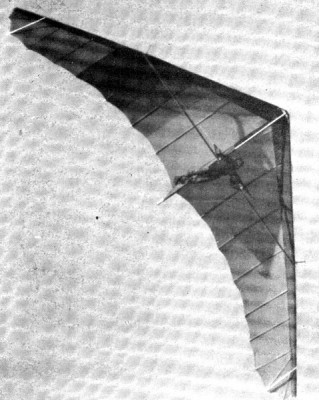
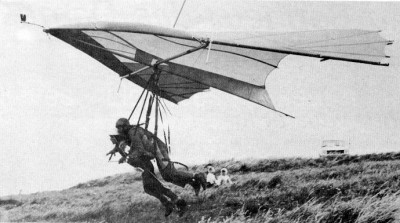
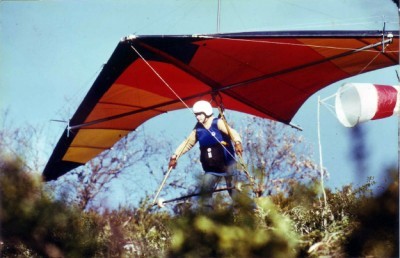
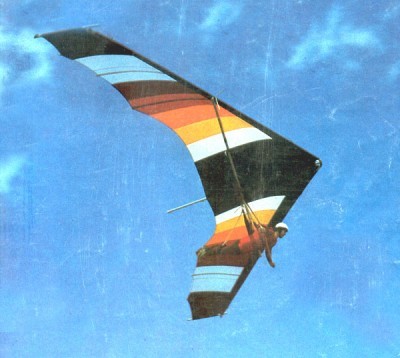
A 1979 hang glider described as having rigging/derigging as incredibly tedious and long: 1/2 cross bars to take apart, 3 deflexors on each side, bolts and shims everywhere. However, excellent finish and viceless glider.
Wing area: 19 m² Aspect ratio: 7 Hang glider weight: 26 kg Minimum pilot weight: 70 kg Maximum pilot weight: 95 kg Packed length: 7 m Number of battens: 16 Nose angle: 116°
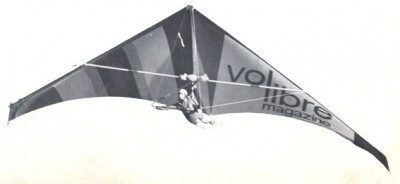
Aspect ratio: 5 Hang glider weight: 37 kg Minimum speed: 30 km/h Maximum speed: 48 km/h Max glide ratio (L/H): 8 Minimum sink rate: 2 m/s Packed length: 7 m Nose angle: 118°
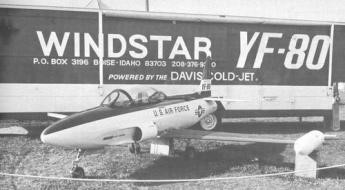
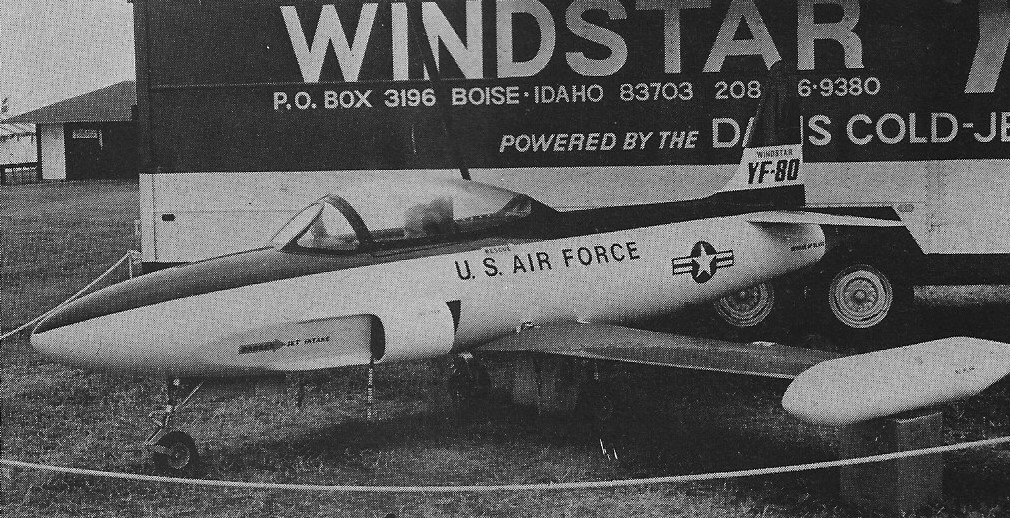
At Oshkosh 1977, Winstar, of Boise, Idaho, showed a half-scale replica of the Lockheed T-33. This small YF-80 is powered by a Davis cold air jet compressed by a compressor producing 220 lb thrust, driven itself by a V8 motor.
The compressor, designed by Davis, underwent static tests showing that it was possible to obtain 110 Kp at 75% power, consuming less than 65 lt / h.
Wingspan 18’6″ Length: 17’3″ Useful load: 400 lb Max speed: 300 mph Stall: 90 mph Range: 490 mi Seats: 1
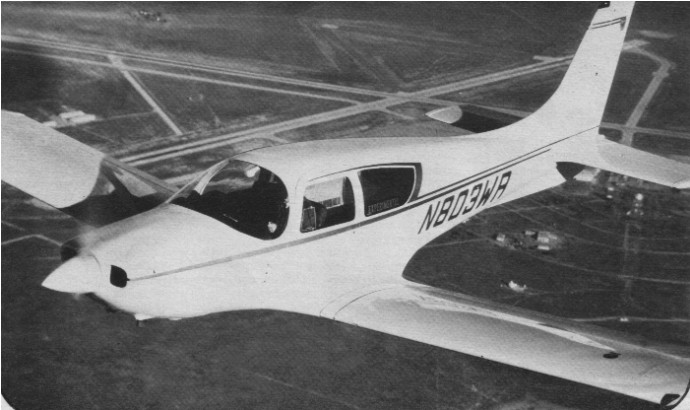
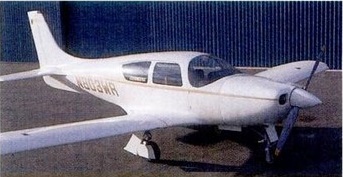
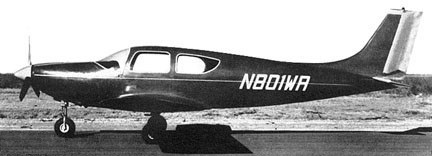
The Windecker Eagle single engine, low wing, four place airplane was built of fiberglass reinforced epoxy and introduced about 1967. The Eagle was fabricated of a resin called “Fibaloy” developed by Dr Leo Windecker, Midland, Texas. It was supposed to make the aeroplane extremely strong, light, easy to manufacture and, because of its rivetless, seamless loveliness, unsurpassedly fast. First flown in 1969, the prototype Eagle (aka X-7) N801WR was lost during spin tests; it wasn’t fast enough and it cost as much as its aluminum competitors.
The Windecler Eagle was certified in 1970 as the first production plastic composite aircraft. Because the FAA was unfamiliar with plastic aircraft t required the Eagle to meet 20 percent higher strength factors than comparable aircraft.
It was not a lack of prospective buyers that sank the Windecker; it was under-capitalization. The cost of getting the Windecker’s foam and fiberglass construction past the FAA is rumored to have been about $20 million; and, although the project started out with generous financing from a large backer, the financing simply stopped, probably because once a certain amount of money has gone down the drain, even an optimistic backer will take flight before sending down even more. Plagued by persistent financial difficulties, the manufacturer, Windecker Industries, was 15 months behind schedule when the first production Eagle emerged from the factory at Midland, Texas. Five airplanes later, the financial ogres halted the program. Production models were Eagle I (aka YE-7) priced at $36,000. Eight were built N801WR-804WR, and N4195G-4198G. NASM has Eagle N4197G s/n 6 at Silver Hill.
Windecker Eagle Prototype N801WR
During the Have Blue era the all composite Windeck Eagle light aircraft was modified and tested by Lockheed for USAF for stealth potential as the YE-5A. A militarised Eagle I c/n 008 (delivered in 1973) as 73-01653, powered by a Continental IO-540G, but the problem of shielding the remaining metal parts (engine, hydraulics, undercarriage) remained, although the YE-5A did contain internal radar absorbent material (RAM) for this purpose.
Jerry Diet¬rick, a Florence, Kentucky mechanical en¬gineer, formed the Composite Aircraft Corporation to acquire the molds, tooling equipment and other assets in 1977 so he could form his own corporation to reopen the factory. Dietrick’s own Eagle, one of the six production aircraft made, un¬derwent detail modifications that would be in¬cluded in future models if the factory reopened.
Composite Aircraft Corp, of Florence, Ken¬tucky, had given details of its plans to produce three derivatives of the all plastics Windecker Eagle, the design and production rights for which were acquired after Windecker Indus¬tries Inc went bankrupt. The four seat high performance Eagle, of glassfibre and epoxy construction, had been certificated by Win¬decker and six examples were built; two of these owned by Jerry Dietrick, president of CAC. The planned developments are Eagle 1, with the same 285 hp Continental IO 520 C engine as the original model but an improved one piece tapered wing with winglets and a single spar in place of the three piece rectangular five spar wing; Eagle 2, combining this new wing with a 317 shp Allison 250 B17C turboprop and Eagle 3, with a new fuselage incorporating a six seat pressurised cabin and turboprop engine. One of the original Eagles was being fitted with an Allison turboprop to help development of the Eagle 2.
The remains of the first two airframes (N801WR and N802WR) are in outdoor storage at KRCK Rockdale HH Coffield Regional Airport, under the stewardship of the local EAA Chapter in 2022. They’re hoping to get these preserved at a museum in Oshkosh. Tail number remains visible on N801WR.
USA Held license from Dow Chemicals for a reinforced plastic aircraft developed by Dr Leo Windecker, Midland, Texas. Flight tested 1967. First production Windecker AC-7 Eagle I, mainly Fibraloy reinforced plastic, flown 1969. Also produced single example of YE-5 for USAF.
 All Aero