The 1963 VG-1 Vertigyro (N5395Z) comprised a Piper Colt aircraft fuselage, complete with engine and prop. Its Sud Djinn rotor system was driven by a turbine engine, enabling the craft to be flown as a gyroplane, a helicopter, or a combination of both. Only the one was built.
The vehicle could take off and fly as a helicopter at 75mph, powered by a Garret-AiResearch GTC-85-90 gas turbine to feed compressed air to nozzles in the two-blade rotor, then convert into an autogyro to do 85mph powered by the one 108hp Lycoming O-235.
Engines: 1 x Garret-AiResearch GTC-85-90 gas turbine / 1 x Lycoming O-235, 108hp Rotor diameter: 36 ft 0 in Minimum gyro speed: 45 mph Seats: 2
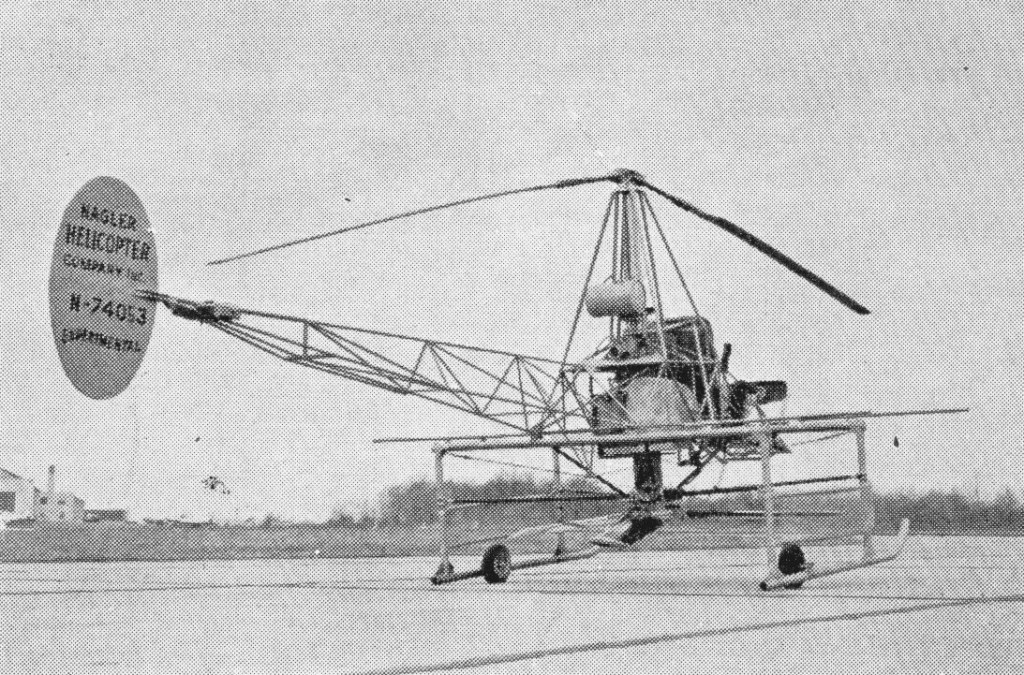
This version incorporates the lessons learnt from the NH 120, and while the general principle remains the same, i.e. the main rotor in the same alignment as the anti-torque rotor, their positions have been changed.
The two-bladed main rotor remains in its usual position, but the anti-torque rotor with three articulated blades is on the helicopter’s underside between the two skis acting as landing gear, and 1.83m away from the main rotor. The latter has cyclic and collective control and is mounted on an oscillating hub. In horizontal flight it turns at 400 r.p.m. and the lower rotor at 1.500 rpm, the latter consuming 55hp, the former 15hp of the engine’s total power.
Nagler has designed an unusual steering system: two disc brakes of the kind used in motor vehicles, one acting on the main rotor, the other on the shaft of the engine to which the anti-torque rotor is fixed. These brakes are pedal operated.
A fixed vertical surface at the end of the rudimentary fuselage ensures directional stability. The production model is planned to have an enclosed cockpit and fuselage.
Nagler’s Model NH-160 single-seat helicopter first flew in 1955.
This 1954 ultra-light single-seater has two rotors: one main rotor with collective and cyclic pitch control, the latter by a hanging stick, and one smaller anti-torque rotor. Nagler’s ingenuity in this design consists in placing the latter above the main rotor, which is thus surmounted by the driving engine directly above it and a two-bladed, much smaller diameter fixed-pitch rotor. This compact unit, two rotors with the engine between them, is supported by the helicopter frame made of tubes and containing the pilot’s seat with fuel tanks behind it. The 45hp engine originally planned for proved insufficiently powerful and has been replaced. The tricycle landing gear has three wheels held at the end of legs fitted with shock absorbers. When folded this rotorcraft will go into a container measuring 0.77 by 2.13m.
This 1954 convertiplane consisted of an Aeronca fuselage minus the wings and plus a two-bladed rotor powered by six solid fuel rockets placed three at the tip of each blade and each providing a 41-68kg thrust.
The airscrew used for forward flight was powered by a Continental reciprocating engine. After the rocket power take-off, the Convertocraft flies forward with the rotor freewheeling.
Engine: Continental, and 6 rockets Rotor diameter: 30 ft (9.14 m) Weight fully loaded: 1,450 lb (658 kg) Cruising speed: 80 m.p.h. (128 k.p.h.) Number of seats: 2
This, the first rotorcraft (1952) which Nagler designed after his arrival in the United States, was of the ‘strap-on’ variety. Its intended use was to cross rivers or other obstacles. The required height was to be reached by power from six solid-propellant rockets, fired in pairs and providing a 9kg thrust for about twenty seconds. Slow descent was ensured by the auto-rotation of the rotor. The six rockets could be replaced for later use. The wearer’s legs were to be the landing gear.
With the addition of a 2 cylinder opposed engine driving a pusher prop also in 1952, the XNH-1 was re-designated XNH-2 Heligyro.
XNH-I Heliglider Engine: 6 x 9 kg rockets Weight empty: 29.5kg / 67 b Crew: 1
Bruno Nagler, whose earliest rotary wing experiments go back to 1929, emigrated to the United States in 1952. There he has built various prototypes, all single-seat, like his former designs, but with a totally different concept of an anti-torque rotor in the extension of the main rotor.
Nagler’s Model NH-160 single-seat helicopter first flew in 1955. The VG-1 Vertigyro developed later comprised a Piper Colt aircraft fuselage with conventional engine. Its rotor system was driven by a turbine engine, enabling the craft to be flown as a gyroplane, a helicopter, or a combination of both.
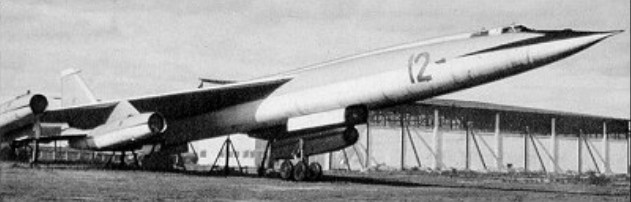
To succeed its M-4, Myasishchyev produced the M-50, codenamed ‘Bounder’ by NATO.
It was based on a very long area-ruled fuselage with two four-wheel main landing gear bogies arranged in tandem to retract into the lower fuselage. This was basically the same arrangement as that used in the M-4, as was the use of two twin-wheel stabilizers of the outrigger type that retracted aft into the wingtips. The cropped delta wing was located in the shoulder position with its leading edges swept at 500 inboard decreasing to 41030’ outboard. The tail unit was conventional for a supersonic type, with powered all-moving slab tailplane halves and a fin with a powered rudder.
The crew of three was accommodated in a pressurized nose compartment on tandem ejector seats behind a V-shaped windscreen whose contours were continued aft of the cockpit by a long dorsal spine stretching as far as the extreme tail. In the first aeroplane the four engines were located on pylons under the wing leading edges. Power was provided by four Soloviev D-15 turbo-jets of 13000kg thrust.
First flight dates between 1957 and 1961 have been quoted, and it is believed that a maximum speed in the order of Mach 1.8 was achieved. By the standards of the day this was a good figure, but the range of 3730 miles (6000 km) without payload was poor. It was seen at the 1961 Soviet Aviation Day display.
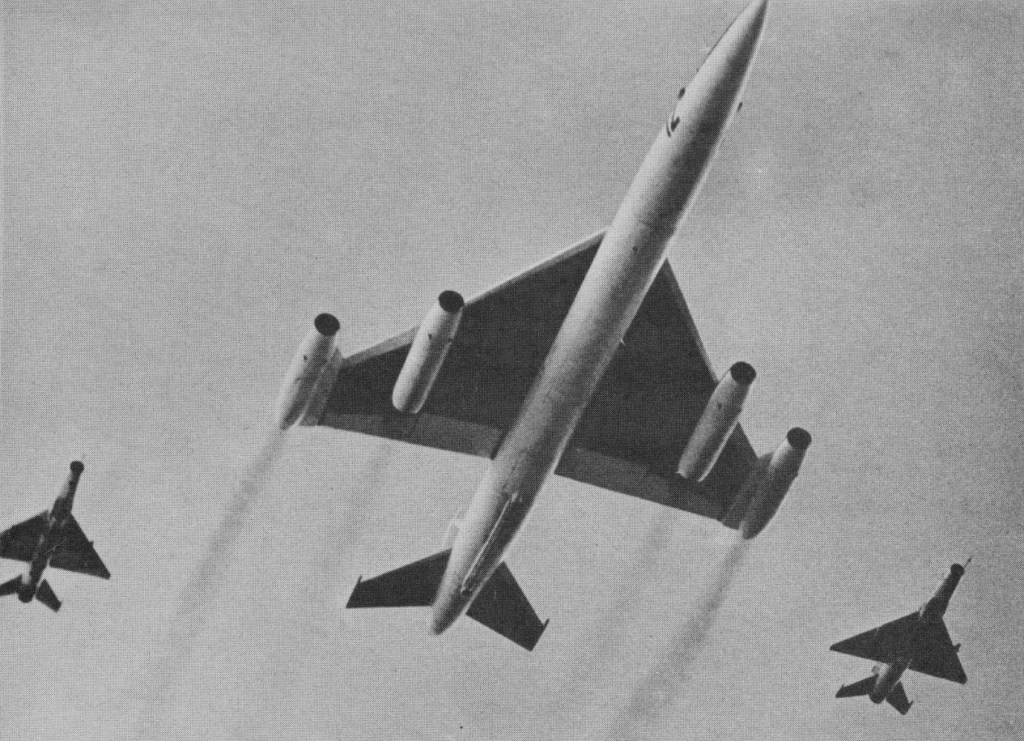
The last of several prototypes, generally known as the M-52, had a different powerplant arrangement: the two inboard engines remained on underwing pylons. The M-52 was powered by four Kolesov ND-7F or VD-7F turbojets, with an afterburning thrust of 18145kg. The two outboard engines remained non-afterburning units but were arranged on pylons with forward-swept leading edges projecting horizontally from the cropped tips of the delta wings. The M-50/M-52 series failed to progress past the prototype stage. The Bounder was intended to carry a weapons load of up to 20,000kg.
M.50 Engines: 2 x 14500kg Kolesov VD-7F and 2 x 12260kg VD-7 turbojets Wingspan: 37.0 m / 121 ft 5 in Length: 57.0 m / 187 ft 0 in Height: 12.0 m / 39 ft 4 in Wing area: 282.0 sq.m / 3035.42 sq ft Max take-off weight: 200000 kg / 440927 lb Empty weight: 74500 kg / 164245 lb Max. speed: 1053 kts / 1950 km/h / 1212 mph Cruise speed: 1500 km/h / 932 mph Ceiling: 20000 m / 65600 ft Range w/max.fuel: 6000 km / 3728 miles Armament: 20000kg of bombs and missiles Crew: 2
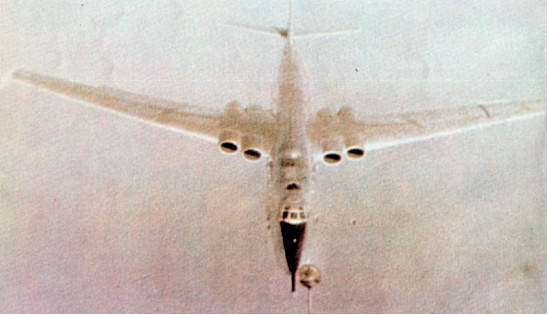
In 1951 V. M. Myasishchyev was directly ordered by Stalin to build a jet bomber to fly long range strategic missions. The Myasishchyev M-4 (often called the Mya 4, and called Molot, meaning hammer, by the Soviets, and given the codename ‘Bison’ by NATO) proved successful.
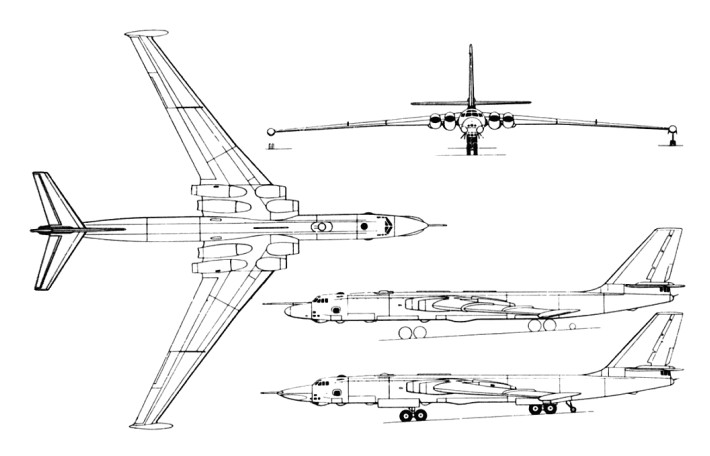
A mid-wing cantilever monoplane with a deep section swept wing, the M-4 has a tail unit with all-swept surfaces, and retractable landing gear comprising two main units in tandem on the fuselage centreline, each with a four-wheel bogie, plus twin-wheel outrigger balancing units which retract into the wingtips. The circular-section fuselage incorporates a pressurised nose compartment and tail turret for the crew, and a large internal weapons bay in the lower fuselage between the main landing gear units. The powerplant comprises four turbojets buried in the wing roots, these being initially Mikulin AM-3Ds each of 8700kg thrust.
Following its maiden flight in late 1953, a single example of this large aircraft took part in the 1954 May Day parade fly past over Moscow, its size being gauged from the escorting MiG fighters. It was expected to appear in large numbers, but little was heard of it for years. In fact a useful run of about 150 had been delivered, at first being used as free fall bombers (Bison A), reaching regiments of the DA (Long Range Aviation) in 1956. Altogether about 200 were built. By 1959 the Mya-4 bombers were being fitted with more powerful engines, and their role changed from bomber to long-range over-sea reconnaissance, ECM and, in some cases, flight-refuelling tanker. Many were given different noses as ‘Bison B’ and ‘Bison C’ for maritime reconnaissance purposes. All aircraft were given large fixed FR probes, the rear turrets were removed and a vast amount of special reconnaissance equipment fitted, with from five to 17 aerials visible all over the aircraft.
In the Bison C- sub-type a large search radar fills the entire nose, lengthening the nose by about 6 ft and changing its shape. Since 1967 these now obsolescent aircraft have been frequently encountered on probing missions far over the Arctic, Atlantic, Pacific and elsewhere, at both high and very low levels, the C-model having been seen most frequently.
Bison C
In 1983 it was estimated that 43 remained in active service in the original role. Supporting them are another 30 rebuilt as inflight-refuelling tankers, with many modifications including a large hose drum unit in the rear of the weapon bay. ‘Bison B’ was a long range maritime reconnaissance version, possibly re-built from the original bomber, with a ‘solid’ nose housing a mapping and ship targeting radar with the refuelling probe above. Numerous other reconnaissance systems were installed. ‘Bison C was an improved maritime reconnaissance version with an even larger surveillance radar (NATO name ‘Puff Ball’) in a more pointed nose swollen at the sides and with the refuelling probe at the tip. These flew surveillance and electronic missions for the AV MF (Naval Air Force).
In all about 150 were built.
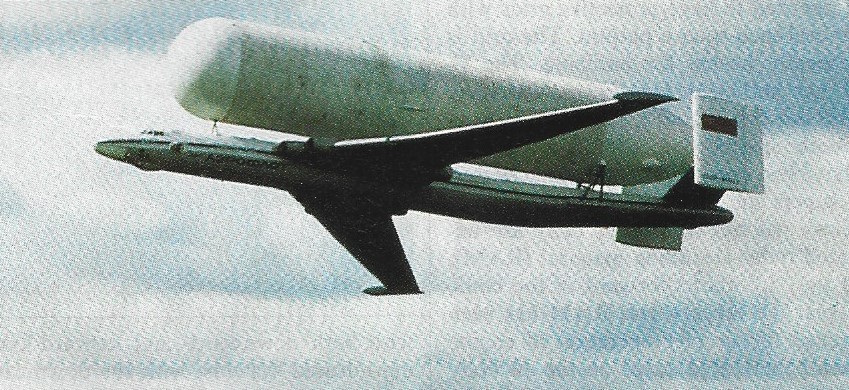
About 40 tanker/transport versions of the M-4 were estimated to remain in service in 1992. These were to be replaced by II-78 ‘Midas’ tankers.
M-4 / 3M Engines: 4 x VD-7, 107.8kN Max take-off weight: 202000 kg / 445336 lb Empty weight: 74430 kg / 164091 lb Wingspan: 50.53 m / 165 ft 9 in Length: 51.70 m / 169 ft 7 in Wing area: 340.0 sq.m / 3659.73 sq ft Max. speed: 940 km/h / 584 mph Ceiling: 12150 m / 39850 ft Range: 11850 km / 7363 miles Endurance: 15 hr Armament: 6 x 23mm cannons, 24000kg of bombs and missiles Crew: 8
Bison A Type: heavy bomber Engines: 4 x Mikulin AM-3D single-shaft turbojets, 19,180 lb (8700 kg). Estimated, span 165 ft 7½ in (50.48 m) Estimated Length 154 ft 10 in (47.2 m) Estimated height 46 ft (14.1 m) Estimated empty 154,000 lb (70,000 kg) Estimated maximum loaded 352,740 lb (160,000 kg) Estimated Max speed 560 mph (900 km/h) Estimated Range 6,835 miles (11,000 km) with 9,920 lb (4500 kg) of bombs or electronic equipment. Service ceiling 42,650 ft (13,000 m) Armament: ten 23 mm NR-23 cannon in manned turret in tail and four remotely controlled turrets above and below front and rear fuselage (two guns in each turret); internal bomb bays in tandem for at least 22,050 lb (10000 kg) stores.
Bison B Type: strategic reconnissance and ECM Engines: 4 x D-15, 28,660 lb (13,000 kg) Estimated empty 176,400 lb (80,000 kg) Estimated maximum loaded 375,000 lb (170,000 kg) Estimated Max speed 560 mph (900 km/h) Estimated Range 6,835 miles (11,000 km) with 9,920 lb (4500 kg) of bombs or electronic equipment. Service ceiling 49,200 ft (15,000 m) Armament: six 23 mm cannon in two forward turrets and tail turret, internal bay for at least 10,000 1b (4500 kg) stores. In many versions a single 23 mm gun is fixed on the right side of the nose, firing ahead.
Bison C Type: multi-role reconnaissance bomber Engines: 4 x D-15, 28,660 lb (13,000 kg) Estimated empty 176,400 lb (80,000 kg) Estimated maximum loaded 375,000 lb (170,000 kg) Estimated Max speed 560 mph (900 km/h) Estimated Range 6,835 miles (11,000 km) with 9,920 lb (4500 kg) of bombs or electronic equipment. Service ceiling 49,200 ft (15,000 m) Armament: six 23 mm cannon in two forward turrets and tail turret, internal bay for at least 10,000 1b (4500 kg) stores. In many versions a single 23 mm gun is fixed on the right side of the nose, firing ahead.
M-4 Bison E Type: six seat strategic bomber Engines: 4 x 9500 kg (20,943 lb) thrust Mikulin RD 3M turbojets Max speed at high alt: 1000 km/h (621 mph) Service ceiling at normal loaded wt: 17000 m (55,775 ft) MTOW Service ceiling: 13000 m (42,650 ft) Range 10700 km (6,650 miles) Empty wt: 70000 kg (154,321 lb) Normal loaded wt: 160000 kg (352,734 lb) MTOW: 210000 kg (462,963 lb) Wing span: 50.48 m (165 ft 7.5 in) Length (no probe): 47.20 m (154 ft 10 in) Height: 14.24 m (46 ft 0 in) Wing area: 309.0 sq.m (3,326.2 sq ft) Armament: (as built) 10x 23 mm cannon in five power turrets; internal bomb bay for 15000 kg (33,068 lb) bombload.
Vladimir Myasishchev’s design career included association with the ANT-16 and ANT-29 before work began, in 1940, on prototype DVB-102 twin-engined bomber.
New bureau established 1951 to develop four-jet long-range heavy bomber, which became Mya-4 Molot (NATO codename: Bison), first flown January 1953; also served as maritime research aircraft and finally as tanker and heavylift transport.
Designed M-52 Bounderiour-\e\ delta-winged strategic bomber seen at 1961 Soviet Aviation Day display, but not put into production. Produced II-22 airborne command post, as converted llyushin 11-18 airliner. Important M-17 first flew in May 1982, having been designed originally in early 1970s as high-altitude reconnaissance balloon interceptor but developed into M-17/M-55 high altitude reconnaissance and ecological monitoring aircraft. Small civil aircraft include pressurized and single turboprop eight-seat M-101 Gzhel (first flown 1995) and M- 201 Sokol twin-engined version, with projects covering M-202PW Olen enlarged development of the Indian Saras, M-203PW Barsuk radial-engined general-purpose transport, and M-500 piston-engined agricultural monoplane suited also to other roles.





 All Aero