NASA AD-1 / Ames AD-1

Robert T. Jones of Ames calculated that an aircraft’s wing made to pivot 4 degrees to the fuselage might halve the fuel consumption. Specifications bases, in particular geometric configuration were established by NASA based on one made by Boeing. In consultation with the Rutan Aircraft Factory, Ames and Dryden built the AD-1 oblique wing aircraft in 1977, a twin jet composite aircraft with direct controls and a top speed of 175kts (324kph). Set perpendicular to the fuselage for takeoff and landing, the oblique wing could be made to rotate up to 60 degrees for higher speed flight and between 1979 and 1982, demonstrated the feasibility of such a concept, performing three landings with the wings pivoted at 45 degrees.

The test aircraft’s 32 foot wing can be pivoted 60 degrees during cruise, to reduce drag while still allowing high airspeeds. In the conventional position, the wing should provide ample lift and stability for takeoffs, landings and low speed manoeuvres. Designated the AD 1, the test aircraft is 40 feet long, has a gross weight of 2,000 pounds and is powered by two 220 pound thrust turbojets. The structure was made entirely of fiberglass.

The aircraft was delivered by Aimes at Dryden Flight Research Center at Edwards Air Force Base in March 1979. The first flight was performed by test pilot NASA Thomas C. McMurtry December 21, 1979. Thomas flew only the 79 flights until 7 August 1982.

Although the oblique wing is still considered by some as a viable concept for large transport, unpleasant flight characteristics of the AD-1 at certain angles discouraged designers to adopt this configuration.

Gallery

Engines: 2 x Microturbo TRS-18, 220 lb / 100 kg
Wing span: 9.85 m / 34 ft 2 in
Length: 11.82 m
Wing area: 8.60 m²
Aspect ratio: 11.2
Thickness/chord: 12%
Loaded weight: 809 kg
Empty weight: 535 kg
Max speed: 220 knts
Min speed: 74 knts
Seats: 1

NASA Space Shuttle / Rockwell Space Shuttle

There had long been the desire to have a reusable vehicle that could be launched into Earth orbit, have the ability to manoeuvre in space, re enter Earth’s atmosphere and land conventionally on an airfield. The first step in this direction was made with lifting body research aircraft which, in turn, led to design of the Space Shuttle Orbiter, for which Rockwell International became prime contractor in July 1972.

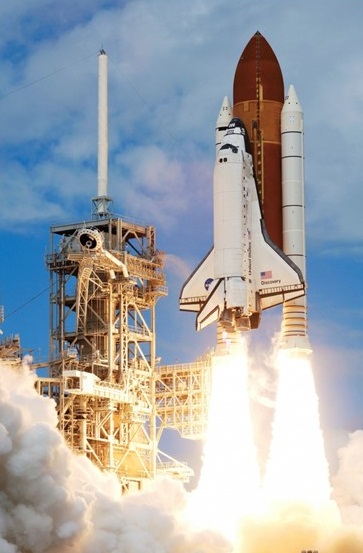
A large vehicle with a thick section wing of double delta planform, the SSO has a fuselage which conforms to lifting body outlines. Mounted in the rear fuselage are three Rocketdyne SSME rocket engines, each developing 417,300 lb (189287 kg) thrust for launch, at which time the SSO has mounted beneath it a large external fuel tank for the SSME rocket engines, and at each side of the tank a solid propellant rocket booster. The whole assembly is launched with the main engines and the boosters firing; after burn¬out the boosters are jettisoned and recovered by parachute, the main engines then being fed from the external fuel tank, which is jettisoned just before entry into orbit. Having completed its orbital mission, during which the SSO is controlled by orbit manoeuvring and reaction control engines, a de orbiting manoeuvre is initiated and, at a high angle of attack, the SSO re enters Earth’s atmosphere to make an unpowered but otherwise conventional aircraft type landing.

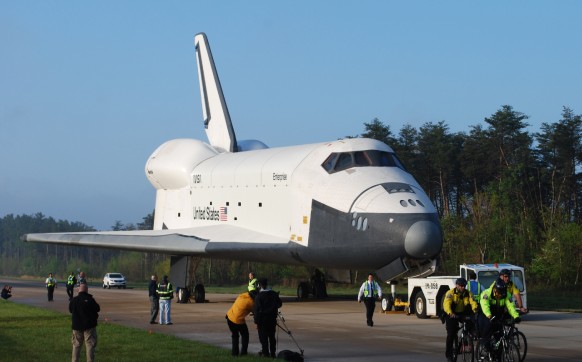
It was not until 13 August 1977 that the Enterprise and its crew were launched in free flight from the SCA at a height of 22,800 ft (6950 m), to make a gliding and unpowered flight to a conventional landing at Edwards AFB, California.

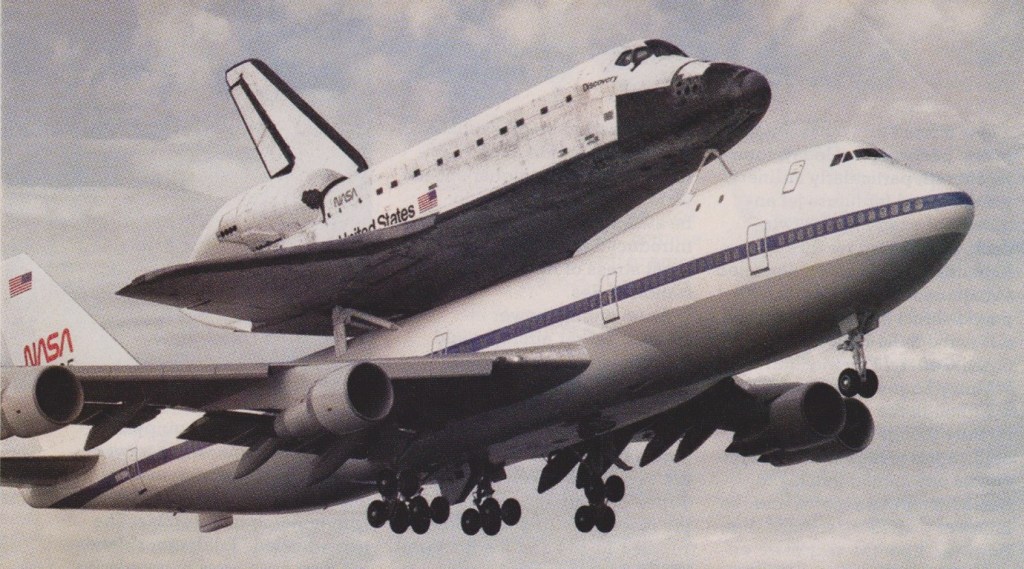
Boeing 747 123 Shuttle Carrier Aircraft (SCA) (NASA 905)

Almost four years later, on 12 April 1981, the spacecraft OV 102 Columbia, crewed by astronauts John Young and Robert Crippen, lifted off from Cape Canaveral on the first orbital mission. It then completed 37 orbits of the earth in 54 hours and on 14 April made a near perfect unpowered 200 mph (322 km/h) landing on Runway 23 at Rogers Dry Lake, Edwards AFB, California. The first ever “soft” return from space in a re-usable craft that is part spaceship and part aeroplane.

The Columbia was subsequently flown back to Cape Canaveral on the back of its Boeing 747 mother-plane for full examination and preparation for the next mission.

Enterprise

Gallery

Boosters: 2 x Solid rocket, 1,315,430 kg (2,900,000 lb) thrust each

Companhia Nacional de Navegagao Aerea

Brazil
Companhia Nacional de Navegagao Aerea, took over manufacture of Muniz-designed aircraft from Companhia Nacional de Navegagao Costiera (CNNC) around 1941. Produced Muniz M-11 two-seat primary trainer, designated HL-1, with strong resemblance to Piper Cub; batch of 50 HL-6 tandem two-seat low-wing monoplane trainers was begun 1943. Other designs included HL-2 and HL-4. In 1947, improved Series B versions of the HL-1 and HL-6 appeared; the company’s activities had ceased by about 1950.

National Aero Manufacturing Corporation

Phillipines
Until 1982 a subsidiary of the Philippines Aerospace Development Corporation, which began assembly and license-manufacture of MBB BO 105 helicopters in 1974. Later that year a contract was signed with Britten- Norman for the assembly and eventual manufacture of the BN-2A Islander, and for the development and marketing of an amphibious version. Assembly of Islanders began in 1976 from sets of parts from the UK. In 1978 a four-seat utility aircraft was developed in conjunction with the Philippine Government’s National Sciences Development Board.
1982 closure.

Nash Petrel / Procter Aircraft Associates Petrel

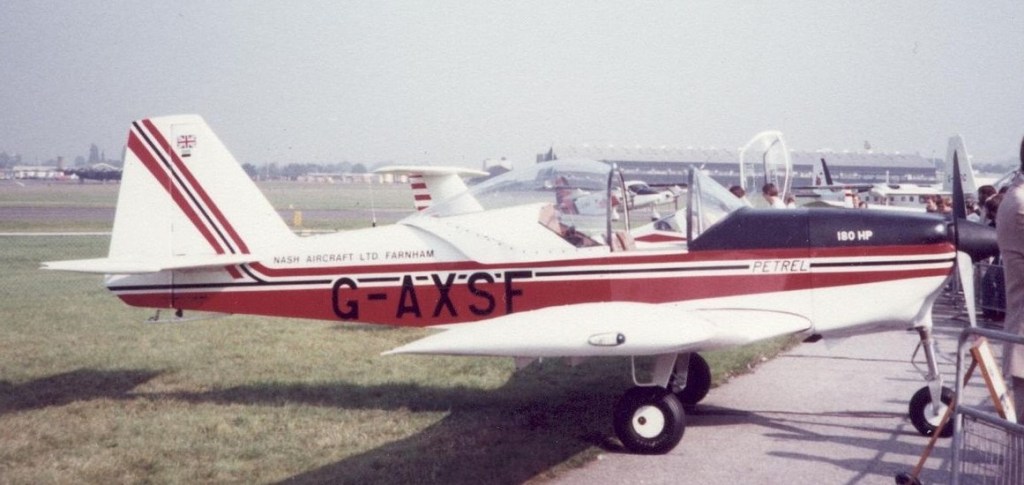
Prototype Nash Petrel at the Farnborough SBAC Show in September 1982

The Nash Petrel also known as the Procter Petrel is a two-seat aerobatic or glider tug aircraft. It was designed for amateur production by Procter Aircraft Associates of Camberley, Surrey, England.

Based on the earlier Mitchell-Procter Kittiwake design, the Petrel is an all-metal low-wing cantilever monoplane of conventional design powered by a 130 hp Rolls-Royce Continental O-240-A piston engine. By the time the aircraft first flew on 8 November 1980, Procter had changed ownership and had been renamed Nash Aircraft Ltd.

Only two aircraft were built, the prototype registered G-AXSF and one built by apprentices at the British Aircraft Corporation factory at Preston in 1973, registered G-BACA. G-BACA had a serious fault with the landing gear and only flew 15 hours before being grounded. The prototype still exists but without a current certificate of airworthiness. It is presently fitted with a Lycoming O-360-A3A engine.

Powerplant: 1 × Avco Lycoming O-320-D2A, 89 kW (119 hp)
Wingspan: 8.94 m (29 ft 4 in)
Wing area: 12.63 m2 (135.9 sq ft)
Aspect ratio: 6.6:1
Airfoil: NACA 3415
Length: 6.22 m (20 ft 5 in)
Height: 2.23 m (7 ft 4 in)
Empty weight: 540 kg (1,190 lb)
Max takeoff weight: 762 kg (1,680 lb)
Fuel capacity: 104.5 L (27.6 US gal; 23.0 imp gal)
Maximum speed: 210 km/h (130 mph, 110 kn)
Cruise speed: 195 km/h (121 mph, 105 kn)
Stall speed: 74 km/h (46 mph, 40 kn) (flaps down)
Rate of climb: 5.6 m/s (1,100 ft/min)
Crew: 2

Nardi

Nardi Sa Per Costruzioni Aeronautiche

Established in Milan in 1933 by three brothers. Nardi’s first aircraft was the F.N.305 tandem two-seat lightplane, which flew in 1935 and was intended as a fighter-trainer. A1938 successor, the F.N.315, was exported to six countries, and a light-attack version was flown experimentally.

The first postwar product was the F.N.333 amphibian, a three/four-seat twin-boom design later acquired by SIAI-Marchetti and marketed from 1962 as the Riviera, and in America as the North Star amphibian.

Napier Oryx

Napier Oryx

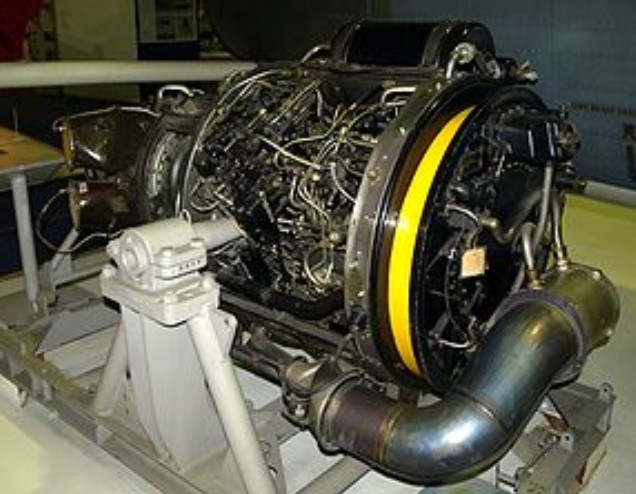
The Napier Oryx was a British gas-turbine engine designed and built by Napier. The engine was developed by the Aero Gas Turbine Division of Napier in conjunction with Percival. Funding came from the Ministry of Supply.

Its sole application was the unsuccessful Percival P.74. The P.74 was a design for a tipjet-powered helicopter. The jet power to be supplied from engines within the helicopter and piped to the rotor tips.

The output gas temperature from the engines had to be below 400°C for the helicopter’s stainless steel rotor ducts, so a bypass design was used. This also blew “cold” air from the compressor, rather than purely hot turbine exhaust. Rather than using an over-sized compressor with a bypass around the turbine (as commonly used in the turbofan engine), the Oryx used an auxiliary compressor in addition. This was mounted behind the turbine, with its gas flow in the opposite direction to the main engine core. The two air streams were deflected through 90° in a collector chamber, then exited vertically upwards. Gas flow through this collector was arranged so that each stream remained separate, the cold air from the auxiliary compressor passing through a bifurcated duct, so as to wrap around the hotter turbine outlet. By this means, the duct was further protected from the hot exhaust. Separator plates inside each duct split the stream into a number of flows and deflected each one separately, thus preserving the flows approximately constant across the whole duct. When the flows finally merged, they were flowing parallel and at approximately the same velocity, thus reducing turbulence and energy loss.

A Corliss non-throttling valve could divert individual engine output to the outside of the aircraft through a butterfly valve (closed in flight), permitting full running with the rotor stationary for starting and ground running. In the P.74 the two Oryx engines fed their outputs to a common duct that took the thrust to the rotor head.

Rotax electric starters were used but alternate methods could have been used.

First run in November 1953, the Oryx and the P.74 tip jet powered helicopter project, were later cancelled.

The Oryx was expected to be used for the planned commercial P.105 development of the P.74. In the P.105 the two engines would have been fitted back to front on either side of the rotor mast, feeding their outputs to the rotor hub. It was anticipated that 900 “gas horsepower” could be produced in its developed form.

Specifications:
Oryx N.Or.1
Type: Single shaft gas generator
Length: 83.5 in (2,121 mm)
Diameter: 19.25 in (489 mm)
Dry weight: 495 lb (225 kg)
Compressor: 12-stage axial flow
Combustors: 5 tubular chambers
Turbine: 2-stage axial flow
Fuel type: Avtur (D.Eng. R.D. 2482) or wide cut gasoline (D.Eng. R.D. 2486)
Oil system: Vane type pressure pump delivering 80 psi (551.58 kPa), Synthetic lubricant to DERD 2487
Maximum power output: Max take-off: 750 hp (559.27 kW) gas horsepower (the power generated by the maximum flow of gas through a turbine of 100% efficiency) at 21,900 rpm
Overall pressure ratio: 6:1
Air consumption: Power unit – 9.9 lb (4.5 kg) / sec, Auxiliary compressor – 5.1 lb (2.3 kg) / sec
Turbine inlet temperature: 752 °F (400 °C)
Specific fuel consumption: Max continuous: 0.735 lb/ghp/hr (0.443 kg/gkW/hour)
Power-to-weight ratio: 1.56 hp/lb (2.565 kW/kg)
Max continuous Power: 610 hp (454.88 kW) gas horsepower at 21,000 rpm
Max take-off Spec Fuel Consumption: 0.68 lb/ghp/hr (0.41 kg/gkW/hour)

Napier Scorpion / Napier NScD.1 Double Scorpion

Double Scorpion

The Napier Scorpion was a British liquid-fuelled rocket aircraft booster engine developed and manufactured by Napier. It used hydrogen peroxide / kerosene propellant.

The first Scorpion NSc.1 was successfully flight-tested in a Canberra.

From 1956 the Double Scorpion NScD.1 was fitted experimentally to two Canberra light bombers, to improve high altitude performance. A world altitude record of 70,300 feet (21,427 m) was set by Canberra WK163 on 28 August 1957.

This was on the eve of cancellation of manned aircraft programmes by the 1957 Defence White Paper.

The Scorpion project was cancelled in February 1959, at a reported total cost of £1.25 million.

Specifications:

Scorpion
Propellant: hydrogen peroxide / kerosene
Thrust: 4,000 lbf (17.8 kN)

Double Scorpion
Propellant: hydrogen peroxide / kerosene
Chamber: two
Thrust: 8,000 lbf (35.6 kN)
Length: 856mm (33.7in)
Diameter: 584mm (23in)
Dry weight: 98kg (216lb)

Triple Scorpion
Propellant: hydrogen peroxide / kerosene
Chamber: three, independently fired
Thrust: 12,000 lbf (53.4 kN)

Napier Gazelle

The Napier Gazelle was a turboshaft aero engine manufactured by Napier Aero Engines in the mid-1950s. First run in December 1955, production ceased when the Napier company was taken over by Rolls-Royce in 1962.

Variants:
NGa.1
NGa.2
NGa.2(R)
NGa.2 series 2
NGa.13(R)
NGa.13 series 2
Mk.101
Mk.161
Mk.162 (NGa.13 series 2)
Mk.165
Gazelle 501
Gazelle 503
Gazelle 512
Gazelle 514
Gazelle E.219

Applications:
Westland Wessex HAS 1 and HAS 3
Bristol Belvedere

Specifications:
Gazelle 501 / Mk.101 / NGa.2(R)
Type: Turboshaft
Length: 70 in (1,778 mm)
Diameter: 33.5 in (851 mm)
Dry weight: 830 lb (376.5 kg)
Compressor: 11-stage axial flow
Combustors: 6 flame tubes
Turbine: 2-stage gas generator power turbine + 1-stage free power turbine
Fuel type: Aviation kerosene, (DERD 2482 / 2485 / 2486 / 2488 / 2494)
Oil system: Pressure spray / splash with gear pump and dry sump, oil grade DERD.2487
Maximum power output: 1,650 hp (1,230.4 kW) + 260 lbf (1.16 kN) thrust at 3,000 output shaft rpm, maximum rating for 2.5 minutes
Overall pressure ratio: 6.25:1
Specific fuel consumption: 0.688 lb/hp-hr (0.4185 kg/kW-hr)
Power-to-weight ratio: 1.458 hp/lb (2.397 kW/kg)