Instytut Szybownictwa (Gliding Institute) Bielsko-Biala Przedsiebiorstwo Doswiadczalno-Produkcyjne Szybownictwa
Between 1947 and 1977 the Polish aircraft industry produced 3,638 gliders of 91 different types, and SZD sailplanes were exported all over the world, setting up many world and national records over the years. The SZD organisation responsible for Polish sailplane design and devleopment was officially formed in April 1946 as the Instytut Szybownictwa (or Gliding Institute) at Bielsko-Biala and was renamed in 1948 the Szybowcowy Zaklad Doswiadczalny – SZD (or Experimental Glider Establishment).
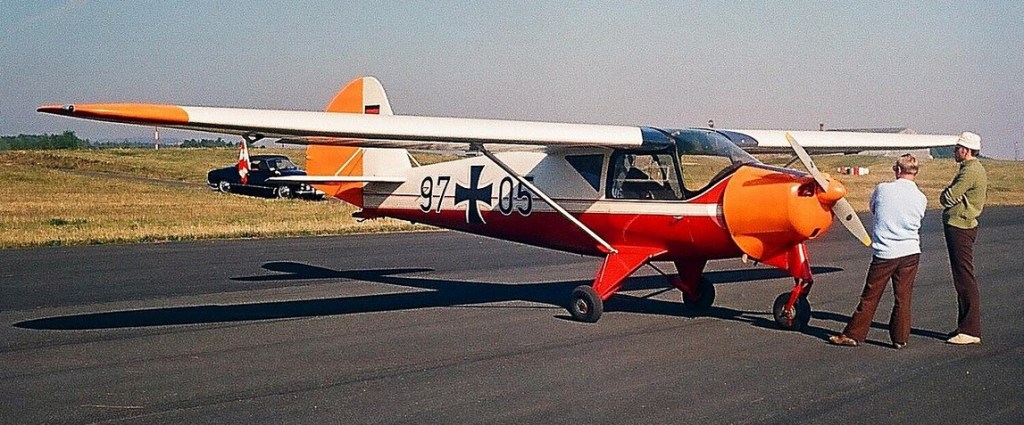
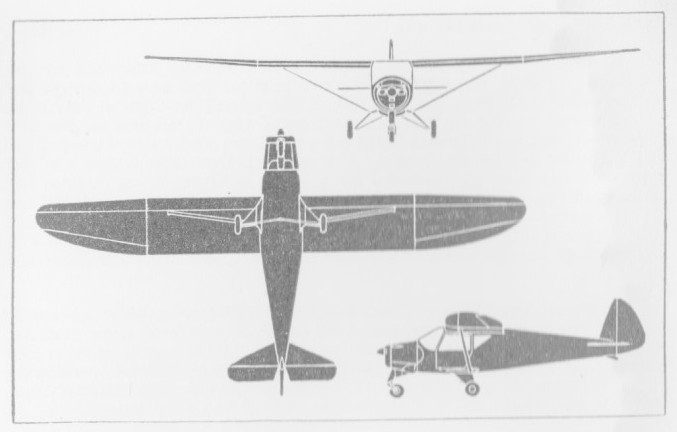
Under political reorganization in 1956, the Polish aircraft industry was revived with production of Soviet aircraft and some indigenous types. In foreign markets most Polish aircraft subsequently appeared under the PZL title, such as the PZL-101 Gawron and PZL-104 Wilga utility aircraft of 1960 and 1962 respectively, the first being a development of the Yak-12. The Gawron was used extensively as an agricultural aircraft, along with the PZL-built An-2 biplane, but later purpose-built dusters and sprayers were built. PZL types are produced under three separate organizations: PZL “Warszawa-Okecie” SA, WSK “PZL-Mielec” SA, and PZL-Swidnik SA.
In July 1969 the name was changed again and since July 1975 the former SZD has been known as Przedsiebiorstwo Doswiadczalno-Produkcyjne Szybownictwa, or Experimental and Production Concern for Gliders, although the well known letters SZD continue to be used for its products. The sale of these to foreign customers, like those of other Polish aircraft, is handled by the PEZETEL trading organsiation.
Founded January 1928 as Poland’s National Aircraft Establishment, built the P.1 single-seat fighter monoplane with Hispano-Suiza engine in 1929-1930, and subsequently the P.11 single-seat fighter and P.19 cabin monoplane. The PZL Los medium bomber of 1937 was followed by the Wilk twin-engined fighter, Sum light bomber and Mewa reconnaissance monoplane by the beginning of Second World War. Factories at Warsaw- Okecie (original) and Mielec, latter used by occupying Germans as forced-labour Heinkel factory 1940-44.
Under political reorganization in 1956, the Polish aircraft industry was revived with production of Soviet aircraft and some indigenous types. In foreign markets most Polish aircraft subsequently appeared under the PZL title, such as the PZL-101 Gawron and PZL-104 Wilga utility aircraft of 1960 and 1962 respectively, the first being a development of the Yak-12. The Gawron was used extensively as an agricultural aircraft, along with the PZL-built An-2 biplane, but later purpose-built dusters and sprayers were built. PZL types are produced under three separate organizations: PZL “Warszawa-Okecie” SA, WSK “PZL-Mielec” SA, and PZL-Swidnik SA.
Around 1955, Walter Horten was interested in developing a long-distance drive for his flying wing aircraft. He commissioned Prof. Karl Lürenbaum ‘s Institute for Engine Dynamics at RWTH Aachen University to develop a suitable engine. Walter Horten commissioned his childhood friend Alfons Pützer to build a suitable test vehicle for long-distance wave testing. Pützer suggested using a Fritz Raab Doppelraab design, which had already been used in the Pützer Motorraab.
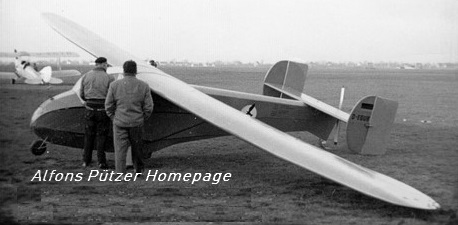
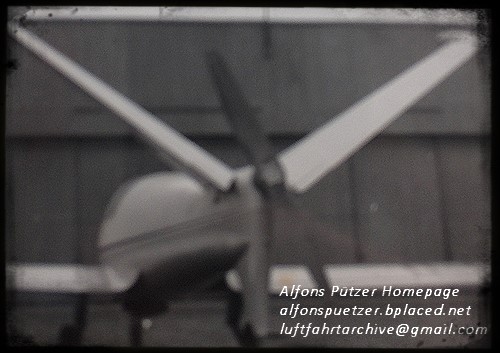
Pützer then commissioned Fritz Raab to modify a Doppelraab 6, in which a small engine was placed in the center of gravity behind the pilot’s seat. The tailplane of the Doppelraab was replaced by an endplate tailplane with two fins, in the middle of which a pusher propeller was placed at the rear of the aircraft. The two-cylinder, two-stroke engine Hansa-Lloyd with 400 cm³ displacement and 12 hp drove the propeller at the rear via the long-distance shaft developed by Karl Lürenbaum. The test vehicle was created by Alfons Pützer KG in Bonn.
In December 1956, the Pützer Dohle took off on its maiden flight in Bonn-Hangelar. The air sports club in Bonn received the jackdaw in early 1957 for its training operations to test in continuous operation. There were several disturbances in the area of the long-distance wave. The propeller, which had little ground clearance at the rear, was also damaged several times.
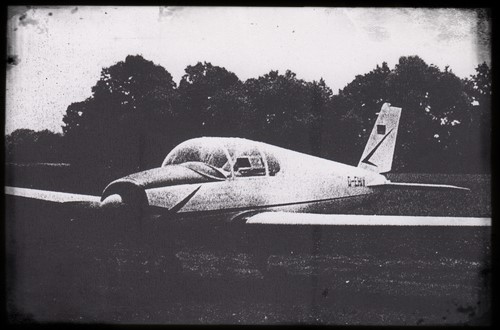
By arranging the engine in the center of gravity of the aircraft and the pusher propeller at the rear, the fundamentally good gliding characteristics of the Doppelraab were retained with the Dohle. Alfons Pützer then developed the jackdaw as a motor glider. He replaced the weak and too heavy Hansa engine with an Ilo F2x376 with 30 hp, with which the Dohle II should be able to self-launch. The small 14 kg fuel tank was replaced by a 40 kg fuel tank for longer cruising flights. This allowed the Dohle II to remain in the air for up to five hours. To protect the rear propeller from touching the ground, the Dohle II was fitted with a spur wedge at the rear.
The Dohle II was created in 1957 by converting the Dohle I at Alfons Pützer KG. It took off on September 2, 1957 in Bonn-Hangelar with the provisional approval D-EGUB for its first flight under its own power. In 1957, the Dohle II was one of the first usable motor glider constructions in Germany. However, Alfons Pützer had to stop further testing a short time later, since the start of series production of the Pützer Elster in the winter of 1957/58 occupied all capacities at Alfons Pützer KG.
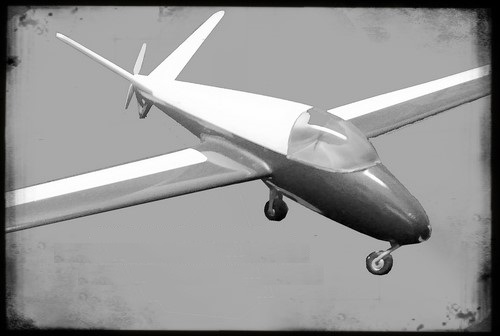
The basic structure of the Dohle II was later the starting point for the development of the Pützer Bussard trainer aircraft , which was also to be equipped with a pusher propeller at the rear in order to achieve jet-like behavior. The first drafts of the buzzard show a completely redesigned fuselage and low-lying wings. As with the Dohle II, however, the terminal plate tail unit with wedge spur was used. This tail was later replaced by a V-tail on the Bussard.
Only after the successful start of Elster production did Alfons Pützer take up the development of a motor glider again at the end of 1958. Drafts from this period show a further developed jackdaw with the V-tail already used in the Bussard and a low-lying wing. From 1959, however, Alfons Pützer gave up further development of the Dohle in favor of the completely new Pützer MS-60 motor glider design. The Dohle II was shut down in 1960.
Jackdaw I Engine: 1 × Hansa-Lloyd, 12 hp Wingspan: 13.20 m Wing area: 18.00 m² Aspect ratio: 9.7 Length: 7.20 m Height: 2.00 m Empty weight: 300kg Maximum take-off weight: 420kg Payload: 120kg Crew: 1
Jackdaw II Engine: 1 × Ilo F2x376, 30 hp Wingspan: 13.20 m Wing area: 18.00 m² Aspect ratio: 9.7 Length: 7.20 m Height: 2.00 m Crew: 1 Empty weight: 325kg Maximum take-off weight: 450kg Payload: 125kg
In the mid-1950s, the German Air Force showed interest in an inexpensive training aircraft for their budding jet pilots. Based on his experiences with the Pützer Dohle, Alfons Pützer suggested a propeller-driven piston aircraft for this purpose, the pusher propeller of which was arranged at the rear of the aircraft between a double tail unit.
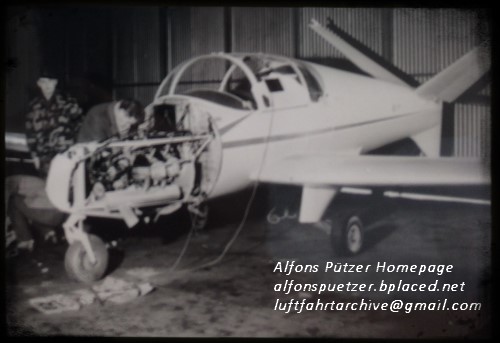
Alfons Pützer and Karl Lürenbaum had already tested a long-distance shaft between the engine located in the fuselage and the propeller located at the stern as part of the Pützer Dohle, which, however, had only delivered unsatisfactory results. Karl Lürenbaum therefore applied to the Ministry of Economics and Transport for the Institute for Engine Dynamics at the RWTH Aachen for funds to further develop existing long-distance wave concepts under the project name SR-57. The research project also included the construction of a test vehicle for the drive, which Alfons Pützer KG operated under the name Pützer Bussard. Originally, Alfons Pützer saw a design similar to that of the Fouga Magister jet trainer for this test vehicle with two seats arranged next to each other and a low-wing construction, which had the double tail unit known from the Pützer Dohle in the rear area and a fuselage wedge to protect the propeller arranged at the rear. However, due to the power loss observed in the Pützer Dohle due to turbulence in the rear propeller, Walter Horten suggested using a V-tail instead of the twin tail of the Dohle. For the first time, Pützer also envisaged a retractable undercarriage for the Buzzard. The Continental C90-12F drive known from the Pützer Elster was used as the engine.
Problems were caused by the 6-metre-long remote shaft running through the entire hull, which showed frequent failure of dynamic components on the remote shaft test bench in Aachen and whose vibration behavior only showed satisfactory results after a complete redesign in the form of a three-part shaft.
In January 1959, the drive was installed in the test vehicle in Bonn. The German Research Institute for Aviation (DVL) in Cologne-Wahn was commissioned to test the test vehicle. There the Pützer Bussard took off for its maiden flight in February 1959 with provisional traffic approval D-EHIV. During the subsequent testing, the Pützer Bussard showed satisfactory results at the DVL up to the end of 1959, especially in the take-off and landing phase.
After the introduction of the Fouga Magister jet trainer, the German Air Force changed its training concept for its jet pilots. In the new training concept, the use of inexpensive upward trainers was no longer provided. Despite the positive testing, the Luftwaffe was no longer interested in purchasing the Pützer Buzzard in 1959. With the end of the SR-57 project, the test vehicle was shut down in the fall of 1959.
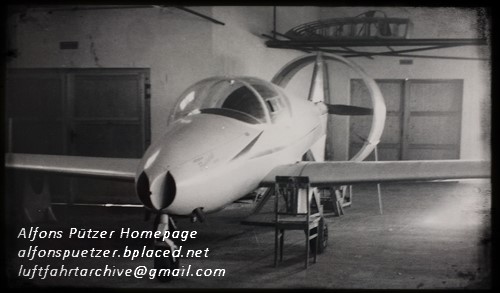
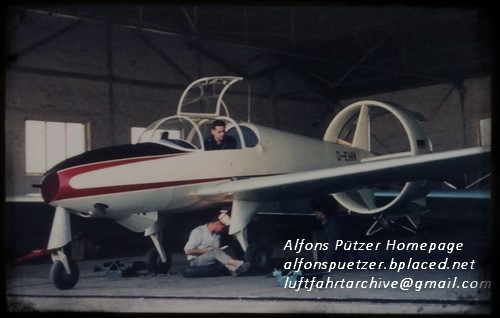
Erich Ufer has been working at Bölkow GmbH in Nabern since 1956 on the development of ring tail units. As part of this development, Bölkow GmbH planned to build the Bölkow P.103 test vehicle. After Ludwig Bölkowand Erich Ufer had not received any funding from state programs for the test vehicle by 1959, Alfons Pützer suggested converting the Bussard long-distance test vehicle that was no longer required to accommodate a ring tail unit. Apart from the redesign of the entire tail unit area with the ring manufactured by Bölkow in GRP construction, the Pützer Bussard received a new landing gear, also designed by Bölkow as part of the P.103, which ensured the necessary ground clearance for the ring tail unit. Due to the high weight of the ring tail, Alfons Pützer exchanged the Continental C90 engine for a 145 hp Continental O300, for which Karl Lürenbaum made the necessary changes to the remote shaft in Aachen.
After completion of the model tests in the wind tunnel in Stuttgart, the conversion of the Pützer Buzzard took place until the end of 1960, which was then given the designation SR-57-2K. In order to gain further experience with the ring tail, before the first flight in early 1961 another wind tunnel program was carried out, in which the finished prototype was examined aerodynamically. On July 12, 1961, the first flight of the Pützer Bussard with a ring tail took place in Bonn-Hangelar. Satisfactory results were demonstrated in a three-month flight test. On March 22, 1963, the Federal Aviation Authority issued a provisional license for the ring tail carrier SR-57-2K. With the submission of the final report in June 1964, the test vehicle was shut down again.
After completing the ring tail testing, the Pützer Bussard came to Karl Lürenbaum’s Institute for Engine Dynamics in Aachen. Together with the Rhein-Flugzeugbau RF-1 developed by Hanno Fischer at Rhein-Flugzeugbau, the Buzzard was used in ground and test bench tests in Aachen to develop turbofan engines, such as those used for the first time in 1968 on the motor glider Rhein-Flugzeugbau Sirius. The Pützer Bussard was largely dismantled during these tests and was later stored in Merzbrück near Aachen.
Walter Horten took over the dismantled Pützer Bussard in 1971. With the support of the Oskar Ursinus Vereinigung (OAV), Horten replaced the annular tail unit with a conventional tail unit and removed the long-distance shaft. Instead, the engine located in the bow was connected to a bow propeller of conventional design. Wings, landing gear and center fuselage with cockpit remained unchanged.
The Pützer Bussard was probably used in this configuration by the OAV for a number of years as a touring aircraft. It is said to have been destroyed later in a fire.
Alfons Pützer KG known primarily as sailplane manufacturer; produced an improved motorized version of the Doppelraab sailplane, known as the Elster in 1957. Small batch produced for German club use.
In post war Germany, General Aviation flight was not permitted until 1956. At the time of this rejuvenation, the Porsche 678 aircraft engine was being developed. This was based on the 4 cylinder Porsche 356 car engine. This air cooled engine was modified for the aviation environment.
At this time Alfons Pützer was also developing the Elster A airframe, powered by the 52HP 678/3 Porsche engine. The prototype was powered by a 52 hp Porche 678/3 engine.
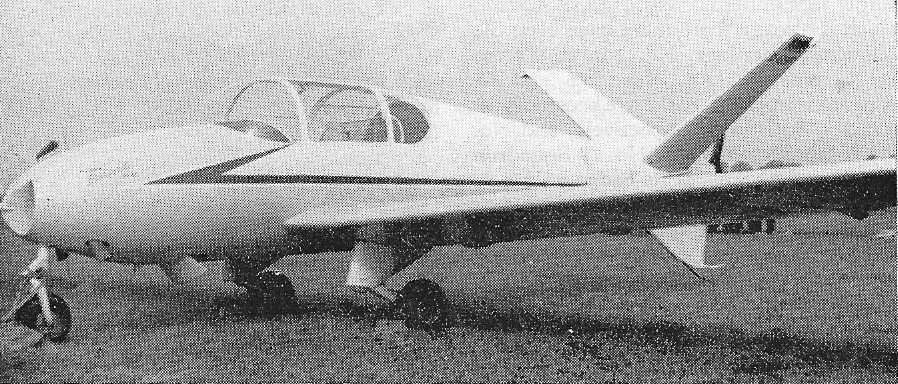
This was followed by the Elster B version powered by the 75 HP Porsche 678/4 engine and the Rolls Royce Continental C-12F and C-14F engines. The 95 hp C90-12F version was selected for use by the Federal German Luftwaffe’s sport flying groups and production deliveries began in 1960, 21 being built.
The Elster-C is specifically for glider towing, powered by a 150 hp Lycoming O-320 engine.
Elster B Engine: Continental C90-12F, 95 hp Wingspan: 43 ft 4 in Length: 23 ft 3.5 in Height: 8 ft 2.5 in Wing area: 188.368 sq.ft Empty weight: 1014 lb Loaded weight: 1543 lb Max speed: 104 mph at SL Cruise: 93 mph ROC: 720 fpm Service ceiling: 16,100 ft Range: 272 mi
Germany Alfons Pützer KG known primarily as sailplane manufacturer; produced an improved motorized version of the Doppelraab sailplane, known as the Elster in 1957. Small batch produced for German club use. Alfons Pützer and Comte Antoine d’Assche, director of the French company Alpavia SA, formed a new company in 1966, Sportavia-Pützer, to produce the Fournier series of light aircraft.
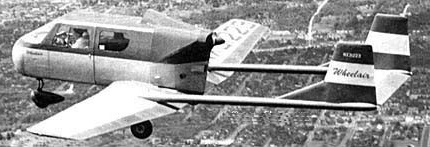
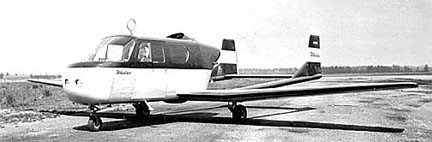
Designed by Donald Wheeler the 1947 III-A was a prototype all-metal, twin-boom, rudderless twin-tail, tricycle-gear, post-war “plane of tomorrow” based on Wheeler’s prize-winning design in a national magazine. The prototype first flew in April 1947.
Featuring a two-control system and offered for $5,000-5,500, only the one was built (NX31223). Originally powered by a 190hp Lycoming O-435 pusher, and also with 170hp a Lycoming GO-290-AP.
USA Formed after Second World War at Tacoma, Washington, to build Wheelair IIIA four-seat twin-boom light aircraft, powered by Lycoming engine. The company filed bankruptcy in 1949.
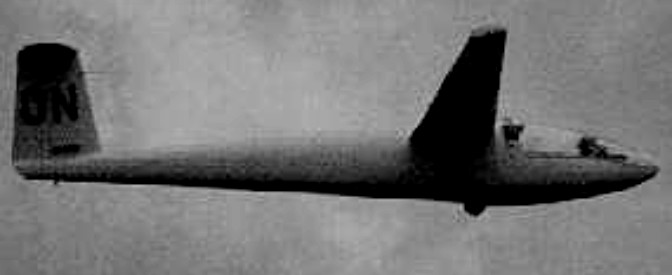
The all metal UHP-1 first flew in 1967 featuring a fixed wheel and skid, spoilers and drag chute and a T- tail with fixed stabilizers and movable rudder and elevator. Fabric covered the wing aft of the spar. A second example was built with an all- metal wing whose specifications and performance are given here(the first ship was more than 100 lbs. Lighter). It is flapped, has retractable gear and gear doors, carries water and has a fully trimmable stabilizer.
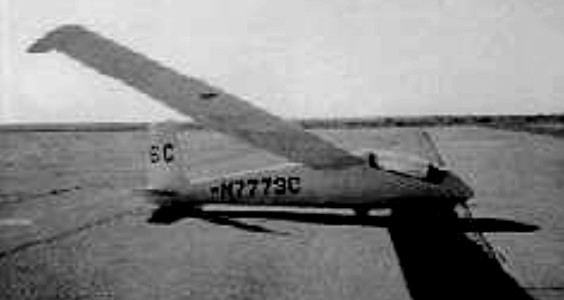
The Super Standard was designed to the early 1960’s Standard Class rules with 15 m wing, fixed gear and no flaps or water ballast, all metal, and with magnesium wing skins.
Amongst other achievements, a Super Standard was flown by sailplane photographer Alex Aldott to win the Hungarian national distance record at 748 km./ 465 miles.