Gobles
MI.
USA
Circa 1955 built the J-1 Jeanie
Gobles
MI.
USA
Circa 1955 built the J-1 Jeanie
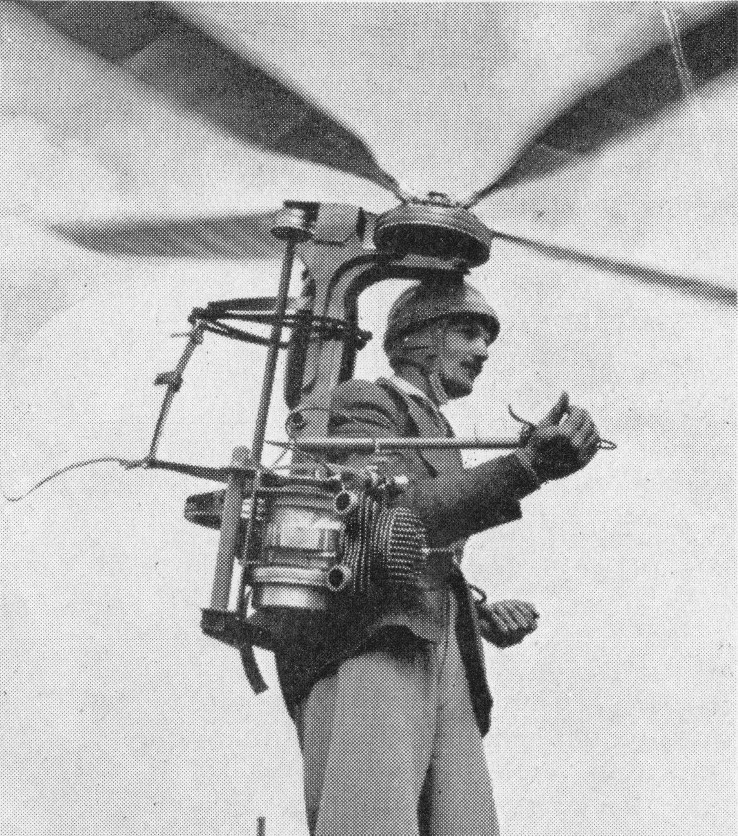
Strap-on personal helicopter built at home in France by George Sablier. George Sablier demonstrated his one-man helicopter at the International Meeting of Individual Helicopters in St. Etienne, France, in 1954. A special apparatus prevents the pilot from gyrating with the propeller.
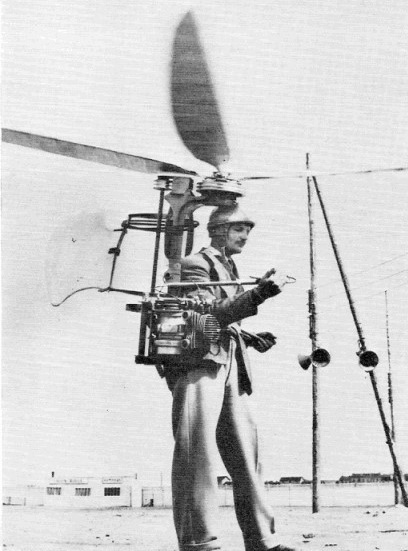
Engine: 6 h.p. piston
Rotors: 4-blade
Rotor diameter: 10 ft
Loaded weight: 60 lb
Max. speed: 31 mph
Endurance: 10 hr
In 1970 Richard Sabey built the SX-1 two place enclosed low wing monoplane, with retractable undercarriage. Registered N25RS was built using parts of Culvers PQ-14 and V, and Cessna 150. The cost of construction was $2,500. Only the one was built.
Engine: Lycoming O-290-G4
Wingspan: 30’0″
Length: 21’6″
Max speed: 234 mph
Cruise speed: 145 mph
CA.
USA
Circa 1970 built the SX-1 airplane
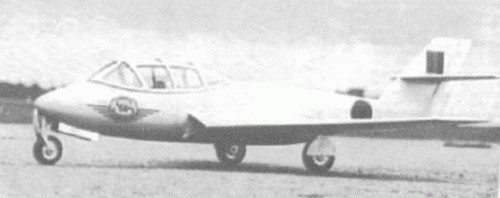
The SABCA S.60 was a two-seat low-wing transition jet trainer project of 1951.
Sabca S 60
Engines: 2 x Turbomeca, 400Kg
Wing area: 13.26 sq,m
Load: 630Kg
Max take-off weight: 1750Kg
Estimated performances:
Take off speed: 130Km/h
Cruising speed: 560Km/h
Max speed: 650Km/h
Belgium
Formed December 1920, SABCA had a close SABENA association and that airline used SABCA’s only S.2 single-engined monoplane transport. Built Handley Page 3-engined airliners for SABENA Belgian Congo service; also other private-owner prototypes.
At the end of 1920 the Société Anonyme Belge de Constructions Aéronautiques (SABCA) was created to ensure the construction, testing and overhaul of aeronautical equipment for the development of civil aviation and air transport (SABENA will be founded three years later). It will begin with the overhaul and overhaul of Belgian Military Aeronautics aircraft, before starting, in 1922, to build foreign aircraft under license.
The first designs and new realizations will be due to members of the staff of SABCA, encouraged and supported by the company. Among others, the moto-aviette Jullien SJ-1 (in 1923), of Henri JULLIEN, engineer director of the design office of the SABCA, and the “Limousine” Demonty-Poncelet of Mathieu DEMONTY (technical director) and Paul PONCELET (head of the wood section) (in 1924).
On his own, but with the support of SABCA, Paul PONCELET designed and built the “Castar” in 1922-1923, then in 1923 the “Vivette”.
SABCA’s first project was a small aeroplane called the Sabca J1, which was powered by the engine of a FN motorcycle. The company also constructed “Sabca” 1500 with a 200 HP engine and some gliders. It later assembled the Handley-Page, Fokker F VII, and the Savoia-Marchetti used by Sabena. Held Breguet and Avia licences, and from 1927 directed attention to metal construction. Outcome was S-XI 20- passenger monoplane with three 500 hp engines, as well as similar S-XII 4-passenger monoplane with three 120 hp engines. Built under license Renard R.31 reconnaissance monoplane and Savoia-Marchetti S.73 transport.
In October 1937, the Belgian aircraft manufacturer Société Anonyme Belge de Constructions Aéronautiques (SABCA) made a marketing agreement with the Italian company Caproni, with SABCA selling some of Caproni’s military aircraft in certain markets, including the Caproni Ca.135, Ca.310 and the Ca.312, which were to be designated SABCA S.45bis, S.46 and S.48 respectively. As part of this agreement, Caproni were to develop a replacement for the Belgium Air Force’s Fairey Fox biplanes, which were used as two-seat fighters and reconnaissance aircraft, but were obsolete.
Built S.47 2-seat low-wing monoplane fighter of 1937 in collaboration with Caproni. Company revived in 1950s. In 1960s assembled, maintained, and repaired Republic F-84; also collaborated with Avions Fairey on Hawker Hunter and made Vautour components for Sud- Aviation. Much work of various kinds on Lockheed Starfighter, Dassault Mirage, and Breguet Atlantic; also missile and space activities. Dassault Aviation took 53 percent shareholding, while in 1998 Fokker’s shareholding was then reportedly being sold. Recent work has included weapon system integration, development of the cockpit front panel, final assembly, and flight testing of Belgian ArmyA-109 helicopters; update of F-5s; production and upgrading of F-16s; upgrade of Mirage 5s and F1s; production of servo actuators; and construction of subassemblies for Dassault, Boeing, Airbus, and Fokker aircraft.

The 1960 Saalfield Aircraft Co Skyskootor, with a molded fiberglass fuselage, was sold either as a complete aircraft or in component form. $3,495-3,995 assembled with motor, $1,995 as a kit less motor.
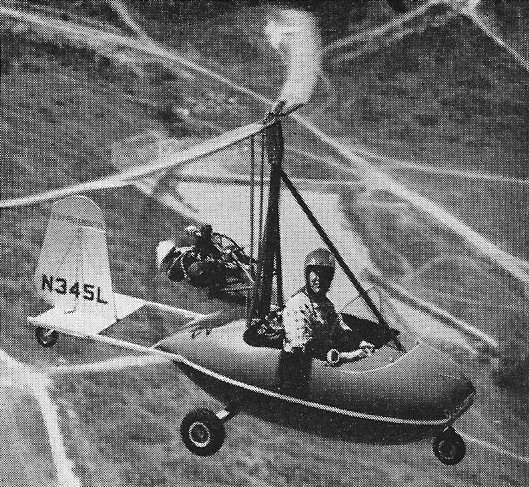
Engine: 72hp McCulloch 4318A (factory overhauled) or 4318E (new)
Rotor: 21’4″
Length: 10’0″
Useful load: 440 lb
Max speed: 85 mph
Cruise speed: 65 mph
Min speed: 25 mph
Range: 250 mi
Ceiling: 12,000 ft
Seats: 2
San Diego CA.
USA
Built the Skyskootor gyrocopter in 1960.
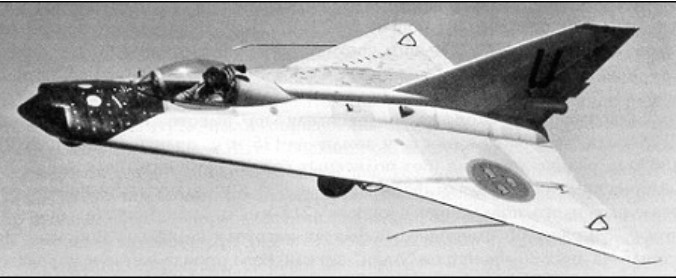
Not long after it had given a go-ahead for development and production of the Saab-32, the Swedish air force began to draw up its specification for a new single-seat fighter that would be able to intercept bombers flying in the transonic speed range. The new type was going to need supersonic speed capability, an unprecedented rate of climb, above, average range and endurance, and a considerable weapon load. It was required to have STOL (short take-off and landing) characteristics to allow for its deployment from a variety of dispersed sites.
Saab began work on this requirement in August 1949, selecting a wing of double-delta configuration that promised great structural integrity with low weight and which, if it performed satisfactorily, would provide the volume needed for the equipment, fuel and weapons demanded by its primary role. The capability of such a wing was confirmed by wind tunnel testing of models and by the Saab-210 small-scale research aircraft, powered by a 476kg thrust Armstrong Siddeley Adder turbojet. First flown on 21 February 1952, the Saab-210 confirmed that there were no particular problems in the handling of the double-delta wing.
A double delta model, with wing sweep at 80o for the inner and 60o for the outer sections was demonstrated and led to a 1:7 scale aircraft being built. The project was launched in November 1950 and on December 7, 1951, the SAAB 210 began its taxi tests. Tests were carried out with ground contact speeds between 250 and 150 km / h.
The ‘Mini-Draken’ (otherwise the Saab 210) was completed and first flown on 21 January 1952, with Bengt Olow at the controls, nine months and SKr 1.7 million later. The landing gear was raised hydraulicly, the descent was by gravity.
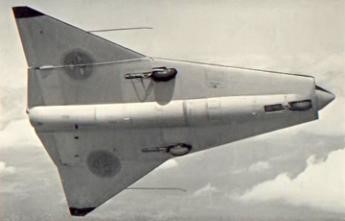
Following a successful test flight, the Swedish Air Force ordered three full-scale J35 prototypes. The 210 flew a total of 887 flights and 286 flying hours.
210
Engine: Armstrong Siddley Adder ASA1, 475 kg
Wingspan: 6.35 m
Length: 8.80 m
Height: 2.78 m
Wing area: 24.20 m²
Aspect ratio: 1.67
Sweepback: 60 – 77 °
Take-off Weight: 1775 Kg
Wing loading: 77 kg / m²
Rate of climb: 11 m/s
Climb to 2000m: 4 min.
Climb to 4000m: 8 min.
Max speed 4000m: 540 km / h
Landing roll: 300 m
Landing roll with parachute: 200 m
Take-off dist: 900 m
Range: 280 km
Takeoff speed: 180 km / h
Landing Speed: 190 km / h
210A
Engine: Armstrong Siddley Adder ASA1, 475 kg
Wingspan: 6.35 m
Length: 8.80 m
Height: 2.78 m
Wing area: 24.20 m²
Aspect ratio: 1.67
Sweepback: 60 – 77 °
Wing loading: 77 kg / m²
Maximum speed: 555 km / h
Max speed 2000 m: 545 km / h
Max speed 4000 m: 540 km / h
Range: 280 km
Takeoff speed: 180 km / h
Landing Speed: 190 km / h
Take-off dist: 900 m
Climb to 2000m: 4 min.
Climb to 4000m: 8 min.
210B
Engine: Armstrong Siddley Adder ASA1, 475 kg
Wingspan: 6.35 m
Length: 9.12 m
Height: 2.78 m
Wing area: 23.00 m²
Aspect ratio: 1.67
Sweepback: 60 – 77 °
Wing loading: 77 kg / m²
Range: 280 km
Takeoff speed: 180 km / h
Landing Speed: 190 km / h
Climb to 2000m: 4 min.
Climb to 4000m: 8 min.
Take-off dist: 900 m
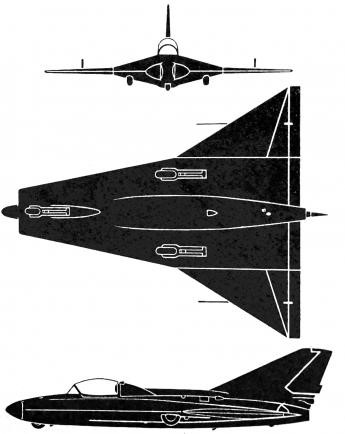
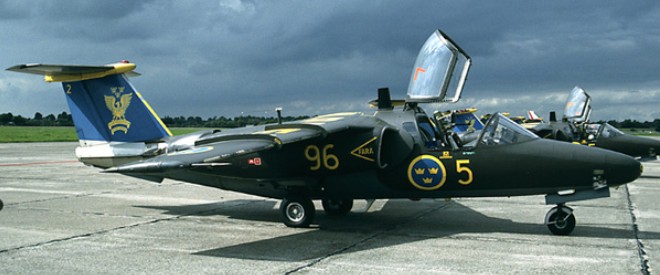
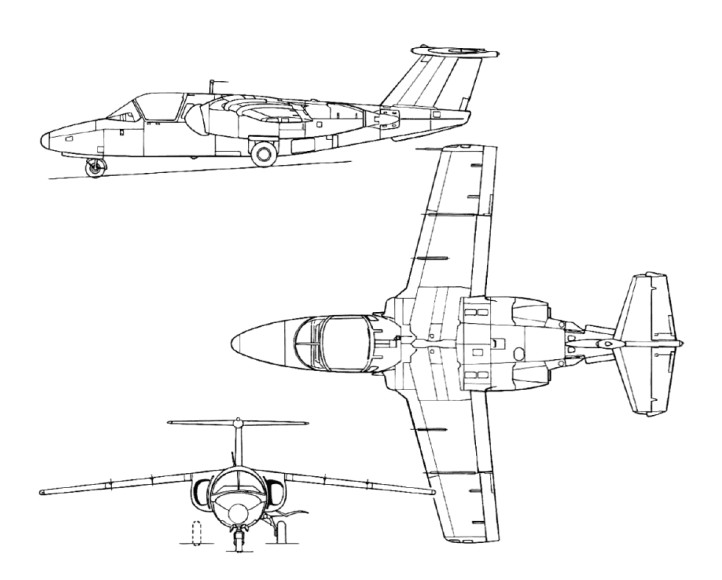
Developed by Saab as a private venture, to add to its product line a lightweight turbojet-powered aircraft able to fulfil a number of civil and military roles, the Saab-105 entered the design stage in 1959. SAAB launched the Saab-105-project in April 1960. This shoulder-wing aircraft was originally engined by two French Turbomeca Aubisque turbofans. The project was company-funded and conducted by a design team under Ragnar Haerdmark.
On 16 December 1961, the Swedish government awarded SAAB a contract for a prototype of the SAAB 105 side-by-side two-seater and signed a letter of intent for at least a hundred production machines. In 1962, the Flygvapnet ordered 150 SAAB 105, designated Sk 60 (was to be Sk 55, but SAAB asked for number 60).
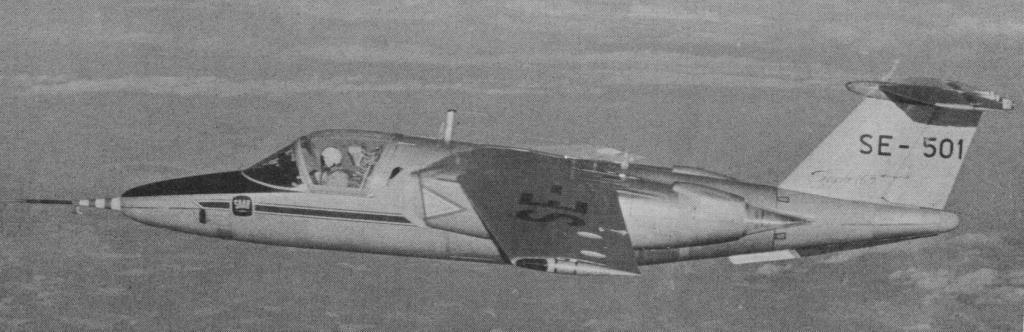
A cantilever-shoulder-wing monoplane with marked wing anhedral and high T-tail, it has retractable tricycle landing gear, is powered by two turbofans nacelle-mounted one on each side of the fuselage, and has an enclosed cockpit that accommodates two side-by-side on ejection seats. Alternative seating for four can be provided on fixed seats.
The initial test flight was delayed to find an appropriate engine, eventually found in the 745kg thrust Turbomeca Aubisque. The first SAAB 105 prototype, registered SE-501, was flown on 29 June 1963. A second prototype, SE-502, flew on 17 June 1964.
Following extensive testing of the prototypes the Flygvapen placed an initial order in early 1964 for 130 production aircraft, a figure that was amended later to 150. The first of them was the Sk 60A trainer/liaison aircraft, flown initially on 27 August 1965 with deliveries for optional deployment in an attack role. The first Sk 60A, Swedish Air Force 60001, was delivered to the F 5 at Ljungbyhed in 1966. By 1969, 149 Saab Sk 60A, were delivered to the Swedish Air Force and placed in service.
Next to the SAAB 105 for the Swedish Air Force, SAAB worked on a military export model, the SAAB 105XT, with “XT” standing for “Export Tropic”. This variant had more powerful General Electric J85-GE-17B turbojets and an improved wing structure. The second SAAB 105 prototype was modified and was flown first as Saab 105XT on 29 April 1967. It was registered SE-XBZ for use as a flying demonstrator. Austria ordered 40 SAAB 105XT machines with the designation of SAAB 105OE (“OE” for “Oesterreich”). Deliveries started in 1970 and the order was completed in 1972. The Saab 105OE is used in Austrian service for reconnaissance, support and air defence tasks.
The Saab 105 delivered to the Swedish Air Force as Sk 60A was an unarmed trainer. Starting in 1970, 46 Sk 60As were converted into Sk 60B standard, with three hardpoints beneath each wing enabling them to operate as a light ground attack aircraft.
Another 28 Sk 60A aircraft were modified to Sk 60C. The Sk 60C has a reconnaissance camera in the nose. The nose is longer and angular compared with the other versions of the aircraft. The Sk 60C prototype was the only new-build Sk 60C, when delivered to the Flygvapnet, making it the 150th and last new-build Sk 60 for the Swedish Air Force service.
In the mid-1970s, ten Sk 60A planes were configured as transports and given the designation of Sk 60D. A further development is the Sk 60E, which is equipped commercial-type instruments, including an instrument landing system. This variant has four seats, and consequently no rocket chairs. The Sk 60D and Sk 60E variants were also used for training of civil pilots. The Sk 60 has now gone trough a modernisation programme. The most important alteration was replacement of the Turbomeccas by the stronger William Rolls FJ 44 turbofans. The first Williams-powered Sk 60(W) was flown in August 1995. A total of about 115 conversions of Sk 60A, Sk 60B, and Sk 60C machines were performed in the late 1990s. In addition to its primary duty as a trainer, the Sk 60 is used as target aircraft, weather flying and liaison aircraft. A new variant, the Sk 60M, was developed to replace the Mitsubishi MU-2 target aircraft / target tug of Nyge Aero.
Surviving Swedish air force Sk 60s, of which there are four squadrons, have undergone a life extension programme at Saab.
Versions:
Sk60A
A60B
Sk60C
Sk60D
Sk60E
105 G/OE
Sk60A
Engine: RM9 Turbomeca Aubisque 2x 1638 lbs
Span: 9.5 m (31’2.25’)
Length: 10.5 m (34’5.5”)
Take-off weight: 4050 kg (8929 lb)
Maximum speed: 770 kph (478 mph)
Cruising speed: 640 kph (398 mph)
Landing speed: 165 kph (103 mph)
Range: 1940 km (1210 miles)
Max. altitude: 13500 m (44290 ft)
Sk60 B
Engine: RM9 Turbomeca Aubisque 2x 1638 lbs
Span: 9.5 ft (31’2.25”)
Length: 10.5 ft (34’5.5”)
Take-off weight: 4500 kg (9921 lb)
Maximum speed: 765 kph (475 mph)
Cruising speed: 640 kph (398 mph)
Landing speed: 165 kph (103 mph)
Range: 1780 km (1110 miles)
Max. altitude: 12000 m (39370 ft)
Sk60C
Engine: RM9 Turbomeca Aubisque 2x 1638 lbs
Span: 9.5 ft (31’2.25”)
Length: 11.0 m (36’1”)
Take-off weight: 4500 kg (9921 lb)
Maximum speed: 765 kph (475 mph)
Cruising speed: 640 kph (398 mph)
Landing speed: 165 kph (103 mph)
Range: 1780 km (1110 miles)
Max. altitude: 12000 m (39370 ft)
Sk60D
Engine: RM9 Turbomeca Aubisque 2x 1638 lbs
Span: 9.5 m (31’2.25’)
Length: 10.5 m (34’5.5”)
Take-off weight: 4050 kg (8929 lb)
Maximum speed: 770 kph (478 mph)
Cruising speed: 640 kph (398 mph)
Landing speed: 165 kph (103 mph)
Range: 1940 km (1210 miles)
Max. altitude: 13500 m (44290 ft)
Sk60E
Engine: RM9 Turbomeca Aubisque 2x 1638 lbs
Span: 9.5 m (31’2.25’)
Length: 10.5 m (34’5.5”)
Take-off weight: 4050 kg (8929 lb)
Maximum speed: 770 kph (478 mph)
Cruising speed: 640 kph (398 mph)
Landing speed: 165 kph (103 mph)
Range: 1940 km (1210 miles)
Max. altitude: 13500 m (44290 ft)
105G/OE
Engine: General Electric J85-17B 2x 2851 lbs
Span: 9.5 m (31’2.25”)
Length: 10.5 m (34’5.5”)
Height: 2.7 m (8ft 10in)
Wing area: 16.3 sq.m (175.46 sq.ft)
Empty weight: 2550 kg (5534 lb)
Disposable wt: 2000 kg (4409 lb)
Take-off weight: 6500 kg (14330 lb)
Maximum speed: 970 kph (603 mph)
Cruising speed: 800 kph (497 mph)
Climb to 10,000m (32810ft): 4.5 min
Landing speed: 165 kph (103 mph)
Range: 2750 km (1710 miles)
Range with 1361kg (3000 lb) load: 825 km (513 sm)
Max. altitude: 13700 m (44950 ft)