Designed primarily to satisfy the need for a good cross-country per¬former that falls into the sport plane category, the three passenger Tri-Z can be fitted with medium power engines in the 125-to 180-hp category. With only two persons in the front seats, the rear bench can be covered with 210 pounds of baggage. The Tri-Z easily adapts to floats or taildrag¬ger options and is easy to fly. It has docile handling characteristics.
A CH-300 Tri-Z set a new 3,000-mile non-stop record in July 1978.
April 1980
CH-300 Tri-Z Engine: Lycoming, 180 hp Speed max: 170 mph. Cruise: 153 mph Range: 480 sm. Stall: 54 mph ROC: 1400 fpm. Take-off dist: 650 ft Landing dist: 650 ft. Service ceiling: 12,000 ft HP range: 125-180. Fuel cap: 34 USG Weight empty: 1140 lbs. Gross: 1850 lbs Height: 6.67 ft. Length: 22.5 ft Wing span: 26.5 ft. Wing area: 130 sq.ft Seats: 3/4. Landing gear: nose or tail.
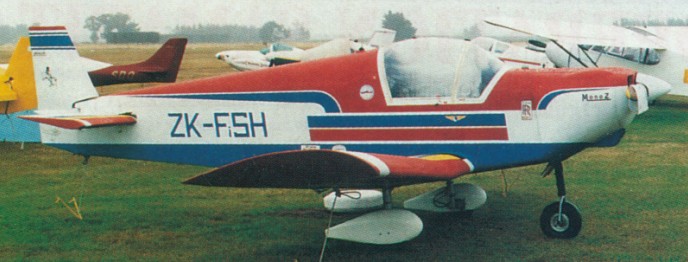
The Mono-Z is a single-place, scaled-down version of the original Zenith first built in 1974. It offers maximum operating economy with VW power at a three gph cruise. Detachable wings leave an 8-foot-wide section for easy road towing, requiring only 20 minutes to install both wings. It is stressed for 9G’s and with 100-hp becomes a powerful aerobatic performer. Engine range from the VW 1600 to 100-hp Continental.
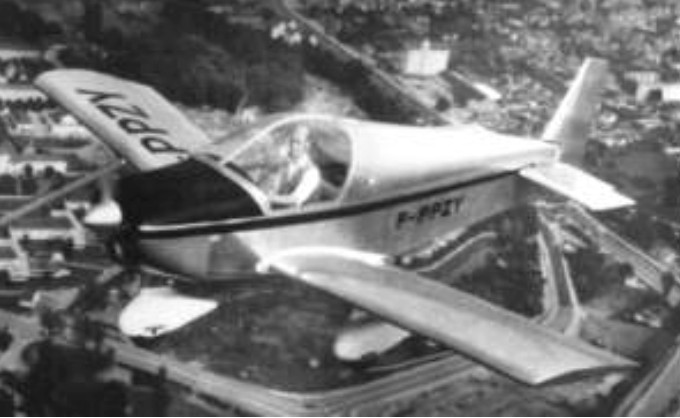
In his spare time, Heintz began to design and build his own aircraft, which he named the Zenith, anagram of Heintz. After a little more than a year’s work, the two-place low-wing Zenith was rolled out and successfully flown on 22 March 1970 as F-WPZY.
Soon after, detailed blueprints and construction manuals of the aircraft were drawn up and offered to the growing number of interested builders and flyers.
Formed 1974 and currently producing the Zenith CH 2000 certificated two-seat Iightpiane (first flown June 1993 and delivered in assembled form from 1994). Also markets the Zenith CH-100 single-seater, Aero CH-150 and CH-180 (aerobatic variants of CH-200), Zenith CH-200 two-seat Iightpiane and Zenith CH-250 long-range version, and Zenith CH-300 (Tri-Z) three/four-seat Iightpiane (as variant of CH 2000), all built from plans and/or kits.
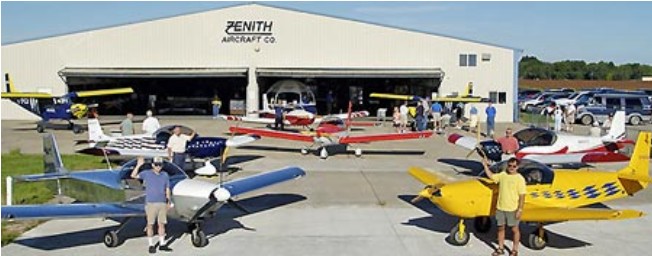
Zenith Aircraft Company is in the exclusive business of designing, developing and manufacturing kit aircraft. The independent, privately-owned company was formed in 1992 in Mexico, Missouri, centrally located in the United States, and is based in leased 20,000+ sq.ft. production facilities at Mexico Memorial Airport. Zenith Aircraft Company has acquired the exclusive rights to manufacture and market Zenair kit aircraft designs from designer Chris Heintz.
Chris Heintz
An aeronautical engineer, Chris Heintz is a graduate of the E.T.H Institute in Switzerland. After serving in the Air Force, Heintz worked for Aerospatiale on the supersonic Concorde jetliner, and later became chief engineer at Avions Robin (France) where he designed several fully-certified two and four seat all-metal production aircraft. In his spare time, Heintz began to design and build his own aircraft, which he named the ZENITH, anagram of Heintz. His all-metal homebuilt aircraft incorporated simple construction methods throughout and after a little more than a year’s work, the two-place low-wing Zenith was rolled out and successfully flown in 1969. Soon after, detailed blueprints and construction manuals of the aircraft were drawn up and offered to the growing number of interested builders and flyers. In 1973, Chris Heintz, his family and the Zenith moved to North America, where Heintz worked for de Havilland (in Toronto) as a stress engineer on the Dash 7 commuter. Chris decided to form his own aircraft company in 1974, and under the name of Zenair Ltd. started to manufacture Zenith kits himself from his two-car garage. Through the company, Heintz has introduced more than twelve successful kit aircraft designs over the years. In 1992, Heintz licensed the kit manufacturing and marketing rights to Zenith Aircraft Company for the STOL CH 701 and the ZODIAC CH 601 designs, and has developed the new STOL CH 801 and the new ZODIAC XL for Zenith Aircraft Company. While Heintz officially retired in 2003, he is still very active as a designer, engineer and consultant.
1996: Huronia Airport, Midland, Ontario L4R 4K8, Canada. PO Box 650, Mexico Memorial Airport, Mexico, MO 65265-0650.
By 1996, Zenair had a production facility in Mexico, Missouri, USA, headed by Sebastion Heintz (son of the designer, Chris Heintz)
This single-seater sailplane was designed and built to Standard Class specifications by Otto Zauner of Vineland, New Jersey, who had previously built from kits and/or plans a Schweizer SGS 1-26, a Briegleb BG 12, a Bryan HP-14 and a Thorpe T-18 ultra-light. The OZ-5’s fuselage and tail unit are of Mr Zauner’s own design but the wings of a Bryan HP-15 are fitted in the shoulder position. The forward fuselage and cockpit tapers to a slim boom carrying the tail, the former being of glassfibre construction to about one-third back along the tail boom; the rest of the boom and the cantilever T-tail are all-metal, the fin and rudder being swept back. There is a retractable monowheel and the pilot sits under a one-piece flush-fitting cockpit canopy. The wings are the same structurally as the HP-15 and of high aspect ratio; they are two-spar all-metal structures with metal skinning and plastic leading edges, and only three ribs in each wing, the spaces between the ribs being filled with plastic foam. Metal fixed hinge flaps are fitted, the ailerons drooping in conjunction with them. Flight testing of the OZ-5 began in 1975.
Span: 49 ft 2.5 in Length: 22 ft 0 in Height: 4 ft 0 in Max pilot weight: 234 lb Max weight: 669.5 lb Max speed: Approx 18 0mph (in smooth air) Max aero-tow speed: 120 mph
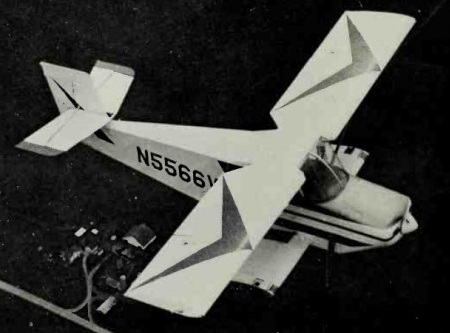
Designed by FAA employee Edward Young of Erie, Colorada, USA, the Young Eddyo F-2 was a two-seat side-by-side light aircraft and took three years of spare-time activity to complete at a cost of $2,500.
The Eddyo F-2 was a sesquiplane and had Vee-braced upper wings, which carried the ailerons, and cantilever lower stubwings which contained the fuel tanks. It had full span trailing-edge flaps. Construction was conventional, with wooden wings and a steel-tube fuselage and tail unit, all fabric-covered. The design featured tail-wheel landing gear which utilised cantilever spring steel main legs. The engine was a Lycoming O-290-D2 four-cylinder 135 hp horizontally-opposed air-cooled which drove a two-blade fixed-pitch propeller.
The sole aircraft, registered N55566V, first flew on November 4, 1963.
The aircraft registration was finally cancelled on 12 December 1983.
Powerplant: Lycoming O-290-D2, 135 hp Wing span (upper): 23 ft 1 in (7.04 m) Constant chord: 3 ft 10 in (1.17 m) Length: 19 ft 5 in (5.92 in) Height: 6 ft 0 in (1.83 m) Empty weight: 997 lb (452 kg) Maximum take-off weight: 1,525 lb (692 kg) Maximum level speed at sea level at MTOW: 145 mph (233 km/h) Cruising speed: 130 mph (209 km/h) Landing speed: 70 mph (ll3 km/h) Service ceiling: 8,000 ft (550 m) Range with maximum fuel: 425 miles (685 km) Accommodation: 2 seats
The Swales SD3-15 was developed from the Birmingham Guild BG 135 Gipsy, the 13.5m span version of the BG 100/12 designed by J. C.Gibson, K. Emslie and L. P. Moore of Sailplane Design Ltd. Manufacturing rights of the BG 135 were acquired by Yorkshire Sailplanes Ltd, who built a batch of seven as the YS 55 Consort. The BG 135 was itself developed from the earlier and very similar Birmingham Guild Gipsy 12/15 project which, like the BG 100/12, was intended to be a low cost lightweight Standard/Sports Class sailplane in which either a medium-performance 12m wing or a high performance 15m one could be fitted to a common fuselage and tail unit. This was to be achieved by special attention to structural efficiency resulting from efficient wing skin stabilisation, with rigid foam cores, and low cost was achieved by eliminating taper as well as twin-skin sandwich or ribbed forms of construction. The prototype BG 100/12, with a 12m (39ft 4in) span wing, first flew on 7 April 1970 and was a cantilever shoulder-wing monoplane of all-metal construction with a V-tail and a large hinged moulded cockpit canopy; a 13.5m span wing was later fitted.
Structurally, the SD3-15 is very similar to the BG 135 and BG 100/12.
Slingsby sold jigs and production rights of their T.53 upon Slingsby’s 1969 receivership to Yorkshire Sailplane which produced an improved version with both nose and centre of gravity tow hooks known as the YS 53 Sovereign.
Yorkshire Sailplanes only turned out three of these all-metal two-seaters, conceived as a T31 replacement for the Air Training Corps only to be rejected due to unpleasant spinning characteristics.




 All Aero