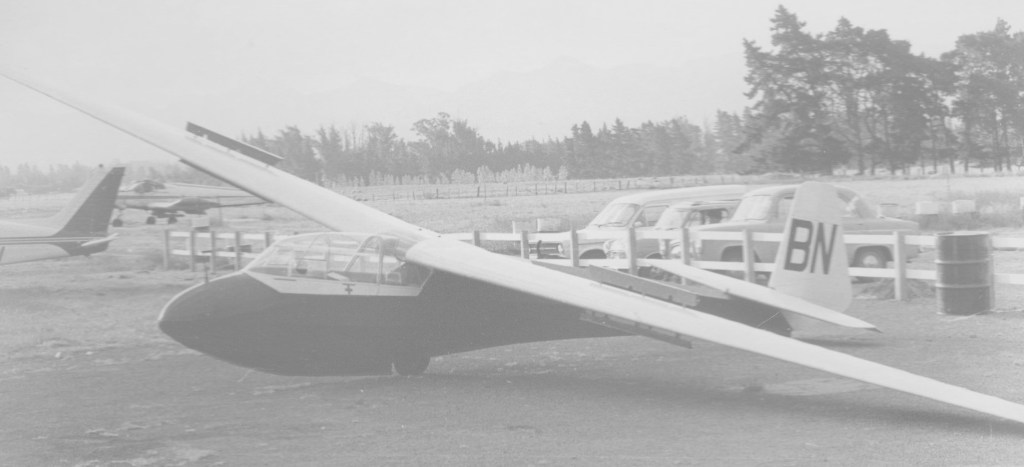
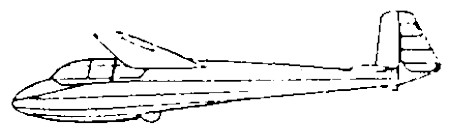
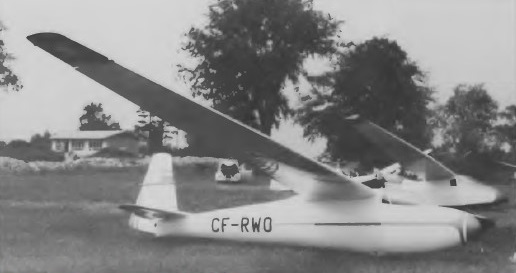
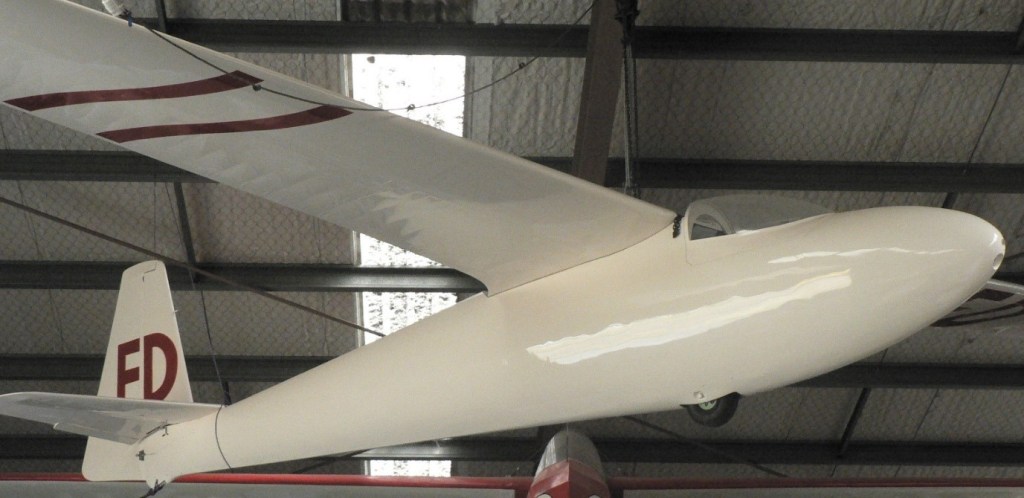
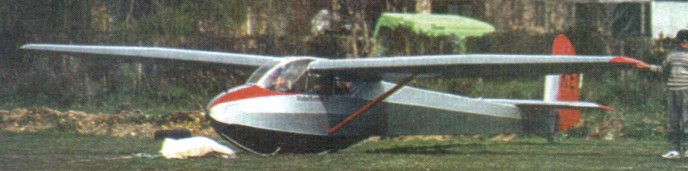
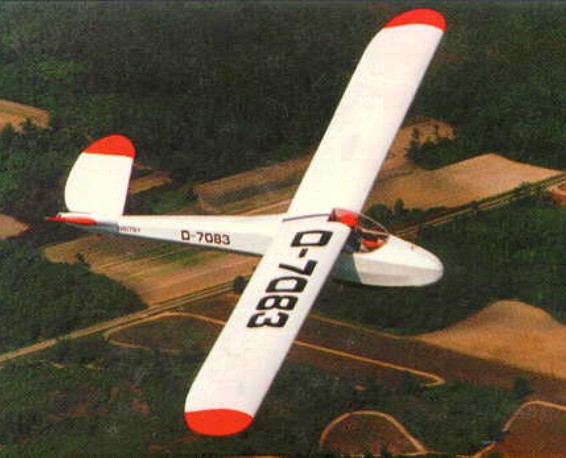
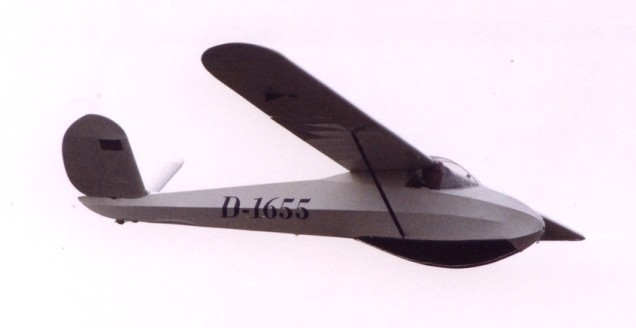
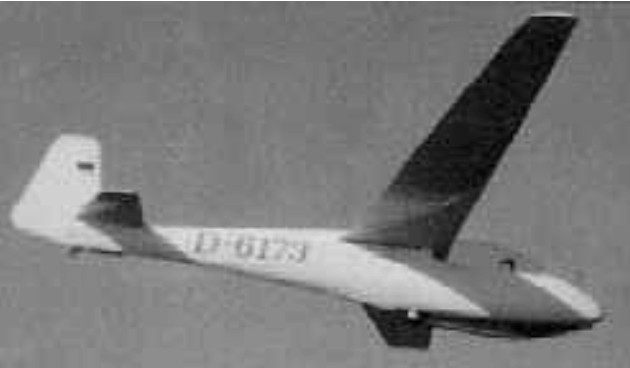
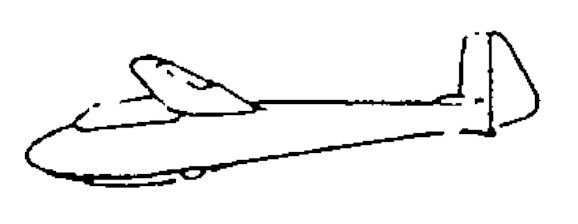
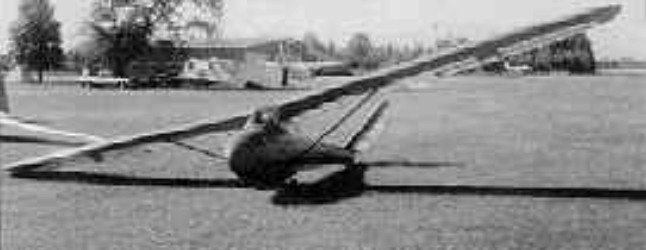
This tandem two-seater training and club sailplane was designed by Rudolf Kaiser to succeed the wooden two-seater Ka 2 and Ka 2B which had proved to be popular trainers in Germany and had been Kaiser’s first design for the Alexander Schleicher firm which he had joined in 1952.
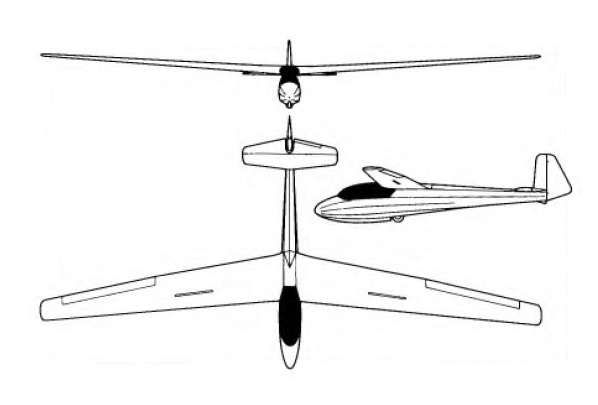
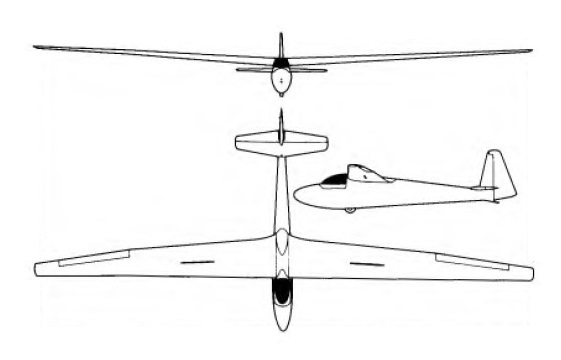
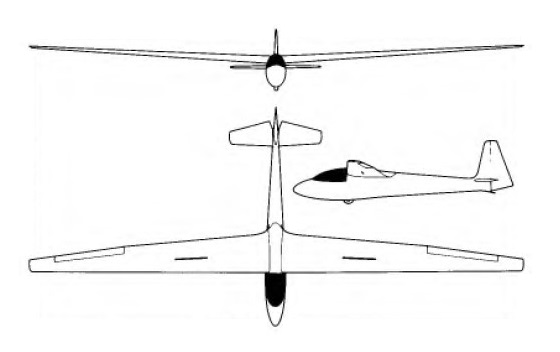
Of conventional wood and fabric construction, with a steel tube fuselage which had fabric covering over wooden formers, the Ka 7 is characterised by high cantilever wings with a forward sweep of 6° 36′ at the quarterchord line and 4° dihedral. The single-spar wings are of pine and plywood with fabric covering and a plywood-covered leading edge torsion box; there are Schempp-Hirth air brakes above and below the wings and the wooden ailerons are fabric-covered. The cantilever tail unit is of similar construction to the wings, and there is a trim tab in the starboard elevator. Landing gear consists of a non-retractable and unsprung Dunlop monowheel and a nose skid forward of it carried on rubber blocks for shock absorbtion; there is also a tailskid. The two pilots sit under a Plexiglas canopy the front portion of which hinges to starboard and the rear portion hinges rearwards.
The Ka 7 first flew in prototype form in 1959 and was intended to provide not only basic training but continuation training without a break for pilots graduating to the more advanced high performance sailplanes. In this it was successful and a total of 370 had been built by the spring of 1964.
Ka 7s twice set new German distance records and the type also set a new German goal flight record for two-seaters over a decade after it first appeared. It once held the multi-place world record for speed around a 500 km Triangle at 84 kph/ 45 kt/ 52 mph, set in South Africa in 1964.
A modified plan exists to lower the wings to the mid position and fit a one piece canopy, which makes the modified glider (Ka-7/ 13) look very similar to its successor, the Schleicher Ka-13. The lowering of the wings greatly improves the visibility from the rear seat.
Schneider also built a few Ka 7 two-seaters under licence.
Kaiser K 7 Rhonadler Length: 23.622 ft / 7.2 m Wingspan: 57.087 ft / 17.4 m Max take off weight: 1058.4 lb / 480.0 kg Max. speed: 92 kt / 170 km/h Crew: 2
Schleicher K7 Rhonadler Wing span: 16 m / 52.5 ft Wing area: 17.56 sq.m / 188.4 sqft Length: 8.1 m / 26 ft 7 in Empty weight: 280 kg / 617 lb Max weight: 480 kg 1,058 lb Water ballast: None Max wing loading: 27.43 kg/sq.m / 5.62 lb/sq ft Max speed: 124 mph / 108 kt / 200 km/h (in smooth air) Max aero-tow speed: 81 mph / 70 kt / 130 km/h Stalling speed: 32 kt / 60 km/h L/DMax: 26 at 80 kph / 43 kt / 50 mph MinSink: 0.70 m/s / 2.3 fps / 1.36 kt at 43.5mph Water Ballast: 27.34kg/sq.m / 5.6lb/sq.ft Aspect ratio: 14.6 Airfoil: Gottingen Go 533, 16/14% Seats: 2
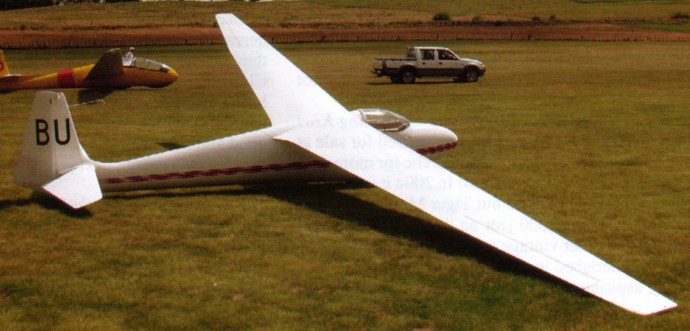
Designed by Rudolf Kaiser and developed by Rudolf Hesse, the Ka 6 series of single-seat Standard Class sailplanes first flew in prototype form in November 1955, with a wing span of 14m (45ft 11 in), and the type’s high performance and attractive price led to steady sales and widespread use in contest flying; more than 1,400 Ka 6s had been built when production ceased in 1968, and the type has been widely exported.
Of conventional wooden construction with ply and fabric covering, the Ka 6 has cantilever high-set single-spar wings of pine and plywood, covered with fabric; they have a forward sweep of 1° 12′ and 3° of dihedral. Schempp-Hirth air brakes are fitted and the wooden ailerons are plywood-covered. The wooden semi-monocoque fuselage is also ply-covered, and the cantilever tail unit is of similar construction to the wings, and a trim tab in the elevator is an optional fitting.
In 1956, when the Standard Class regulations were revised, the wing span was increased to 15m (49ft 2.5 in), this version being the Ka 6B with a landing skid under the fuselage, and the Ka 6BR with a non-retractable monowheel in place of the skid. The Ka-6B won the OSTIV prize for the best Standard Class design at the 1958 World Championships at Leszno, Poland.
The -6C version was a -6B with modified wing root. It has more of the wing covered with plywood and incorporates other minor improvements, and also comes in skid and wheeled (-6CR) models. The Ka 6CR has a non-retractable unsprung monowheel with a band-brake, and both the Ka 6C and CR have a tailskid. The pilot sits under a one piece blown Plexiglas canopy just ahead of the wing leading edge. All models have airbrakes for approach control. Some later -6CR models are designated as Ka-6CRPE’s, the PE standing for pendulum elevators (the all-moving tail used on the Ka-6E).
Ka 6CR
An Australian-built version of the Ka 6CR was produced by Edmund Schneider Pty Ltd, the makers of the prewar Grunau Baby, who had transferred their operations to Australia after the war. Known as the ES Ka 6, this licence-built Australian version first flew in December 1961, and had many changes to suit Australian conditions. The keefer main spar was retained, but the rest of the structure was changed to spruce. The monowheel was enlarged to allow interchangeability with that of the ES 52 Kookaburra, and a new sideways-hinging metal-framed Perspex canopy was introduced. Lifting handles were also provided at the nose and tail. Schneider built seven ES Ka 6s, and was planning to start a further batch of four late in 1964, but production was ended apparently before the latter were built.
At the 1958 World Championships at Leszno in Poland, a Ka 6 flown by Heinz Huth of Germany came 3rd in the Standard Class, and Rudolf Kaiser was awarded the prize for the best sailplane design in this class for the Ka6. Heinz Huth of Germany won in the Standard Class at the 1960 Koln-Butzwelerhof, Germany and 1963 Junin, Argentina World Championships in Ka-6’s; 16 of the 35 Standard Class entries in 1960 were Ka 6s, which took 2nd, 4th, 5th and 6th places, and in 1963 22 out of 38 Standard Class entries were also Ka 6s, the best position gained by a Ka 6CR was 6th place, taken by W. Scott of the USA. In 1963 two Ka-6’s were flown 876.0 km / 544.3 miles by Karl Betzler and Otto Schauble from Germany to France, setting a world distance record, and in 1964, Wally Scott of the U.S. flew his Ka-6CR to a world goal of 837.7 km / 520.55 miles.
Ka-6CR ZK-GFD
ZK-GFD piloted by Ann Johnson achieved a number of New Zealand local and national women’s records including a maximum height of 28,000 ft.
The Ka-6E was produced concurrently with the Ka-6CR for three years. The Ka 6E Standard Class single-seater differs from the Ka 6CR in having a revised wing with modified leading edge profile and mounted just a little bit lower on the fuselage, a slightly different fuselage profile of 10% less cross-sectional area, a slightly longer cockpit canopy lowered by three inches and a redesigned tail unit, with a taller fin and rudder and a low-set all-moving tailplane; the latter is the same (except for the lack of trim tabs) as on the Ka 10, which did not go into production and was a modified Ka 6CR with the tailplane moved to about one-third of the way up the fin. Like the CR, the Ka 6E has Schempp-Hirth air brakes, and tailpiane stability and trimming are controlled by a single lever which adjusts the spring tension on the control column; glassfibre wing tips are featured. The Ka 6E first flew in the spring of 1965, and the E version took part in many national championships and other contests. It is of the same wooden construction with ply and fabric covering as the Ka 6CR, and the landing gear is the same except that the monowheel is now retractable.
Ka-6E
Hans Werner Grosse of Germany, flying a Ka-6E as a guest, was the highest scoring pilot at the 1965 U.S. Nationals. Wally Scott won the 1967 Barringer Trophy by flying 888 km / 552 miles in a Ka-6E. One belongs to the National Soaring Museum.
Schleicher Ka 6 Rhönsegler Length: 21.982 ft / 6.7 m Wingspan: 49.213 ft / 15.0 m Max take off weight: 661.5 lb / 300.0 kg Max. speed: 108 kt / 200 km/h Crew: 1
Schleicher Ka 6b Rhönsegler Length: 21.916 ft / 6.68 m Wingspan: 49.213 ft / 15.0 m Max take off weight: 661.5 lb / 300.0 kg Max speed: 108 kt / 200 km/h Crew: 1
Ka-6CR Wing span: 15m / 49.2ft Wing area: 12.45sq.m / 134sq.ft Length: 6.66 m / 21 ft 10 in Height: 5 ft 1.5 in Empty Weight: 190kg / 420lb Payload: 114kg / 250lb Gross Weight: 304kg / 670lb Water ballast: None Max wing loading: 24.2 kg/sq.m / 4.95 lb/sq ft Max speed: 124 mph / 108 kt / 200 km/h Max aero-tow speed: 87 mph / 76 kt / 140 km/h Stalling speed: 33.5 kt / 62 km/h L/DMax: 31 80 kph / 43 kt / 50 mph MinSink: 0.61 m/s / 2.0 fps / 1.18 kt at 42 mph / 36.5 kt / 68 km/h Wing Load: 24.41kg/sq.m / 5lb/sq.ft Aspect ratio: 18.1 Airfoil: NACA 63-618/63-615 Seats: 1
Ka-6E Wing span: 15 m / 49.2 ft Wing area: 12.41 sq.m / 133.6sq.ft Aspect ratio: 18.1 Airfoil: NACA 63-618/63615/Joukowsky 12% Length: 6.66 m / 21 ft 10 in Height: 1.6 m / 5 ft 3 in Empty Weight: 190 kg / 420 lb Payload: 110 kg / 243 lb Gross Weight: 300 kg / 663 lb Water ballast: None Max speed: 124 mph / 108 kt / 200 km/h (in smooth air) Max aero-tow speed: 87 mph Stalling speed: 32 kt / 59 km/h L/DMax: 33 80 kph / 43 kt / 50 mph MinSink: 0.62 m/s / 2.03 fps / 1.20 kt at 38 kt / 70 km/h Wing Load: 24.17 kg/sq.m / 4.97 lb/sq.ft Seats: 1
Designed by Rudolf Kaiser, the Rhonlerche is a small, strut-braced, 2-seat trainer which first flew in 1955. It features a steel-tube, fabric-covered fuselage, a wooden fabric-covered wing with top-surface spoilers, a fixed wheel and nose skid, and tandem seating.
The type’s comparatively steep glide slope of 19:1 combined with relatively ineffective airbrakes and very restricted visibility from the back seat seem mediocre compared to modern sailplanes.
The Rudolf Kaiser designed Ka-3, which first flew in 1956, was a development of the earlier Ka-1 with a steel fuselage instead of wood. The wood and fabric wing, steel tube and fabric fuselage Ka-3 has top surface spoilers for approach control and main skid, but no wheel.
Schleicher also offered the Ka-3 in kit form.
Wing span: 10 m / 32.8 ft Wing area: 9.9 sq.m / 106.6 sq.ft Empty Weight: 95 kg / 210 lb Payload: 100 kg / 220 lb Gross Weight: 195 kg / 430 lb Wing Load: 19.7 kg/sq.m / 4.03 lb/sq.ft L/DMax: 18 75 kph / 40 kt / 47 mph MinSink: 0.95 m/s / 3.12 fps / 1.85 kt No. of Seats: 1 Aspect ratio: 10.1 Airfoil: Go 549
The 1955 Ka-2 was designed as a two-place advanced trainer. The later Ka-2B had the wingspan inceased to 16 m. Approach control is effected by top and bottom surface Schempp-Hirth type airbrake.
Ka-2 Wing span: 15 m / 49.2 ft Wing area: 16.8 sq.m / 180.8 sq.ft Aspect ratio: 13.4 Airfoil: Go 533 Empty Weight: 254 kg / 560 lb Payload: 208 kg / 454 lb Gross Weight: 460 kg / 1014 lb Wing Load: 27.38 kg/sq.m / 5.61 lb/sq.ft L/DMax: 24 87 kph / 47 kt / 54 mph MinSink: 0.96 m/s / 3.15 fps / 1.87 kt Seats: 2
KA2b Rhonschwalbe Wingspan: 52.493 ft / 16.0 m Wing area: 17.5 sq.m / 188.4 sq.ft Aspect ratio: 14.63 Airfoil: Go 533 Length: 26.739 ft / 8.15 m Empty Weight: 278 kg / 613 lb Gross Weight: 480 kg / 1058 lb Payload: 202 kg / 445 lb Wing Load: 27.43 kg/sq.m / 5.62 lb/sq.ft Max. speed: 92 kt / 170 km/h Crew: 2
Designed by Rudolf Kaiser, the prototype Ka-1, which first flew in 1952, was constructed in Kaiser’s attic. The model was later produced by Schleicher. The Ka-1 has top surface spoilers for approach control. No landing wheel is fitted, takeoff normally being made with the glider sitting on its mainskid.
Wing span: 10 m / 32.8 ft Wing area: 9.9 sq.m / 106.6 sq.ft Empty Weight: 95 kg / 209 lb Payload: 100 kg / 221 lb Gross Weight: 195 kg / 430 lb L/DMax: 18 75 kph / 40 kt / 47 mph MinSink: 0.95 m/s / 3.12 fps / 1.85 kt Wing Load: 19.7 kg/sq.m / 4.04 lb/sq.ft Aspect ratio: 10.1 Airfoil: Go 549 mod. Seats: 1
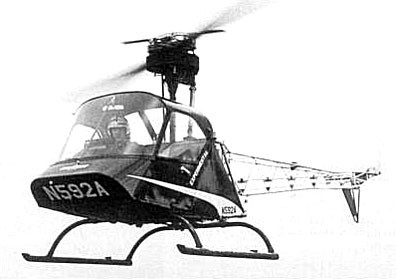
The 1963 Scheutzow Helicopter Flexhub was described “test-bed” version of Model B N564A, the blades were set on rubber bushings instead of conventional ball- and roller-bearings..
Webb Scheutzow formed Scheutzow Helicopter Corp in the early 1960s by to build a light helicopter with special rotorhead (blades carried on rubber bushings). The Bee side-by-side two-seater flew 1968 and three prototypes were built.
USA Scheutzow Helicopter Corp, Berea OH., USA, was formed the early 1960s by Webb Scheutzow to build a light helicopter with special rotorhead (blades carried on rubber bushings). Bee side-by-side two-seater flew 1966. Ceased development 1977.
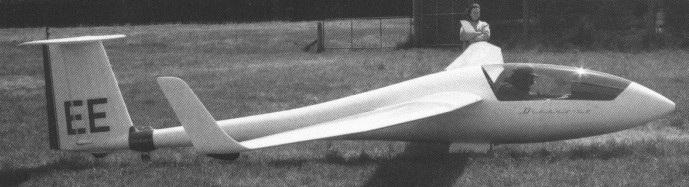
The Schempp-Hirth Standard Class Discus was the successor to the Standard Cirrus, and dominated numerous World Championships between 1985 and 1995 (6 world titles in succession). The Standard Class Discus A first flew in 1984 using the fuselage and tail unit of the original Ventus with a new unflapped wing. The wing planform is noteworthy as being the first production sailplane to have the now common distictive shape where the leading edge sweepback increases towards the tip, establishing a worldwide trend in wing planforms.
Approach control is by top surface double panel schempp- hirth airbrakes. There is a 5kg / 11 lb water ballast tank in the fin for trimming purposes when the main wing mounted ballast tanks are used.
The Discus B incorporates the longer fuselage (about 23 cm/ 9 in) and roomier cockpit of the Ventus B.
The sustainer engined Discus bT, which first flew in 1988, has a retractable mast mounted15kW/ 21 bhp Solo engine with a Oehler folding prop. The T (for Turbo) model incorporates an engine, with no starter, choke and throttle. It is started by wind-milling the multi-blade folding prop. Once started, the engine runs at full power until switched off and then is automatically retracted. Over 150 of the Discus bT were built. The turbo-drive system also equips a successor the Nimbus-4DM.
Whilst the production of the single seat Nimbus-3 had to be discontinued after a fire in one of the production halls, this enabled the production of the Racing Class glider Ventus to be increased, allowing the increase in demand for its motorized variant Ventus-bT to be satisfied.
The self-launching Discus bM has a Rotax engine in the fusealage (in co-operation with Walter Binder) with a retractable mast mounted prop and was manufactured only in small numbers.
The Discus won the first three places in the Standard Class at the 1985 World Championships at Rieti, Italy, 12 out of the first 15 at the 1987 Worlds at Benalla, Austria, and again the first three places at the 1989 Worlds at Wiener Neustadt, Austria. Up to 1995 the Discus won all first places in the world championships.
The Discus CS is built under license in the Czech Republic by Orlican. The winglets (WL) is an option that was developed for further improvement of the climb performance.
After approximately 570 copies weere manufactured in Kirchheim/Teck (including Discus bT and Discus CBM), the Discus A and Discus b production stopped now in favour of the Discus-2. The design Discus CS, identical in constructed with the Discus b, was produced by Schempp Hirth vyroba letadel, at Chocen, CR.
The Discus 2 airfoil is thin (about 14.5 percent), incorporating studies by K.H. Horstmann and Dr. Wuerz (wing) and Luc Boermans (tail). The 5″ wheel with a hydraulic brake keeps the fuselage far away from the ground. The tail and cockpit are completely new designs. Empty weight of the prototype is about 240 kg. There is a tail ballast tank.
During stalls in clean configuration (flaps and gear not extended) buffetings on the airspeed indicator begins at about 77 km/h IAS (vortices of the upper fuselage hitting the airspeed probe that was mounted on the vertical tail), followed by a slight vibration at about 73 km/h IAS. The stall ocurred at less than 70 km/h IAS, the airplane vibrating and the airspeed indicator trembling between 65 and 80 km/h.
The Duo-Discus was designed specifically by Klaus Holighaus for two seat high performance flight. With its wingspan of 20m, the two seat fixed profile glider first flew on the 11.03.1993 on the Hahnweide. Despite limited production opportunities, over 150 aircraft were already in service around the world by the end of 1997.
In April 1998, the maiden flight of the first prototype of the Discus 2, registrated D-6111, took place. In 1998 the Discus-2 gained first place in the Hahnweide competition and also National Championships in Germany and England. In late summer 1998, the 250th Discus-CS delievered from Chocen.
1999 brought the maiden flight of the “Duo-Discus-Turbo” and Gunther Stahl became the “Junior World Champion” in the Standard Class with a “Discus-2b”.
The Duo Discus was conceived as an advanced trainer with good cross country ability. It has a four piece unflapped wing with a modified Discus wing. The fuselage is derived from that of the two-place Janus. Approach control is by top surface airbrakes.
With the title of European Champion in all three classes, in 2000 two new motor gliders were announced. The Discus-2T, and the Nimbus-4M with an internal lying Solo 2625-02 engine as copied from the Nimbus-4DM.
The World Championships were successful in Mafeking 2001, with a renewed title for the Discus-2 and the Ventus-2ax in the 15m class, a variant sporting a drag reduced tail section and Maughmer winglets. These modifications (which improved the flight characteristics at lower speeds and higher wing loadings) were carried through to the Ventus2-bx, along with a newly designed outer contour and cockpit area shape.
Additionally, the Ventus-2cT won the 18m class at the FAI World Air Games in Lillo/Spain. Mid May 2002 saw the delivery of the first ballistic chute “total recovery system“ fitted to a Ventus-2bxR which was designed by the neighbouring company Glasfaser-Flugzeug-Service GmbH in Grabenstetten and tested in a Discus.
2002 saw the delivery of the 1000th Discus (all variants) as well as the completion of the 1000th Ventus (all variants).
The 18m Discus-2C, first flown on the 16.09.2004, integrates of the “Turbo“ sustainer and shorter outer panels, allowing the Discus-2C to be used in standard class competitions.
Discus b Span 15.0 m Wing area 10.58 sq.m Wing aspect ratio 21,3 Fuselage length 6.58 m Unloaded weight approx. 230 kg Gross weight 525 kg Wing loading 29.5-49.6 kg/sq.m Max water ballast 180 lt Maximum speed 250 km/h Maneuver speed 200 km/h Leastst sink approx. 0.59 m/s Best lift/drag ratio 43