Akaflieg Braunschweig SB 8 & 8V2

SB-8

The Akaflieg Braunschweig SB-8 is an experimental, single-seat, high performance glider built in Germany in the 1960s, constructed largely from glass fibre skin over built up balsa wood structure. Two were built; the second of which was later fitted with a high aspect ratio (30:1) wing, becoming the Akaflieg Braunschweig SB-9 Stratus.

The Akaflieg Braunschweig or Akademische Fliegergruppe Braunschweig (English: The Brunswick Academic Flying Group) is one of fourteen German undergraduate student flying groups sponsored by their home technical university. Several have designed and built aircraft, often technically advanced and leading the development of gliders in particular. The Brunswick students had been exploring the use of GRP in a series of related gliders, beginning with the SB-6. From the SB-8 to the SB-10, wingspan and aspect ratio were progressively increased. The aspect ratio was increased from 23 to 36.6, resulting in aeroelastic problems.

The SB-8 is similar to the SB-7, which also had an aspect ratio of 23. It performed well but had difficult handling characteristics, attributed to its Eppler aerofoil section. The SB-8 has an 18 m (59 ft 1 in) wingspan, a two-piece wing of Wortmann FX 62 profile with an unswept leading edge, a slightly tapered center section, and more strongly tapered outer sections. It is built around a box beam, with balsa ribs and a torsion shell of glass fibre laid over balsa. The wing is shoulder mounted at 1.5° dihedral, with Schempp-Hirth airbrakes at mid-chord midway along the center section and ailerons on the outer panels. Both SB-8 built have camber flaps on the inboard wing panel and ailerons which are coupled to the flaps (flaperons) on the outboard panels.

The fuselage of the SB-8 is built with a fibreglass skin, over a balsa shell, with balsa vertical frames and two pine plywood main formers in the region between the wings. The nose is pointed and slightly drooped, with a short, single piece, canopy just ahead of the wings, tapering gently aft to a straight tapered balsa/GRP T-tail unit. The tailplane carries a conventional single-piece elevator and the rudder is fabric covered. On the ground the SB-8 is supported by a retractable, unsprang monowheel undercarriage, assisted by a tail bumper.

The first flight was made from Brunswick airport on 25 April 1967; testing confirmed that the glass fibre structure was too flexible and at high speeds the SB-8 exhibited wing flutter, limiting its maximum permitted speed to 170 km/h (105.6 mph; 91.8 kn). The low wing loading also limited its smooth air cross country speed as there was no provision for ballast. Later, removable steel tubes filled with lead pellets were added to the wing roots of the SB-8 V1 to increase wing loading. A second aircraft, SB-8 V2, was therefore built with a stiffened, heavier wing and provision for water ballast, which addressed both aero-elasticity and wing loading problems, allowing the glider to fly safely, without flutter, at 200 km/h (124.3 mph; 108.0 kn).

The SB-8 V2 had shown that glass-fibre wings could be made stiff enough to avoid aeroelastic flutter problems and that the higher aspect ratio produced the expected improvement in glide angle. It was natural for the next Akaflieg Braunschweig design to have a wing of greater span, replacing the wing of the SB-8 V2 airframe with a four-panel wing of similar construction but 22 m (72 ft 2 in) span. At the time of its first flight in January 1969 the SB-9 had probably the greatest span of any glider then flying, though the 22 m (72 ft 2 in)-span Holighaus Nimbus 1 flew only three days later. The increase in aspect ratio over the SB-8 increased the measured best glide ratio from 40:1 to 46:1 and decreased the measured minimum sink rate from 0.61 m/s (120.08 ft/min) to 0.51 m/s (100.39 ft/min). The new wing took advantage of the flexibility of glass fibre to implement elastic flaps. The intention was to avoid the interruption to the wing profile at the hinge, particularly on the critical upper surface, and leakage through it by bending the upper surface instead. This method had been used earlier in the wooden-winged HKS-1 glider of 1953.

Both SB-8s competed at the German National Championships of 1968, Wolfgang Beduhn finishing fifth in the V1 and Helmut Treiber seventh in the V2. The V2 went on to become the SB-9, but the V1 remained in regular use at Brunswick until 1989. It remained airworthy after that, though flown less often, and was still on the German Civil Aircraft register in 2010.

The SB-9 was used by the Akaflieg students in competitions between 1969 and 1971. It also gave them the opportunity to film and study the alarming motions of the wing when fluttering, recording their observations on film in slow motion and in the air. Two antisymmetric, odd, sine-like lateral displacement modes were observed at 90 km/h (55.9 mph; 48.6 kn). The fundamental mode was seen, at a frequency of 3.3 Hz but at 140 km/h (87.0 mph; 75.6 kn) the wing oscillated at 5.8 Hz in a second harmonic mode. During these largely vertical excursions, the wing also twisted and its overall motion excited vibrations in the rear fuselage and tail unit. The flutter problems were addressed by mass-balancing, the ailerons, and by a span reduction to 21 m (68 ft 11 in).

Neil Armstrong was given the opportunity to fly the SB-8 large sailplane, innovative for its use of structural composite materials.

The career of the SB-9 ended in 1972, when it was decided to use its wing on the SB-10 two-seater, a new design with a very different fuselage and the span increased still further with an 8.7 m (28t ft 7 in) centre section.

Variants

SB-8 V1
Original aircraft, empty weight of 260 kg (570 lb) and a maximum take-off weight of 365 kg (805 lb).[3] Flutter restricted maximum permitted speed to 170 km/h (110 mph; 92 kn).
SB-8 V2
Stiffened wing, weights increased by 40 kg (88 lb). Provision for water ballast, maximum permitted speed increased to 200 km/h (120 mph; 110 kn)
SB-9 Stratus
The SB-8V2 was modified with a four-part wing of 22 m (72 ft 2 in) span, fitted with elastic flaps. SB-9 Stratus was first flown in January 1969. It is Empty weight, 325 kg (717 lb), maximum in flight weight, ballasted, 421 kg (928 lb). Flutter problems were tackled with a span reduction to 21 m (68 ft 11 in) and mass-balancing the ailerons.

Crew: 1
Length: 7.505 m (24 ft 7 in)
Wingspan: 18 m (59 ft 1 in)
Wing area: 14.1 sq.m (152 sq ft)
Aspect ratio: 23
Airfoil: root:Wortmann FX 62-K-153, mid:Wortmann FX 62-K-131, tip:Wortmann FX 60-126
Empty weight: 301 kg (664 lb)
Gross weight: 403 kg (888 lb)
Max takeoff weight: 451 kg (994 lb)
Never exceed speed: 200 km/h (120 mph, 110 kn)
Maximum glide ratio: 41.6 at 85 km/h (53 mph; 46 kn)
Rate of sink: 0.61 m/s (120 ft/min) at 88 km/h (55 mph; 48 kn) at 27.7 kg/m2 (5.7 lb/sq ft) and 385 kg (849 lb)
Wing loading: 28.6 kg/m2 (5.9 lb/sq ft)

Boeing 417

Boeing’s vision of a futuristic regional airliner, the model 417, emerged in the years following WWII.
Boeing took a fresh look at the travel requirements of a postwar populace and identified a need for a smaller airliner to serve regional routes. In 1946, it came up with the 417, an 18,365-pound, twin-engine aircraft designed to carry 20-24 passengers at a speed of 200 mph.

Boeing chose the 800 hp Wright Cyclone C7BA1, essentially the same powerplant as the R-1300 used by the North American T-28 Trojan trainer.

The Boeing appeared more advanced than the competing DC-5, but the performance numbers were nearly an exact match with the exception of the 417’s short-field performance, which was notably optimistic. The 417 was claimed to require only 1,200 feet to clear a 50-foot obstacle and 1,735 feet very impressive performance for its size and weight.

Proposed performance on the ground was similarly impressive, with features that were said to enable turnaround times of six minutes or less.

Boeing claimed this was achievable through the aircraft’s independence from ground equipment. The airstair door enabled boarding without the need for separate stairs, and the height of the cargo hold floor was said to match the height of truck beds, eliminating the need for ramps or hoists. In this diagram, we see the aircraft being refueled with the right engine running as cargo is loaded and passengers begin to board.

Presenting the concept to potential customers like Pan Am was one thing. Boeing also released data and artists’ renderings to the media, and it became prominently featured on magazine covers.

Boeing even ran its own ads in various publications.

Boeing did secure at least one order for the 417 when Empire Airlines ordered three of them to replace their Boeing 247s. In the September 1946 issue of Boeing Magazine, the 417 was said to provide a 57 percent greater break-even load factor than the 247D, promising greater profitability with fewer seats filled.

Just as Boeing was presenting the 417 to customers, Convair was doing the same with its 107, albeit without such a strong marketing and promotional effort.

While both concepts were forward-thinking solutions to shorter, lower-capacity routes, their roles would ultimately be filled with the glut of surplus aircraft from the war effort—namely, the DC-3, which provided similar performance for pennies on the dollar.

Zuck-Whitaker Plane-Mobile

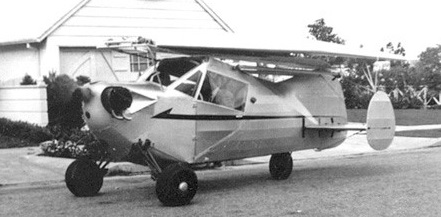
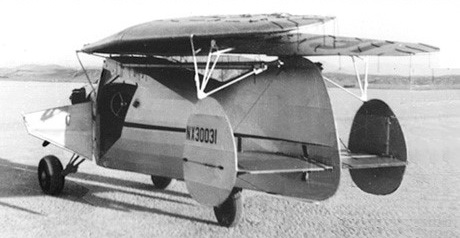
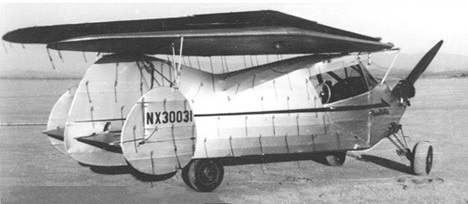
Plane-Mobile NX30031

The 1947 Plane-Mobile built by Daniel R Zuck and Stanley D Whitaker was a roadable airplane with a floating, or pivotal, wing, free to change its angle of attack according to the vagaries of the air currents. There were no rudders or elevators in the tail, instead the wings had “ailerators,” a combination of ailerons and elevators.

Registered NX30031, it reportedly suffered a severe ground loop during a test flight.

Engine: Continental A-40, 40hp
Wingspan: 31’6″
Length: 15’6″
Useful load: 375 lb
Max speed: 90 mph
Cruise speed 80 mph
Stall: 40 mph
Range: 285 mi
Seats: 2

Zlin Z-50

Z-50L

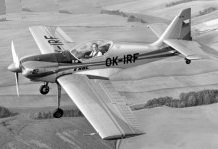
First flown in 1975 in the original Z 50 L version, the Zlin Z 50 is an all metal low wing monoplane with a mid fin tailplane braced by two struts that attach at the bottom of a tapering vertical fin. It has a fixed spring gear and a Lycoming AEIO-540 D1B5, putting out 260 hp to a three blade Hoffmann wood fiberglass propeller driven through a constant speed hub. The original prototype that appeared in the Zlin literature apparently had six short stacks that exited from the sides of the cowl, but the noise was unbelievable; they had to go to a pair of collectors that exit at the rear of the lower cowl lip. It has an empty weight of 1,254 pounds in aerobatic configuration and an aerobatic performing weight of 1,584 pounds. All up maximum gross weight is 1,760 pounds, and the Zlin is stressed to plus nine or minus six Gs. The wing is fabricated entirely with round head rivets apparently for strength. The Zlin 50 has a truly impressive roll rate, the product of very generous aileron area for its size and weight; its wing span in aerobatic trim is about 28 feet, and it is about 21 and a half feet long. The Z 50 has a symmetrical wing section without dihedral, a single seat cabin under a one piece plexiglas canopy and full inverted systems are standard. The wing area is 120 square feet; with a power loading of 5.5 pounds per horsepower and a maximum rate of climb of around 3,000 fpm, the airplane will possess the vertical capability the elder Zlin lacked. The structure is principally aluminum, with some fabric covered portions and a fiberglass cowling.
Moravan Aeroplanes built the Z-50 as a certified aircraft in the standard category in the Czech Republic.
Eighty-one were built in the various sub-types from 1976 until the ’90s.
The Zlin 50L has a 260 hp Lycoming modified by the Czechs to run all ways up and a three blade German composite propeller.
The Czech team flew five 50 Ls at the 1976 world contest in Russia, and despite the newness of the type, came second in the team prize and third in the men’s individual championships. The undercarriage is of titanium spring.

L.Tuček with Z-50L

There appeared to be no ad¬verse aileron yaw, which was remark¬able in view of the almost full span control surfaces. They had an odd tab arrangement: the left aileron had a conventional geared tab; the right one worked through a cam, so that at small deflections it was an anti balance tab, but at larger ones it reverted to acting as a conventional geared tab. The symmetrical wing was thinner at the tip, giving it a washout effect both erect and inverted.
It is a single-seat, low-wing monoplane with an enclosed cockpit and fixed undercarriage. Built predominantly of anodised aluminium, with fabric covered tail and fibreglass engine cowls, the Z-50LS is powered by the 300-hp Lycoming AEIO-L1B5D, driving a three-blade composite Hoffmann propeller.

Later came the Z 50 LS aerobatic version.

Z-50LS
Engine: Lycoming AEIO-L1B5D, 300 hp

Zlin 50
Engine: Lycoming AIO-540, 260hp
Wing span: 27 ft 11 in
Length: 21 ft 2 in
Top speed: 180mph

Zlin Z-43 / Z-143 / Aeronautical Manufacturing Enterprise Safir 43 / Fernas 142

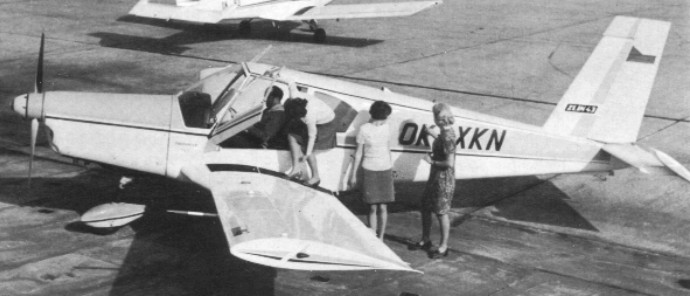
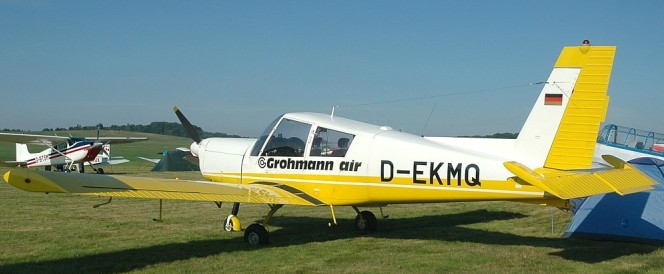
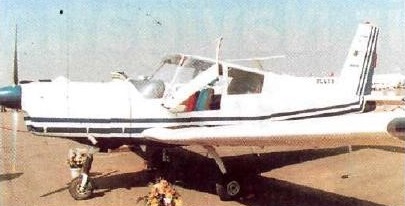
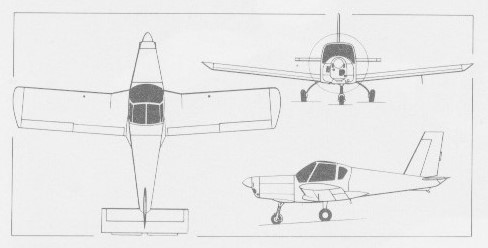
After successful production of the Z-26 aircraft family, the Czechoslovak aircraft manufacturer Moravan, began design of a new series of training aircraft, known as the Z-40 family. Unlike the previous tandem-seat aircraft, the Z-40 family featured a side-by-side cockpit. It was available in two basic variants, a two-seat trainer, the Zlín Z-42, and a four-seat aircraft, the Zlin Z-43 capable of being used both as a trainer and a tourer.

Zlin 43

The resulting design is a single-engined low-wing monoplane of all-metal construction and a fixed nosewheel undercarriage. The Z 43 shares 80% of its structure with the Z 42, but is fitted with a revised fuselage accommodating a four-seater cabin and a more powerful engine. The Z-43’s wings are of greater span and do not have the slight forward sweep of the Z- 42.

The Z-43 first flew on 10 December 1968, with production starting in 1972. It proved less popular than its two-seat contemporary, and production ended in 1977 after 80 aircraft were built.

The Z-143 is a version introduced in 1992, powered by a six-cylinder Lycoming O-540 engine, in parallel to the Z-42 being re-engined with a Lycoming to become the Z-242. The Z143 L four-seat lightplane with Textron Lycoming engine first flew in April 1992.

Pictures released by the Tamil Tigers in Sri Lanka indicate that they operated Czech-built Zlin Z-143 single-engine, four-seater light aircraft modified to carry four bombs mounted on the undercarriage. On 9 September 2008, the Sri Lanka Air Force reportedly brought down an Air Tigers Z-143 over Mullaittivu.

The Air Tigers carried out a Suicide air raid on Colombo on 20 February 2009 using two of these aircraft. Under heavy anti-aircraft fire one of these aircraft crashed into Sri Lanka Inland Revenue Department building in Colombo and the other craft was shot down near Sri Lanka Air Force Base at Katunayake.

Other operators include; Hungarian Police, Hungarian Air Force, Algerian Air Force – producing locally under Safir-43 name, Cuban Air Force, East German Air Force, and Macedonian Air Force.

Z-143 LSi Genius

Algeria’s Aeronautical Manufacturing Enterprise started manufacturing the Safir 43 in 1993, although they initiated the project in 1987. They are built under licence from the Czech Republic, but are manufactured completely in Algeria.

The aircraft were designed by the Zlin company and are marketed by the Aeronautical Manufacturing Enterprise throughout the whole of Africa.

AMC Safir 43

The Safir is used in Algeria for training, recreational flying, coastal and pipeline surveillance and agriculture. Around 50 examples of the four seater had been built since it entered service in 1994.

AME is also building the two-seat Firnas 142 aerobatic trainer, based on the Zlin 143, complete with aerobatic modifications. The Firnas 142 is a two-seater and the Safir 43 a four-seater. AMC has built some 60 of the aircraft, 20 for use by the Algerian Air Force, government departments and parastatal corporations in a variety of roles.

These include basic training, aerobatic training, aerial surveying of powerlines and pipelines, as well as normal general aviation and utility duties, including banner and glider towing.

Both aircraft have fixed tricycle landing gear.

Variants:

Zlín Z 43
Base model
Engine: 1 × Avia M 337 A, 160 kW (210 hp)
Wingspan: 9.76 m (32 ft 0 in)
Wing area: 14.50 sq.m (156.1 sq ft)
Length: 7.75 m (25 ft 5 in)
Height: 2.91 m (9 ft 7 in)
Empty weight: 730 kg (1,609 lb)
Max takeoff weight normal: 1,350 kg (2,976 lb)
Max takeoff weight utility: 1,000 kg (2,204 lb)
Fuel capacity normal: 130 L (34 US gal; 29 imp gal)
Fuel capacity opt/ wingtips: 110 L (29 US gal; 24 imp gal)
Maximum speed: 146 km/h (91 mph, 79 kn) at sea level
Cruise speed: 210 km/h (130 mph, 113 kn)
Stall speed: 103 km/h (64 mph, 56 kn) (flaps down)
Never exceed speed: 273 km/h (170 mph, 147 kn)
Range standard: 610 km (380 mi, 330 nmi)
Range opt/fuel: 1,150 km (710 mi; 620 nmi)
Service ceiling: 3,800 m (12,465 ft)
Rate of climb: 3.5 m/s / 210 m/min (690 ft/min)
Takeoff distance to 15 m (50 ft): 700 m (2,300 ft)
Landing distance to 15 m (50 ft): 590 m (1,940 ft)
Cabin length: 8 ft 2.5 in / 2.50 m
Cabin width: 3 ft 8 in / 1.12 m
Cabin height: 3 ft 11.25 in / 1.20 m
Cabin baggage: 7.1 cu.ft / 0.2 cu.m
Rear baggage: 8,8 cu.ft / 0.25 cu.m
Crew: 1
Capacity: 3 passengers

Zlín Z 43M
Experimental model.
Only one was built

Zlín Z 143
Improved model

Aeronautical Manufacturing Enterprise Safir 43
Engine: LOM M337AK, 157kW (210hp)
Empty weight: 761kg / 1,676lb
Take-off weight: 1,350kg
Maximum speed: 166kt / 307km/h
Cruising speed: 212 km/h
Range: 1,060km / 570nm
Endurance: 6h
Seats: 4

Aeronautical Manufacturing Enterprise Firnas 142
Engine: LOM M337AK, 154 kW / 210 hp max, 103 kW cruise
Propeller: two-blade
Length: 7.33 m
Wingspan: 9.16 m
Height: 2.75 m
Empty weight: 745 kg
MTOW: 1090 kg
Top speed: 333 km/h
Cruising speed: 215 km/h
Endurance: 5+ hr
Maximum range: 1050 km
Maximum ceiling: 5000 m

Zlin Z-42 / Z-142 / Z-242

Z-42

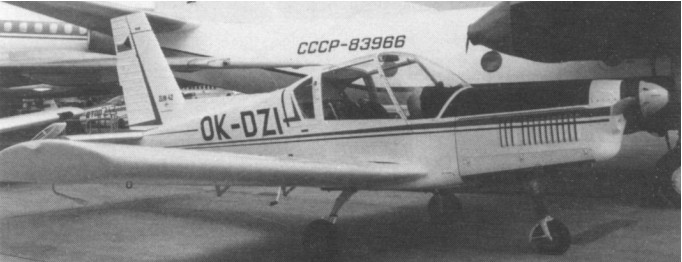
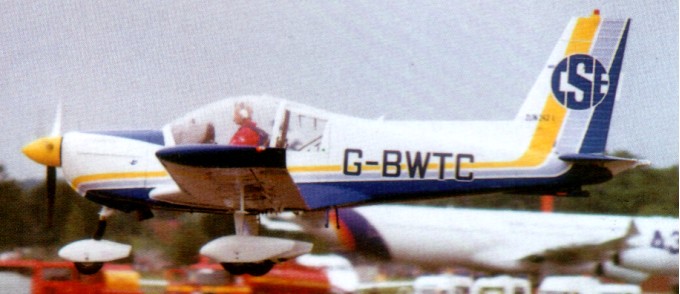
A two-seat trainer and touring aerobatic aircraft, the Zlin 42 (first flown in 1967) was developed in the late sixties and followed by the Z-142 with a slightly modified cockpit canopy and a more powerful engine. The Z 142 two-seat basic and advanced civil/military trainer was first flown in December 1978.

Zlin 142

The Z 242 is a variant of the Z142 with a U.S. Textron Lycoming engine in place of the L0M Prague type.

Z-242
Zlin Z.42M

Gallery

Z-42
Engine: Avia M 137 A, 180 hp
Wing span: 30 ft (9.1m)
Seats: 2

Z-42 M
Seats: 2

Z-142

Z-242L
Engine: Lycoming
Seats: 2

Zlin 42

Zlin Z-37 Cmelak / OK-60 / Bumble Bee / Z-237

The XZ-37 was first flown as OK-60 on 29 June 1963. Powered by a 310 hp Ivchenko Al-14VF, the aircraft went into production as a joint venture between Moravan and SPP at Kunovice in 1966. The Zlin Z-37 Cmelak was fitted with a 315 hp Walter M-462RF radial, a licence-built version of the Ivchenko AI-14.

Zlin Z-37 Brochure

Z-37

In 1967, the first Z-37s were exported to East Germany and Yugoslavia. The Z-37A was an improved version from 1971 with stronger and more corrosion-resistant airframe and other changes. Both featured an auxiliary seat behind the hopper.

As in the West, the swing to turbines was noticed by Moravan and a new aircraft, the XZ-37T, was built at Otrokovice and made its maiden flight on 6 September 1981. It was powered by a 691-shp Walter M-60lB. Two more prototypes were completed in 1983, these powered by a 483-shp M-601Z turbine. Certification under BCAR (British Civil Air Regulations) was received in 1984 and production was started in 1985 as the Z-37T Agro Turbo. Two Z-37T-2 two-seat trainers were completed in 1987. An upgrade of the Z-37 with increased engine power followed and, although the aircraft was designated the Z-137T, the same type certificate is used. A total of 713 piston engined aircraft were built with the last being 25-40.

Z-37
Engine: M 462 RF, 315 hp
Span: 40’ 01” / 12.22 m
Length: 28’ 0.5” / 8.55 m
Height: 9’ 10”
Wing area, 256 sq.ft
Empty weight 2,295 lb / 1043 kg
MTOW normal: 3,855 lb / 1750 kg
Cruise 4920 ft / 1500 m: 99 kt / 114 mph / 183 kph
ROC SL: 925 fpm / 282 m/min
Service ceiling: 13,125 ft / 4000 m
Range w/1 hr +10% res: 345 nm / 398 mi / 640 km
Seats: 1 crew + 1 pax

Z-37 Ag
Engine: M 462 RF, 315 hp
Span: 40’ 01” / 12.22 m
Length: 28’ 0.5” / 8.55 m
Height: 9’ 10”
Wing area, 256 sq.ft
Empty weight 2,295 lb / 1043 kg
MTOW: 4089 lb / 1850 kg
Cruise 4920 ft / 1500 m: 92 kt / 106 mph / 170 kph
ROC SL: 728 fpm / 222 m/min
Hopper capacity: 143 Imp.Gal / 650 lt / 1323 lb / 600 kg
Hopper / cargo volume: 63.5 cu.ft / 1.8 cu.m

Let Z 37 A Cmelak
Engine : Avia M 462 RF, 306 hp
Length : 28.215 ft / 8.6 m
Height : 9.514 ft / 2.9 m
Wingspan : 40.026 ft / 12.2 m
Wing area : 256.183 sqft / 23.800 sq.m
Max take off weight : 4079.3 lb / 1850.0 kg
Max. speed : 108 kts / 200 km/h
Cruising speed : 100 kts / 185 km/h
Initial climb rate : 787.40 ft/min / 4.00 m/s
Service ceiling : 13287 ft / 4050 m
Wing load : 15.99 lb/sq.ft / 78.00 kg/sq.m
Range : 346 nm / 640 km
Crew : 1-2

Z-37T
Engine : Walter M 601 Z, 360-483 shp
Length: 34.449 ft / 10.5 m
Height: 11.483 ft / 3.5 m
Wingspan : 44.619 ft / 13.6 m
Wing area : 287.399 sqft / 26.7 qm
Max take off weight : 5567.6 lb / 2525.0 kg
Weight empty : 2756.3 lb / 1250.0 kg
Max. weight carried : 2811.4 lbs / 1275.0 kg
Max. speed : 118 kts / 218 km/h
Landing speed : 42 kts / 77 km/h
Cruising speed : 103 kts / 190 km/h
Initial climb rate : 826.77 ft/min / 4.20 m/s
Wing load : 19.48 lb/sq.ft / 95.00 kg/sq.m
Range : 189 nm / 350 km
Crew : 1

Z-37T-2
Seats: 2

Z-237