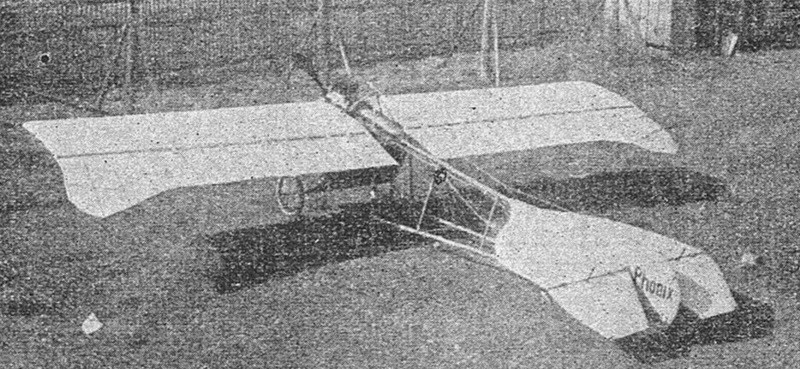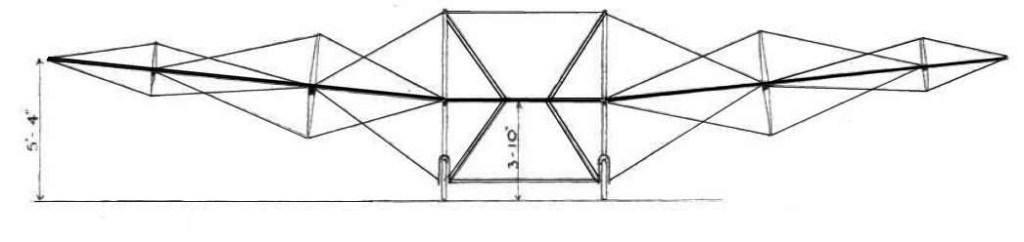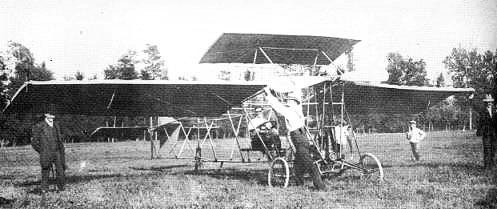
Pini 1910 Monoplano/Biplano

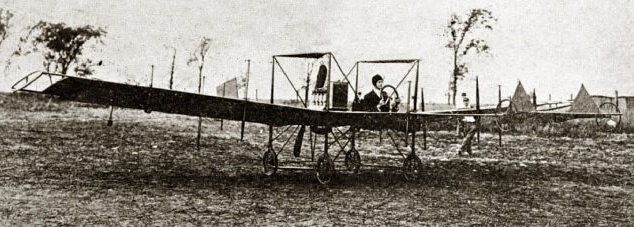
In 1908 Enrico Pini (born in Milan in January 1889), was in Paris during time when Wilbur Wright presented their airplanes. He became excited and remained influenced by aviation. He abandoned his normal activities and followed the American aviator, with such interest as to attract attention and sympathy of Wilbur Wright, who wanted to reward him by taking him as a passenger in a short flight. Then Pini decided to build himself an airplane, he designed one, a monoplane-biplane that best met his needs for aesthetics rather than technical ones.

In Milan, Enrico Pini had a brother, engineer Adolfo Pini, who was five years elder, he was an electrical engineer and occupied a responsible position at the Edison Electric Company. Bothe brothers started to build a full size machine according to Enricos drawing and with help of Adolfos fundings (this sum was to be used for the expenses of his marriage, which was therefore postponed), Adolfo even resigned from Edison`s company to dedicate himself fully to the project.

The brothers built the machine at the Bezzi`s factory, he was an industrialist, who owned an electric motor factory. Designed Enrico Pini, its planes were so arranged as to widely separate a large rectangular monoplane wing, then to add a small horizontal plane above the gap. All year 1909 was dedicated to the creation of the airplane, the assembly of which took place in the hangar of Societa Restelli, which built the Rebus engines, located in Piazza d’Armi nuova. In turn, the uncle and godfather of the two brothers Adollo, wanted to help them by providing them with the engine unit, a three-cylinder fan-type Anzani fan of about 25 HP, the kind used by Bleriot in his famous crossing of the Channel.
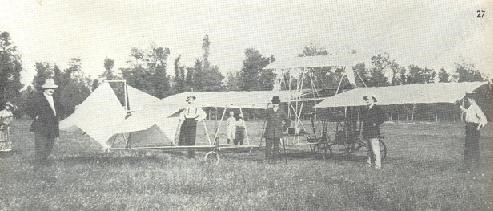
At the end of 1909, on 15th November, it was inaugurated in Milan the first exhibition of Italian Air Force “1a Esposizione Italiana d’Aviazione” organized by the Gazzetta dello Sport, at the vast halls of the Splendido Corso Hotel. The Pini brothers exhibited the model of their aircraft that was awarded by the jury with a bachelor’s bronze medal. In the spring of 1910 finally they began testing, pilot was Enrico, but at first the machine rarely reached the desired speed, it was only taxiing, the engine was underpowered. They made some improvement of undercarriage. With the daily trials and modifications aimed at improving the performance of complex propulsion and weight reduction, the device gradually lengthened its hops up to make small flight in height ranging between 50 and 80 cm from grass surface and a length variation from 200 to 500 meters.

Unfortunately the financial means of the two brothers were soon at the end, in view of their uncle would not hear of poor results to come to the aid; they tried to borrow, but even this was limited by the lack of trust that was fed to the success of the company (Bezzi was the same creditor to over six thousand liras) and therefore the tests had to be suspended and the two unfortunate inventors, despite all the sacrifices and renunciations that were subjected to succeed in their intent, reluctantly abandoned their aviation activities. The autumn saw the device removed and deposited in a cellar and was eventually sold as scrap.

A manufacturer from Milan, Ercole Marelli, which had seen the equipment of the Pini brothers had been appreciated, rather than the qualities of the aircraft itself, the brilliant and original construction, the engineer then offered a job in his company. Enrico Pini, after the bitter disappointment, continued in his business with bold new initiatives, and finally, helped by luck managed to form a solid financial position.
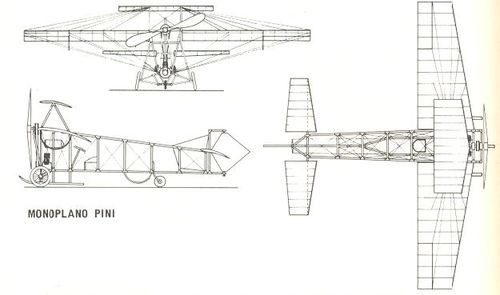
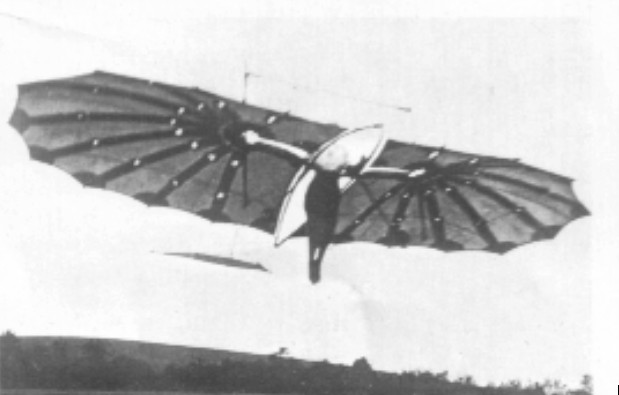
Pilcher Bat

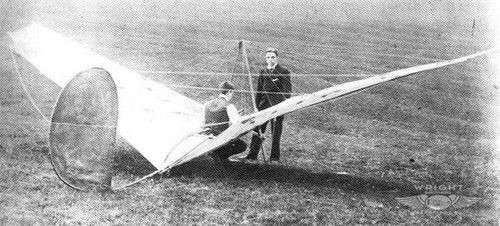
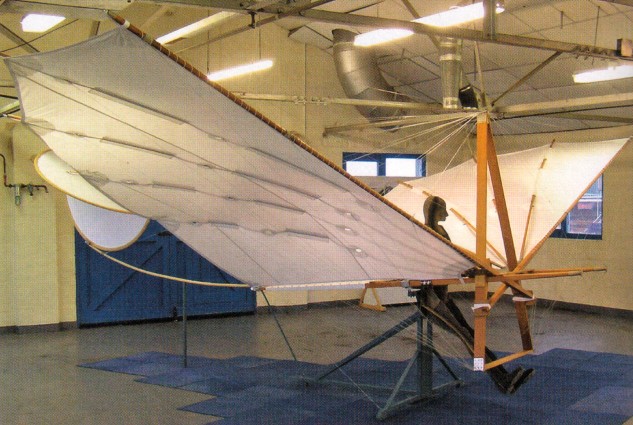
In 1893 Pilcher had been appointed assistant lecturer in Naval Architecture and Marine Engineering at Glasgow University, and it was there, inspired by Otto Lilienthal, that he designed his first glider, the Bat, in 1895 and tested it at Cardross. In 1896 he made his first glides, under Lilienthal’s tuition. This was the second form of Bat, with a bisecting circular fin and tailplane. Longer flights were made, some under tow when the wings’ dihedral was reduced.

2nd form (replica)

Phillips Multi-Wing

1907 Phillips Multi-Wing

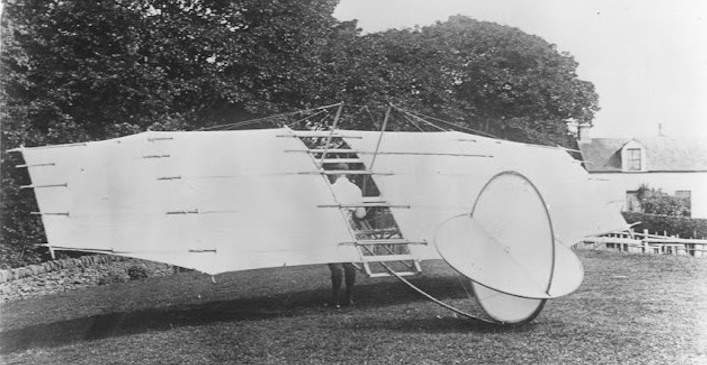
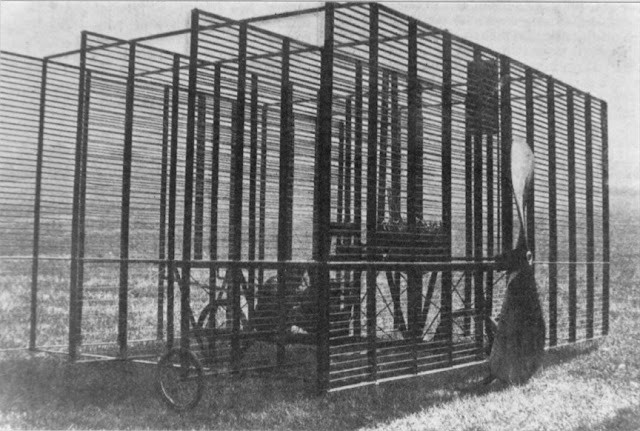
A second version of Horatio Phillips’ 1893 steam powered test-rig study model on its wooden 200 foot diameter circular test-track at Harrow, England, where, tied to a cable fixed on a central mast, its first test was made on June 19th. 9 ft 6 in tall and about 22 feet long, with 40 lifting surfaces arranged like Venetian blinds.

He continued to experiment with wing designs, and built another test rig in 1902, which had 120 wings and was powered by a gasoline engine.

The 1893 machine’s thin profile with one of Horatio Phillips’ sons.

Reaching a speed of 64 km/h with a total weight of 174 Kg, it rose to a height of 90 cm and covered a distance of 600 meters.

Phillips also built multiplane machines in 1904, 1907 and 1911; his elaborate multiwing approach – 40 double-surface airfoils grace this early example – is often referred to as the “Venetian Blind”.

The 1907 Phillips Multi-Wing Flying machine was designed and built by Horatio Phillips in the UK. It featured 20 rows of aerofoils and flew more than 500 yards.

Phillips built his first man-carrying machine, with 20 lifting surfaces, in 1904, and was able to make at least one short hop of 50 feet. His 1907 machine had four banks of 50 wings each and an eight-foot propeller. In this machine Phillips made a powered, although uncontrolled, flight of about 500 feet.

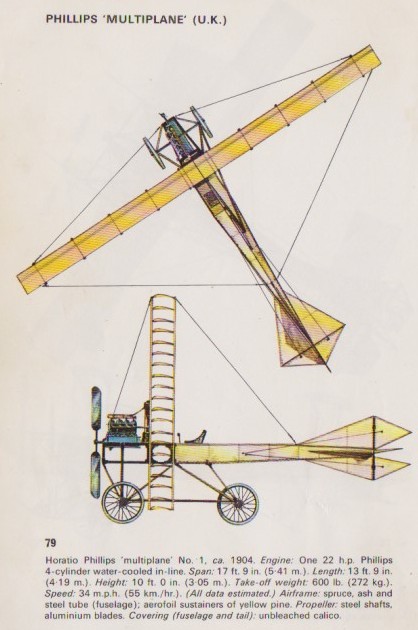
Philips Multiplane 1907

Engine: Phillips 4-cyl inline, water-cooled, 22 hp
Wingspan: 17 ft 9 in / 5.41 m
Length: 13 ft 9 in / 4.19 m
Height: 10 ft 0 in / 3.05 m
TO weight: 600 lb / 272 kg
Speed: 34 mph / 55 kph

Pfitzner Flyer / Curtiss Pfitzner Flyer

Since their success with the first recorded powered flight, the Wright Brothers had patented many of their methods and had sought to enforce their patents through the courts. Most if not all other manufacturers were keen to develop alternative techniques; Pfitzner avoided the Wrights’ method of warping the wings to achieve a lift differential between port and starboard wings by using wing extensions (or ‘compensators’). In his book “Monoplanes and Biplanes: Their Design, Construction and Operation” (1911), Grover Loening wrote “This aeroplane is a distinct departure from all other monoplanes in the placing of the motor, aviator, and rudders, and in the comparatively simple and efficient method of transverse control by sliding surfaces, applied here for the first time.”. The issue of patent protection was sufficiently in the public eye for The New York Times, in its issue of 16 January 1910, to headline Pfitzner’s design as an “Aeroplane Without Patent Drawbacks”. The same article refers to the “Wright suits” and their attempts to “build up their patent fences”; Pfitzner is quoted there as saying that “any one who wants to do so is welcome to use [his] panel invention without cost or fear of injunction”. Pfitzner designed his Flyer as a private project but it was constructed in the Curtiss factory.

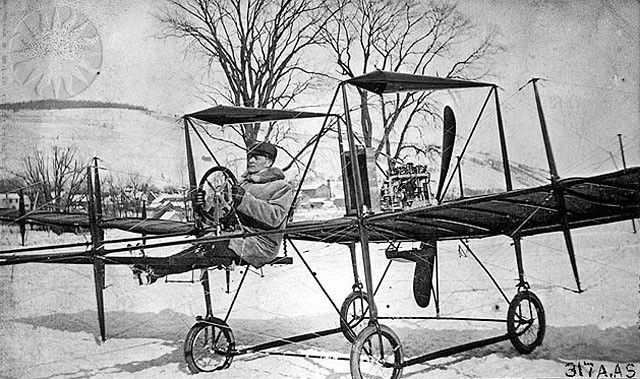
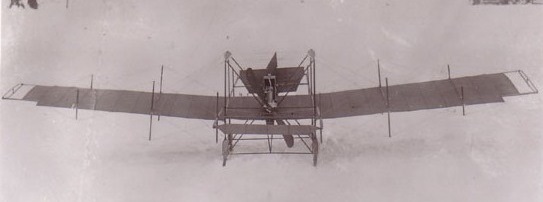
The Pfitzner Flyer was designed in 1909 by Alexander Pfitzner and built by the Curtiss company at Hammondsport, NY, where Pfitzner was employed at the time, a “designer of high-class gasoline motors, transmissions, and gears”. The Flyer was the first monoplane designed, built and flown in the United States. It incorporated several novel features, the most innovative of which was the method of achieving lateral control by means of reciprocating lateral (telescopic) wing extensions, which the pilot controlled via a steering wheel. Also unusual for a monoplane was the use of a pusher configuration, the engine also being mounted behind the pilot.

The aircraft consisted of a rectangular cuboid cross-braced central frame, onto which the main monoplane wing, the motor, the forward and rear booms and the ‘undercarriage’ (consisting of one wheel at each of the lower corners) were mounted. Between the upper front and rear posts of the frame were fitted two streamlined fuel tanks (clearly visible in the image above), one on each side of and above the pilot’s seat, with a combined capacity of six gallons (22.7 L.).

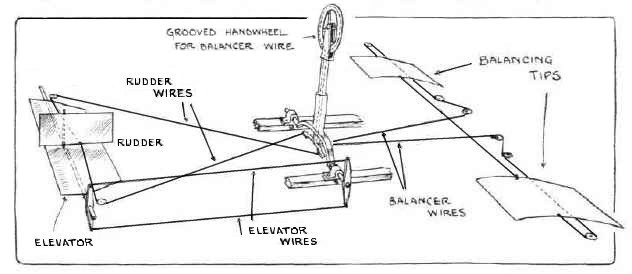
The pilot sat immediately forward of the wing and controlled the aircraft by a combination a movable column and a wheel mounted on that column. Pitch was controlled by fore and aft movement of the column, which, by means of wires, moved the elevator mounted at the forward end of the front boom. Yaw control was effected by twisting the column about its vertical axis (by means of pressure on the steering wheel), which turned the vertical rudder (mounted above the elevator) left or right. Lateral control was achieved by rotating the wheel: When the pilot turned the steering-wheel to port, the linkage retracted the port wingtip, at the same time extending the starboard extension by the same amount. Thus there was no need for a rudder bar (or pedals); the pilot’s feet were not used for controlling the aircraft. Also mounted on the control column was a throttle lever; a button on the wheel enabled “the Bosch high-tension magneto to be switched off for the purpose of switching off the engine”. There was a fixed tail-plane surface with an area of 10.5 sq.ft. (0.98 sq.m.) at the end of the rear boom to provide longitudinal stability.

The span of the main wing, which was set at an angle for incidence of 8°, was 31 ft., with a wingtip extension of 30 in (76 cm) on each wing, providing a constant wingspan of 33 ft. 6 in. (10.21 m). The wing was 6 ft. (1.8 m) wide; the extensible wingtips were 4 ft. 2 in. (1,27 m) wide, each providing a maximum of 10.5 sq. ft. (0.98 sq.m.) wing area. The wing extensions were of the same curvature as the main wing. “The main supporting plane at a 5-deg. dihedral angle consists of two main beams across which are placed spruce ribs. The surface is made of Baldwin vulcanized silk, of jet black colour, tacked to the top of the ribs and laced to the frame. The curvature of the surface is slight and is designed for high speed.” The wing ribs had a camber of 3.75 in. (9.05 cm) over 6 ft (1.8 m).

Each of the wings consists of three detachable sections, each 5 ft. (1.5 m.) long, which are supported by steel sockets and steel cable, the latter forming a symmetrical double king truss with the beams, fore and aft pairs of King posts being situated at the junctions of the sections.

Pfitzner himself, although an inexperienced flyer at the time, conducted initial test flights with his Flyer, the first taking place in early January 1910. Despite the presence of a light covering of snow at the time, it was reported that the Flyer had made a large number of short flights and that it required an average run of 100 ft. (30 m) to get airborne.

The aircraft was not a success, and a disappointed Pfitzner is thought to have committed suicide on 12 July 1910.

Following Pfitzner’s disappearance (and assumed suicide) in July, 1910, Horace K. Kearney took over the aircraft and demonstrated it at aero meets in the succeeding months, including in Boston, before the Pfitzner Flyer became little more than an interesting footnote in the history of aviation.

Powerplant: 1 × Curtiss 4-cyl., 25 hp (19 kW)
Propellers: 2-bladed, 6 ft (1.8 m) diameter
Wingspan: 33 ft 6 in (10.21 m) (The main span was 31 ft, with extensions providing additional 2 ft. 6 in.)
Wing area: 196.5 sq ft (18.26 sq.m) (Area of main wing: 186 sq. ft. (17.3 sq.m.); area of each wingtip extension 10.5 sq. ft.(0.98 sq.m.))
Aspect ratio: 5.17 : 1
Length: 30 ft (9.1 m)
Height: 7 ft (2.1 m)
Gross weight: 430 lb (195 kg) (Gross weight includes 6 gallons of petrol, 1 gallon of oil and 1.5 gallons of water.)
Max takeoff weight: 600 lb (272 kg)
Wing loading: 3.2 lb/sq ft (16 kg/sq.m)
Maximum speed: 42 mph (68 km/h; 36 kn)
Crew: 1

Pfitzner, Sándor (Alexander)

Pfitzner was born in 1880 in Csete, Hungary. He attended the Hungary University of Technology before joining the Hungarian Army, serving as a Lieutenant in an artillery regiment before immigrating to the United States in the early years of the 20th century.

Pfitzner worked for several automobile manufacturers before starting with the Curtiss Aeroplane and Motor Company. He designed and built the gasoline engine with which Curtiss won the overall speed event in 1909 Gordon Bennett Cup in Rheims, France.

Frustrated by the efforts of the Wright Brothers’ use of the courts to dominate the developing market for powered flight, Pfitzner designed his own aircraft, the Pfitzner Flyer, which avoided the Wrights’ method of warping the wings to achieve a lift differential between port and starboard wings by using wing extensions (or ‘compensators’). In his book “Monoplanes and Biplanes: Their Design, Construction and Operation” (1911), Grover Loening wrote “This aeroplane is a distinct departure from all other monoplanes in the placing of the motor, aviator, and rudders, and in the comparatively simple and efficient method of transverse control by sliding surfaces, applied here for the first time”. The issue of patent protection was sufficiently in the public eye for the “New York Times”, in its issue of 16 January 1910, to headline Pfitzner’s design as an “Aeroplane Without Patent Drawbacks”. The same article refers to the “Wright suits” and their attempts to “build up their patent fences”; Pfitzner is quoted there as saying that “any one who wants to do so is welcome to use [his] panel invention without cost or fear of injunction”.

The performance of his monoplane “Flyer” disappointed Pfitzner. In 1910 he joined the Burgess Company at Marblehead, Massachusetts, where he worked on the design of a biplane which also employed his sliding wing-tip principle. This aircraft was destroyed in a crash in 1910.

Pfitzner is reported to have been depressed by his lack of success; on July 12, 1910 he rowed out into Marblehead Harbour with a suitcase containing his drawings. The otherwise empty boat was found a few days later with his hat, coat and a recently used revolver, but Pfitzner’s body was never found.