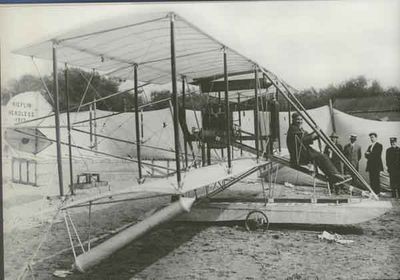
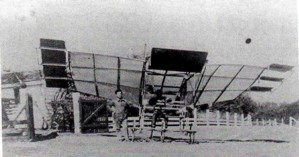
The Rieflin Headless Aeroplane Co Hydro-aeroplane of 1912 set a world’s record for sustained hydro-aeroplane flight over water when piloted by Fred C. Eels on June 25, 1912 over Irondequoit Bay, New York, seventy-three miles in 1:21:00, at an average speed of fifty-four miles per hour. Eells’ flight was cut short when his supply of gasoline gave out and he dropped his machine to the bay. The best previous record for sustained flight was forty-six miles.
Baldwin’s Aerial Rowboat proved a remunerative attraction, though a short-lived one: One night its hydrogen inexplicably ignited, destroying the craft.
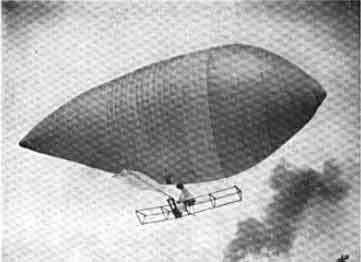
That didn’t deter Alva L. Reynolds from launching his own version at nearby Fiesta Park the same year. Thirty-four feet long and 14 feet in diameter, Man Angel had a four- by 10-foot wooden gondola, a 3,000-cubic-foot gas envelope, and a weight of only 18 pounds. Like Baldwin’s craft, it was propelled by oars.
The earliest of six neutral-buoyancy man-powered dirigibles designed and built by Alva L. Reynolds of Los Angeles, California, trials performed above Fiesta Park, Los Angeles, where the aerial rowboat was first flown by Herbert Burke on July 27, 1905.
Reynolds claimed that just about anyone could operate Man Angel. To prove it, he allowed 17-year-old Hazel Odell to take the helm. According to a reporter at the Los Angeles Herald Examiner:
“Miss Odell entered the car and…raised herself to 100 feet. After slight effort she was able to propel the airship in any direction and control its ascent and descent at will. When asked for her motive for performing the feat Miss Odell said: ‘Why should I not? Other people have done it and I was not afraid.’ ”
Reynolds built six Man Angels and leased them to fairs in Kansas, Arizona, and Texas. He also opened a flying school, where he gave twice-daily demonstrations.
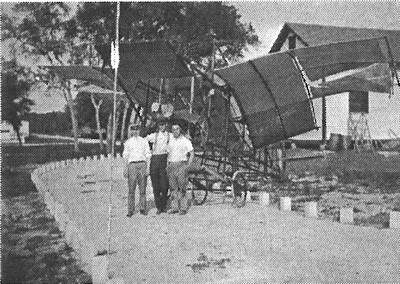
Man Angel No.2
The 1905 “Man Angel” hydrogen-filled balloon was 34 feet long and carried an 18 pound frame in which a man sat using ten foot long oars to row across the sky.
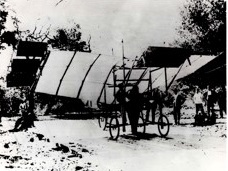
Man Angel No.2
The U.S. government investigated purchasing one.
That October, Reynolds challenged Baldwin to an airship race. When Baldwin’s pilot, the balloonist Roy Knabenshue, asked for $20,000 in expense money, Reynolds said Knabenshue was “afraid to race.” In 1906, to keep up interest (and revenue), Reynolds challenged an automobile to a 30-mile race from Chutes Park to Pomona. So confident was Reynolds that Man Angel No. 6 would win, he gave the Herald Examiner $1,000 to hold as prize money. On the day of the race, Man Angel faced such strong head winds it was handily beaten. In a subsequent race, the airship got caught on a telephone wire and crashed into a treetop.
Reynolds never raced Man Angel again. He returned to inventing, and found a method for generating electricity from ocean waves.
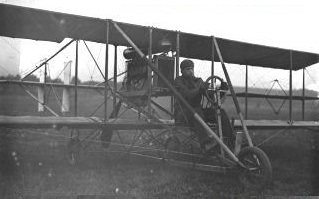
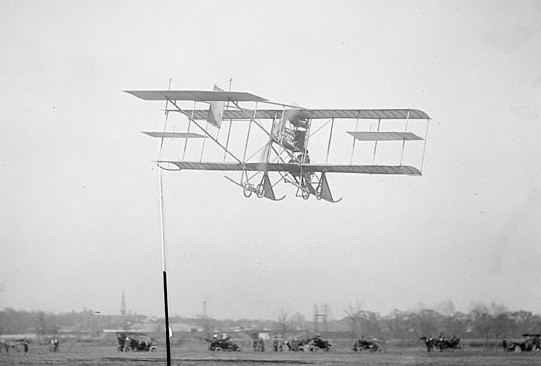
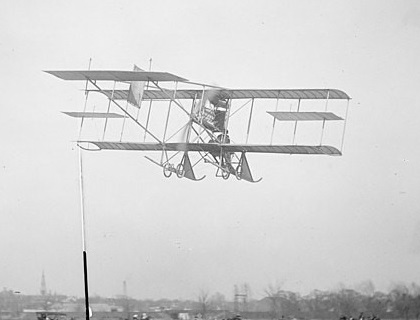
Designed by Rex Smith and Frederick Fox, the Rex Smith Biplane Curtiss-type first flew on 5 November 1910, piloted by R Smith. It was built and demonstrated at College Park, Maryland, at the same airfield that the Wright Brothers trained pilots using their aircraft for the U.S. Army Signal Corps just north of Washington, D.C.
This followed the initial demonstration at Fort Myer, Virginia, in 1908 and 1909, when the U.S. Army Signal Corps accepted the Wright Flyer in July 1909. Both the Wright Brothers and Curtiss continued to demonstrate their aircraft at the College Park Airport.
A two-place biplane powered by an Emerson marine engine pusher, it was used in Signal Corps experiments with wireless radio-telegraphy in April 1911, piloted by Antony Jannus.
Rex Smith Tony Jannus piloting
At a 1911 display in Washington, D.C., of the Smith biplane, a large crowd gathered to watch the motor started indoors, kicking dust throughout the building. On April 13, the biplane demonstrated wireless air-to-ground communications at College Park. On April 15, test pilot Tony Jannus attempted a take-off from the Potomac River with new pontoons attached to the landing skids. The plane plowed into the water, nearly drowning Jannus. By the end of the year, the aircraft had demonstrated 137 flights, including takeoffs and landings during snowstorms.
An aircraft was developed with an airfoil that tapered from four feet thick to nearly flat at the wingtips. The aircraft used wing warping tips rather than ailerons. It was tested with a Hall-Scott engine by test pilot Paul Peck. A Berliner Rotary was also considered for the design.
Rex Smith Biplane Powerplant: 1 × Emerson 2 cycle, six cylinder, 100 hp (75 kW) Propeller: 2-bladed Paragon, 9 ft (2.7 m) diameter Wingspan: 40 ft (12 m) span later reduced to 32 feet for speed Empty weight: 875 lb (397 kg) Capacity: 1-3
The founder of Rex Smith Aeroplane Company, Rex Smith (1862–1923), was an inventor and a patent attorney. He placed his offices in Washington D.C., and operations at College Park Airport, Maryland. The company was capitalized with $500,000 in 1910 with Victor J Evans as president and Rex Smith as Vice president.
(Rexford) Rex Smith Aeroplane Co, College Park MD. USA
In 1911, Rex Smith moved his hangar to line up with the Army Aviation School, and hired Frank Kastory from Anzani, and Abraham Whalomie Raygorodsky from Russia. He test flew Smith aircraft alongside Fox engine powered Curtiss aircraft. Rex also hired Tony Jannus, and Paul Peck as test pilots. In a stroke of coincidence, flying at the same airport at the same time was another military aviator, Paul W. Beck.
Rex Smith plane in flight
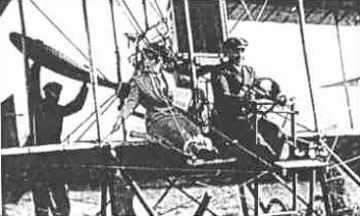
Two Rex Smith Biplane were built and used in the successful April 3, 1911 U.S. Army Signal Corps experiments in wireless communications. Potomac river pontoon experiments on April 5, were not as successful, with the aircraft plowing into the water headfirst nearly drowning the test pilot Jannus. Just two days later the machine was ready again. Janus took up actor Nat M. Wills, and later two female passengers at the same time. Marking the first time an aircraft flew with more than one passenger.
The Signal Corps did not buy any Smith Biplanes, they did however use them from time to time to train pilots to fly the Curtiss aircraft at the same field.
Operations continued until 1916 in building several other Curtiss-type biplanes.
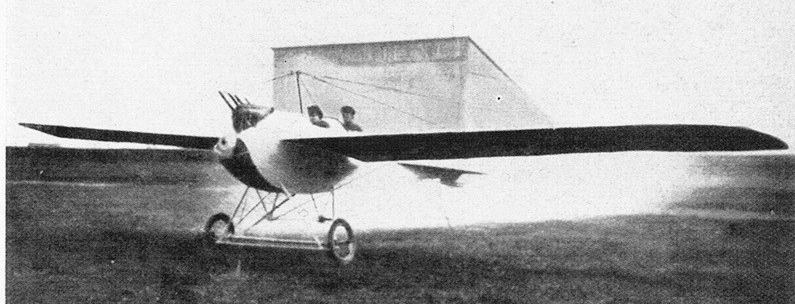
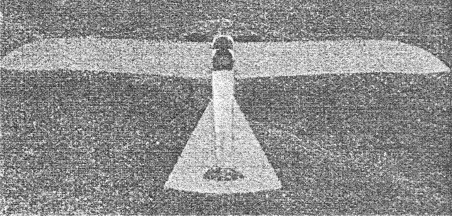
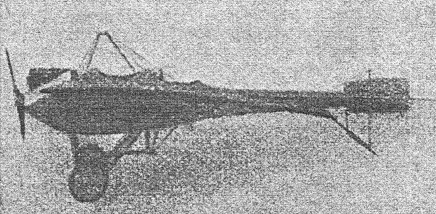
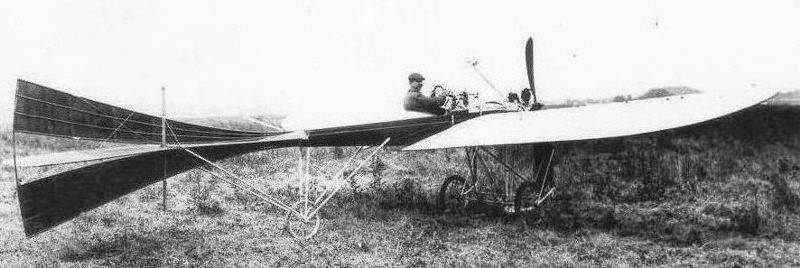
Requillard’s monoplane made its official appearance at Juvisy, France, in June 1910, flown by Marc Pourpe. The machine was very slender and streamlined, with long and triangular fixed tail surfaces, the rudder in two parts connected at the trailing edges to allow the elevator to move up and down between them. It was powered by a 50 hp Gnome. It was reported to have flipped onto its back on its first tests.
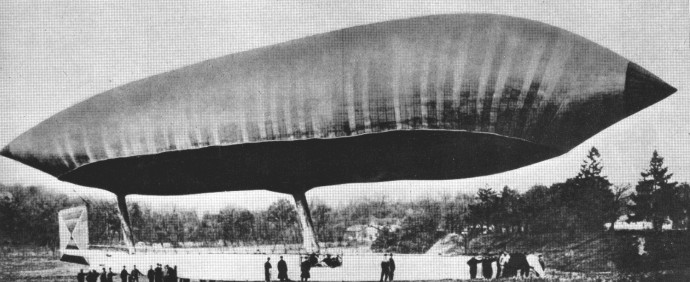
In 1884, under the direction of Renard and Krebs of the French army aeronautical establishment at Chalais Meudon, successful experiments were made employing electrical power with the airship La France.
At the French military balloon establishment at Chalais Meudon, in 1884, engineers Charles Renard and Captain A.C.Krebs designed and constructed the airship La France which was to prove capable of steady, navigable flight, and eas able to describe circular flights against the wind and return to its departure point.
La France, with a capacity of 66,000 cu.ft, was 165 ft long with a diameter of 28 ft, the envelope being made from Chinese varnished silk and of streamlined form. Below the envelope an enclosed car, 108 ft in length, contained a Gramme electric motor, developing 8.5-9 hp for a weight of 210 lb, together with the chromium-chloride batteries that drives a cloth covered tractor airscrew of 23 ft diameter. The battery weighed 435 kg.
The France was thirty-two feet in maximum diameter and nearly 200 feet long, the empennage planes aggregating about 400 square feet were placed forward of the stern.
Steering in the horizontal plane was effected by a large rectangular rudder at the stern, while vertical movement and attitude were controlled by a sliding weight mounted within the body of a car assistd by an ‘elevating rudder’.
In a series of trials the airship demonstrated controlled flight, achieved a speed of 14 mph and made several flights over Paris. The weight of the batteries, limited range and carrying capacity prevented further development.
The first trial of La France took place on 9 April 1884. The flight proving a limited success: making a circular flight of 5 miles in twenty-three minutes at a speed of around 12.5 mph in still air, then returning to its starting point, Chalais-Meudon – the first time this had ever been done. Six other flights were made during 1884-85, including two over Paris.
Chalais-Meudon Renard-Krebs “La France” Engine: 1 x Elektromoteur Gramme electric: 9 hp Batteries: Chromium chloride Contained volume: 65,695 cu.ft / 1860 cu.m Length: 165 ft / 50.0 m Width of hull: 27.887 ft / 8.5 m Height: 60 ft Gross lift: 2.0 ton Useful lift: 0.1 ton Max. speed: 13 mph / 11 kt / 20 km/h Crew: 3
In 1884, Charles Renard and Arthur Krebs, achieve the first closed circuit flight aboard the airship « La France » starting from Meudon, depot Y
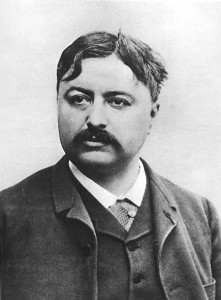
Charles Renard
Charles Renard was born at Damblain, Viosges, France, 23 November 1847. In 1873, he had developed an unmanned glider which was controlled by a pendulum device linked to its control surfaces. The glider was flown from a tower at Arras.
Renard also developed the powered Renard Road Train, in which the trailers were powered by drive shafts from the forward power car, and each car was steered through a system of linkages attached to the car ahead of it. He also developed the concept of preferred numbers.
Charles Renard remained in charge of the aeronautical establishment at Chalais-Meudon until his death. He committed suicide, 13 April 1905.
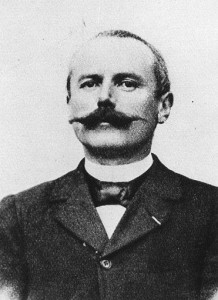
Arthur Constantin Krebs was born 16 November 1850 at Vesoul, France.
Arthur Constantin Krebs
Krebs was a prolific inventor. Following his work with La France, he completed the development of Gymnote (Q1), the world’s first all-electric submarine. His work on automobiles was extensive. He developed the concept of the front engine/rear wheel drive (Systeme Panhard); engine balancing; caster in the steering and suspension system, which allowed the steering wheels to self-center; the steering wheel; shock absorbers; four-wheel drive and four-wheel steering, etc. He invented the electric brake dynomometer which is used to measure power output of engines.



 All Aero