1913 Experimental
Engine: 1 x 140-h.p. Gnome
Speed: 91 mph
Seats: 2
1913 Experimental
Engine: 1 x 140-h.p. Gnome
Speed: 91 mph
Seats: 2
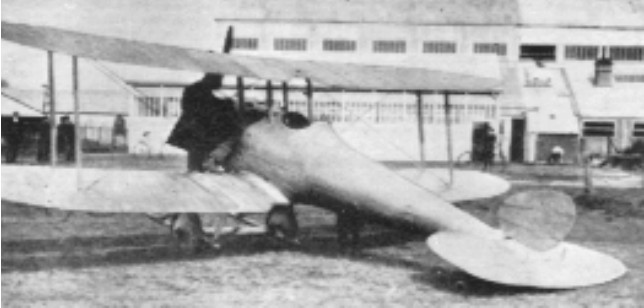
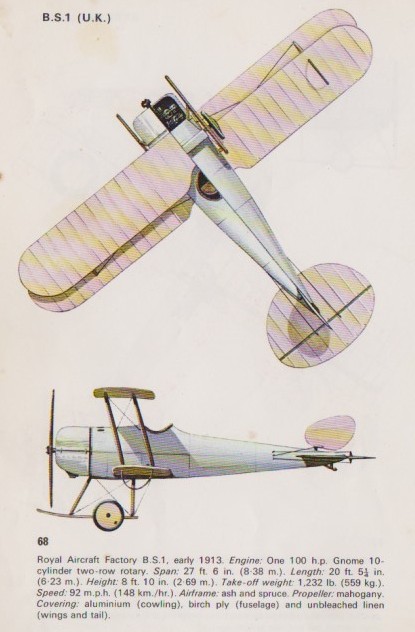
Designated as a “Bleriot Scout”, the B.S.1 was a single-bay equi-span biplane with a circular-section fuselage which was of monocoque construction aft of the single-seat cockpit. Power was provided by a partially-cowled 100hp Gnome rotary engine. The B.S.1 achieved 148km/h and a climb rate of 4.6m/s in early tests, but was badly damaged on 27 March 1913. It was then rebuilt, being redesignated S.E.2

Engine: 1 x 100-h.p. Gnome
Span: 27 ft 6in
Loaded wt: 1,230 lb
Speed: 92 mph
Seats: 1
1912 Experimental. Development of B.E.2
Engine: 1 x 80-h.p. Gnome
Seats: 2
1912 Experimental. Rotary-engined version of B.E.2
Engine: 1 x 50-h.p. Gnome
Span: 39 ft 6in
Seats: 2
The Royal Aircraft Factory (so named in April 1912) was responsible for the design and development of a number of warplanes during World War I. In accordance with the factory’s purpose they received designations combining a prefix letter (at first indicating the general configuration, but later the role) with E for experimental (although several, such as the B.E.2, F.E.2, R.E.8 and S.E.5, were to be built in large numbers).
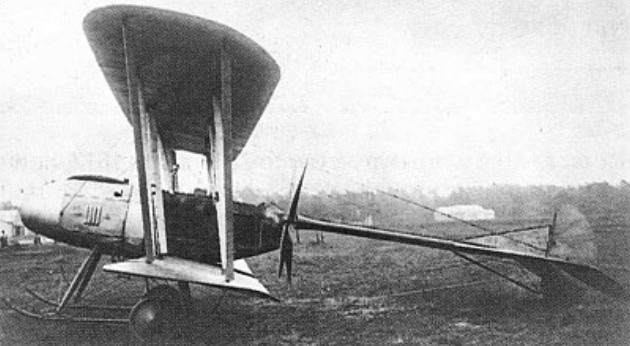
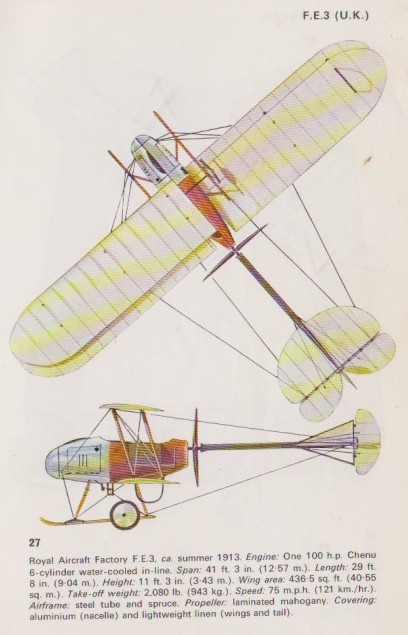
Built in 1913, the F.E.3 was thus the third design in the “Farman Experimental” series of pusher biplanes, and was designed to carry a COW one-pounder quick-firing gun. Alternatively known as the A.E.1 (“Armoured Experimental”), the two-seat F.E.3 was a two-bay biplane with overhanging upper wing, and a four-bladed pusher propeller driven by a shaft and chain from the 100hp Chenu eight-cylinder watercooled inline engine mounted in the front of the fuselage. The large cruciform tail unit was carried on a single central boom secured through the hollow propeller shaft and braced by wires to the upper wing and the undercarriage. Flight tests showed that the tail attachment was not sufficiently rigid and the gun, fitted in front of the fuselage, was fired only in static tests at Farnborough after flight testing was abandoned.
The F.E.3 used fabric-covered wooden construction for the wings and tail unit, but the fuselage nacelle was of steel tube construction with aluminium and plywood skinning. A large central orifice in the nose took in air for the engine radiators, which were inside the nacelle.
Engine: 1 x 100-h.p. Chenu
Max take-off weight: 943 kg / 2079 lb
Empty weight: 635 kg / 1400 lb
Wingspan: 12.19. m / 40 ft 0 in
Length: 8.91 m / 29 ft 3 in
Height: 3.43 m / 11 ft 3 in
Wing area: 40.55 sq.m / 436.48 sq ft
Max. speed: 121 km/h / 75 mph
Ceiling: 1525 m / 5000 ft
Seats: 2
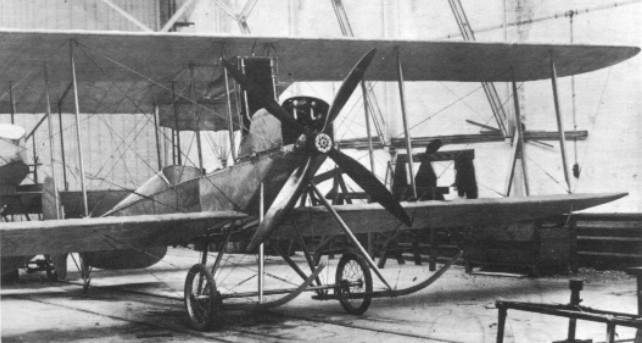
In April 1911 a Voisin biplane, came to Farnborough ostensibly for repair. Reconstructed from the crashed Duke of Westminster’s Voisin pusher biplane, it emerged as the B.E.1 (Bleriot Experimental No.1) tractor biplane, designed by F. M. Green and de Havilland.
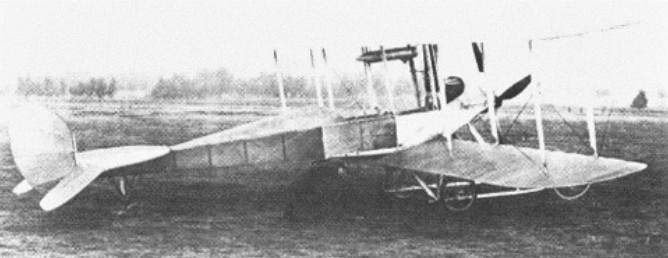
The BE.1 first flew on New Year’s Day 1912.
The B.E.1 was recipient of the first official airworthiness certificate awarded in the UK.
Engine: 1 x 60-h.p. Wolseley, later 60-h.p Renault
Wingspan: upper-11.79 m / 39 ft 8 in, lower-34’11.5″
Length: 9.02 m / 30 ft 7 in
Weight all-up: 1700 lb
Max. speed: 95 km/h / 59 mph
Seats: 2


The Balloon Factory, under the direction of Mervyn O’Gorman, was authorized only to repair a crashed experimental 60 h.p. E.N.V. Bleriot monoplane. In seeking authorization to carry out repair work, he asked that it cover reconstruction as well, and when this was granted the Factory at last had the all clear they wanted to exercise the ideas of their own designers. So far as the Bleriot was concerned, all that remained of it by the time that Green and de Havilland had finished with it was the 60 h.p. E.N.V. engine. By the time the “repair” work was finished it had turned into a tail first biplane classified S.E.1 – the “S” standing for Santos Dumont, in deference to the inventor of the tail first formula. (As the S.E.1 was the only tail first type built by the Factory, the letters S.E. were later taken to mean Scout Experimental.).
Engine: 1 x 60-h.p. E.N.V., “F”
Span: upper 38ft 0in, lower 36 ft
Length: 40′
Loaded wt: 1,200 lb
Seats: 1
Known originally as the Royal Aircraft Factory, Farnborough, under the direction of Mervyn O’Gorman, was authorized only to repair a crashed experimental 60 h.p. E.N.V. Bleriot monoplane. By the time the “repair” work was finished it had turned into a tail first biplane classified S.E.1 – the “S” standing for Santos Dumont, in deference to the inventor of the tail first formula. (As the S.E.1 was the only tail first type built by the Factory, the letters S.E. were later taken to mean Scout Experimental.) Faced with a fait accompli, the War Office wound up the Balloon Section R.E. on April 1st, 1911, and replaced it by the Air Battalion; three weeks later they renamed the Balloon Factory the Army Aircraft Factory. One of the Factory’s first jobs was to “repair” the Duke of Westminster’s Voisin pusher biplane, which emerged as the B.E.1 (Bleriot Experimental No. 1) tractor biplane, designed by F. M. Green and “D.H.”
At the same time, it was decided to inaugurate the designations R.E. (Reconnaissance Experimental, two seat tractor biplane), T.E. (Tatin Experimental monoplane with pusher propeller at tail), and B.S. (Bleriot single seat Scout) for future use.
Was involved in dirigible construction and repair before First World War. It was renamed Royal Aircraft Establishment during the war and initiated biplane designs for the Royal Flying Corps, including the B.E.2 and F.E.2 series, F.E.8, R.E.8, and finally the S.E.5 fighter.

The 1910 “Mosquito”, a minimalist high-wing monoplane with flat airfoil and 4×4-looking fuselage was built by Roger Roy of Thouars, France. It was powered by a V-2 engine, probably a Buchet. Little is known of this machine, which doesn’t look very airworthy and probably never flew.
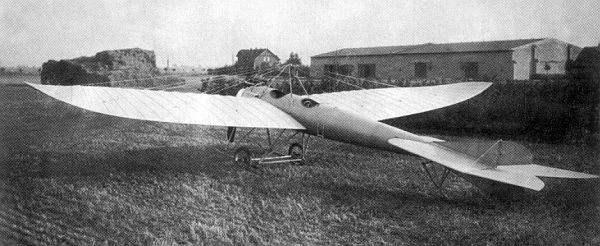
Hans Röver in 1912 built the Röver Monoplane with circular body covered with glue-laminated fabric for what Ernst Röver, his father, was granted German Patent Nr. 271112.
This monoplane was entered into meets in Johannisthal twice that year, with only minor success.
In 1913 Hans Röver rented a shed at Johannisthal, built a second monoplane, and trained pilots until August 1, 1914. Afterwards he flew for the navy and did not return from a reconnaissance mission in 1917.
 All Aero