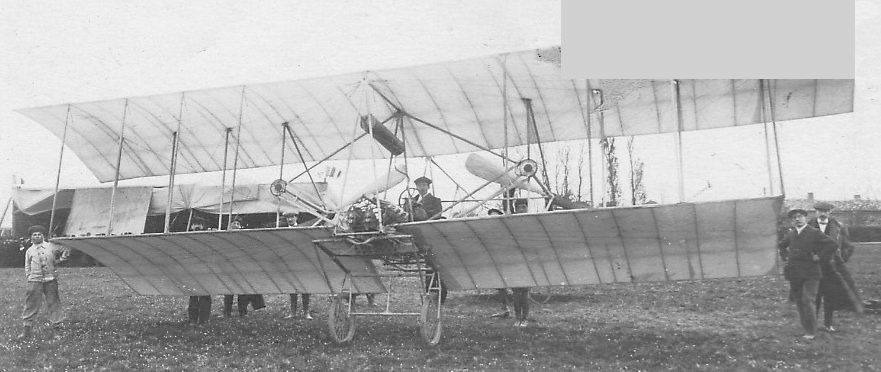
Rozé, Perret et Chaffal 1910 biplane

The Roze, Perret, et Chaffal biplane was a large overhung biplane that might have been designed by Francois Denhaut and was made partly of steel tubing. It had a single trapezoidal tailplane aft only and no apparent vertical surfaces. The arrangement of the two pusher propellers was similar to that on the Wright. It was damaged in 1909 at Poitiers, and probably rebuilt into the photographed configuration, which was tested at Poitiers, France, in May 1910.

Roze Aviateur

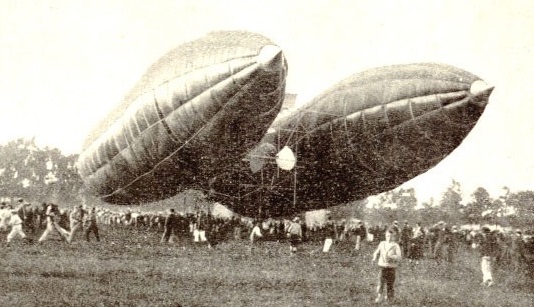
The “Aviateur”, as designed and built by Louis-Étienne Roze. Recognizable due to the catamaran configuration of the rigid airship hulls. The Aviateur was a putative challenger for the Deutsch de la Meurthe prize, eventually won by Santos-Dumont using his No. 6 dirigible – but when tested in 1901, it failed to fly.

Trials took place on the 5th and 6th of September 1901. Miscalculations by M.Roze meant the airship was too heavy and managed to lift only fifteen feet, then coming down and landing softly. At 10 hp each, the two Santos-Dumont (Buchet) motors were too weak. The inherent problem with the motors was that they served the lifting propellors, which in turn had to be switched over to the propulsion/push propellors to move forward. Thus , no forward flight and the silk “wings” remained vertical, not closing to the horizontal.

As Roze had no further financial means to build the Aviateur larger nothing was ever heard of his airship again.

Royal Aircraft Factory Eta

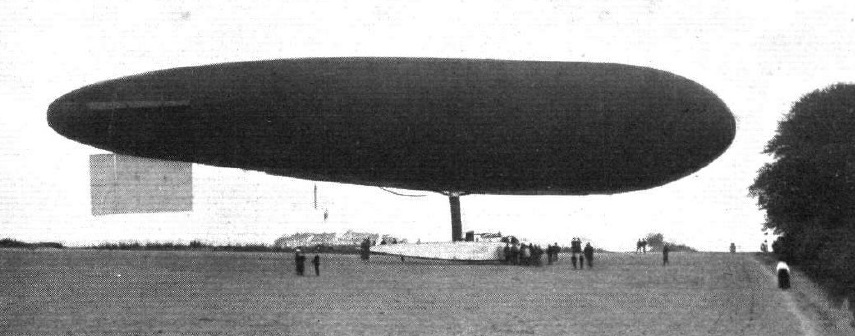
The “Eta” which in a progressive series of small experimental airships built at the Royal Aircraft Factory. The small airships that have been built there were quite inadequate from the standpoint of national requirements.

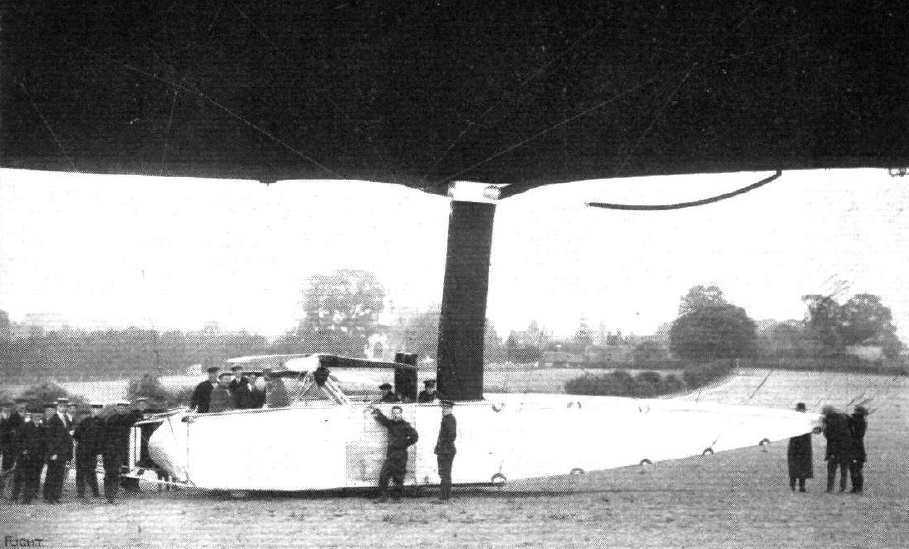
The capacity of the 1913 “Eta” is 100,000 cubic ft, and.it carried 160 hp in two radial stationary Canton-Unne engines, set on opposite sides of the car with their axes placed transversely. Oblique shafts transmit the power to gearing, supported by an overhead framework, which also carries the swivelling propellers. As the airship ascends, these propellers are swivelled round, so that ultimately their axes are horizontal for full speed ahead. In order to stop the airship they can be turned completely round so as to thrust backwards, and they can similarly be used for lowering the airship for the purposes of descent.

Launched in August 1913, the Eta was a non-rigid of 118,000 cu.ft incorporating twin ballonets and capable of 46 mph. The Eta introduced the ‘Eta patch’ in its design as an improved anchorage system for car suspension that greatly reduced drag. The Eta patch allowed the car to be made smaller and attached nearer to the envelope, providing a better streamlined form and reducing drag. The patch consisted of a steel ring through which several layer of overlapping material were rove, forming a fan-shaped patch with the ring positioned at the lower apex. The overlapping layers of fabric were glued and stitched to each other and to the envelope, forming a strong attachment position allowing fr better distribution of load.

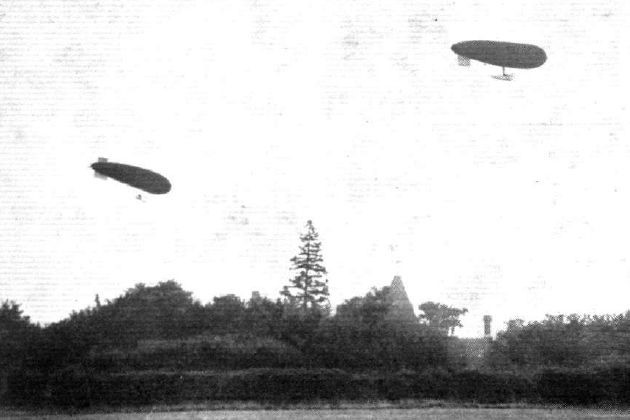
On August 19, 1913, “Naval Airship No.2” (the re-constructed “Willows No.4” – under the command of Lieut. Neville Usborne, R.N.) experienced engine failure due to a broken crankshaft near Odiham in Hampshire. In order to save the hydrogen in the disabled airship, it was decided to try and tow it home employing the airship “Eta” – newly-constructed by the Royal Aircraft Factory and currently undergoing its acceptance trials. Accordingly, a tow-line was attached and the two airships ascended, the “Eta” keeping about 600 feet above the towed ship so as to avoid all chances of fouling the rudder gear. The approximate 8-mile trip back to the airfield at Farnborough was made at a groundspeed of 25 mph against a 5 mph headwind. The “Eta” was in all probability skippered by Army Capt. Waterlow at the time.
Royal Aircraft Factory RAF 2

The RAF 2 was a British air-cooled, nine-cylinder radial engine developed for aircraft use just prior to World War I. It was designed and built by the Royal Aircraft Factory, and first run in October 1913.

Applications:
Royal Aircraft Factory B.E.8

Specifications:
RAF 2
Type: 9-cylinder, single-row, radial engine
Bore: 3.94 in (100 mm)
Stroke: 5.51 in (140 mm)
Displacement: 604.6 cu in (9.9 L)
Valvetrain: Poppet valve
Cooling system: Air-cooled
Reduction gear: 0.563:1, geared epicyclic, right-hand tractor
Power output: 120 hp (90 kW)
Specific power: 0.2 hp/cu in (9.2 kW/L)

Royal Aircraft Factory BS.2 / SE.2

SE.2a

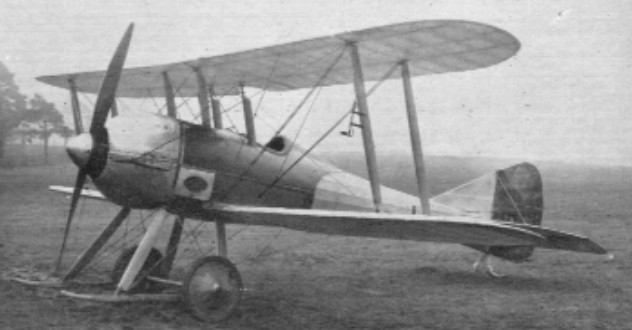
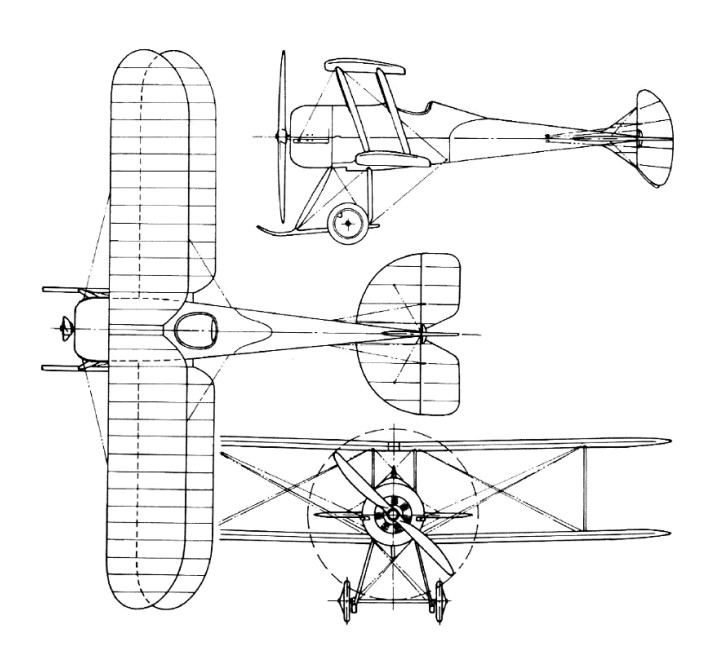
The S.E.2 was a rebuild of the unarmed B.S.1, which was designed at Farnborough by Geoffrey de Havilland assisted by H P Folland and S J Waters, and flown in early 1913. Designated as a “Bleriot Scout”, the B.S.1 was a single-bay equi-span biplane with a circular-section fuselage which was of monocoque construction aft of the single-seat cockpit. Power was provided by a partially-cowled 100hp Gnome rotary engine. The B.S.1 achieved 148km/h and a climb rate of 4.6m/s in early tests, but was badly damaged on 27 March 1913. It was then rebuilt with a redesigned tail unit that included a semicircular tailplane with a lifting profile, divided elevators, a small fin and large rudder. With a fully-cowled 80hp Gnome nine-cylinder rotary engine, the aircraft flew again in October 1913, being redesignated S.E.2 as a Scouting Experimental (although the S.E. series had earlier been intended for “Santos Experimental”, of canard configuration).

RFC handling trials took place (with No 5 Squadron) early in 1914, after which the S.E.2 was again rebuilt, with a more conventional rear fuselage of wooden construction and fabric covering, larger fin and rudder, constant-chord tailplane and other smaller changes. Taken to France (by No 3 Squadron) later in 1914, the S.E.2 was fitted with two Army rifles firing at outward angles to clear the propeller, and other (revolver) armament was also tried during the several months it remained with the squadron.

BS.2 / SE.2
Engine: 1 x 80-h.p. Gnome
Span: 27ft 6in
Length: 6.22 m / 20 ft 5 in
Height: 2.83 m / 9 ft 3 in
Wing area: 17.47 sq.m / 188.05 sq ft
Loaded wt: 1,150 lb
Empty weight: 327 kg / 721 lb
Max. speed: 137 km/h / 85 mph
Seats: 1

SE.2a
Engine: 1 x 80-h.p. Gnome
Span: 27ft 6in
Loaded wt: 1,200 lb
Speed: 96 mph
Seats: 1

Royal Aircraft Factory S.E.2

Royal Aircraft Factory RE.1

In 1912 Edward Teshmaker Busk was taken on to study problems of aeroplane stability. The Factory’s Assistant Superintendent, Lieutenant Ridge, had been killed the previous summer in the SE.1, in what was probably one of the first recorded cases of spinning, and it was to this problem particularly that Busk devoted his talents. The first aeroplane to incorporate his findings was the RE.1, which appeared in the autumn of 1913, and lessons learnt from evaluating the RE.1 were built into nearly two thousand B.E.2c fighters produced in the war years ahead.

Two built.

Engine: 1 x 70-h.p. Renault
Span: 34′
Weight allup: 1580 lb
Speed: 78 mph
Seats: 2