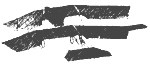
In 1913 New Zealand, the homebuilt Howard Wright biplane constructed by the Walsh brothers was later modified by Fredrik Sandford and William Miller as the Miller Sandford biplane.
In 1913 New Zealand, the homebuilt Howard Wright biplane constructed by the Walsh brothers was later modified by Fredrik Sandford and William Miller as the Miller Sandford biplane.
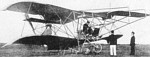
The 1909 Sanders No. 1 biplane was designed by Capt.H.A. Sanders and built by London Aeroplanes and Navigation Co. in the UK.
Span: 50′
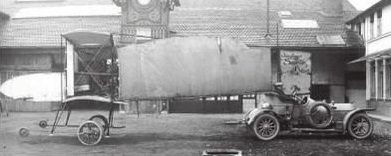
The Sanchez-Besa Demountable Biplane (Type Militaire) was a variant of Jose Luis Sanchez-Besa’s Renault powered 1912 biplane, identified as his third design.
Purportedly Salmson powered with slightly different dimensions. The tow vehicle is a 1910 model Delage type French roadster.
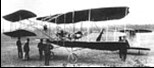
The 1909 Sanchis was designed and built by Sanchis in France
Span: 39’4″
Length: 37’9″
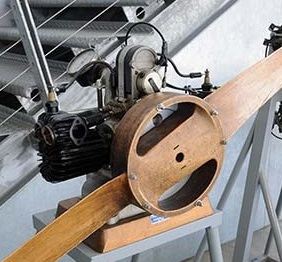
After their successful water-cooled radial engines, developed from 1908 to 1918, Salmson changed their focus to air-cooling to reduce weight and increase specific power (power per unit weight). The majority of the engines produced by Salmson were of radial type with a few other arrangements such as the Salmson T6.E. In common with other engines produced by this manufacturer, the air-cooled radial engines featured the unorthodox Canton-Unné internal arrangement that dispensed with a master rod in favour of a cage of epicyclic gears driving the crankpin. Built from 1920, production ended in 1951 with the liquidation of the manufacturing company.
The 3,7 and 9 cylinder Salmsons were license built in Great Britain, during the 1920s and 1930s, by the British Salmson engine company as the British Salmson AD.3, British Salmson AC.7, British Salmson AC.9, and British Salmson AD.9.
In common with several other French aero-engine manufacturers Salmson named their engines with the number of cylinders then a series letter in capitals followed by variant letters in lower-case.
3 Ad
Founded 1912 at Billancourt, Seine, by Emile Salmson (1859-1917) to develop radial type watercooled engines jointly designed by Canton and Unne as installed in French, British and Russian aircraft. In late 1915 Salmson turned to airplane construction. First was unorthodox Salmson- Moineau SM-1 of 1916, designed by Rene Moineau, with “buried” engine and twin tractor propellers. The Type 2 conventional two-seat reconnaissance tractor biplane was tested early 1917, with Salmson (Canton-Unne) engine. As the 2A2 it served with French and U.S. squadrons and 2,300 were built. At Armistice 2A2 converted to Limousine, used by several European airlines. In mid-1930s Salmson turned to light aircraft, producing D6 Cricri parasol monoplane with small Salmson air-cooled radial engine.
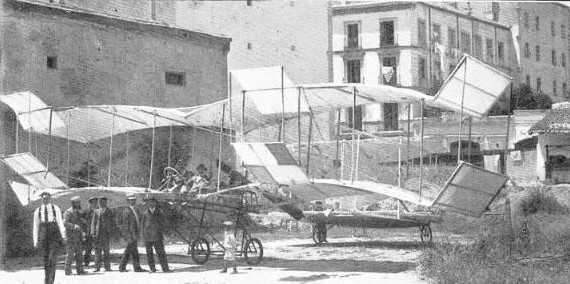
This Anzani-powered pusher biplane was designed and built by the two brothers Carlos and Fernando de Salamanca of Barcelona. The brothers designed, built and tested their pusher biplane in Carabanchel, a southwestern suburb of Madrid, on July 1, 1909.
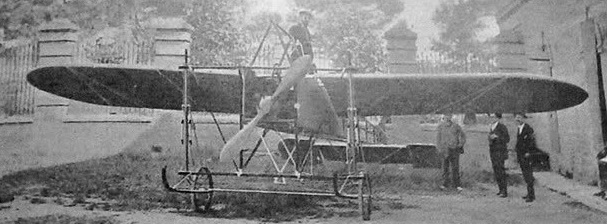
In 1910, mechanic-electrician of the Carcel Modelo de Valencia, Arturo Salvador Gómez, designed and constructed a monoplane at Valencia, Spain, completing the craft in 1911.
The airplane was presented in public on the occasion of the Valencia-Alicante-Valencia aerial raid and subsequent Aviation Festival held at the airfield of La Malvarrosa Beach from 29 to 31 July.
Lacking the engine, the plane was bought by the Aragonese pilot Gregorio Campaña, who had broken his own design plane by falling into the water during the Raid. Campaña intended to equip the Salvador monoplane with the 50 hp Anzani engine from its shattered plane. On August 6, 1911, Campaña departed from Valencia in the direction of Huesca taking with him the plane of Salvador and the remains of his own.
He arrived in Huesca on 9 August and flew on 11 and 12 August. It is not know if the flights made were with the airplane of Salvador with the Anzani engine or if he repaired his own airplane.
Wingspan: 8.9 m
Length: 9 m
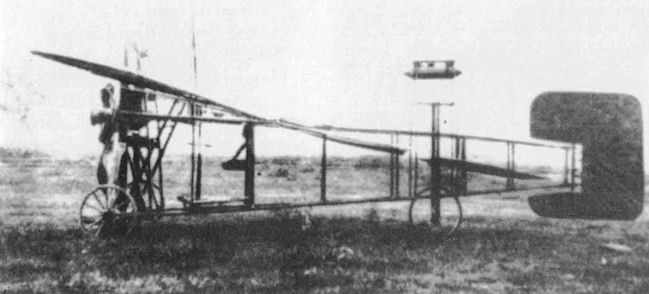
Sotoichi Saito of Tsuruoka City, Yamagata Prefecture, had been involved in the development of balloon flight since 1889. In 1910 he bought a 50hp Gnome engine from France so that he could study aero-engines. He later acquired a patent for a ‘Flying Machine’ and manufactured an aircraft resembling a Bleriot monoplane. Helping with this project was Shotaro Ueda. Single-engine monoplane. Wooden structure with fabric-covered wing and uncovered fuselage structure.
The aeroplane contained some rather innovative features. For protection against inflight fire, the fuel tank was installed on struts high above the rear fuselage at a considerable distance from the engine. Another feature was that in the event of an inflight emergency, a cable could be pulled, causing the fuselage and engine to separate from the wings leaving the pilot still seated on the wing section which was to act as a parachute.
Saito named his aeroplane the Saigai, an acronym derived from his own name. In june 1912 he tested the aeroplane on the dry bed of the Akagawa River in Tsuruoka City. The aeroplane, piloted by Suketaro Koya, was put on a special railway track for take off. Koya was probably selected because of his engine experience in operating the Mogami Maru river boat. Soon after becoming airborne, Koya felt that further flight would be risky and pulled the emergency cord, thus destroying the aeroplane. The Gnome engine was salvaged and installed in the Tamai 3 Aeroplane in 1917, in which the pilot, Seitaro Tamai, was killed. The engine then passed to Shigesaburo Torigai, and still later was installed in the Tsurubane No.2 Aeroplane of Otojiro Itoh, which made the first loop by a Japanese civil aeroplane when piloted by Toyotaro Yamagata in 1918.
Engine: 50hp Gnome
Propeller: two-blade wood
Span: 10.30m (33ft 9 1/2in)
Length: 9.10m (29ft 10 1/4in)
Loaded weight: 560kg (1,234Ib)

On September 24, 1810, James Sadler and local chemist William Clayfield took off from Bristol in their hydrogen-filled balloon. At first the intrepid balloonists flew towards Leigh Down, where they proceeded to parachute a small basket containing a cat down to earth. Fortunately the cat, who was subsequently named ‘Balloon’ by the local doctor, seems to not to have suffered from the ordeal. The balloon continued on its flight passing over Clevedon before crossing the Bristol Channel towards Barry in South Wales where, fearing they would not make land before ditching in the sea, the men threw as much as they could out of the basket – including Mr Sadler’s hat. The balloon drifted down the channel before landing on the sea about four miles off Combe Martin. Both men were then rescued by lifeboat.
 All Aero