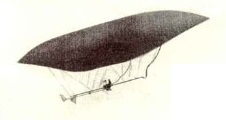
Santos-Dumont No.4
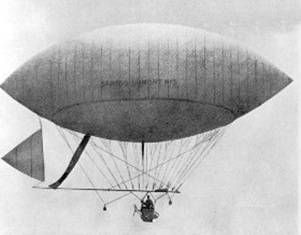
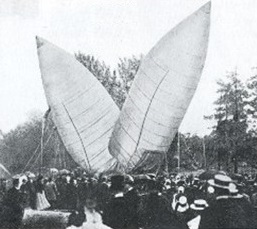
The second balloon of Alberto Santos-Dumont, “America,” had 500 cu.m of capacity and gave Santos Dumont the Aero Club of Paris’ award for the study of atmospheric currents. Twelve balloons participated in this competition but “America” reached a greater altitude and remained in the air for 22 hours.
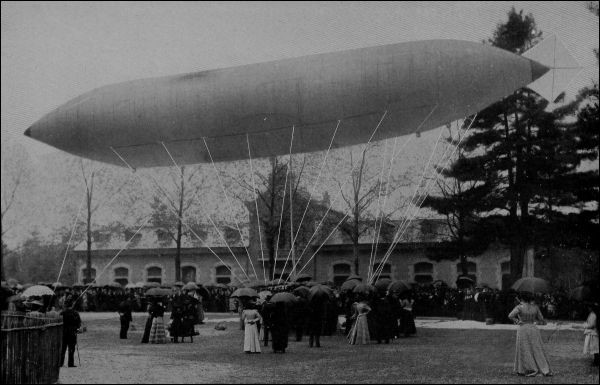
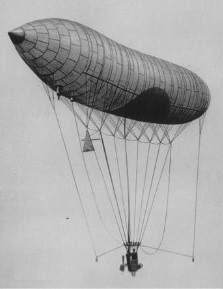
The first dirigible was 25 m (8½ ft) long and contained 180 cubic metres (6400 cubic feet) of hydrogen gas beneath which he suspended a 3½ hp petrol engine, called “Brazil”. On 18 September 1898 he took off from the jardin d’acclimatisation in the Bois de Boulogne and promptly ended up in a clump of trees. Know-all bystanders had advised him to take-off downwind. Two days later he was back, this time rising effortlessly into wind to complete a figure of eight 400 m (1300 ft) above an astonished, cheering crowd. ‘Le Petit Santos’ — for he weighed just 49 kg (108 lb) — was an instant hero.
The son of a wealthy Brazilian coffee-planter, Alberto Santos Dumont was born on July 20th, 1873, in the village of Cabangu, State of Minas Gerais, Brazil. At the age of 18, his father sent Santos Dumont to Paris where he devoted his time to the studies of chemistry, physics, astronomy and mechanics. He had a dream and an objective: to fly. In 1898, Santos-Dumont went up in his first balloon. It was round and unusually small and he called it Brésil (Brazil).
His first dirigible was 25 m (8½ ft) long and contained 180 cubic metres (6400 cubic feet) of hydrogen gas beneath which he suspended a 3½ hp petrol engine. On 18 September 1898 he took off from the jardin d’acclimatisation in the Bois de Boulogne and promptly ended up in a clump of trees. Know-all bystanders had advised him to take-off downwind. Two days later he was back, this time rising effortlessly into wind to complete a figure of eight 400 m (1300 ft) above an astonished, cheering crowd. ‘Le Petit Santos’ — for he weighed just 49 kg (108 lb) — was an instant hero.
Santos embarked on an ambitious de¬velopment programme after this modest triumph, and soon became a familiar sight puttering over the Paris suburb of Neuilly-¬Saint James on his latest dirigible. In the summer of 1901 he made two attempts to win a 125,000-franc prize offered by Henri Deutsche de la Meurthe for a flight from the parc d’aerostation at St Cloud to the Eiffel Tower and back, a distance of about 12 km (4 miles), in half an hour. The first began on 13 July. With a following wind Santos’s No. 5 dirigible was soon rounding the Eiffel Tower, but on his return trip the little air¬ship could make no headway, the time limit elapsed and the engine stopped. Santos valved off hydrogen and settled into a large chestnut tree in the grounds of Edmund de Rothschild’s house. During his second attempt, on 8 August, Santos again circled the Eiffel Tower but was foiled on the way back, crashing noisily and explosively on to the roof of an hotel at Trocadéro. Shaken and singed he climbed through an attic window and was held by the manager on suspicion of cat burglary.
Another dirigible was hastily constructed to replace the wrecked No. 5, and on 19 October 1901 Santos just succeeded in making the round trip within the specified 30 minutes. Typically philanthropic, he divided the prize between his workers and the Parisian poor, keeping not a centime for himself. Santos built 14 airships in all, of which his diminutive No. 9 was the best-known and most successful. On this personal runabout he challenged a friend’s after-dinner remark that his dirigibles were no more than ‘scientific curiosities’ by flying right into the heart of Paris, landing in the Avenue des Champs-Elysées and mooring it on the railings of his house on the corner of Rue Washington while he went inside for coffee. Thereafter Parisians became quite blasé about the sight of No. 9 parked outside fashionable restaurants or in the grounds of the country houses of Santos’s many friends.
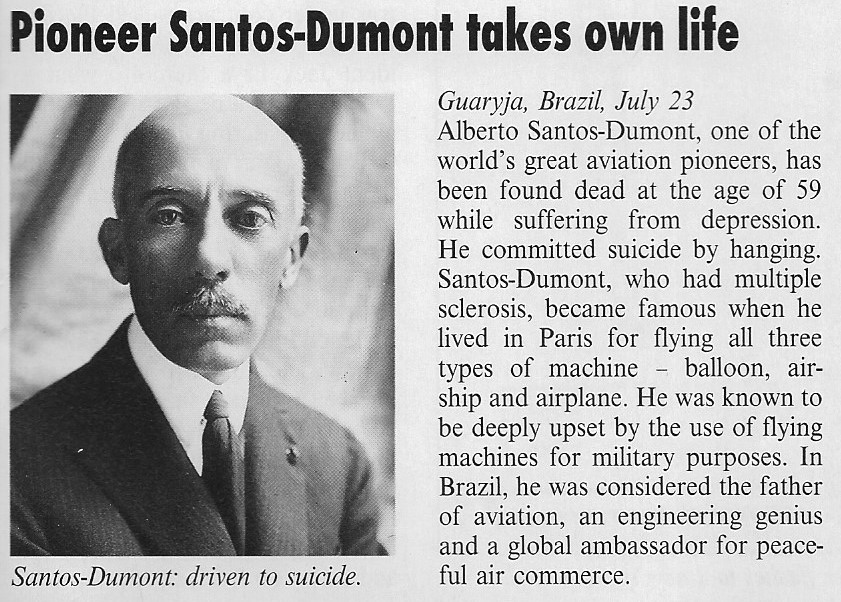
Dumont retired from his aeronautical activities in 1910. Alberto Santos Dumont, seriously ill and disappointed, it is said, over the use of aircraft in warfare, committed suicide in the city of Guarujá in São Paulo on July 23, 1932.
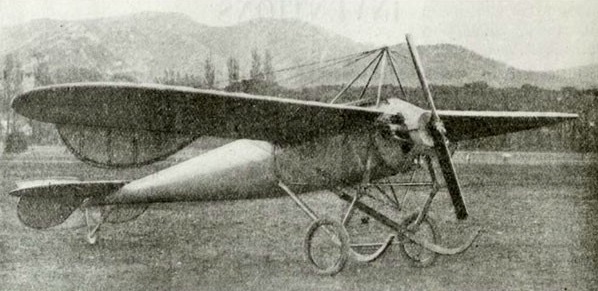
The Italian engineer M. Santo of Marseilles. France, designed this monoplane. Its streamlined circular cross section hull was made of wood covered with tarred fabric and was stated to be absolutely waterproof, allowing it to float indefinitely in the event of a fall to the sea. The fuselage of 7 meters length rested on a patented landing gear. The wing area was 16 square meters. The empennage of this aircraft was with two small surfaces on each side of the rear fuselage that provided lateral and longitudinal stability at the same time. Instead of being hinged, the surfaces rotated about an axis in the fuselage parallel with the direction of travel; they lowered or rose “like the wings of a bird”, depending on whether the pilot wants to descend or climb. They could also tilt to the right or left to restore the lateral balance, or to turn the device. It was intended for an 80 hp Anzani engine, but the photo shows a Dutheil & Chalmers engine giving only 18 hp.
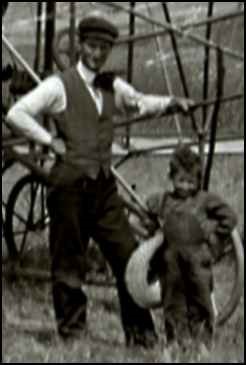
Apparently Walsh built a Macomber powered open cockpit biplane that he eventually modified with three seats in order to carry his wife and young son on publicity flights in the Los Angeles area. Around that time there was a similar craft ordered by San Diego sportsman Harry Harkness, designed by Walsh and built by the Eaton Brothers in Los Angeles, which might have been the same plane.
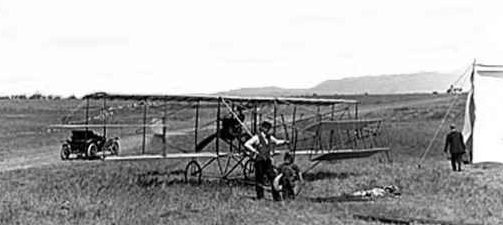
The second San Diego Aeroplane Mfg Co aircraft of 1910 was based on the prevailing Curtiss design. A single place, open cockpit biplane powered by a 25hp Cameron engine, Walsh succeeded in making two flights on 3 April 1910, and, with several design modifications and an Elbridge motor, continued exhibition and competition flights in Southern California into 1911.
A similar craft, with a Hall-Scott motor, was used by Walsh for exhibition work throughout the nation in 1911-12, but he was known to have also used Curtiss-built planes, while a member of the Curtiss Exhibition Co team.
The first San Diego Aeroplane Mfg Co aircraft of 1910 was a Cameron automobile motor powered single place, open-cockpit, mid-wing monoplane, based on the smaller Blériot XI.
Walsh tried several times to get airborne on 23 Januaray 1910, but finally crashed into a fence on a take-off run, and the plane was damaged beyond economical repair. The major claim was being the first powered airplane built in San Diego.
Wingspan: 50’0″
Length: 40’0″
Seats: 1
Founded by Charles Francis Walsh, San Diego CA.USA, in 1909.
Operated 1909-11.
Walsh was killed when a wing collapsed during a demonstration flight at Trenton NJ on 23 October 1912.
 All Aero