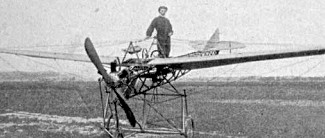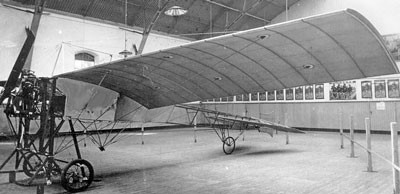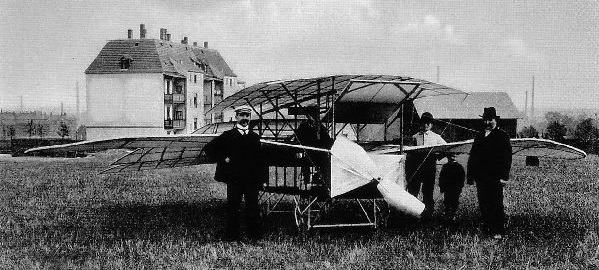
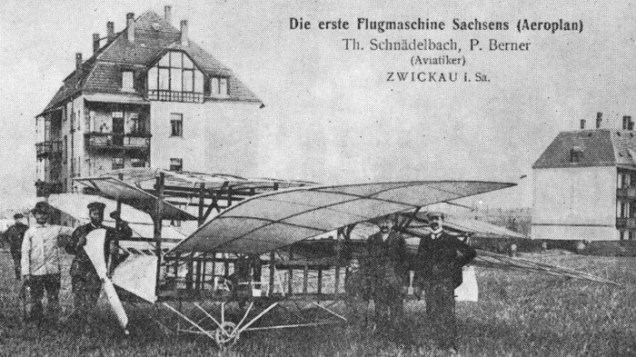
Schnädelbach-Berner 1909 Flugmaschine

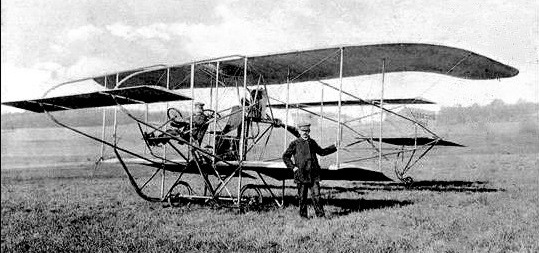
The first Flugmaschine in Sachsen, Germany, in 1909. It was a mixed version of a Schwingenflieger and a Gleitflieger, as the wings could flap but there were also two (tandem) wings fitted above the open fuselage. The elevator in the front was an ‘all-flying’ construction and the rudder is at the back. Total wing area is 40,10 square meter. The engine of 10 hp (due to be upgraded to 25 hp) drove the propeller at the front of the fuselage. Total weight (empty) of the machine is 335 kg, span is 9 meter and length 7 meter. Height is 2,20 meter.
There are contradictory accounts as to its flying success.
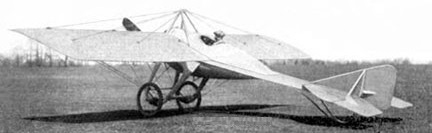
Schmitt Monoplane / Biplane

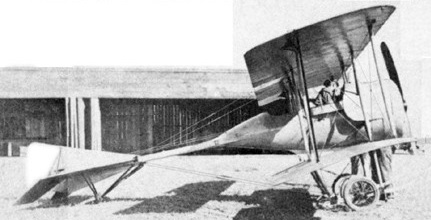
Designed by Etienne Dormoy and brought from France to the USA by Maximilian Schmid, this fully monocoque fuselage design was first of its kind in USA. Built for competitions, it won the $1,000 NY Times Race on 4 July 1914 at Governor’s Island NY (piloted by Harold Kantner), as well as several more subsequent races.

It was then converted into a biplane with a 100hp LeRhône for military trials at North Island, San Diego. It and three other entrants were rejected for not meeting certain requirements specified by the Army.

Monoplane
Engine: 50hp LeRhône
Speed: 70 mph
Seats: 1

Schmidt / U S Aerial Navigation Co 1911 Biplane

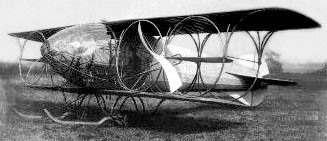
A large, rounded, startlingly modern fuselage for its day, using what appears to be almost geodesic construction, with chain-driven twin tractor propellers.

During 1910 and 1911 this aircraft was built in a shop adjacent to Mineola Field NJ. The design was basically sound and the plane performed well beyond expectations. In Jan 1912, US Patent #596448 was granted to the aeroplane per notification from Munn & Co, Patent Attorneys, NYC.

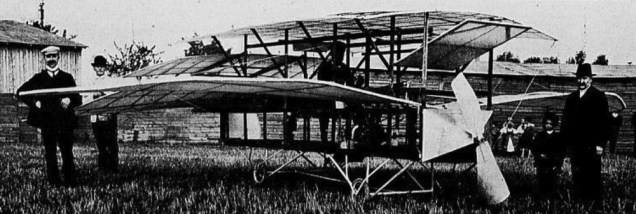
Schmelzenbach und Hollmann Halbdoppeldecker

This machine was tested in spring or summer 1911 at the flying ground Plauen-Reisig in Sachsen, Germany. It had a Taube-like top wing, a forward elevator, a chain driven pusher propeller and a small stabilizing plane on top the original tail-boom construction. According to Lange it was powered by a 65hp Hilz inline-4. There are thoughts that Schmelzenbach and Hollmann wanted to open a flying school and this plane was intended as a trainer, therefore being equipped with dual controls.

Schmaltz Eindecker

Ernst Schmalz, born 1879 in Nidau, Switzerland, in 1908 built with the help of Failloubaz, a pusher monoplane, powered by a 12 hp Anzani motor, with large ailerons he himself named “Stabiloklappen”. In flight tests at Thun he made jumps of up to a height of 6 meters. In 1909, Schmalz retired from flying. He sold his apparatus to a chauffeur, who collided with a tree top in flight tests on the Beundenfeld in Bern. Although the pilot remained intact, the aeroplane itself was a total loss.

Schlageter 1910 Eindecker

Robert Schlageter of Luzer, Switzerland, was born in 1887. He quit his technical studies in Burgdorf to devote himself to aviation. After first tests with gliders, he began to build, with the help of two friends, his first monoplane, with a triangular-section fuselage and an Anzani engine, in 1909. Then he built in four months, for a company in Mainz, another monoplane of the same type. His planes flew only in good wind conditions, but he won a prize at a fair in Chemnitz in 1911. He had to quit aviation for economic reasons, was forced to sell his planes and spare parts.

Schepper and Hagens Helpman I

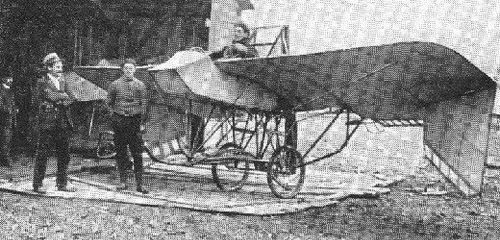
The Emile de Schepper and Hubert Hagens “Helpman I” monoplane was exhibited in the bicycle school of Fongers in Groningen (Netherlands) in May 1911. It had an open fuselage aft of the pilot seat and triangular-section fuselage and was powered by a 5-cylinder Anzani, rated at 50 hp. The monoplane was designed and built by Emile de Schepper and Hubert Hagens. Hagens was the mechanician of the famous Belgian flyer Jan Olieslagers and Emile de Schepper was the son of the Belgian E. J. de Schepper, who was a wealthy billiard manufacturer in Helpman (a separate village then, now a part of the town Groningen), hence the name “Helpman I”.