Schüler 1909 Eindecker

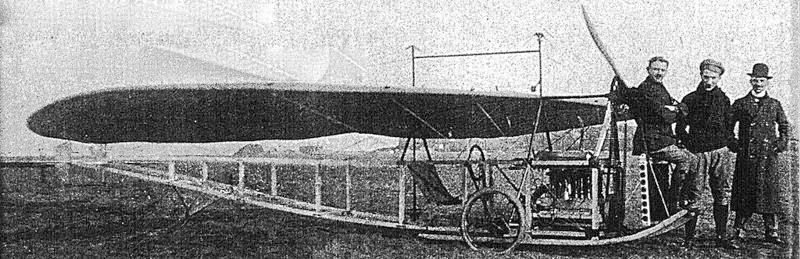
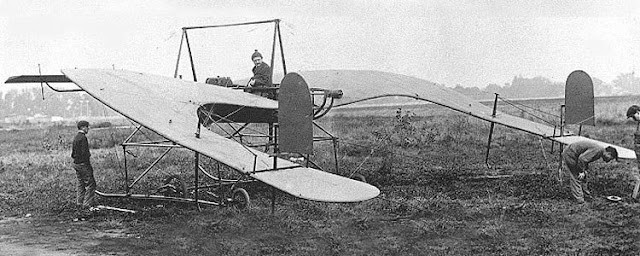
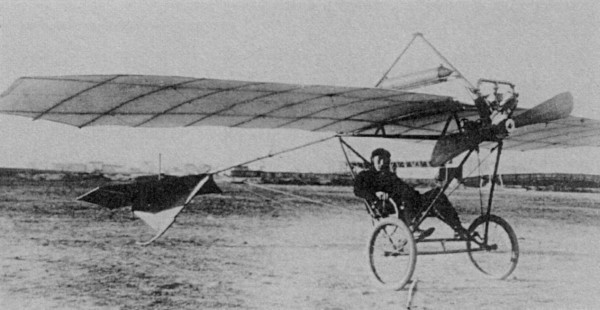
This high-wing monoplane was tested in late spring and summer of 1909 at the parade ground in Chemnitz, Saxony, after a public exhibition in April 1909. Schüler had completed his engineering studies there. It was probably inspired by the Demoiselle and was completed before Hans Grade had built his first similar “Libelle” in June 1909. The machine was not a great success and thus Schüler didn’t appear at the first German aeronautical exhibition (ILA) in Frankfurt or the first meeting at Johannisthal in September/October 1909, but he was among the first who rented a shed at this newly built airfield. At the beginning of 1910 Schüler was busy working on a monoplane for Leo Lendner and building engines for Hanuschke and others in his “Max Schüler Aeroplan-Fabrik”, which he had founded in his hometown Berlin in late 1909.

Schukking 1908 Glider

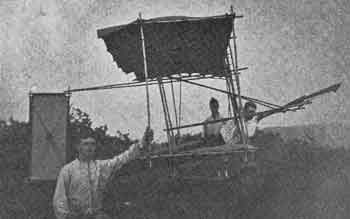
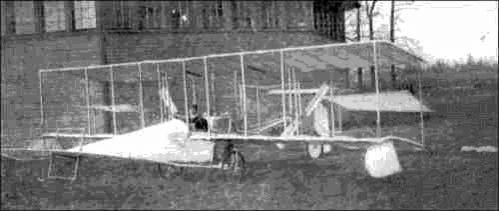
A glider built and flown in the Netherlands by Willem Hendrik Schukking – a member of the the Dutch Royal Engineers – in 1908. It was not proceeded with, one reason being that Schukking married and had to swear that he would never fly again. The machine was a biplane on which the pilot flew downhill while in a forward prone position.

Schreck Diapason I

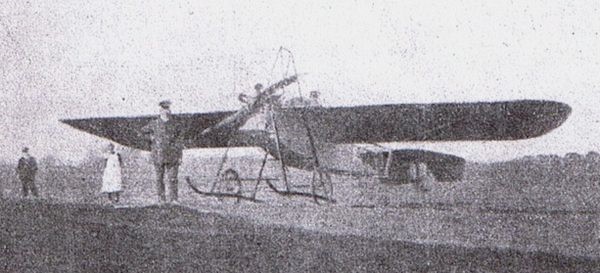
The Diapason (French for tuning-fork of which it resembled), was monoplane of 1910 in a form where the wing was swept back in a wide curve. The photo clearly shows a hefty radiator at the front of the small fuselage, from which may be concluded that one is looking at the 50 hp water-cooled Chenu-powered version. This engine was placed directly in front driving the pusher propeller at the back of the short central nacelle via a long shaft. In this version the entire nacelle is uncovered.

Span: 39’4″
Length: 46′
Weight: 880 lb

Scholz Schwingenflieger

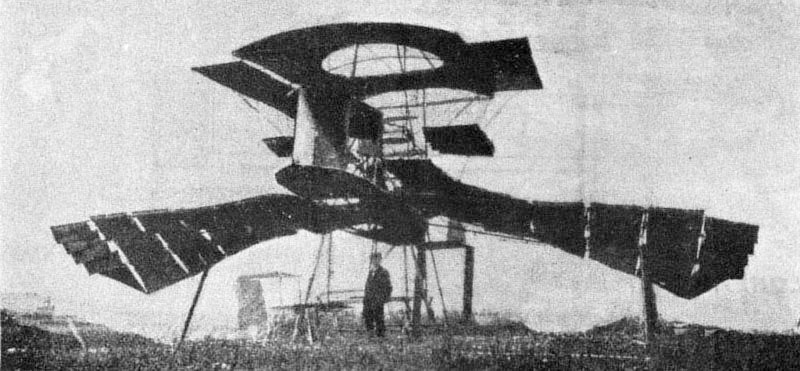
This big, strange ornithopter was designed by architect Bruno Scholz of Schulzendorf near Berlin after 12 years of studies of birds. It was “modelled after real birds” and the frame was made of bamboo sticks with multiple-slatted wings covered canvas. The apparatus measured from head to tail 17 meters, the wing span was 14 meters and the height 6 meters. The bird’s body held a cockpit for two passengers, two engines, each of 8 hp, and a centrifuge (fan?) which would help to lift it. It was built at great expense in 1909/10, but after it had been found to be complete failure it was reportedly smashed by hand by its builder.
Schneider No.1 Biplane

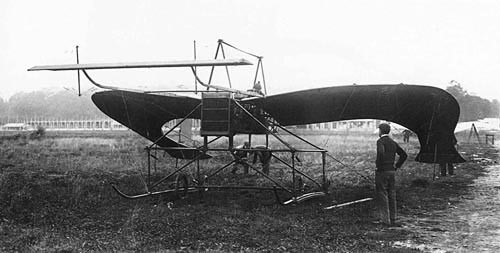
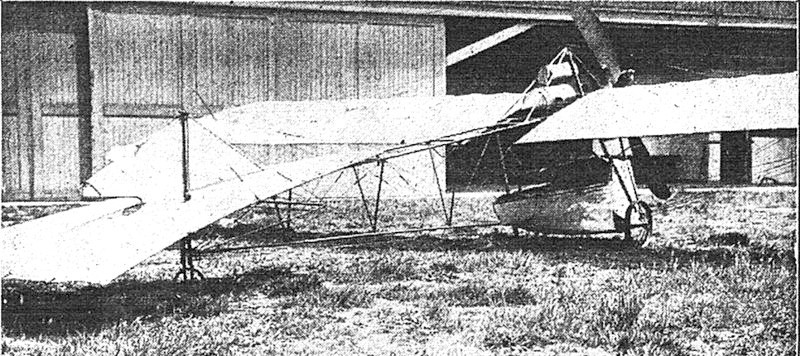
The Frederick Schneider No.1 Biplane was shown at an exhibition at Morris Park called by the Aeronautic Society of New York at the end of 1908, where Schneider tested the biplane of 30 ft. span. Among the most notable of its features was a low total weight of only 450 lbs and the use of three aluminium propellers of variable pitch. The engine, an air-cooled rotary, caused the failure of these flights.