1913: (John Eyre) Sloan Aeroplane Co Inc, Company funded by Thomas A Edison. 1733 Broadway, New York NY. USA
In 1913 Déperdussin were manufactured under US license.
Built a military biplane with unusual back-swept wings. Believed to have built aircraft under subcontract for the U.S. government.
1916: Sloan Aero Corp
Sloan Aircraft Co, Bound Brook NJ. USA
On 12 May 1916, Sloane Aeroplane Co. was taken over involuntarily by the newly-formed Standard Aero Corp., which had possession of a majority of Sloane Aeroplane Co.’s shares, and Sloane’s assets became the nucleus of Standard Aero Corp.
The NY Times, 1 May 1917, revealed that John Sloane, who held 26,500 of the 50,000 shares in Sloane Manufacturing Co., had provided his shares as collateral to the Mitsui Co., the large Japanese banking conglomerate, in order to borrow funds from them to finance the manufacture of aeroplanes for the Russian government. Sloane alleged that Mitsui, rather than waiting to be repaid from the profits of this venture, transferred Sloane’s stock shares to Standard Aero Corp., which then stripped the Sloane Co. of its assets and business. Mitsui contended that after Sloane had borrowed funds from Mitsui and been unable to repay the loan, Sloane had adjusted the matter by turning over his stock in payment.
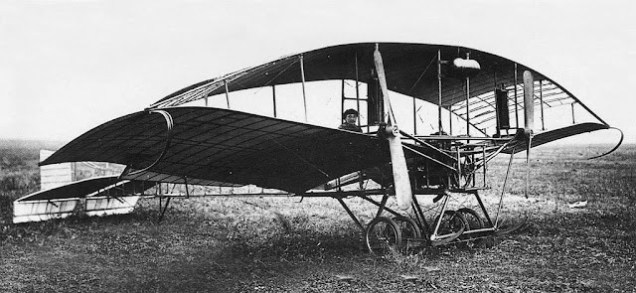
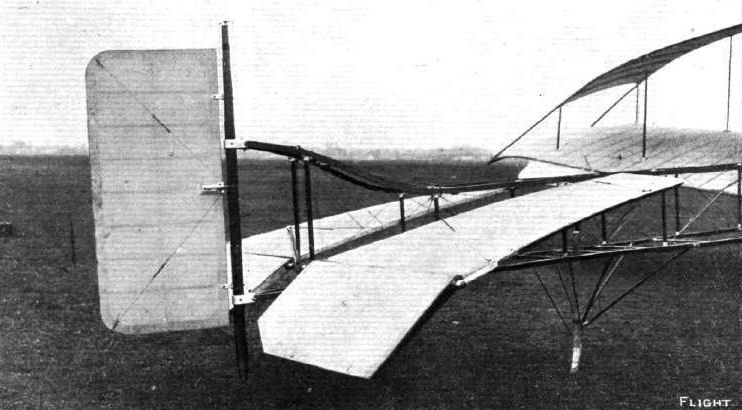
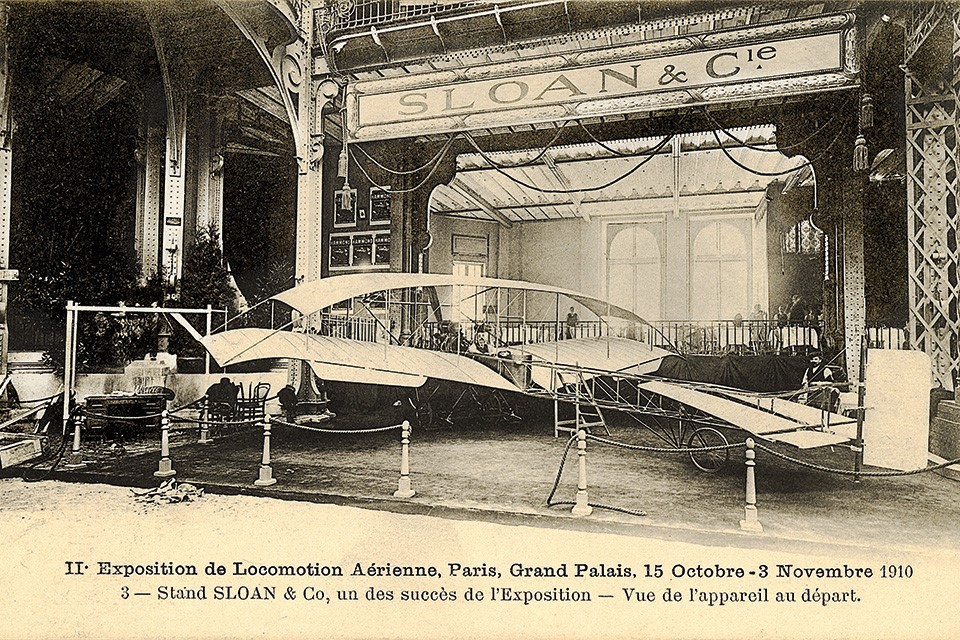
Between 1910 and 1912, American expatriate Jacques-Jules Sloan built a series of biplanes he called Bicurves in his small workshop in the Paris suburb of Charenton-le-Pont. The Bicurve’s fuselage, tail and landing gear were similar to those found on French Blériot monoplanes of that period. As initially constructed, the fuselage terminated in a movable rudder, without a fixed fin, and fixed horizontal stabilizers of flat section without any airfoil. The elevators were originally mounted ahead of the fuselage on struts, in canard fashion. Those struts were subsequently removed and the elevators relocated to a more conventional position at the tail, hinged at the trailing edge of the horizontal stabilizers.
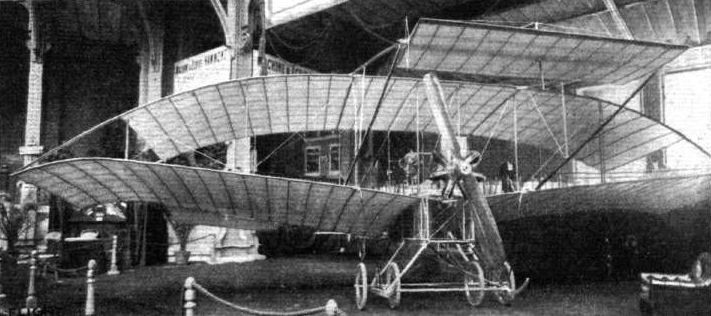
It was in its wing cellule that the Bicurve differed markedly from any of its contemporaries, or from any subsequent biplane designs. The Bicurve’s lower wing attached to the upper fuselage longerons. The lower wing, which was reminiscent of that found on contemporary Antoinette monoplanes, was designed with marked dihedral, transforming to anhedral near the tips, and was fitted with conventional trailing-edge ailerons. The upper wing, on the other hand, was deeply arched, both in section and in span, so much so that the tips curved sharply downward and were attached by struts to the lower wingtips.
The initial version of his Bicurve was fitted with two propellers driven by a single engine via chains and gears. An examination of photographs of the airplane provides a clue as to why he added the additional weight and complexity of such a drive system. The two propellers were clearly arranged to turn in opposite directions, suggesting that Sloan was trying to further improve the airplane’s handling characteristics by canceling out the torque effect imparted by a single propeller.
Lateral control was achieved not by wing-warping but by means of fins installed on the trailing edge of the lower wings, just before the wingtips drooped. Due to the airplane’s inherent natural stability, their surface area was quite small. Vertical control could be achieved any of two ways, depending on the pilot’s preference. One method involved using two elevators, one at the front coupled with another at the rear, acting simultaneously by opposite bearings. This control system was very effective, but some pilots preferred to use only the rear elevator.
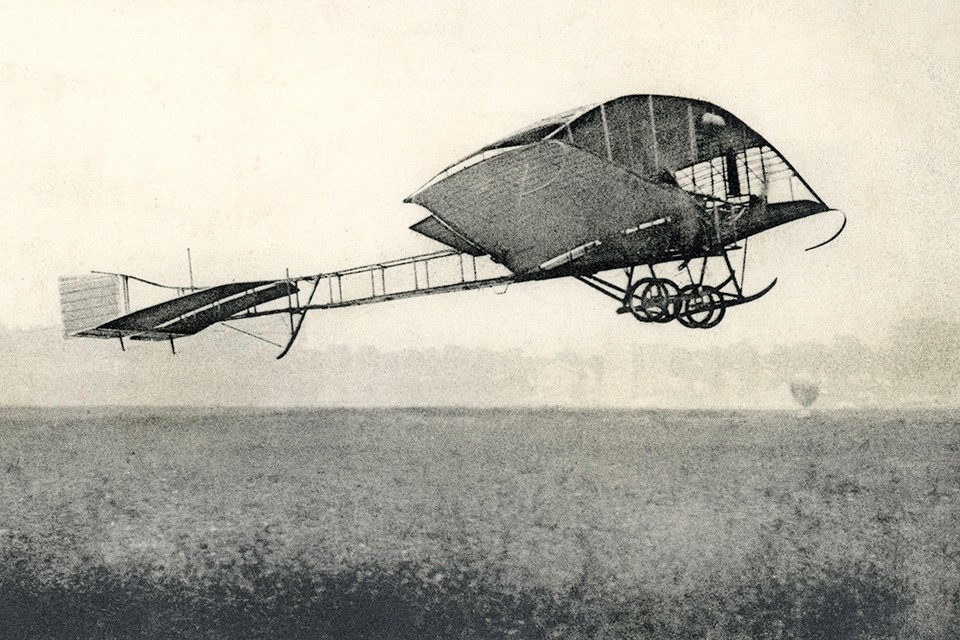
The main undercarriage consisted of two forward-facing skids carrying two pairs of wheels, which were equipped with dampers and mounted on a universal joint that could absorb shocks from rough field landings. The undercarriage was secured, as with the fuselage itself, by means of special aluminum fittings. The main gear was complemented by either a rear skid or wheel.
The original Bicurve had a wingspan of 35 feet 11 inches, a length of 37 feet 1 inch and wing area of 161 square feet. Maximum speed was recorded as 46 mph.
Sloan seems to have built and flown at least three different versions of the Bicurve between 1910 and 1912, and it is also reported to have been powered at various times by at least two different engines: a 35-hp Labor-Aviation and, later, a 50-hp Gnome. As was the case with numerous early airplanes, however, there is little documentation as to whether the various Sloan Bicurves were new builds or simply improved versions of the same airframe. For example, while the original airplane had twin propellers driven by a single engine and elevators mounted in front, other versions featured a single propeller and conventional tail-mounted elevators.
A photograph exists of the Bicurve exhibited by Sloan & Company at the Exposition de Locomotion Aérienne in Paris between October 15 and November 3, 1910. In spite of that publicity, the airplane was not a financial success and the design proved to be a dead end. Nevertheless, unlike many strange-looking early airplanes, the Sloan Bicurve actually flew, and apparently flew well. Motion picture footage still exists showing the machine taking off and landing, and it appears to do so quite smoothly.
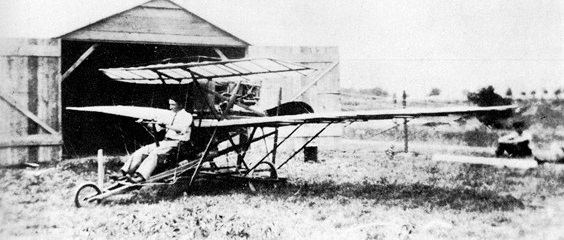
In 1911 an open-cockpit, single seat, mid-wing monoplane was built by (James B) Slinn Aeroplane Co for Eugene Brown of Peoria IL.
The only one built had an oversize elevator mounted above the wing almost making this one a biplane. It was a headless monoplane design with tricycle gear and pusher engine.
A pusher built by James B. Slinn in 1911, looking almost like a biplane as the large elevator was mounted above the wing. Slinn was an inventor who developed aeronautical devices between 1899 and 1910. His first design dates from 1899 when he designed a flying machine with wings and horizontal propellers. This ‘autogiro’ type avant la lettre failed to fly. After he moved from New Orleans to Chillicothe, Illinois he designed in 1910 this monoplane, named the Falcon, for Eugene Brown, a Peoria real estate dealer and president of the local aero club. It completed one flight that ended in a big crash and total destruction.
About 1910 James Joseph Slavin of Los Angeles CA., USA, built an open-cockpit biplane.
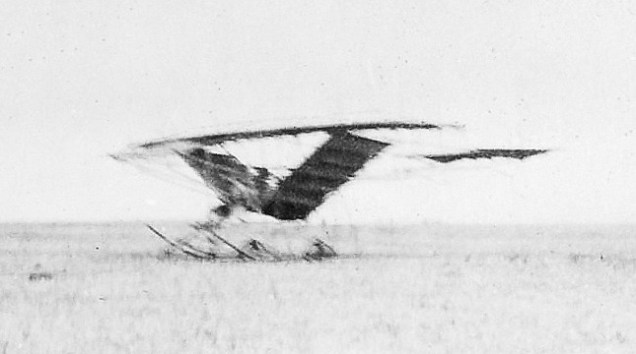
[Probably] the first version of the biplane of James Joseph Slavin, in 1910 around Los Angeles during a very hard landing (crash?) which resulted in a cracked lower wing and a cracked undercarriage.
Present but not flown at the Los Angeles Aviation Meet at Dominguez in January 1910. This engine-less plane had unique “ailerons”, being like roller blinds controlled by a lever such that one increases in area as the other decreases. Charles Skoglund was active in the Aero Club of California.
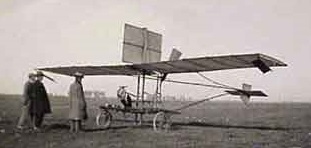
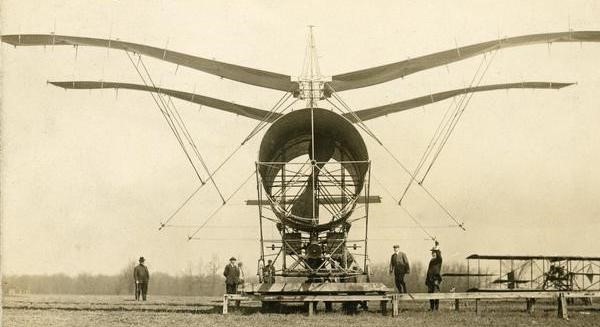
Silverston Vacu-Aerial” Flying Machine No. 2 of 1912 was also known as Dr. Rudolph Silverston’s Milwaukee Flying Machine No. 2. The photo caption reads “Pendulum system 120hp engine.”
According to historical reports, the good doctor had a school of aviation in Milwaukee, and persuaded a number of local investors to support construction of a machine of his devising, which seems to have been an early ducted fan type. The first was a failure; the second (shown) likewise refused to fly, whereupon Dr. Silverston left town with no forwarding address.
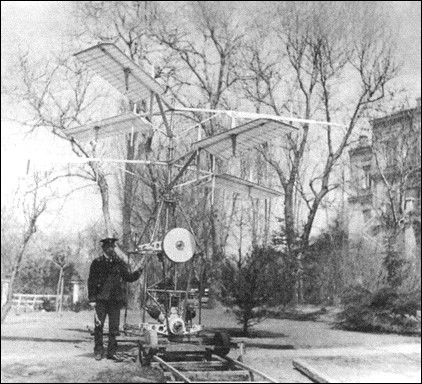
The Sikorsky Helicopter No.2 of 1910 was also known as the S-2; an identification later designated. Powered by the same Anzani 3-cylinder of 25 hp as in the No.1. Developing lift force using contra-rotating three-bladed rotors, reportedly it could almost lift itself.
In 1912 Igor Sikorsky began construction of an aircraft with a wingspan of 28 m (92 ft) it was at that time by far the largest heavier than air craft to fly; the first to have four engines; the first with a fully enclosed passenger cabin; and the first designed specifically as an airliner.
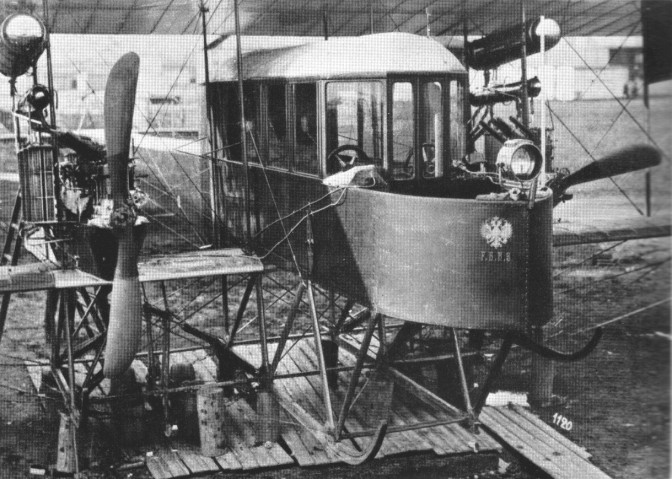
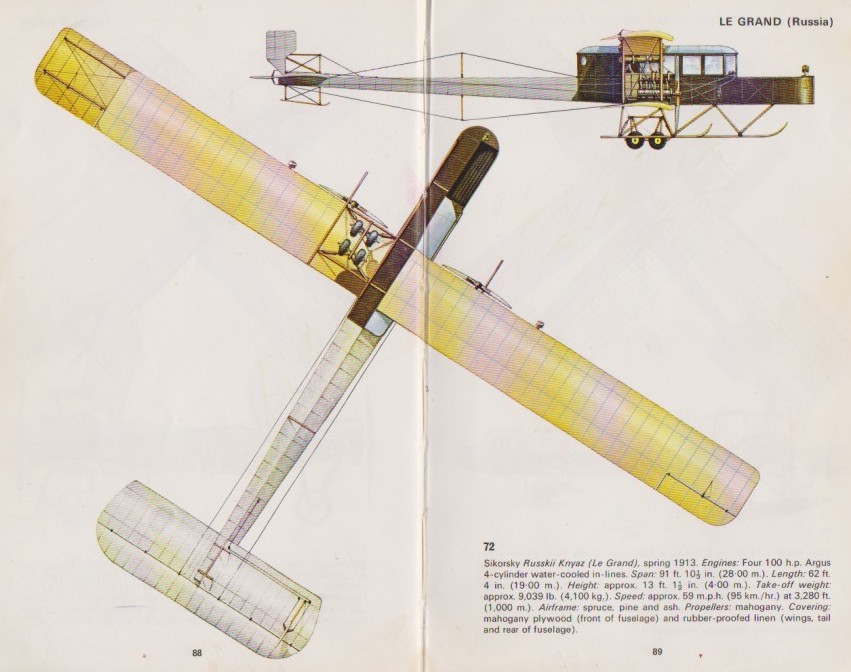
Officially known as Russkii Vitiaz (Russian Knight), the big biplane was dubbed the Grand or Bolshoi before its first flight on 13 May 1913. The Grand weighed 4080 kg (8000 lb) and was powered by four 100 hp water cooled Argus engines arranged initially in tandem pairs, but after the first ten minute test flight the two rear mounted engines were moved outboard on the wings. In June 1914, Sikorsky piloted the 10,000-1b. S-22 named Ilia Mourotz on a 1,600mi. round trip from St. Petersburg to Kiev.
Czar Nicholas II inspected LeGrand with Sikorsky in the summer of 1913.
Numerous difficulties were encountered in the design and construction; there were no wheels of adequate size to support the Grand, so a 16 wheel bogie undercarriage had to be built. The cabin incorporated some novelties. At the front was a large open balcony with a searchlight mounted on a gimbal; next came the cockpit with dual controls for two pilots; behind this was the passenger cabin, luxuriously appointed with four seats, sofa, table, washroom and wardrobe.
The Grand flew well and subsequently made 53 flights including a record breaking duration flight of 1 hour 53 minutes with eight people aboard on 2 August 1913. Later that month a military Voisin biplane broke up in the air over the airfield and its engine fell onto the Grand. Sikorsky subsequently redesigned the aircraft as the Ilya Muromets.
Engines: 4 x 100 hp Argus four cylinder in line piston Wing span: 91 ft 10.25 in (28.00 m) Length: 62 ft 4 in (19.00 m) Gross weight: approx. 9,039 lb (4,100 kg) Max. speed: approx. 59 mph (95 km/h) at 3,280 ft (1,000 m) Accommodation: Crew of 2 + 8 passengers Typical endurance: 1 hr 45 min


 All Aero