San Diego CA.
USA
Built a tractor biplane in 1912.
San Diego CA.
USA
Built a tractor biplane in 1912.

Built by Edgar Smith, a tandem monoplane with variable-incidence wings for pitch control. The self-built opposed two-cylinder engine proved to be too weak to enable flights at the January 1910 Los Angeles meeting, where Smith was lucky to survive, being hit in the head by its spinning propeller.
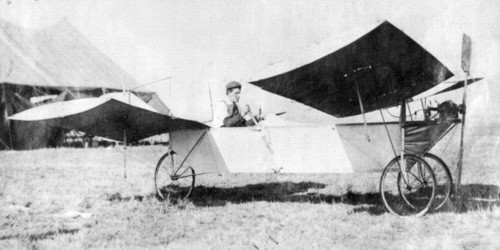
Three aircraft are said to have been constructed for Arthur L Smith’s exhibition performances at the 1915 Panama-Pacific Exposition by Al Mensaco. The use of “Smith-Curtiss Pusher” in a contemporary journal leads to an assumption of their being Curtiss machines assembled by Smith, or copies using Curtiss motors. Smith was pictured in several different types of aircraft during this period, most of them looking much like the tried-and-true Curtiss designs—or at least faithful replicas.
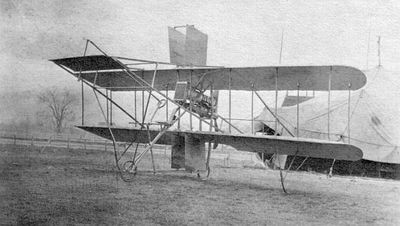
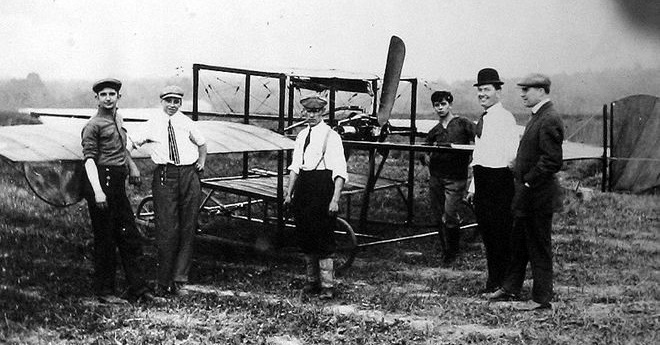
Arthur L Smith believed he could build a plane that would fly better than the Wright airplane, and as he worked on his design, he was careful to avoid infringing on their patents. This was the end result of two prototypes that crashed, mainly because Smith was teaching himself to fly as he went along.
It took him and a friend six months to build the single-place, open cockpit, biplane, which they moved through the streets of Fort Wayne at night to a field in what is now Memorial Park.
Built by Arthur L. Smith, a Curtiss-type biplane flown and crashed at Fort Wayne, Indiana, on January 18, 1910. The aeroplane reached almost fifty miles per hour before leaving the ground when suddenly it rose alarmingly, dipped, rose again, and crashed into the field in what is now Memorial Park. Art was thrown onto the frozen ground and badly injured. The machine was ruined except for the 40 hp Elbridge engine and never rebuilt.
A replica of this ship, built by Billy Parker and Bob McComb, is now hung on display at Ft Wayne Intl Airport terminal.
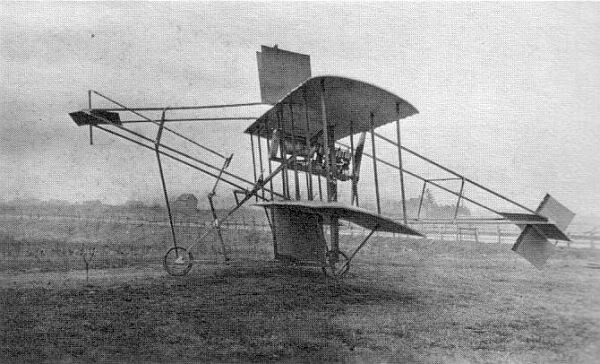
1910:
Arthur L Smith,
Ft Wayne IN.
USA
San Francisco CA.
USA
From books and magazine articles Art learned about aircraft construction, designs, and patents. He believed he could build a plane that would fly better than the Wright airplane, and as he worked on his design, he was careful to avoid infringing on their patents. It took him and a friend six months to build the plane
Smith also previously built a “gasless air-ship,” according to 1909 Jane’s.
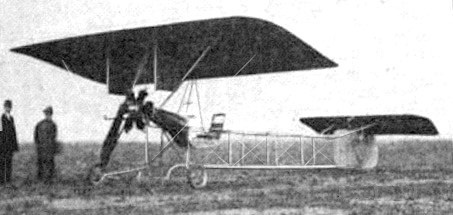
The Franklin P Smith 1911 Monoplane photographed for Aero 3/16/12. Apparently it flew only once.
Smidley began construction of his monoplane in 1909. It was described in the August 1909 NY Times as having large wings on either side of the central rectangular box. A smaller plane was above and in front, and a fixed semicircular plane was at the tail. Control was a semicircular device at the front with the halves of the semicircle moving together as elevator or separately. It was mounted on four small wheels that ran on rails. This was the 223 pound bamboo version with 18 hp engine. At some point the machine was changed to larger wheels for take-off from the ground and probably rebuilt in other ways. Smidley is credited with three aircraft and a completely rebuilt version of his first machine was reported to be ready for testing in a March 1910 Aeronautics. There is a small picture in November 1910 Aeronautics that shows a machine with the larger wheels, powered by an 18 hp 2-cylinder Stevens Duryea air-cooled engine, and the structure doesn’t look like bamboo. These machines were not powered by an electric motor, but a machine identified as Smidley’s third machine was displayed at a Harrisburg auto show in early 1910, where an electric motor was used to run the propeller in the exhibition. The picture is either the second version incomplete or the third, with the Duryea.
Engine: Duryea auto
Wingspan: 32’0″
Seats: 1
College Park MD.
USA
Built and flew a monoplane in 1910.
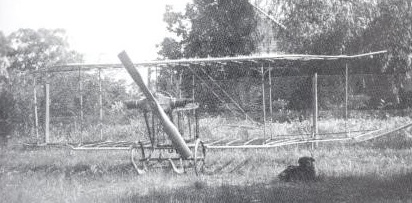
Australian tractor biplane designed and constructed by Douglas Sloane. The engine was also of his own design and one of the things that held him up in his attempt to fly. Despite the stage of progress seen in this photo, the plane was eventually covered. It was towed behind a car to give it extra power but the engine just didn’t have the muscle. However the plane did manage a short hop at “Dick’s Plain” swamp in late April 1912.
Douglas Sloane (1890-1917) was killed in an RE8 of 69 (Australian) Sqn RFC headed for France on August 21, 1917. With it was 2AM Sloane (observer/gunner), piloted by 2nd Lt FG Shapira. Having some engine trouble, they landed to have it rectified. This was done and after lunch they set off again. The plane reached about 600 feet when the nose suddenly dropped and it went into a spin from which it never recovered. Shapira and Sloane were the first active service casualties of the squadron.
 All Aero