Sopwith Tabloid / SS

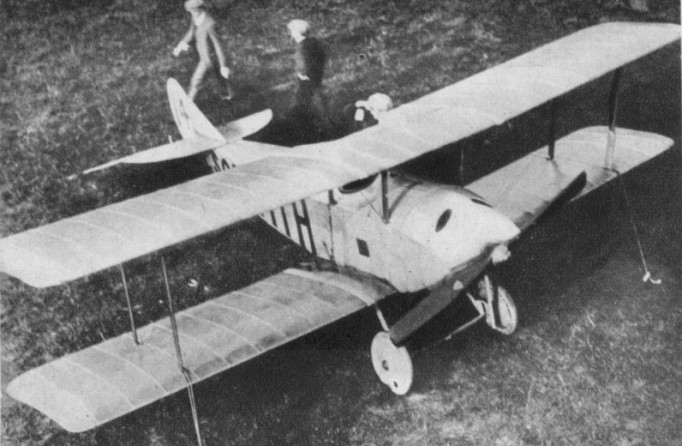
The Sopwith Aviation Company Tabloid was originally designed as sports aircraft and was first flown by Harry Hawker on 27 November 1913. It was a two-seater single-bay biplane with a side-by-side seating configuration. It was powered by a Gnôme rotary and had warping wings for lateral control.
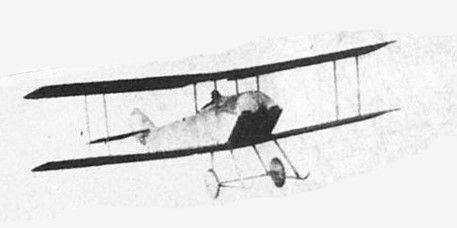
A single-seat Tabloid was quickly mounted on floats and entered in the 1914 Schneider Trophy in Monaco – which it handily won giving Britain her first victory in the annual contest piloted by Howard Pixton, at the same time setting a world seaplane speed record at 92 mph. It’s turn of speed so demoralised the other dozen or so entries from 6 countries that only one other even bothered to take off. The performance was so convincing that the British military ordered many of these aircraft, which was developed into the Sopwith Schneider. It therefore became the first single-seat scout anywhere to go into production for military use.
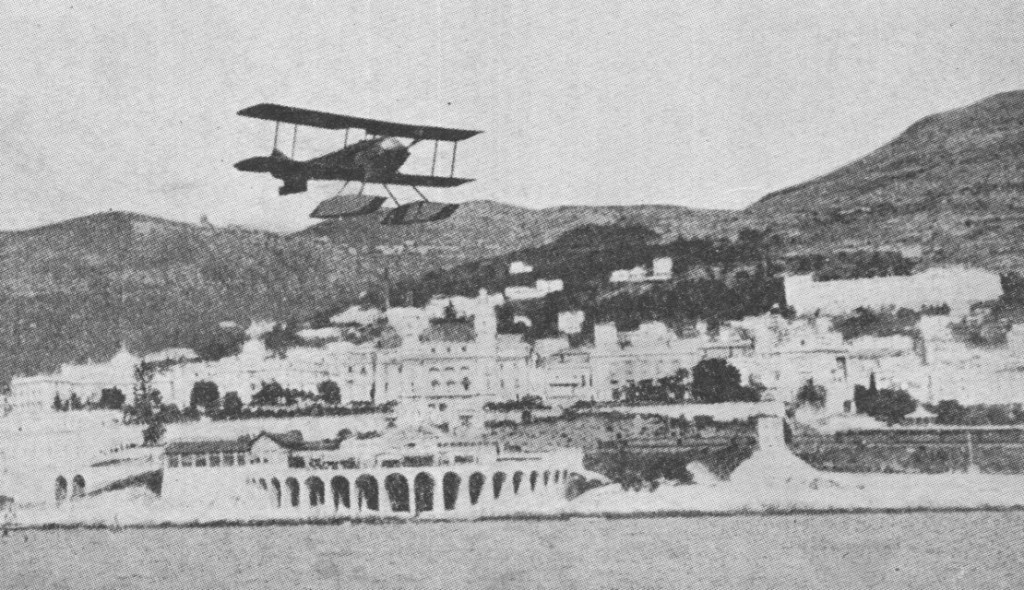
Howard Pixton at Monaco averaging 86.78 mph

Sopwith Tabloid Article

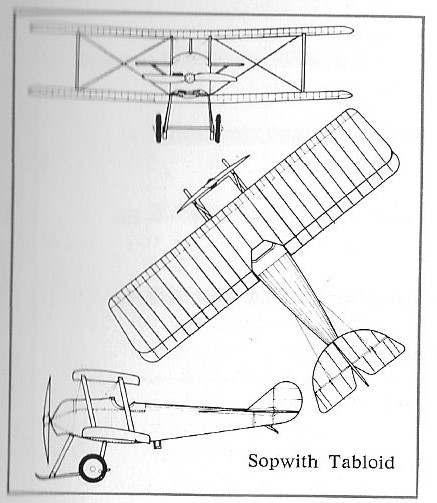
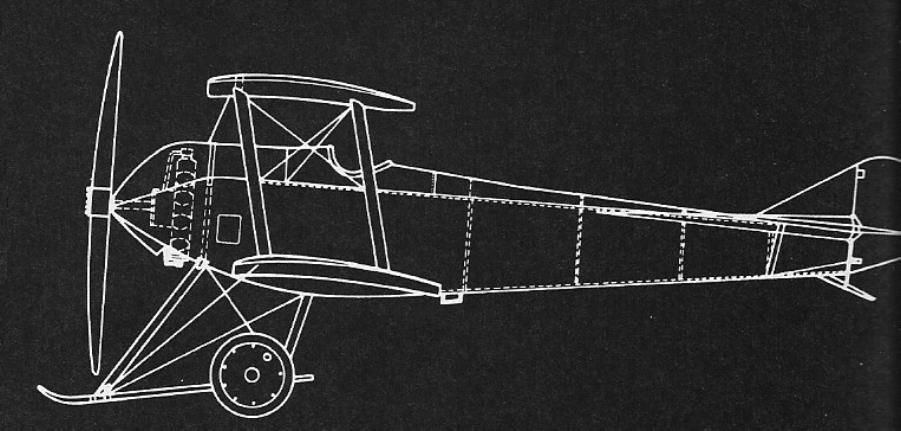
A single-bay biplane, the two-spar wooden wings and wooden fuselage are fabric covered. Wing warping rather than ailerons was used, and conventional tail surfaces were fitted. Two skids were normally fitted forward of the wheels.

Some aircraft were fitted experimentally with a Lewis machine gun above the wing centre section or on the side of the fuselage, with steel plates on the airscrew blades to deflect bullets. A few 20 lb bombs could be carried.

The Tabloid was ordered by both the Royal Flying Corps and Royal Naval Air Service; the latter using it for some of the earliest strategic bombing attacks against Germany. Thirty-six Tabloid were delivered for the RNAS and RFC between October 1914 and June 1915. When the 1914 18 War started, Tabloids went to Belgium with a squadron of the RNAS.
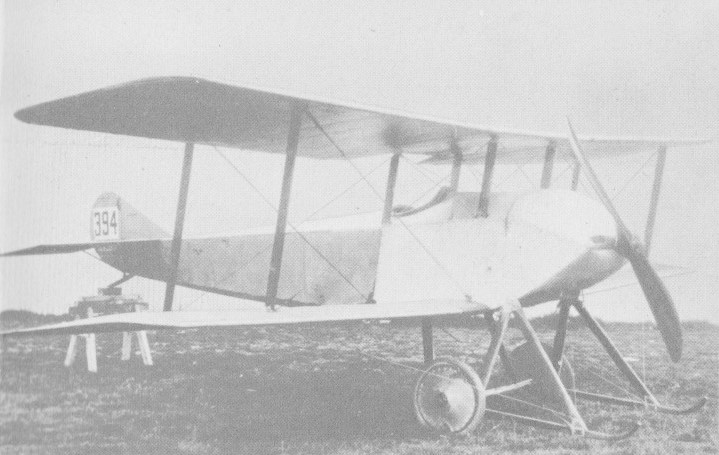
The Royal Naval Air Service used their Tabloids in early bombing attacks against the airship sheds at Cologne and Dusseldorf in an attempt to deny the Germans the use of operating bases close to the North Sea. The first raid took place on 22 September 1914 and although not a success was the first ever air raid on Germany. The second raid was much more successful. In one raid F1t. Lt. R.L.G.Marix destroyed an airship shed at Dusseldorf with his 20 lb bombs, complete with the secret Zeppelin Z.1X inside.
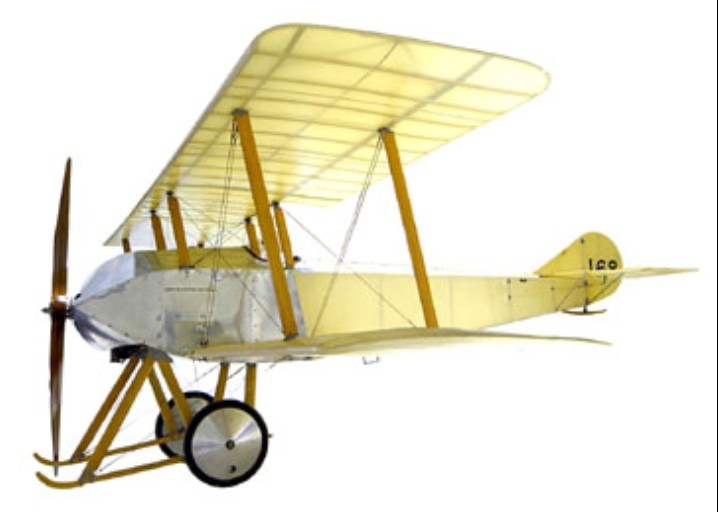
Royal Flying Corps Tabloids were used for scouting duties and were involved in some of the earliest experiments in arming aircraft. From February 1915 a number of Tabloids were fitted with Lewis machine-guns. Although it was one of the first aircraft to have a machine gun fitted to fire through the propeller arc it was only after the Tabloid had been withdrawn from operational service in the spring of 1915 that a successful interrupter gear was developed.

Replica ultralight:
Circa Reproductions Sopwith Tabloid / Baby

Gallery

Engine: Gnome Monosoupape, 80 hp / 75kW
Span: 25 ft. 6 in / 7.76 m
Length: 20 ft. 4 in / 6.1 m
Height: 8 ft. 5 in / 2.56 m
Wing chord: 5 ft. 11 in
Wing area: 241.3 sq. ft / 22.3 sq.m
Weight empty: 730 lb
Loaded weight: 1120 lb
ROC: 1200 fpm
Endurance: 2.5 hr
Max speed: 80 kt / 92 mph / 148km/h
Landing speed: 32 kt / 59 km/h
Seats: 2

Engine: Gnome, 100 hp
Wingspan: 25 ft 6 in / 7.77 m
Length: 20 ft 4 in / 6.20 m
Height: 8 ft 5 in / 2.57 m
Weight: 1120 lb / 508 kg
Max speed: 92 mph / 148 kph
Ceiling: 15,000 ft / 4572 m
Endurance: 3.30 hrs
Armament: 1 x mg
Crew: 1
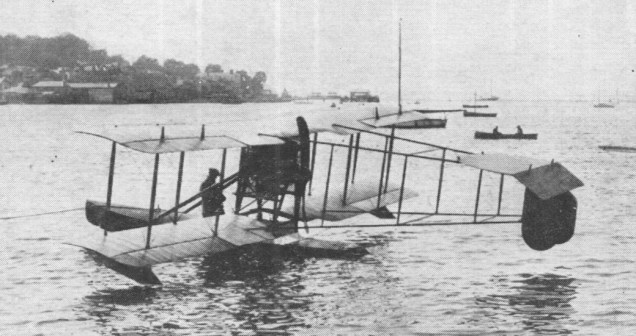
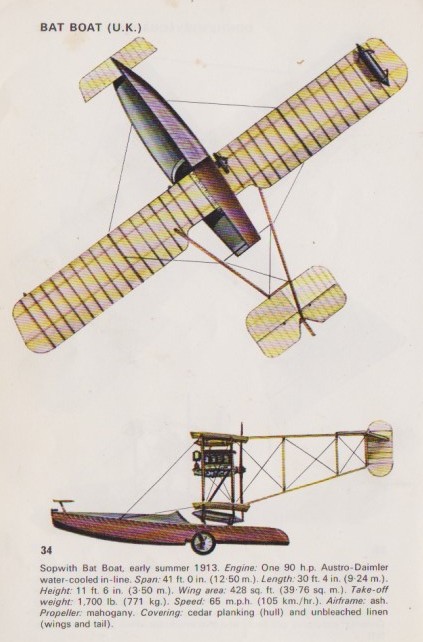
Sopwith Bat Boat

The first amphibian built in Europe circa 1913. A reconnaissance flying boat.

One Bat Boat and two Three-seaters were bought by Winston Churchill for the Naval Wing of the RFC.

Bat Boats Type 1
1913 Sopwith Bat Boats Type 1 amphibian version

1913 Bat Boats Type 1 BB1
Span: 41′
Length: 30’4″
Weight: 1540 lb allup
Speed: 60-65 mph

Bat Boat Type 1 BB2 and BB3 amphibian
Span: 41′
Length: 32′
dihedral 3 deg

Sopwith Bat Boat II
Engine: Salmson, 197 hp
Length: 35.302 ft / 10.76 m
Height: 11.909 ft / 3.63 m
Wingspan: 54.987 ft / 16.76 m
Wing area: 599.985 sqft / 55.74 sq.m
Max take off weight: 3184.0 lb / 1444.0 kg
Weight empty: 2302.0 lb / 1044.0 kg
Max. weight carried: 882.0 lbs / 400.0 kg
Max. speed: 61 kts / 113 km/h
Wing loading: 5.33 lbs/sq.ft / 26.00 kg/sq.m
Crew: 2

Sopwith Aviation Co

The Sopwith Aviation Company Ltd in Kingston-on-Thames was founded in a shed at Brooklands in 1912 by Tommy, Thomas Octave Murdoch Sopwith.

Tommy Sopwith

Sopwith rebuilt early aircraft before First World War, began development of own types and formed important associations with F. Sigrist (engineer and largely responsible for future success) and H. G. Hawker (pilot). Company registered March 1914.

Sopwith Aviation Co Article

Bat Boat of 1913 was notable flying-boat and Tabloid landplane of same year gained renown as floatplane by winning 1914 Schneider Trophy. Wartime developments were Schneider and Baby floatplanes.

Became world famous for fighter aircraft, built in great numbers by many companies, though first landplane fighter built in great numbers was two-seat 1 1/2-Strutter. Pup was smaller single-seater. Triplane of 1916 excelled in climb. Two-gun Camel, in service 1917, excelled in maneuverability; shipboard version had detachable rear fuselage. Cuckoo of 1917 was world’s first deck-landing torpedo-bomber. Snipe was intended to succeed Camel late in war, and remained in RAF service until 1926: Salamander was similar but armored for ground attack.

With an output of 90 ships a week at Kingston alone, due for commercial reasons this company had to end its activities in 1920 and the busi¬ness had to liquidate.

Sopwith wanted to stay in aviation and couldn’t start a company with the same name. So he called the new company the Hawker Engineering Company, with a capital of 20,000 pounds.

Somerville 1912 Biplane

The 1912 Somerville Biplane was an exhibition and sightseeing ship for Earl S Daughery, who relocated to Long Beach CA and founded its municipal airport.

Somerville Biplane with Daugherty at the helm

Coal City’s Illinois Aero Construction Co (IAC) initials were on the plane and 51; most likely when it was used as a trainer at IAC’s flying school.

Somerville-Borel monoplane

Somerville-Borel

Built by the Illinois Aero Construction Company and designed as an automatically stable machine by William E. (Billy) Somerville.

The 1910 Somerville-Borel was mentioned in the 27 September 1913 Aero and Hydro as a 50hp Gnôme-powered monoplane being flown at Rensselaer IN. Advertised as “automatically stable,” it might have been a copy, rather than a rebuild as thought, of the Morane-Borel.

Engine: 50hp Gnôme
Wingspan: 45’0″
Seats: 1

Sommer 1910 biplane

Humber-Sommer biplane in India

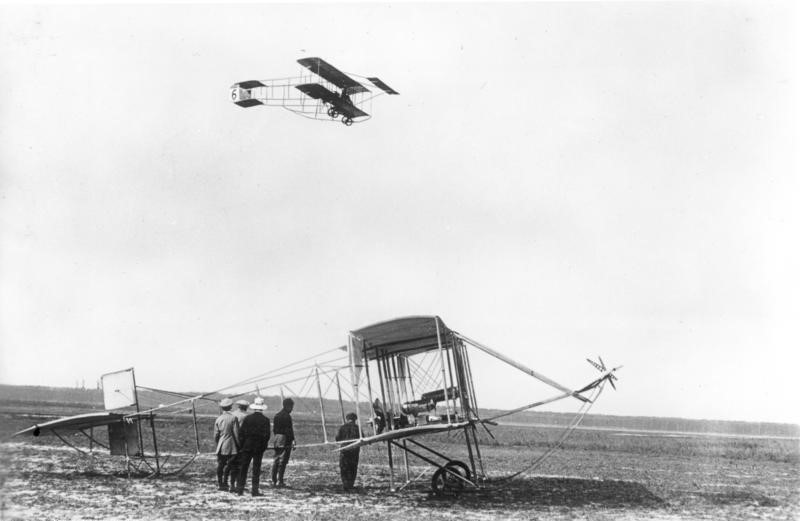
The Sommer 1910 Biplane was designed by Roger Sommer. It was a pusher configuration biplane resembling the successful Farman III, and was built in large numbers for the time. One was owned by Charles Rolls.

In May 1909 Sommer bought a Farman III aircraft, and on 7 August 1909 he gained fame in this by breaking the endurance record held by Wilbur Wright, making a flight lasting 2 hr 27 min 15 sec. Later that year he made a successful appearance at the Doncaster flight meeting, winning the prize for the greatest distance flown during the meeting. Meanwhile, he had started building an aircraft of his own design at Mouzon in the Ardennes, where his family had a felt-making business.

The design of the Sommer biplane was derived from that of the Farman III, the aircraft being a pusher configuration equal-span biplane powered by a 50 hp (37 kW) Gnome Omega. Lateral control was effected by D-shaped ailerons on the upper wing. A single elevator was mounted in front of the wings: behind the wings wire-braced wooden booms carried a horizontal surface which was operated independently of the front elevator and was used to adjust the aircraft’s trim rather than for control purposes. Early examples has a single large rudder mounted below this: this was later changed to four smaller rudders, two above it and two below, and subsequently changed again to one above and one below. The twin skids of the undercarriage were extended forwards to form part of the supporting structure for the elevator, and a single pair of wheels were mounted on an axle between the skids. A two-seat “Military” version with an extended upper wing was produced later.

The prototype was first flown by Sommer on 4 January 1910 at Mouzon, when he managed three flights of over 4 km (2.5 mi) This first machine was sold to a M. Viateaux within two weeks, and by the end of February he had built a replacement and established a flying school at Mouzon. A large number of examples were built: by spring 1910 Sommer had sixty aircraft on order. Sommer had established flying school at Douzy using his machines.

One example was bought by Charles Rolls, and was exhibited on the Royal Aero Society stand at the 1910 Aero Show at Olympia

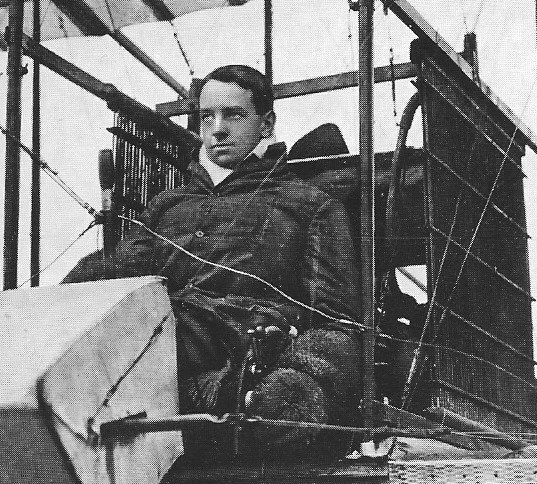
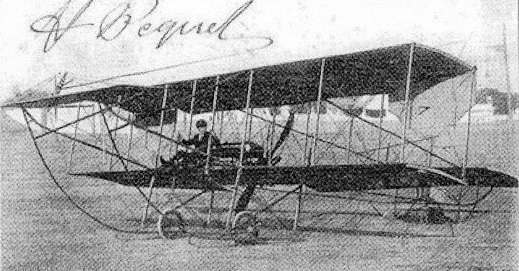
A small number of license-built copies of the Sommer biplane were built in England by Humber. These were of mixed steel and wood construction, and one was used to carry out the world’s first official mail-carrying flight, when 6,500 letters were flown by Henri Pequet from the United Provinces Exhibition at Allahabad to Naini. The letters bore an official frank “First Aerial Post, U.P. Exhibition, Allahabad, 1911”, the text surrounding a drawing of the aircraft.

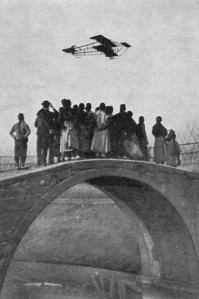
The first aeroplane flight in China was most likely on February 21, 1911, with René Vallon and his Sommer biplane flying over Shanghai. Like other entrepreneurial aviators, he was hoping to sell the concept to onlookers.

René Vallon and his Sommer above Shanghai.

Powerplant: 1 × Gnome Omega 7, 37 kW (50 hp)
Wingspan: 10.36 m (34 ft 0 in)
Wing area: 36 m2 (390 sq ft)
Length: 12.5 m (41 ft 0 in)
Crew: 1
Capacity: 1

Sommer Type E Monoplane / Bathiat-Sanchez

This Roger Sommer monoplane, a fabric covered fuselage version, was designed by Ingénieur Tonnet and flown circa 1911/1912. Léon Bathiat flew many variants of this fast monoplane in several competitions during 1910 and 1911, and in 1912 all interests were purchased by Bathiat who sold these monoplanes under the name Bathiat-Sanchez. Very similar to the Bathiat-Sanchez Type E, shown at the Paris Aero Salon of 1913.